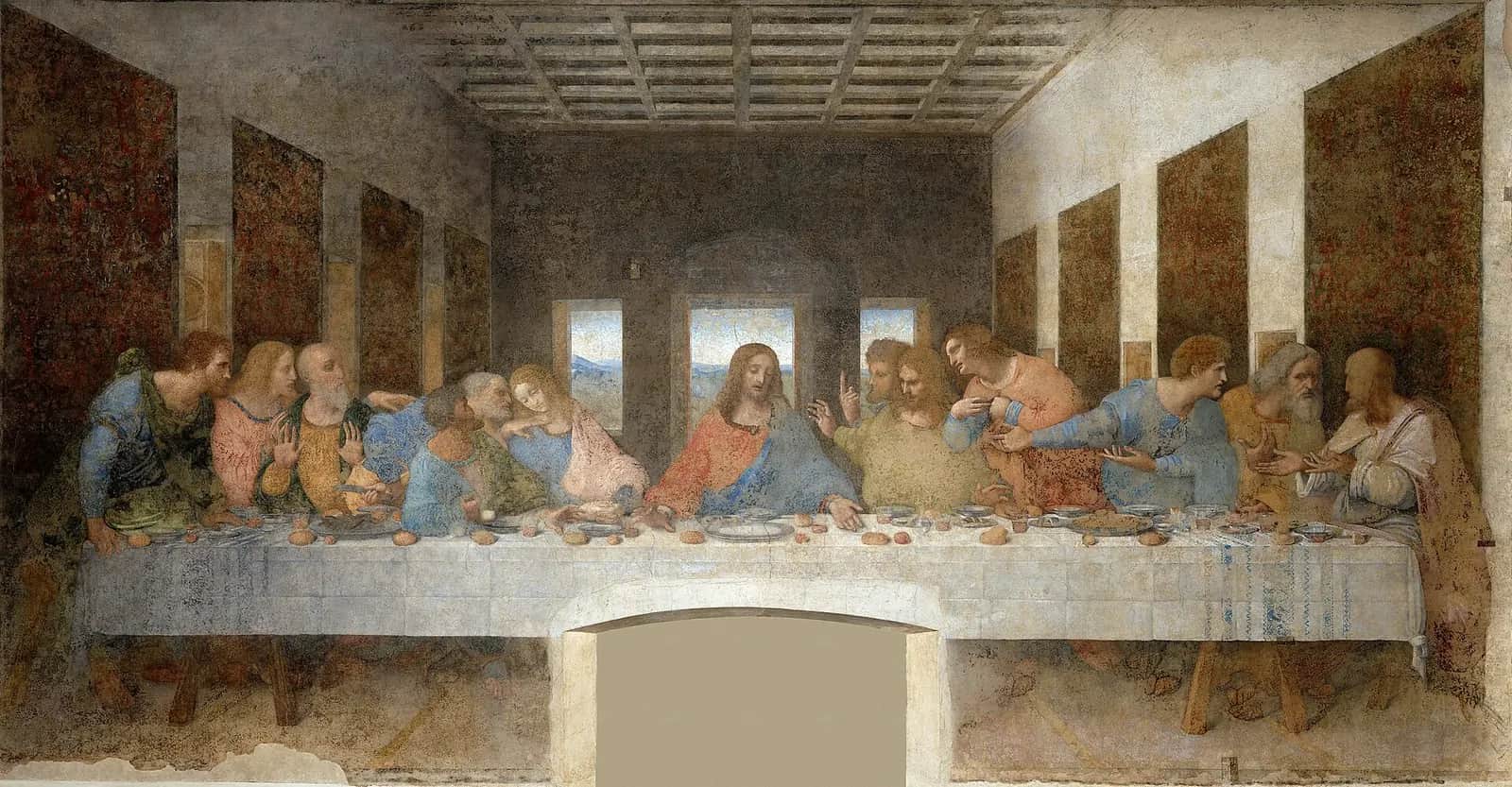
John 13:28 (WEB)
Now nobody at the table knew why he said this to him.
Fathers and councils · 36
Augustine of Hippo
“In what we have now presented for consideration here, the other three evangelists, who also record such matters, offer nothing calculated to raise any question of serious difficulty.” — editor's note: [No notice is taken by Augustin, in this treatise, of the most serious difficulty connected with the narratives of the Lord’s Supper; namely, that of the day…
Read the whole comment“Therefore, when he was gone out, Jesus saith, Now is the Son of man glorified, and God is glorified in Him: and if God be glorified in Him, God shall also glorify Him in Himself, and shall straightway glorify Him.”” — editor's note: John xiii. 28–32.
Read the whole comment
John Chrysostom
“Ver.” — the author cites it
Read the whole comment
Catena Aurea on John
- John ChrysostomCatena Aurea on John
Our Lord after His twofold promise of assistance to the Apostles in their future labours, remembers that the traitor is cut off from both, and is troubled at the thought: When Jesus had thus said, He was troubled in…
Read the whole comment - Augustine of HippoCatena Aurea on John
This did not come into His mind’then for the first time; but He was now about to make the traitor known, and single him out from the rest, and therefore was troubled in spirit. The traitor too was now just about to…
Read the whole comment - OrigenCatena Aurea on John
His being troubled in spirit, was the human part, suffering under the 1excess of the spiritual. For if every Saint lives, acts, and suffers in the spirit, how much more is this true of Jesus, the Rewarder of Saints.
Read the whole comment - Augustine of HippoCatena Aurea on John
Away then with the reasonings of the Stoics, who deny that perturbation of mind can come upon a wise man; who, as they take vanity for truth, so make their healthy state of mind insensibility. It is good that the…
Read the whole comment - John ChrysostomCatena Aurea on John
As He did not mention Him by name, all began to fear: Then the disciples looked one on another, doubting of whom He spake; not conscious of any evil in themselves, and yet trusting to Christ’s words, more than to…
Read the whole comment - Augustine of HippoCatena Aurea on John
They had a devoted love for their Master, but yet so that human weakness made them doubt of one another2.
Read the whole comment - OrigenCatena Aurea on John
They remembered too, that, as men, before they were matured, their minds were liable to change, so as to form wishes the very opposite to what they might have had before.
Read the whole comment - John ChrysostomCatena Aurea on John
While all were trembling, and not excepting even Peter, their head, John, as the beloved disciple, lay upon Jesus’ breast. He then lying on Jesus’ breast saith unto Him, Lord, who is it?
Read the whole comment - Augustine of HippoCatena Aurea on John
This is John, whose Gospel this is, as he afterwards declares. It is the custom of the sacred writers, when they come to any thing relating to themselves, to speak of themselves, as if they were speaking of another.…
Read the whole comment - John ChrysostomCatena Aurea on John
If thou want to know the cause of this familiarity, it is love: Whom Jesus loved. Others were loved, but he was loved more than any.
Read the whole comment - OrigenCatena Aurea on John
I think this has a peculiar meaning, viz. that John was admitted to a knowledge of the more secret mysteries of the Word.
Read the whole comment - John ChrysostomCatena Aurea on John
Whom Jesus loved. This John says to shew his own innocence, and also why it was that Peter beckoned to him, inasmuch as he was not Peter’s superior: Simon Peter therefore beckoned to him, that he should ask who it…
Read the whole comment - Augustine of HippoCatena Aurea on John
Observe too his mode of speaking, which was not by word, but by beckoning; Beckoned and spake, i. e. spake by beckoning. If even thoughts speak, as when it is said, They spake among themselves, much more may…
Read the whole comment - OrigenCatena Aurea on John
Or, at first he beckoned, and then not content with beckoning, spake: Who is it of whom he speaks? He then lying on Jesus’ breast, saith unto Him, Lord, who is it?
Read the whole comment - Augustine of HippoCatena Aurea on John
On Jesus’ breast; the same as in Jesus’ bosom. Or, he lay first in Jesus’ bosom, and then ascended higher, and lay upon His breast; as if, had he remained lying in His bosom, and not ascended to lie on His breast,…
Read the whole comment - BedeCatena Aurea on John
That he lay in the bosom, and upon the breast, was not only an evidence of present love, but also a sign of the future, (non occ.). viz. of those new and mysterious doctrines which he was afterwards commissioned to…
Read the whole comment - Augustine of HippoCatena Aurea on John
For by bosom what else is signified but secret? Here is the hollow of the breast, the secret1 chamber of wisdom.
Read the whole comment - John ChrysostomCatena Aurea on John
But not even then did our Lord expose the traitor by name; Jesus answered, He it is, to whom I shall give a sop when I have dipped it. Such a mode of declaring him, should itself have turned him from his purpose.…
Read the whole comment - Augustine of HippoCatena Aurea on John
Not as some careless readers think, that then Judas received singly Christ’s body. For our Lord had already distributed the sacraments of His body and blood to all of them, while Judas was there, as Luke relates; and…
Read the whole comment - OrigenCatena Aurea on John
Observe, that at first Satan did not enter into Judas, but only put it into his heart to betray his Master. But after the bread, he entered into him. Wherefore let us beware, that Satan thrust not any of his flaming…
Read the whole comment - John ChrysostomCatena Aurea on John
So long as he was one of the twelve, the devil did not dare to force an entrance into him; but when he was pointed out, and expelled, then he easily leaped into him,
Read the whole comment - Augustine of HippoCatena Aurea on John
Or entered into him, that he might have more full possession of him: for he was in him, when he agreed with the Jews to betray our Lord for a sum of money, according to Luke: Then entered Satan into Judas Iscariot,…
Read the whole comment - OrigenCatena Aurea on John
It was proper that by the ceremony of the bread, that good should be taken from him, which he thought he had: whereof being deprived, he was laid open to admit Satan’s entrance.
Read the whole comment - Augustine of HippoCatena Aurea on John
But some will say, was his being given up to the devil the effect of his receiving the sop from Christ? To whom we answer, that they may learn here the danger of receiving amiss what is in itself good. If he is…
Read the whole comment - OrigenCatena Aurea on John
This may have been said either to Judas, or to Satan, either to provoke the enemy to the combat, or the traitor to do his part in bringing on that dispensation, which was to save the world; which He wished not to be…
Read the whole comment - Augustine of HippoCatena Aurea on John
He did not however enjoin the act, but foretold it, not from desire for the destruction of the perfidious, but to hasten on the salvation of the faithful.
Read the whole comment - John ChrysostomCatena Aurea on John
That thou doest, do quickly, is not a command, or a recommendation, but a reproof, meant to shew too that He was not going to offer any hindrance to His betrayal. Now no man at the table knew for what intent He spake…
Read the whole comment - Augustine of HippoCatena Aurea on John
Our Lord then had bags, in which He kept the oblations of the faithful, to supply the wants of His own followers, or the poor. Here is the first institution of ecclesiastical property. Our Lord shews that His…
Read the whole comment - John ChrysostomCatena Aurea on John
None of the disciples contributed this money, but it is hinted that it was certain women, who, it is said, ministered to Him of their means. But how was it that He Who forbad scrip, and staff, and money, carried bags…
Read the whole comment - OrigenCatena Aurea on John
Our Lord then said to Judas, That thou doest, do quickly, and the traitor this once obeyed his Master. For having received the sop, he started immediately on his work: He then having received the sop, went,…
Read the whole comment - John ChrysostomCatena Aurea on John
It follows: And it was night, to shew the impetuosity of Judas, in persisting in spite of the unseasonableness of the hour.
Read the whole comment - OrigenCatena Aurea on John
The time of night corresponded with the night which overspread the soul of Judas.
Read the whole comment - Gregory the GreatCatena Aurea on John
By the time of the day is signified the end of the action. Judas went out in the night to accomplish his perfidy, for which he was never to be pardoned.
Read the whole comment
Cross-references · 1
Cited together in Augustine of Hippo on John 13:21–30 (9) (Catena Aurea).