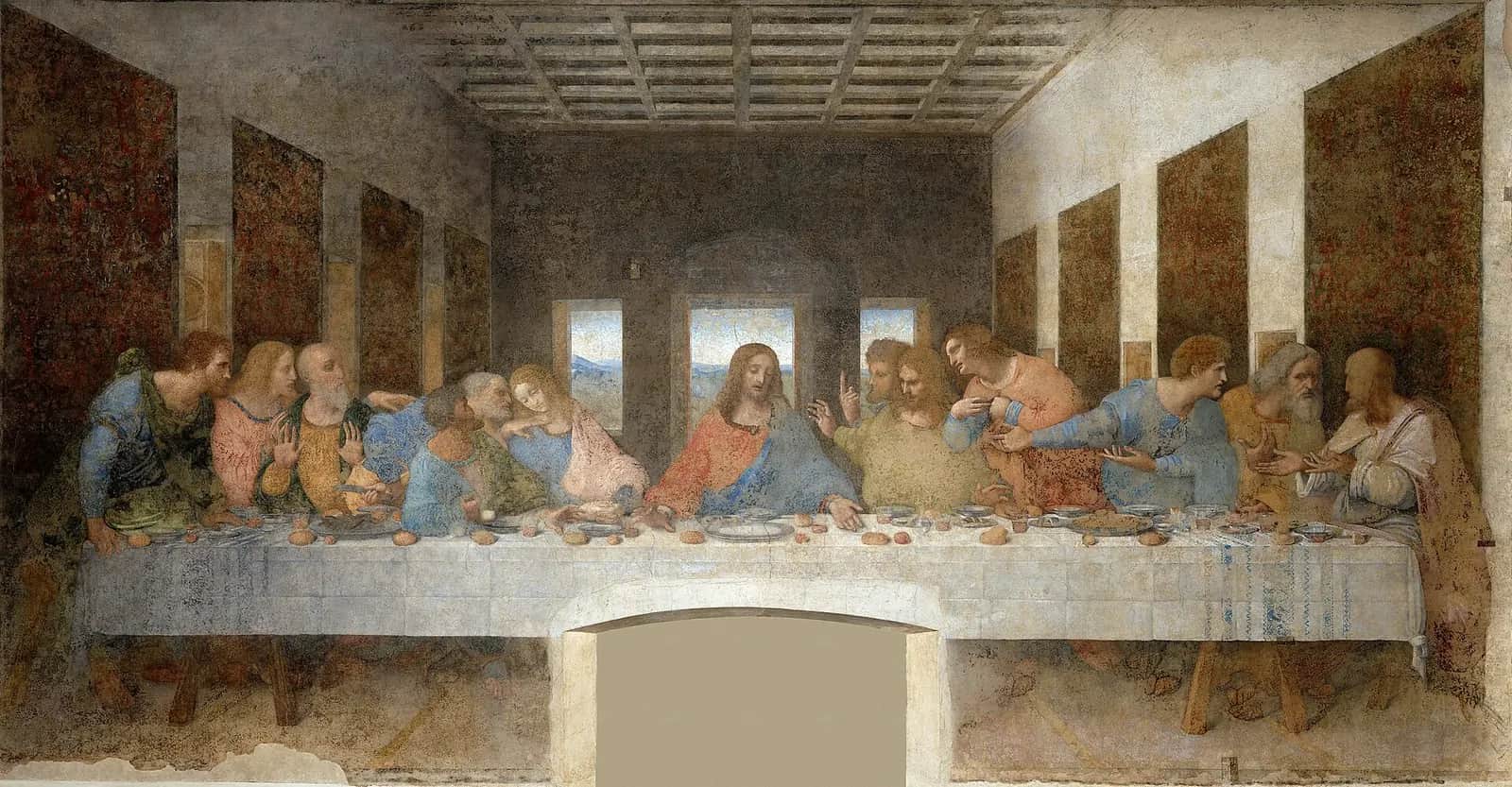
John 6:13 (WEB)
So they gathered them up, and filled twelve baskets with broken pieces from the five barley loaves, which were left over by those who had eaten.
Catechism · 1
“By freeing some individuals from the earthly evils of hunger, injustice, illness and death,” — Catechism footnote: Cf. Jn 6:5-15; Lk 19:8; Mt 11:5.
Fathers and councils · 51
John Damascene
“In the upper chamber, then, of holy and illustrious Sion, after He had eaten the ancient Passover with His disciples and had fulfilled the ancient covenant, He washed His disciples’ feet in token of the holy baptism.” — editor's note: Ibid. xiii.
Read the whole comment
Augustine of Hippo
“Therefore they gathered them together, and filled twelve baskets with the fragments of the five barley loaves, which remained over and above unto them that had eaten.”” — editor's note: John vi. 5–13.
Read the whole comment
Catena Aurea on Matthew
- John ChrysostomCatena Aurea on Matthew
“So also Christ as knowing the mind of John, said not, I am He; for thus He would have put an obstacle in the way of those that heard Him, who would have at least thought within themselves, if they did not say, what the Jews did say to Christ, “Thou bearest witness of thyself.” [John 6:13]” — the author cites it
Read the whole comment
Jerome
“But of the two multitudes miraculously supplied in the Gospel the larger was fed upon barley loaves, and the smaller on corn bread.” — editor's note: Matt. xiv. 15–21; xv. 32–38. Cf. Joh. vi. 5–13.
Read the whole comment
Catena Aurea on John
- John ChrysostomCatena Aurea on John
As missiles rebound with great force from a hard body, and fly off in all directions, whereas a softer material retains and stops them; so violent men are only excited to greater rage by violence on the side of their…
Read the whole comment - Alcuin of YorkCatena Aurea on John
This sea hath different names, from the different places with which it is connected; the sea of Galilee, from the province; the sea of Tiberias, from the city of that name. It is called a sea, though it is not salt…
Read the whole comment - Theophylact of OhridCatena Aurea on John
He goes from place to place to try the dispositions of people, and excite a desire to hear Him: And a great multitude followed Him, because they saw His miracles which He did on them that were diseased.
Read the whole comment - Alcuin of YorkCatena Aurea on John
viz. His giving sight to the blind, and other like miracles. And it should be understood, that all, whom He healed in body, He renewed likewise in soul.
Read the whole comment - John ChrysostomCatena Aurea on John
Though favoured with such teaching, they were influenced less by it, than by the miracles; a sign of their low state of belief: for Paul says of tongues, that they are for a sign, not to them that believe, but to…
Read the whole comment - Theophylact of OhridCatena Aurea on John
The persecutions of the Jews gave Him reason for retiring, and thus setting aside the Law. The truth being now revealed, types were at an end, and He was under no obligation to keep the Jewish feasts. Observe the…
Read the whole comment - BedeCatena Aurea on John
If we compare the accounts of the different Evangelists, we shall find very clearly, that there was an interval of a year between the beheading of John, and our Lord’s Passion. For, since Matthew says that our Lord,…
Read the whole comment - John ChrysostomCatena Aurea on John
Nor did He only sit with His disciples, but conversed with them familiarly, and gained possession of their minds. Then He looked, and saw a crowd advancing. But why did He ask Philip that question? Because He knew…
Read the whole comment - Augustine of HippoCatena Aurea on John
One kind of temptation leads to sin, with which God never tempts any one; (James 1:13.) and there is another kind by which faith is tried. (Deut. 13:3.) In this sense it is said that Christ proved His disciple. This…
Read the whole comment - Alcuin of YorkCatena Aurea on John
He asks him this question, not for His own information, but in order to shew His yet unformed disciple his dulness of mind, which he could not perceive of himself.
Read the whole comment - Theophylact of OhridCatena Aurea on John
Or to shew others it. He was not ignorant of His disciple’s heart Himself.
Read the whole comment - Augustine of HippoCatena Aurea on John
But if our Lord, according to John’s account, on seeing the multitude, asked Philip, tempting him, whence they could buy food for them, it is difficult at first to see how it can be true, according to the other…
Read the whole comment - John ChrysostomCatena Aurea on John
Or they are two different occasions altogether.
Read the whole comment - Theophylact of OhridCatena Aurea on John
Thus tried by our Lord, Philip was found to be possessed with human notions, as appears from what follows, Philip answered Him, Two hundred pennyworth of bread is not sufficient for them, that every one of them may…
Read the whole comment - Alcuin of YorkCatena Aurea on John
Wherein he shews his dulness: for, had he perfect ideas of his Creator, he would not be thus doubting His power.
Read the whole comment - Augustine of HippoCatena Aurea on John
The reply, which is attributed to Philip by John, Mark puts in the mouth of all the disciples, either meaning us to understand that Philip spoke for the rest, or else putting the plural number for the singular, which…
Read the whole comment - Theophylact of OhridCatena Aurea on John
Andrew is in the same perplexity that Philip is; only he has rather higher notions of our Lord: There is a lad here which hath five burley loares and two small fishes.
Read the whole comment - John ChrysostomCatena Aurea on John
Probably He had some reason in his mind for this speech. He would know of Elijah’s miracle, by which a hundred men were fed with twenty loaves. This was a great step; but here he stopped. He did not rise any higher.…
Read the whole comment - Theophylact of OhridCatena Aurea on John
This passage confounds the Manicheans, who say that bread and all such things were created by an evil Deity. The Son of the good God, Jesus Christ, multiplied the loaves. Therefore they could not have been naturally…
Read the whole comment - Augustine of HippoCatena Aurea on John
Andrew’s suggestion about the five loaves and two fishes, is given as coming from the disciples in general, in the other Evangelists, and the plural number is used.
Read the whole comment - John ChrysostomCatena Aurea on John
And let those of us, who are given to pleasure, observe the plain and abstemious eating of those great and wonderful menb. He made the men sit down before the loaves appeared, to teach us that with Him, things that…
Read the whole comment - Alcuin of YorkCatena Aurea on John
Sit down, i. e. lie down, as the ancient custom was, which they could do, as there was much grass in the place.
Read the whole comment - Theophylact of OhridCatena Aurea on John
i. e. green grass. It was the time of the Passover, which was kept the first month of the spring. So the men sat down in number about five thousand. The Evangelist only counts the men, following the direction in the…
Read the whole comment - John ChrysostomCatena Aurea on John
But why when He is going to heal the impotent, to raise the dead, to calm the sea, does He not pray, but here does give thanks? To teach us to give thanks to God, whenever we sit down to eat. And He prays more in…
Read the whole comment - Hilary of PoitiersCatena Aurea on John
Five loaves are then set before the multitude, and broken. The broken portions pass through into the hands of those who break, that from which they are broken all the time not at all diminishing. And yet there they…
Read the whole comment - Augustine of HippoCatena Aurea on John
He multiplied in His hands the five loaves, just as He produces harvest out of a few grains. There was a power in the hands of Christ; and those five loaves were, as it were, seeds, not indeed committed to the earth,…
Read the whole comment - John ChrysostomCatena Aurea on John
Observe the difference between the servant and the lord. The Prophets received grace, as it were, by measure, and according to that measure performed their miracles: whereas Christ, working this by His own absolute…
Read the whole comment - Theophylact of OhridCatena Aurea on John
We learn too from this miracle, not to be pusillanimous in the greatest straits of poverty.
Read the whole comment - BedeCatena Aurea on John
When the multitude saw the miracle our Lord had done, they marvelled; as they did not know yet that He was God. Then those men, the Evangelist adds, i. e. carnal men, whose understanding was carnal, when they had…
Read the whole comment - Alcuin of YorkCatena Aurea on John
Their faith being as yet weak, they only call our Lord a Prophet, not knowing that He was God. But the miracle had produced considerable effect upon them, as it made them call our Lord that Prophet, singling Him out…
Read the whole comment - Augustine of HippoCatena Aurea on John
Christ is a Prophet, and the Lord of Prophets; as He is an Angel, and the Lord of Angels. In that He came to announce something, He was an Angel; in that He foretold the future, He was a Prophet; in that He was the…
Read the whole comment - John ChrysostomCatena Aurea on John
Their expression, that should come into the world, shews that they expected the arrival of some great Prophet. And this is why they say, This is of a truth that Prophet: the article being put in the Greek, to shew…
Read the whole comment - Augustine of HippoCatena Aurea on John
But let us reflect a little here. Forasmuch as the Divine Substance is not visible to the eye, and the miracles of the divine government of the world, and ordering of the whole creation, are overlooked in consequence…
Read the whole comment - Alcuin of YorkCatena Aurea on John
Mystically, the sea signifies this tumultuous world. In the fulness of time, when Christ had entered the sea of our mortality by His birth, trodden it by His death, passed over it by His resurrectionf, then followed…
Read the whole comment - BedeCatena Aurea on John
Our Lord went up to the mountain, when He ascended to heaven, which is signified by the mountain.
Read the whole comment - Alcuin of YorkCatena Aurea on John
His leaving the multitude below, and ascending the heights with His disciples, signifies, that lesser precepts are to be given to beginners, higher to the more matured. His refreshing the people shortly before the…
Read the whole comment - Augustine of HippoCatena Aurea on John
The five barley loaves signify the old law; either because the law was given to men not as yet spiritual, but carnal, i. e. under the dominion of the five senses, (the multitude itself consisted of five thousand:) or…
Read the whole comment - BedeCatena Aurea on John
Barley is the food of cattle and slaves: and the old law was given to slaves and cattle, i. e. to carnal men.
Read the whole comment - Augustine of HippoCatena Aurea on John
The two fishes again, that gave the pleasant taste to the bread, seem to signify the two authorities by which the people were governed, the Royal, viz. and the Priestly; both of which prefigure our Lord, who…
Read the whole comment - BedeCatena Aurea on John
Or, by the two fishes are meant the saying or writings of the Prophets, and the Psalmist. And whereas the number five refers to the five senses, a thousand stands for perfection. But those who strive to obtain the…
Read the whole comment - Augustine of HippoCatena Aurea on John
The boy who had these is perhaps the Jewish people, who, as it were, carried the loaves and fishes after a servile fashion, and did not eat them. That which they carried, while shut up, was only a burden to them;…
Read the whole comment - BedeCatena Aurea on John
And well is it said, But what are these among so many? The Law was of little avail, till He took it into His hand, i. e. fulfilled it, and gave it a spiritual meaning. The Law made nothing perfect. (Heb. 7:19)
Read the whole comment - Augustine of HippoCatena Aurea on John
By the act of breaking He multiplied the five loaves. The five books of Moses, when expounded by breaking, i. e. unfolding them, made many books.
Read the whole comment - Augustine of HippoCatena Aurea on John
Our Lord by breaking, as it were, what was hard in the Law, and opening what was shut, that time when He opened the Scriptures to the disciples after the resurrection, brought the Law out in its full meaning.
Read the whole comment - Augustine of HippoCatena Aurea on John
Our Lord’s question proved the ignorance of His disciples, i. e. the people’s ignorance of the Law. They lay on the grass, i. e. were carnally minded, rested in carnal things, for all flesh is grass. (Isa. 40:6) Men…
Read the whole comment - Augustine of HippoCatena Aurea on John
And what are the fragments, but the parts which the people could not eat? An intimation, that those deeper truths, which the multitude cannot take in, should be entrusted to those who are capable of receiving them,…
Read the whole comment - Alcuin of YorkCatena Aurea on John
Baskets are used for servile work. The baskets here are the Apostles and their followers, who, though despised in this present life, are within filled with the riches of spiritual sacraments. The Apostles too are…
Read the whole comment
Cross-references · 5
Cited together in John Chrysostom on Matthew 11:2–6 (4) (Catena Aurea).
Cited together in John Chrysostom on Matthew 11:2–6 (4) (Catena Aurea).
Cited together in John Chrysostom on Matthew 11:2–6 (4) (Catena Aurea).
Cited together in John Chrysostom on Matthew 11:2–6 (4) (Catena Aurea).
Cited together in John Chrysostom on Matthew 11:2–6 (4) (Catena Aurea).