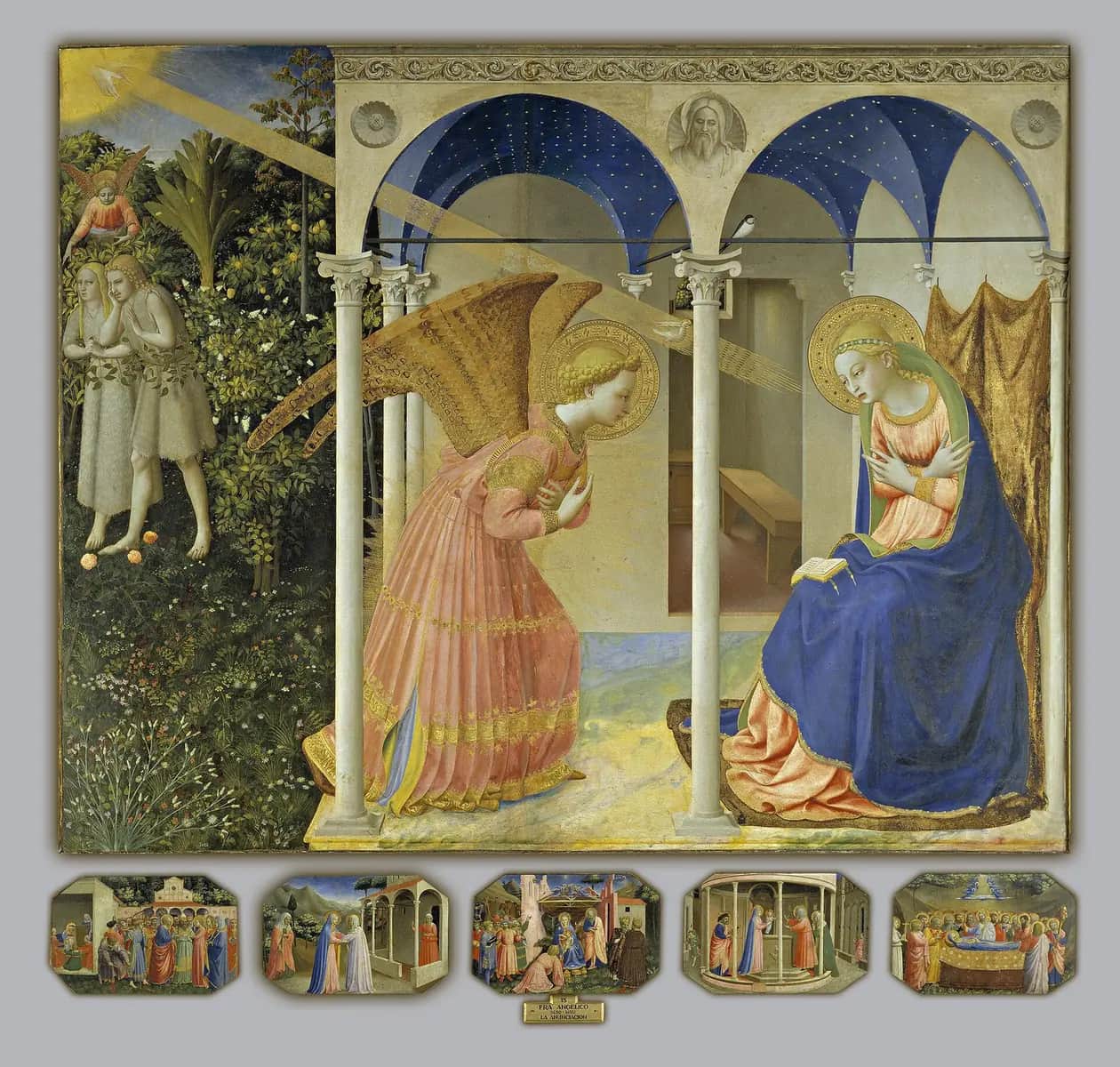
Luke 1:37 (WEB)
For nothing spoken by God is impossible.”
Catechism · 8
I Believe
“By faith Mary welcomes the tidings and promise brought by the angel Gabriel, believing that "with God nothing will be impossible" and so giving her assent: "Behold I am the handmaid of the Lord; let it be [done] to me according to your word."” — Catechism footnote: Lk 1:37-38; cf. Gen 18:14
In the Old Testament
“Abraham's remarkable hospitality at Mamre foreshadows the annunciation of the true Son of the promise.” — Catechism footnote: Cf. Gen 18:1-15; Lk 1:26-38.
The Almighty
“Nothing is impossible with God, who disposes his works according to his will.” — Catechism footnote: Cf. Jer 27:5; 32:17; Lk 1:37
“The Virgin Mary is the supreme model of this faith, for she believed that "nothing will be impossible with God", and was able to magnify the Lord: "For he who is mighty has done great things for me, and holy is his name."” — Catechism footnote: Lk 1:37, 49.
"Conceived by the Power of the Holy Spirit and Born of the Virgin Mary"
- §494Paragraph 2 · "Conceived by the Power of the Holy Spirit and Born of the Virgin Mary"Read at vatican.va
“At the announcement that she would give birth to "the Son of the Most High" without knowing man, by the power of the Holy Spirit, Mary responded with the obedience of faith, certain that "with God nothing will be impossible": "Behold, I am the handmaid of the Lord; let it be [done] to me according to your word."” — Catechism footnote: Lk 1:28-38; cf. Rom 1:5.
- §497Paragraph 2 · "Conceived by the Power of the Holy Spirit and Born of the Virgin Mary"Read at vatican.va
“The Gospel accounts understand the virginal conception of Jesus as a divine work that surpasses all human understanding and possibility:” — Catechism footnote: Mt 1 18-25; Lk 1:26-38.
"I Believe in the Holy Spirit"
Against all human hope, God promises descendants to Abraham, as the fruit of faith and of the power of the Holy Spirit. In Abraham's progeny all the nations of the earth will be blessed.
“By the Holy Spirit's power and her faith, her virginity became uniquely fruitful.” — Catechism footnote: Cf. Lk 1:26-38; Rom 4:18-21; Gal 4:26-28.
Fathers and councils · 16
Ambrose of Milan
“Therefore we ought to believe that God is good, eternal, perfect, almighty, and true, such as we find Him in the Law and the Prophets, and the rest of the holy Scriptures, for otherwise there is no God.” — editor's note: Vide, e.g., Ps. xxv. 8; Jer. x. 10; James i. 17, 18; Dan. ix. 9, 10; S. Luke i. 37.
Read the whole comment
Augustine of Hippo
Chapter IX.—Of the Question How It Can Be Shown that the Narrative of the Haul of Fishes Which Luke Has Given Us is Not to Be Identified with the Record of an Apparently Similar Incident Which John Has Reported…
Read the whole comment“…Him, recognized Him; that Zacharias, being filled with the Holy Ghost, said many things; that Mary herself received the Holy Ghost to conceive the Lord.” — editor's note: Luke i. 35–79.
Read the whole comment
Tertullian
“But what with men is difficult, with God is easy.” — editor's note: Matt. xix. 26; Luke i. 37; xviii. 27.
Read the whole comment“Clearly enough is the nativity announced by Gabriel.” — editor's note: Luke i. 26–38.
Read the whole comment
Hippolytus of Rome
“…of this (Jesus), he expresses himself thus: That powers emanating from the second tetrad fashioned Jesus, who appeared on earth, and that the angel Gabriel filled the place of the Logos, and the Holy Spirit that of Zoe, and the “Power of the Highest” that of Anthropos, and the Virgin that of Ecclesia.” — editor's note: Luke i. 26–38.
Read the whole comment
Catena Aurea on Luke
- John ChrysostomCatena Aurea on Luke
Seeing that his previous words had overcome the mind of the virgin, the angel drops his discourse to a humbler subject, persuading her by reference to sensible things. Hence he says, And, behold, Elisabeth thy…
Read the whole comment - Gregory of NazianzusCatena Aurea on Luke
But some one will ask, How is Christ related to David, since Mary sprang from the blood of Aaron, the angel having declared Elisabeth to be her kinswoman? But this was brought about by the Divine counsel, to the end…
Read the whole comment - BedeCatena Aurea on Luke
So it was then, lest the virgin should despair of being able to bear a son, that she received the example of one both old and barren about to bring forth, in order that she might learn that all things are possible…
Read the whole comment - John ChrysostomCatena Aurea on Luke
For the Lord of nature can do all things as He will, Who executes and disposes all things, holding the reins of life and death.
Read the whole comment - Augustine of HippoCatena Aurea on Luke
But whoever says, “If God is omnipotent, let Him cause those things which have been done to have not been done,” does not perceive that he says, “Let Him cause those things which are true, in that very respect in…
Read the whole comment - Ambrose of MilanCatena Aurea on Luke
Behold now the humility, the devotion of the virgin. For it follows, But Mary said, Behold the handmaid of the Lord. She calls herself His handmaid, who is chosen to be His mother, so far was she from being exalted…
Read the whole comment - A Greek expositorCatena Aurea on Luke
Some men will highly extol one thing, some another, in these words of the virgin. One man, for example, her constancy, another her willingness of obedience; one man her not being tempted by the great and glorious…
Read the whole comment - Gregory the GreatCatena Aurea on Luke
Through an ineffable sacrament of a holy conception and a birth inviolable, agreeable to the truth of each nature, the same virgin was both the handmaid and mother of the Lord.
Read the whole comment - BedeCatena Aurea on Luke
Having received the consent of the virgin, the angel soon returns heavenward, as it follows, And the angel departed from her.
Read the whole comment - Eusebius of CaesareaCatena Aurea on Luke
Not only having obtained what he wished, but wondering at her virgin beauty, and the ripeness of her virtue.
Read the whole comment
Cross-references · 17
Cited together in Catechism §494.
Cited together in Catechism §273.
Cited together in Catechism §273.
Cited together in Catechism §148.
Cited together in Catechism §269.
Cited together in Gregory of Nazianzus on Luke 1:36–38 (Catena Aurea).
Cited together in Catechism §269.
Cited together in Catechism §269.
Cited together in Catechism §269.
Cited together in Catechism §269.
Cited together in Catechism §269.
Cited together in Catechism §269.
Cited together in Catechism §269.
Cited together in Catechism §269.
Cited together in Catechism §269.
Cited together in Catechism §269.
Cited together in Catechism §269.