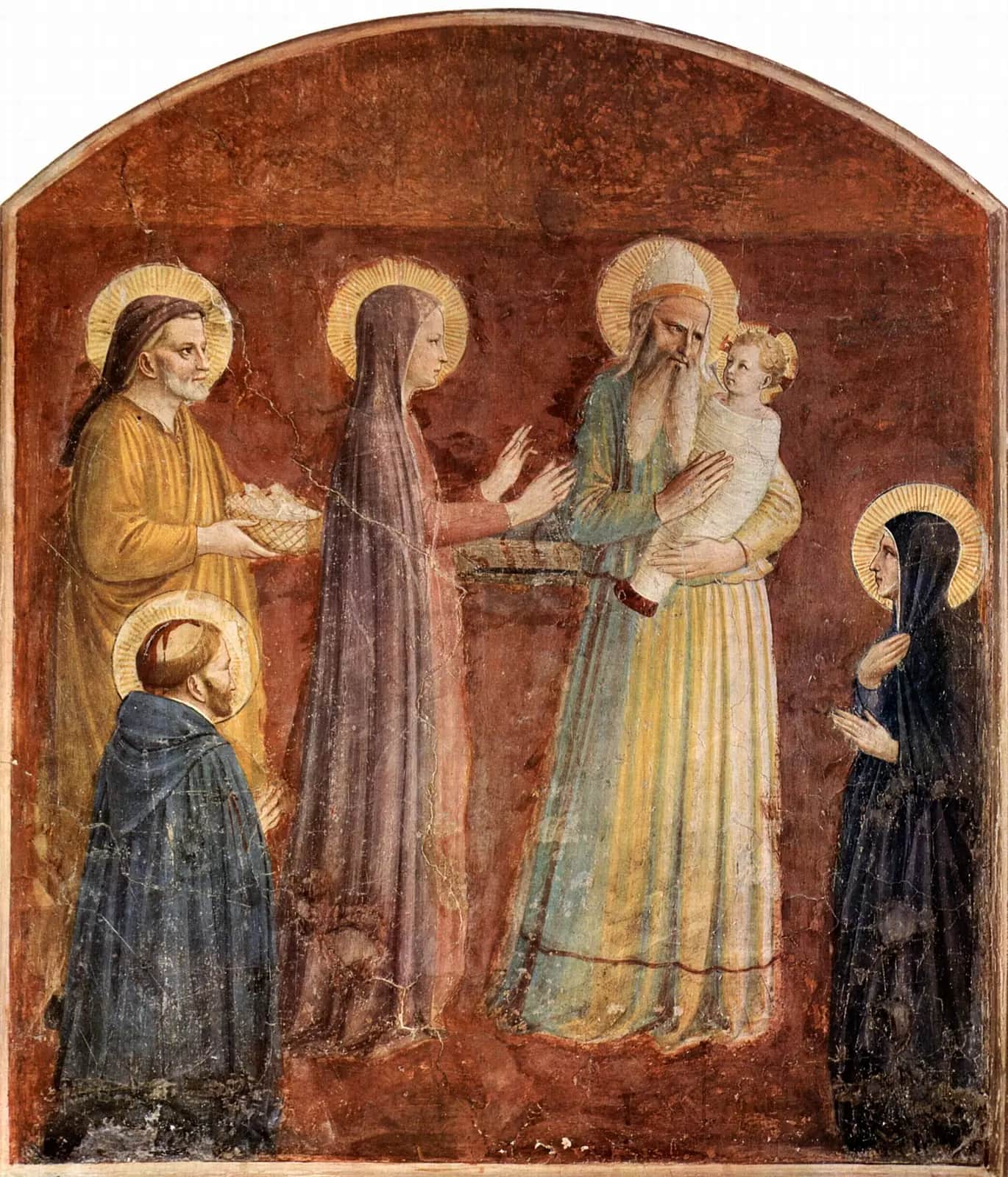
Luke 2:24 (WEB)
and to offer a sacrifice according to that which is said in the law of the Lord, “A pair of turtledoves, or two young pigeons.”
Catechism · 2
The Mysteries of Christ's Life
“The presentation of Jesus in the temple shows him to be the firstborn Son who belongs to the Lord.” — Catechism footnote: Cf. Lk 2:22-39; EX 13:2, 12-13.
Jesus and Israel
“It was in the Temple that Joseph and Mary presented him forty days after his birth.” — Catechism footnote: Lk 2:22-39.
Fathers and councils · 34
Cyril of Jerusalem
“…among men of His good pleasure: the Temple into which He was then carried up on the fortieth day: the pairs of turtle-doves, which were offered on His behalf: and Symeon who then took Him up in his arms, and Anna the prophetess who was present.” — editor's note: Ib. ii. 24. In Lev. xii. 8 one pair only of turtles is prescribed, to be offered for the mother, not for the child. But the reading τὰ ζεύγη in Cyril is…
Read the whole comment
Theodoret of Cyrus
“…the offerings of purification’ ‘to offer a sacrifice according to that which is said in the law of the Lord a pair of turtle doves or two young pigeons.’” — editor's note: Luke ii. 22, 24
Read the whole comment
Augustine of Hippo
“In it, too, it is recorded that the ceremonies proper to the earliest priestly service were attended to in the case of the infant Christ; and a careful examination brings a variety of other matters under our notice in this Gospel, by which it is made apparent that Luke’s object was to deal with the part of the priest.” — editor's note: Luke ii. 22–24.
Read the whole comment“And when they had performed all things according to the law of the Lord, behold, the angel of the Lord appeared to Joseph in a dream, saying, Arise, and take the young child and His mother, and flee into Egypt, and be thou there until I bring thee word; for Herod will seek the young child to destroy Him.” — editor's note: Luke ii. 22–39.
Read the whole comment“…they had gone with Him to Jerusalem after the purification of His mother, and when those things had been performed in the temple which are recounted by Luke, inasmuch as the words which were spoken by Simeon and Anna in their prophesyings regarding Him, when publicity began to be given to them by the persons who had…” — editor's note: Luke ii. 22–39.
Read the whole comment
Tertullian
“Spare also the babe from circumcision, that he may escape the pain thereof; nor let him be brought into the temple, lest he burden his parents with the expense of the offering; nor let him be handed to Simeon, lest the old man be saddened at the point of death.” — editor's note: Luke ii. 22–24.
Read the whole comment
Clement of Alexandria
“Again, by Moses, He commands “two young pigeons or a pair of turtles to be offered for sin;” thus saying, that the harmlessness and innocence and placable nature of these tender young birds are acceptable to God, and explaining that like is an expiation for like.” — editor's note: Lev. xv. 29, xii. 8; Luke ii. 24.
Read the whole comment
Catena Aurea on Luke
- Cyril of AlexandriaCatena Aurea on Luke
Next after the circumcision they wait for the time of purification, as it is said, And when the days of her purification according to the law of Moses were come.
Read the whole comment - BedeCatena Aurea on Luke
If you diligently examine the words of the law, you will find indeed that the mother of God as she is free from all connexion with man, so is she exempt from any obligation of the law. For not every woman who brings…
Read the whole comment - Titus of BostraCatena Aurea on Luke
Therefore the Evangelist has well observed, that the days of her purification were come according to the law, who since she had conceived of the Holy Spirit, was free from all uncleanness. It follows, They brought…
Read the whole comment - Athanasius of AlexandriaCatena Aurea on Luke
But when was the Lord hid from His Father’s eye, that He should not be seen by Him, or what place is excepted from His dominion, that by remaining there He should be separate from His Father, unless brought to…
Read the whole comment - BedeCatena Aurea on Luke
On the thirty-third day after His circumcision He is presented to the Lord, signifying in a mystery that no one but he who is circumcised from his sins is worthy to come into the Lord’s sight, that no one who has not…
Read the whole comment - OrigenCatena Aurea on Luke
Where are they who deny that Christ proclaimed in the Gospel the law to be of God, or can it be supposed that the righteous God made His own Son under a hostile law which He Himself had not given? It is written in…
Read the whole comment - BedeCatena Aurea on Luke
By the words, opening the womb, he signifies the first-born both of man and beast, and each one of which was, according to the commandment, to be called holy to the Lord, and therefore to become the property of the…
Read the whole comment - Gregory of NyssaCatena Aurea on Luke
Now this commandment of the law seems to have had its fulfilment in the incarnate God, in a very remarkable and peculiar manner. For He alone, ineffably conceived and incomprehensibly brought forth, opened the…
Read the whole comment - Ambrose of MilanCatena Aurea on Luke
For no union with man disclosed the secrets of the virgin’s womb, but the Holy Spirit infused the immaculate seed into an inviolate womb. He then who sanctified another womb in order that a prophet should be born, He…
Read the whole comment - Gregory of NyssaCatena Aurea on Luke
But the offspring of this birth is alone seen to be spiritually male, as contracting no guilt from being born of a woman. Hence He is truly called holy, and therefore Gabriel, as if announcing that this commandment…
Read the whole comment - Ambrose of MilanCatena Aurea on Luke
For among those that are born of a woman, the Lord Jesus alone is in every thing holy, who in the newness of His immaculate birth experienced not the contagion of earthly defilement, but by His Heavenly Majesty…
Read the whole comment - Cyril of AlexandriaCatena Aurea on Luke
Oh the depth of the riches of the wisdom and knowledge of God! (Rom. 11:33.) He offers victims, Who in each victim is honoured equally with the Father. The Truth preserves the figures of the law. He who as God is the…
Read the whole comment - BedeCatena Aurea on Luke
Now this was the victim of the poor. For the Lord commanded in the law that they who were able should offer a lamb for a son or a daughter as well as a turtle dove or pigeon; but they who were not able to offer a…
Read the whole comment - Cyril of AlexandriaCatena Aurea on Luke
But let us see what these offerings mean. The turtle dove is the most vocal of birds, and the pigeon the gentlest. And such was the Saviour made unto us; He was endowed with perfect meekness, and like the turtle dove…
Read the whole comment - BedeCatena Aurea on Luke
Or the pigeon denotes simplicity, the turtle dove chastity, for the pigeon is a lover of simplicity, and the turtle dove of chastity, so that if by chance she has lost her mate, she heeds not to find another. Rightly…
Read the whole comment - Athanasius of AlexandriaCatena Aurea on Luke
He ordered two things to be offered, because as man consists of both body and soul, the Lord requires a double return from us, chastity and meekness, not only of the body, but also of the soul. Otherwise, man will be…
Read the whole comment - BedeCatena Aurea on Luke
But while each bird, from its habit of wailing, represents the present sorrows of the saints, in this they differ, that the turtle is solitary, but the pigeon flies about in flocks, and hence the one points to the…
Read the whole comment - BedeCatena Aurea on Luke
Or the pigeon which flies in flocks sets forth the busy intercourse of active life. The turtle, which delights in solitariness, tells of the lofty heights of the contemplative life. But because each victim is equally…
Read the whole comment - Ambrose of MilanCatena Aurea on Luke
Not only did Angels and Prophets, the shepherds and his parents, bear witness to the birth of the Lord, but the old men and the righteous. As it is said, And, behold, there was a man in Jerusalem whose name was…
Read the whole comment - Ambrose of MilanCatena Aurea on Luke
Well is he called righteous who sought not his own good, but the good of his nation, as it follows, Waiting for the consolation of Israel.
Read the whole comment - Gregory of NyssaCatena Aurea on Luke
It was not surely worldly happiness that the prudent Simeon was waiting for as the consolation of Israel, but a real happiness, that is, a passing over to the beauty of truth from the shadow of the law. For he had…
Read the whole comment - Ambrose of MilanCatena Aurea on Luke
He desired indeed to be loosed from the chains of bodily infirmity, but he waits to see the promise, for he knew, Happy are those eyes which shall see it. (Job 6.)
Read the whole comment - Gregory the GreatCatena Aurea on Luke
Hereby also we learn with what desire the holy men of Israel desired to see the mystery of His incarnation.
Read the whole comment - BedeCatena Aurea on Luke
To see death means to undergo it, and happy will he be to see the death of the flesh who has first been enabled to see with the eyes of his heart the Lord Christ, having his conversation in the heavenly Jerusalem,…
Read the whole comment - OrigenCatena Aurea on Luke
If thou wilt touch Jesus and grasp Him in thy hands, strive with all thy strength to have the Spirit for thy guide, and come to the temple of God. For it follows, And when his parents brought in the child Jesus, (i.…
Read the whole comment - Gregory of NyssaCatena Aurea on Luke
How blessed was that holy entrance to holy things through which he hastened on to the end of life, blessed those hands which handled the word of life, and the arms which were held out to receive Him!
Read the whole comment - BedeCatena Aurea on Luke
Now the righteous man, according to the law, received the Child Jesus in his arms, that he might signify that the legal righteousness of works under the figure of the hands and arms was to be changed for the lowly…
Read the whole comment
Cross-references · 7
Cited together with
Cross-reference given by the World English Bible's translators.
Cited together in Cyril of Alexandria on Luke 2:22–25 (2) (Catena Aurea).
Cited together in Ambrose of Milan on Luke 2:22–25 (3) (Catena Aurea).
Cited together in Origen on Luke 2:22–25 (Catena Aurea).
Cited together in Cyril of Alexandria on Luke 2:22–25 (2) (Catena Aurea).
Cited together in Ambrose of Milan on Luke 2:22–25 (3) (Catena Aurea).
Quotes
Luke 2:24 takes up the words of 1 Kings 2:3 (8 words in common).