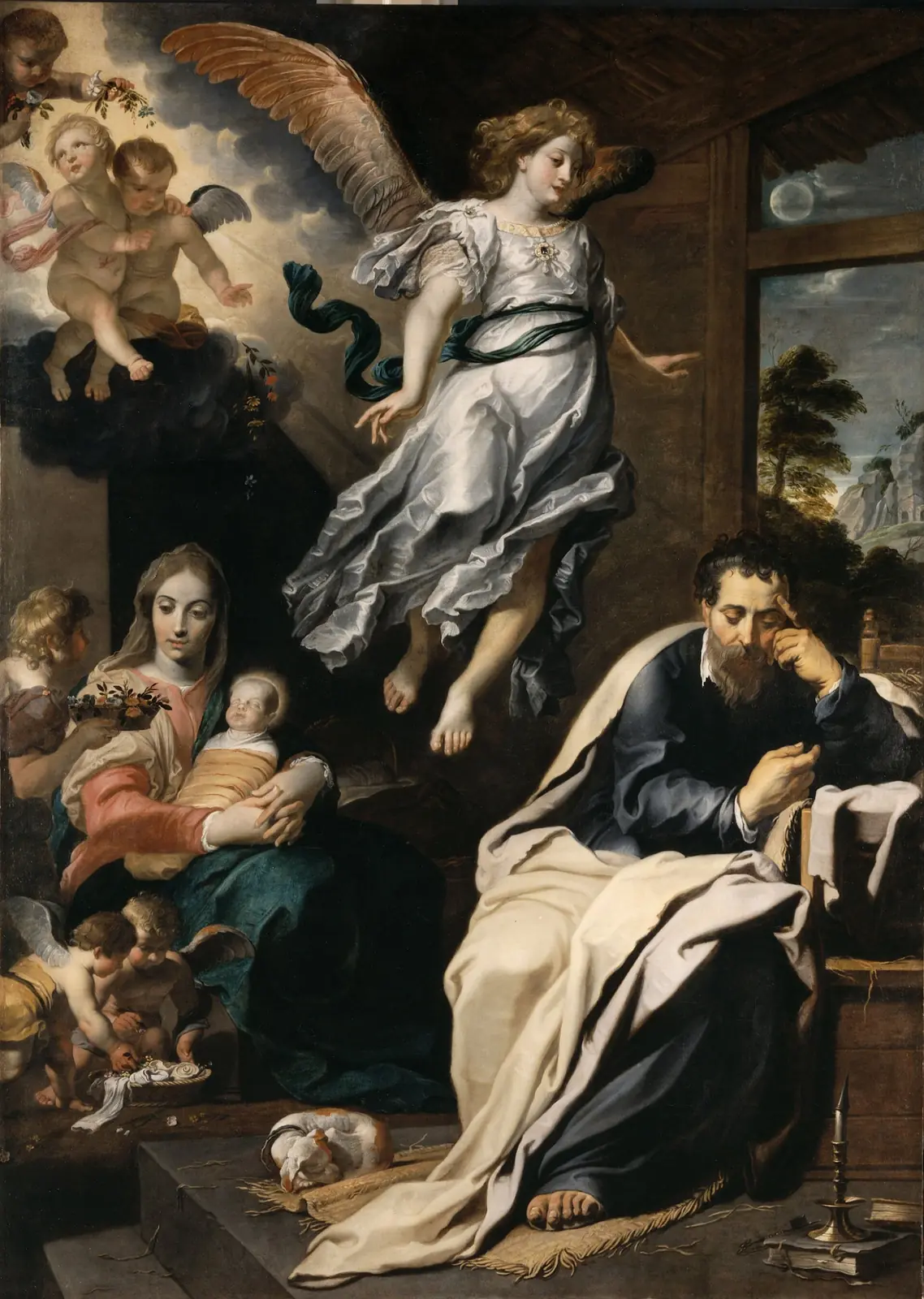
Matthew 1:11 (WEB)
Josiah became the father of Jechoniah and his brothers at the time of the exile to Babylon.
Fathers and councils · 20
Augustine of Hippo
“…critics who find a difficulty in the circumstance that Matthew enumerates one series of ancestors, beginning with David and travelling downwards to Joseph, while Luke specifies a different succession, tracing it from Joseph upwards as far as to David, they might easily perceive that Joseph may have had two…” — editor's note: Matt. i. 1–16.
Read the whole comment“Then in order to tell us how Christ was born of the Virgin Mary, he went on and said, “Now the birth of Jesus Christ was on this wise;” for by the line of the generations he had showed why Christ is called the Son of David, and the Son of Abraham.” — editor's note: Matt. i. 7–18.
Read the whole comment
Catena Aurea on Matthew
- JeromeCatena Aurea on Matthew
In the fourth book of Kings we read, that Ochozias was the son of Joram. On his death, Josabeth, sister of Ochozias and daughter of Joram, took Joash, her brother’s son, and preserved him from the slaughter of the…
Read the whole comment - Hilary of PoitiersCatena Aurea on Matthew
Thus the stain of the Gentile alliance being purged, the royal race is again taken up in the fourth following generation.
Read the whole comment - Pseudo-ChrysostomCatena Aurea on Matthew
What the Holy Spirit testified through the Prophet, saying, that He would cut off every male from the house of Ahab, and Jezebel, that Jehu the son of Nausi fulfilled, and received the promise that his children to…
Read the whole comment - Augustine of HippoCatena Aurea on Matthew
Or, Ochozias, Joash, and Amasias, were excluded from the number, because their wickedness was continuous and without interval. For Solomon was suffered to hold the kingdom for his father’s deserts, Roboam for his…
Read the whole comment - Glossa OrdinariaCatena Aurea on Matthew
This Ezekias was he to whom, when he had no children, it was said, “Set thy house in order, for thou shalt die.” [Isa 38:1] He wept, not from desire of longer life, for he knew that Solomon had thereby pleased God,…
Read the whole comment - Pseudo-ChrysostomCatena Aurea on Matthew
But the order in the Book of Kings is different [2 Ki 23], thus namely; Josias begot Eliakim, afterwards called Joakim; Joakim begot Jechonias. But Joakim is not reckoned among the Kings in the genealogy, because…
Read the whole comment - JeromeCatena Aurea on Matthew
Otherwise, we may consider the first Jeconias to be the same as Joakim, and the second to be the son not the father, the one being spelt with k and m, the second by ch and n. This distinction has been confounded both…
Read the whole comment - Ambrose of MilanCatena Aurea on Matthew
That there were two kings of the name of Joakim, is clear from the Book of Kings. “And Joakim slept with his fathers, and Joachim his son reigned in his stead.” [2 Ki 24:6] This son is the same whom Jeremiah calls…
Read the whole comment - Remigius of AuxerreCatena Aurea on Matthew
But it may be asked, why the Evangelist says they were born in the carrying away, when they were born before the carrying away. He says this because they were born for this purpose, that they should be led captive,…
Read the whole comment - Glossa OrdinariaCatena Aurea on Matthew
Mystically, David is Christ, who overcame Golias, that is, the Devil. Urias, i.e. God is my light, is the Devil who says, “I will be like the Highest.” [Isa 14:14] To Him the Church was married, when Christ on the…
Read the whole comment - Remigius of AuxerreCatena Aurea on Matthew
Bersabee is interpreted, ‘the seventh well,’ or, ‘the well of the oath’ [ed. note, c: בְאֵר שָׁבַע the well of the oath, the origin of the name is given, Gen 21:28-31. “satiety” as if from שׂבע, by which is signified…
Read the whole comment - Rabanus MaurusCatena Aurea on Matthew
Or; ‘the might of the people,’ because he quickly converts the people to the faith.
Read the whole comment - Remigius of AuxerreCatena Aurea on Matthew
He is also Abias, that is, ‘the Lord Father,’ according to that, “One is your Father who is in heaven.” [Matt 23:9] And again, “Ye call me Master and Lord.” [John 13:13] He is also Asa [ed. note, e: So Jerome; as if…
Read the whole comment - Rabanus MaurusCatena Aurea on Matthew
Or, ‘embracing,’ because, “None knoweth the Father but the Son.” [Matt 11:27]
Read the whole comment - Remigius of AuxerreCatena Aurea on Matthew
His is also Ezekias, that is, ‘the strong Lord,’ or, ‘the Lord shall comfort;’ according to that, “Be of good cheer, I have overcome the world.” [John 16:33] He is also Manasses, that is, ‘forgetful,’ or,…
Read the whole comment - Rabanus MaurusCatena Aurea on Matthew
And that incense signifies prayer, the Psalmist witnesses, saying, “Let my prayer come up as incense before Thee.” [Ps 141:2] Or, ‘The salvation of the Lord,’ according to that, “My salvation is for ever.” [Isa 55]
Read the whole comment - Remigius of AuxerreCatena Aurea on Matthew
He is Jechonias [ed. note, k: יכניהו “the Lord establisheth,” also “prepareth.”], that is, ‘preparing,’ or ‘the Lord’s preparation,’ according to that, “If I shall depart, I will also prepare a place for you.” [John…
Read the whole comment - Glossa OrdinariaCatena Aurea on Matthew
Morally; After David follows Solomon, which is interpreted, ‘peaceful.’ For one then becomes peaceful, when unlawful motions being composed, and being as it were already set in the everlasting rest, he serves God,…
Read the whole comment
Cross-references · 17
Cited together in Remigius of Auxerre on Matthew 1:8–11 (3) (Catena Aurea).
Cited together in Remigius of Auxerre on Matthew 1:8–11 (3) (Catena Aurea).
Cited together in Remigius of Auxerre on Matthew 1:8–11 (3) (Catena Aurea).
Cited together in Remigius of Auxerre on Matthew 1:8–11 (5) (Catena Aurea).
Cited together in Remigius of Auxerre on Matthew 1:8–11 (2) (Catena Aurea).
Cited together in Remigius of Auxerre on Matthew 1:8–11 (2) (Catena Aurea).
Cited together in Remigius of Auxerre on Matthew 1:8–11 (2) (Catena Aurea).
Cited together in Remigius of Auxerre on Matthew 1:8–11 (2) (Catena Aurea).
Cited together in Remigius of Auxerre on Matthew 1:8–11 (2) (Catena Aurea).
Cited together in Pseudo-Chrysostom on Matthew 1:8–11 (Catena Aurea).
Cited together in Remigius of Auxerre on Matthew 1:8–11 (4) (Catena Aurea).
Cited together in Ambrose of Milan on Matthew 1:8–11 (Catena Aurea).
Cited together in Rabanus Maurus on Matthew 1:8–11 (3) (Catena Aurea).
Cited together in Remigius of Auxerre on Matthew 1:8–11 (4) (Catena Aurea).
Cited together in Glossa Ordinaria on Matthew 1:8–11 (2) (Catena Aurea).
Cited together in Glossa Ordinaria on Matthew 1:8–11 (Catena Aurea).
Cited together in Remigius of Auxerre on Matthew 1:8–11 (3) (Catena Aurea).