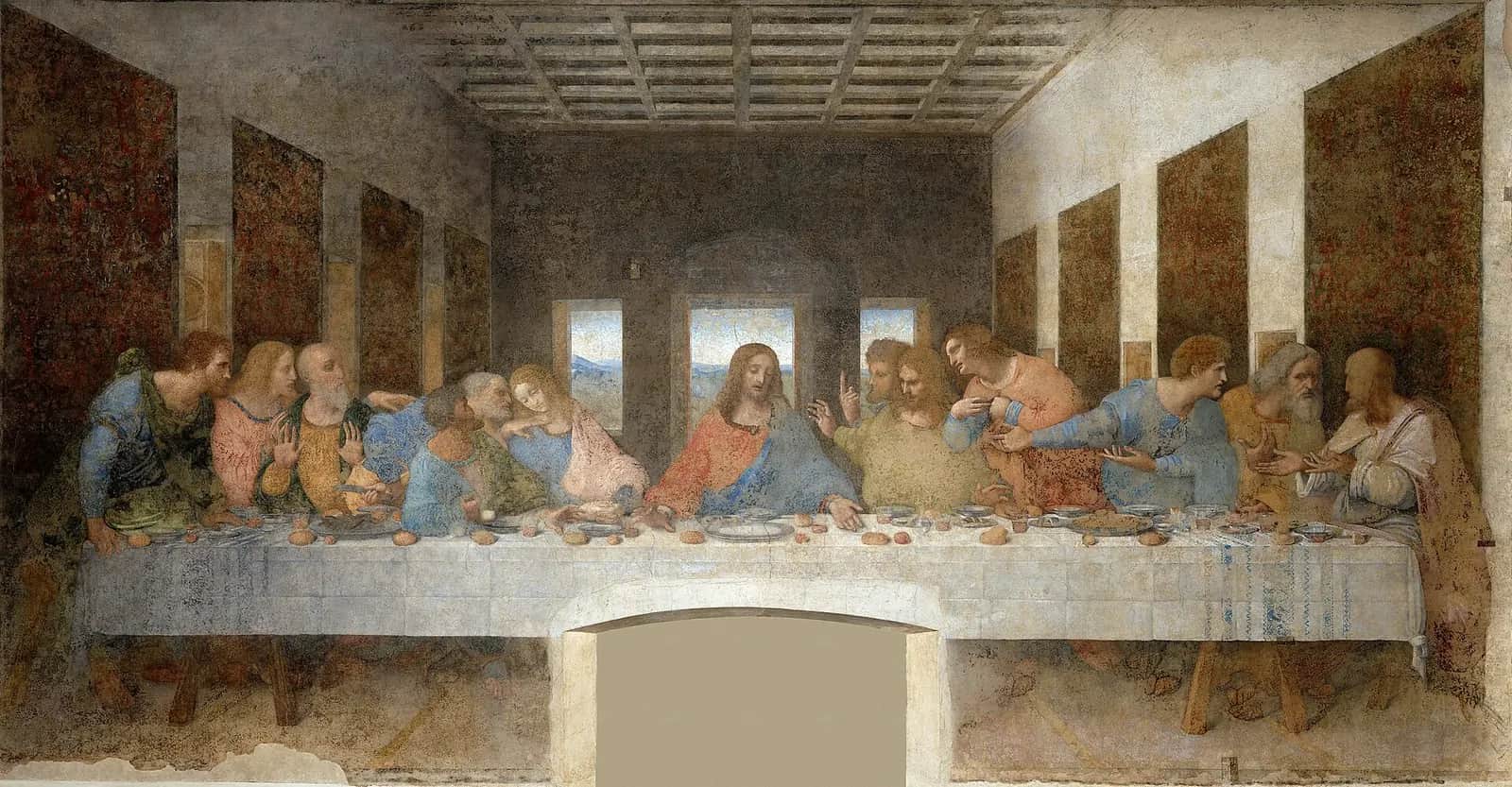
Matthew 26:26 (WEB)
As they were eating, Jesus took bread, gave thanks for it, and broke it. He gave to the disciples and said, “Take, eat; this is my body.”
Catechism · 4
“It is called: Eucharist, because it is an action of thanksgiving to God. the Greek words eucharistein and eulogein” — Catechism footnote: Cf. Mt 26:26; Mk 14:22.
“The Breaking of Bread, because Jesus used this rite, part of a Jewish meat when as master of the table he blessed and distributed the bread, above all at the Last Supper.” — Catechism footnote: Cf. Mt 26:26; 1 Cor 11:24.
“Do this in remembrance of me." and likewise the cup after supper, saying, "This cup which is poured out for you is the New Covenant in my blood."” — Catechism footnote: Lk 22:7-20; Cf. Mt 26:17-29; Mk 14:12-25; 1 Cor 11:23-26.
“This change the holy Catholic Church has fittingly and properly called transubstantiation."” — Catechism footnote: Council of Trent (1551): DS 1642; cf. Mt 26:26 ff.; Mk 14:22 ff.; Lk 22:19 ff.; 1 Cor 11:24 ff.
Fathers and councils · 33
Irenaeus of Lyons
“Again, giving directions to His disciples to offer to God the first-fruits of His own, created things—not as if He stood in need of them, but that they might be themselves neither unfruitful nor ungrateful—He took that created thing, bread, and gave thanks, and said, “This is My body.”” — editor's note: Matt. xxvi. 26, etc.
Read the whole comment
Athanasius of Alexandria
“And so let Paul of Samosata also stand corrected on hearing the divine voice of Him who said ‘My body,’ not ‘Christ besides Me who am the Word,’ but ‘Him with Me, and Me with Him.’” — editor's note: i.e. τὸν Χρ. vid. Matt. xxvi. 26.
Read the whole comment“The Saviour also, since He was changing the typical for the spiritual, promised them that they should no longer eat the flesh of a lamb, but His own, saying, ‘Take, eat and drink; this is My body, and My blood.’” — editor's note: Matt. xxvi. 26–28
Read the whole comment
John Damascene
“Then having broken bread He gave it to them saying, Take, eat, this is My body broken for you for the remission of sins.” — editor's note: St. Matt. xxvi. 26; Liturg. S. Jacobi.
Read the whole comment
Cyril of Jerusalem
“For you have just heard him say distinctly, That our Lord Jesus Christ in the night in which He was betrayed, took bread, and when He had given thanks He brake it, and gave to His disciples, saying, Take, eat, this is My Body: and having taken the cup and given thanks, He said, Take, drink, this is My Blood.” — editor's note: 1 Cor. xi. 23. The clause “and gave to His disciples” is an addition taken from Matt. xxvi. 26. The part relating to the cup does not correspond exactly either…
Read the whole comment
Ambrose of Milan
“For he, himself, had learnt that the Lord Jesus gave to some barley bread lest they should faint by the way, and administered His Body to others, that they might strive for the kingdom.” — editor's note: S. Matt. xxvi. 26.
Read the whole comment“The Lord Jesus Himself proclaims: “This is My Body.”” — editor's note: S. Matt. xxvi. 26.
Read the whole comment
Augustine of Hippo
“Because when He commended His Own Body and Blood, He took into His Hands that which the faithful know; and in a manner carried Himself, when He said, “This is My Body.”” — editor's note: Matt. xxvi. 26.
Read the whole comment“Let us commence here, accordingly, with the notice presented by Matthew, [which runs thus]: “And as they were eating, Jesus took bread, and blessed it, and brake it, and gave it to His disciples, and said, Take, eat; this is my body.”” — editor's note: Matt. xxvi. 26.
Read the whole comment
John Chrysostom
“Matt. XXVI. 26-28.” — the author cites it
Read the whole comment
Jerome
“For he had himself learned that the Lord Jesus gave to some barley bread, lest they should faint by the way, but offered to others His own body, that they should strive to attain His kingdom;” and immediately afterwards: “The nuptial tie, then, is not to be avoided as a crime, but to be refused as a hard burden.” — editor's note: Matt. xxvi. 26, 29.
Read the whole comment
Tertullian
“Then we find, too, that His body is reckoned in bread: “This is my body.”” — editor's note: Matt. xxvi. 26.
Read the whole comment
Catena Aurea on Matthew
- JeromeCatena Aurea on Matthew
When the typical Passover was concluded, and He had partaken of the Lamb with His Apostles, He comes to the true paschal sacrament; that, as Melchisedech [marg. note: Gen 14:18], Priest of the most high God, had done…
Read the whole comment - Augustine of HippoCatena Aurea on Matthew
“And as they were eating,” whereby it is clearly seen that at their first partaking of the Lord’s Body and Blood, the disciples did not partake fasting. But are we therefore to except against the practice of the…
Read the whole comment - Glossa OrdinariaCatena Aurea on Matthew
Christ delivered to us His Flesh and Blood under another kind, and ordained them to be thenceforth so received, that faith might have its merit, which is of things that are not seen. Ambrose, Ambr. de Sacr., vi, 1…
Read the whole comment - Augustine of HippoCatena Aurea on Matthew
The Lord committed His Body and Blood to substances which are formed a homogeneous compound out of many. Bread is made of many grains, wine is produced out of many berries. Herein the Lord Jesus Christ signified us,…
Read the whole comment - Remigius of AuxerreCatena Aurea on Matthew
Fittingly also did He offer fruit of the earth, to shew thereby that He came to take away the curse wherewith the earth was cursed for the sin of the first man. Also He bade be offered the produce of the earth, and…
Read the whole comment - Ambrose of MilanCatena Aurea on Matthew
Hence learn that the Christian mysteries were before the Jewish. Melchisedech offered bread and wine, being in all things like the Son of God, to Whom it is said, “Thou art a Priest for ever after the order of…
Read the whole comment - Glossa OrdinariaCatena Aurea on Matthew
[ed. note: This Gloss is partly from the Gloss on Gratian de Cons. d. ii. c. 5. The next passage is headed ‘Gregorius in Registro’ in the editions, and is so quoted by S. Thomas, Summa 3. q. 74. art. 4. but cannot be…
Read the whole comment - Gregory the GreatCatena Aurea on Matthew
It has given trouble to divers persons, that in the Church some offer unleavened and others leavened bread. The Roman Church offers unleavened, because the Lord took flesh without any pollution [marg. note:…
Read the whole comment - Ambrose of MilanCatena Aurea on Matthew
This bread before the sacramentary words, is the bread in common use; after consecration it is made of bread Christ’s flesh. And what are the words, or whose are the phrases of consecration, save those of the Lord…
Read the whole comment - Paschasius RadbertusCatena Aurea on Matthew
As then real flesh was created by the Holy Spirit without sexual union, so by the same Holy Spirit the substance of bread and wine are consecrated into the Body and Blood of Christ. And because this consecration is…
Read the whole comment - Remigius of AuxerreCatena Aurea on Matthew
Hereby He shewed also that He together with the Father and the Holy Spirit has filled human nature with the grace of His divine power, and enriched it with the boon of immortality. And to shew that His Body was not…
Read the whole comment - LanfrancCatena Aurea on Matthew
When the host is broken, when the blood is poured from the cup into the mouth of the faithful, what else is denoted but the offering of the Lord’s Body on the cross, and the shedding of His Blood out of His side?…
Read the whole comment - Dionysius the AreopagiteCatena Aurea on Matthew
In this is also shewn, that the one and uncompounded Word of God came to us compounded and visible by taking human nature upon Him, and drawing to Himself our society, made us partakers of the spiritual goods which…
Read the whole comment - Leo the GreatCatena Aurea on Matthew
Not excluding the traitor even from this mystery, that it might be made manifest that Judas was provoked by no wrong, but that he had been foreknown in voluntary impiety.
Read the whole comment - Augustine of HippoCatena Aurea on Matthew
Peter and Judas received of the same bread, but Peter to life, Judas to death.
Read the whole comment - John ChrysostomCatena Aurea on Matthew
And this John shews when be says “After the sop, Satan entered into him.” [John 13:27] For his sin was aggravated in that he came near to these mysteries with such a heart, and that having come to them, he was made…
Read the whole comment - Remigius of AuxerreCatena Aurea on Matthew
In so doing He left an example to the Church, that it should sever no one from its fellowship, or from the communion of the Body and Blood of the Lord, but for some notorious and public crime.
Read the whole comment - Hilary of PoitiersCatena Aurea on Matthew
Or, The Passover was concluded by the taking the cup and breaking the bread without Judas, for he was unworthy the communion of eternal sacraments. And that he had left them we learn from thence, that he returns with…
Read the whole comment - Augustine of HippoCatena Aurea on Matthew
[ed. note: This passage, headed ‘Augustinus’ in the Bodl. MS., and ‘Aug de Verb. Dom.’ in the earlier editions, is apparently taken from two canons in the 3d pt. of Gratian, viz. c. 70. and c. 58. to which…
Read the whole comment - Augustine of HippoCatena Aurea on Matthew
Let us not eat Christ’s flesh only in the Sacrament, for that do many wicked men, but let us eat to spiritual participation, that we may abide as members in the Lord’s body, that we may be quickened by His Spirit.
Read the whole comment - Ambrose of MilanCatena Aurea on Matthew
Before consecration, it is bread; after Christ’s words, “This is my body,” have been pronounced, it is Christ’s Body.
Read the whole comment
Cross-references · 15
Parallel passages
Matthew 26:26 and Mark 14:22 share the same wording (15 words).
Cited together with
Cited together in Catechism §1328 and 1 other place.
Cited together in Catechism §1328 and 1 other place.
Cited together in Concerning Widows Chapter 13.
Cited together in Ambrose of Milan on Matthew 26:26 (Catena Aurea).
Cited together in John Chrysostom on Matthew 26:26 (Catena Aurea).
Cited together in Concerning Widows Chapter 13.
Cited together in Catechism §1328 and 1 other place.
Cited together in Concerning Widows Chapter 13.
Cited together in Jerome on Matthew 26:26 (Catena Aurea).
Cited together in Ambrose of Milan on Matthew 26:26 (Catena Aurea).
Cited together in Concerning Widows Chapter 13.
Cited together in Concerning Widows Chapter 13.
Cited together in Concerning Widows Chapter 13.
Cited together in Concerning Widows Chapter 13.