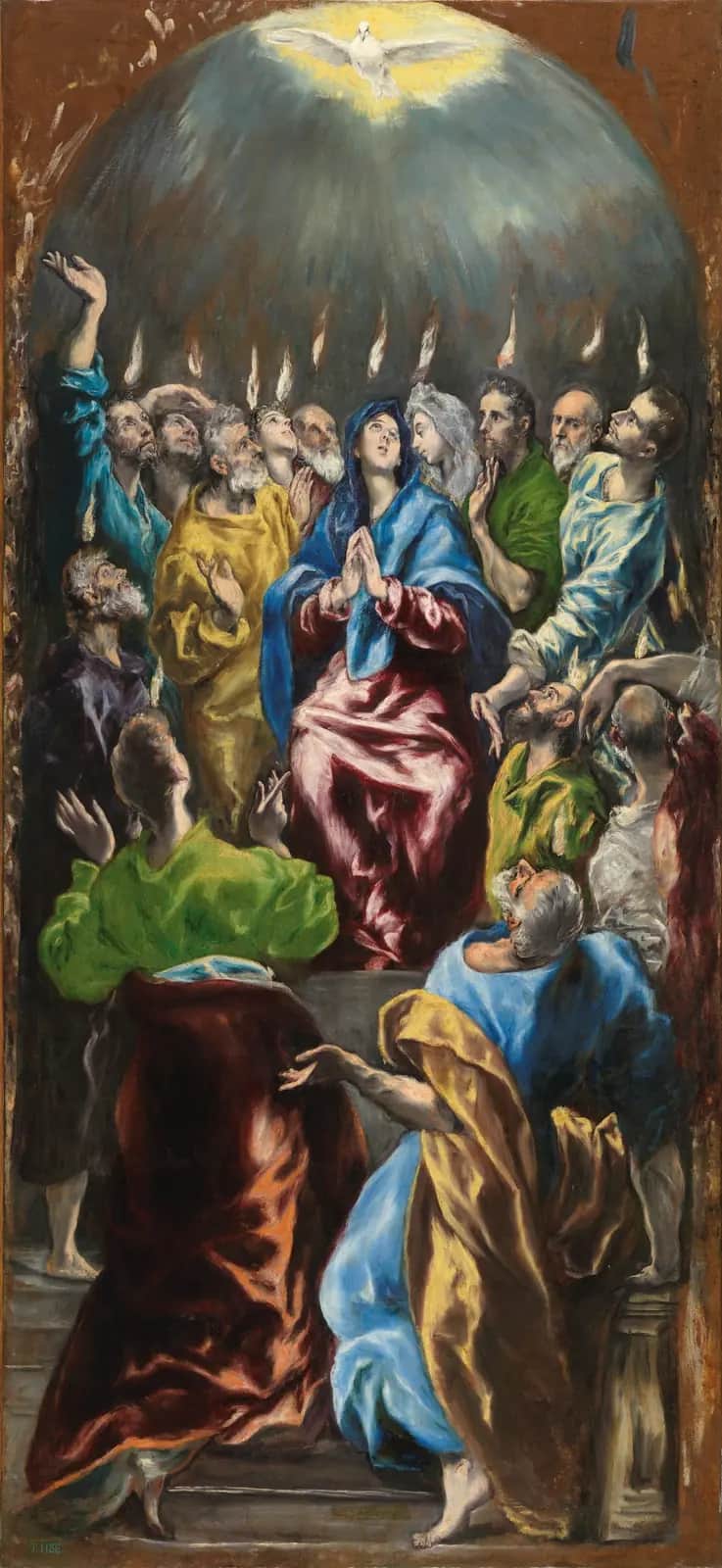
Acts 2:36 (WEB)
“Let all the house of Israel therefore know certainly that God has made him both Lord and Christ, this Jesus whom you crucified.”
Catechism · 7
The Sacrament of Penance and Reconciliation
“But this same Spirit who brings sin to light is also the Consoler who gives the human heart grace for repentance and conversion.” — Catechism footnote: Cf. Jn 15:26; Acts 2:36-38; John Paul II, DeV 27-48.
"And in Jesus Christ, His Only Son, Our Lord"
“Only after his Resurrection will Peter be able to proclaim Jesus' messianic kingship to the People of God: "Let all the house of Israel therefore know assuredly that God has made him both Lord and Christ, this Jesus whom you crucified."” — Catechism footnote: Acts 2:36.
“Jesus ascribes this title to himself in a veiled way when he disputes with the Pharisees about the meaning of Psalm 110, but also in an explicit way when he addresses his apostles.” — Catechism footnote: Cf. Mt 22:41-46; cf. Acts 2:34-36; Heb 1:13; Jn 13:13.
“By attributing to Jesus the divine title "Lord", the first confessions of the Church's faith affirm from the beginning that the power, honour and glory due to God the Father are due also to Jesus, because "he was in the form of God",” — Catechism footnote: Cf. Acts 2:34 - 36; Rom 9:5; Titus 2:13; Rev 5:13; Phil 2:6.
Jesus Died Crucified
“Hence we cannot lay responsibility for the trial on the Jews in Jerusalem as a whole, despite the outcry of a manipulated crowd and the global reproaches contained in the apostles' calls to conversion after Pentecost.” — Catechism footnote: Cf. Mk 15:11; Acts 2:23, 36; 3:13-14; 4:10; 5:30; 7:52; 10:39; 13:27-28; I Th 2:14-15.
"I Believe in the Holy Spirit"
“Now, fully established as "Christ" in his humanity victorious over death, Jesus pours out the Holy Spirit abundantly until "the saints" constitute - in their union with the humanity of the Son of God - that perfect man "to the measure of the stature of the fullness of Christ":” — Catechism footnote: Eph 4:13; cf. Acts 2:36.
“On the day of Pentecost when the seven weeks of Easter had come to an end, Christ's Passover is fulfilled in the outpouring of the Holy Spirit, manifested, given, and communicated as a divine person: of his fullness, Christ, the Lord, pours out the Spirit in abundance.” — Catechism footnote: Cf. Acts 2:33-36.
Fathers and councils · 20
Gregory of Nyssa
“…having been transformed to the Divine nature by its union with God, as Peter said, “This same Jesus Whom ye crucified, hath God made both Lord and Christ;” and we might cite many passages of Scripture to support such a position, showing how the Lord, reconciling the world to Himself by the Humanity of Christ,…” — editor's note: Acts ii. 36. A further exposition of Gregory’s views on this passage will be found in Book V.
Read the whole comment“It is now, perhaps, time to make enquiry into what is said concerning the words of the Apostle Peter, by Eunomius himself, and by our father concerning the latter.” — editor's note: The words referred to are those in Acts ii. 36.
Read the whole comment“It is said, then, by Peter to the Jews, “Him God made Lord and Christ, this Jesus Whom ye crucified,” while on our part it is said that it is not pious to refer the word “made” to the Divine Nature of the Only-begotten, but that it is to be referred to that…” — editor's note: Acts ii. 36.
Read the whole comment“The Apostle Peter says, “God made this Jesus, Whom ye crucified, Lord and Christ.”” — editor's note: Acts ii. 36.
Read the whole comment“But I perceive that while the necessities of the subject compelled me to follow this line of thought, I have lingered too long over this passage.” — editor's note: The passage in S. Peter’s speech (Acts ii. 36) discussed in the preceding book.
Read the whole comment“For since, when St. Peter says, “He made Him Lord and Christ,” and again, when the Apostle Paul says to the Hebrews that He made Him a priest, Eunomius catches at the word “made” as being applicable to His pre-temporal…” — editor's note: Acts ii. 36.
Read the whole comment“…us that we deny that the Essence of the Son has been made, as contradicting the words of Peter, “He made Him Lord and Christ, this Jesus Whom ye crucified”; and he is very forcible in his indignation and abuse upon this matter, and moreover maintains certain points by which he thinks that he refutes our doctrine.” — editor's note: Acts ii. 36.
Read the whole comment
Irenaeus of Lyons
“Therefore let all the house of Israel know assuredly, that God hath made that same Jesus, whom ye have crucified, both Lord and Christ.”” — editor's note: Acts ii. 30–37.
Read the whole comment
Tertullian
“To the same effect are the words of Peter: “Let all the house of Israel know assuredly that God hath made that same Jesus, whom ye have crucified, both Lord and Christ,” that is, Anointed.” — editor's note: Acts ii. 36.
Read the whole comment
Athanasius of Alexandria
“And in the Acts, ‘Therefore let all the house of Israel know assuredly, that God hath made that same Jesus whom ye have crucified both Lord and Christ.’” — editor's note: Acts ii. 36. vid. Orat. ii. §§11–18.
Read the whole comment“…good pleasure of the Father the Word became man, that it was said of Him, as by John, ‘The Word became flesh;’ so by Peter, ‘He hath made Him Lord and Christ’;—as by means of Solomon in the Person of the Lord Himself, ‘The Lord created me a beginning of His ways for His works;’ so by Paul, ‘Become so much better…” — editor's note: Acts ii. 36.
Read the whole comment“Chapter XV.—Texts explained; Fifthly, Acts ii. 36.” — the author cites it
Read the whole comment
Theodoret of Cyrus
“But God being most high needs no exaltation, and so the Apostle says that the human is exalted, exalted that is in being ‘made both Lord and Christ.’” — editor's note: Acts ii. 36
Read the whole comment“…in the flesh say ‘Therefore let all the house of Israel know assuredly that God hath made that same Jesus, Whom ye have crucified, both Lord and Christ.’” — editor's note: Acts ii. 36
Read the whole comment
Ambrose of Milan
“An explanation of Acts ii. 36 and Proverbs viii. 22, which are shown to refer properly to Christ’s manhood alone.” — the author cites it
Read the whole comment
John Chrysostom
“For no longer is “Jacob the portion of the Lord” nor “Israel His inheritance” ( Deut. xxxii. 9 ), but all men: that is to say, He hath made Him Lord of all: which Peter also said in the Acts, “God hath made Him both Lord and Christ.” ( Acts ii. 36.)” — the author cites it
Read the whole comment“Although he might have expressed the difference as follows: “Of His Angels He saith, Who maketh His Angels spirits, but of the Son, ‘The Lord created Me’: ‘God hath made Him Lord and Christ.’” ( Prov. viii. 22; Acts ii. 36.)” — the author cites it
Read the whole comment““When speaking to the Jews he said, that ‘God hath made Him both Lord and Christ.’” ( Acts ii. 36.)” — the author cites it
Read the whole comment
Gregory of Nazianzus
“…do you reckon up for me the expressions which make for your ignorant arrogance, such as “My God and your God,” or greater, or created, or made, or sanctified; Add, if you like, Servant and Obedient and Gave and Learnt, and was commanded, was sent, can do nothing of Himself, either say, or judge, or give, or will.” — editor's note: Prov. viii. 22; John x. 36; Acts ii. 36.
Read the whole comment“And what else can this be than God?—and that every knee should bow to Him That was made of no reputation for us, and That mingled the Form of God with the form of a servant, and that all the House of Israel should know that God hath made Him both Lord and Christ?” — editor's note: Acts ii. 36.
Read the whole comment
Cross-references · 38
Cited together in Against Praxeas Chapter 28.
Cited together in Against Praxeas Chapter 28.
Cited together in Against Eunomius VI.1.
Cited together in Against Eunomius VI.1.
Cited together in Catechism §449.
Cited together in Against Eunomius VI.1 and 1 other place.
Cited together in Against Eunomius V.2 and 2 other places.
Cited together in Against Eunomius VI.1.
Cited together in Against Eunomius VI.1.
Cited together in Against Praxeas Chapter 28.
Cited together in Catechism §449 and 1 other place.
Cited together in Catechism §449 and 1 other place.
Cited together in Catechism §449.
Cited together in Against Eunomius VI.4.
Cited together in Catechism §449.
Cited together in Catechism §447.
Cited together in Against Praxeas Chapter 28.
Cited together in Against Praxeas Chapter 28.
Cited together in Catechism §449.
Cited together in Against Eunomius VI.4.
Cited together in Against Eunomius VI.4.
Cited together in Against Eunomius VI.4.
Cited together in Against Eunomius VI.4.
Cited together in Against Eunomius V.1.
Cited together in Against Eunomius V.3 and 2 other places.
Cited together in Against Eunomius V.2.
Cited together in Catechism §447.
Cited together in Catechism §447.
Cited together in Catechism §447.
Cited together in Catechism §447.
Cited together in Catechism §447.
Cited together in Catechism §447.
Cited together in Against Eunomius V.3.
Cited together in Against Eunomius V.1 and 2 other places.
Cited together in Against Eunomius V.3.
Cited together in Against Eunomius V.2 and 1 other place.
Cited together in Catechism §447.
Cited together in Catechism §1433.