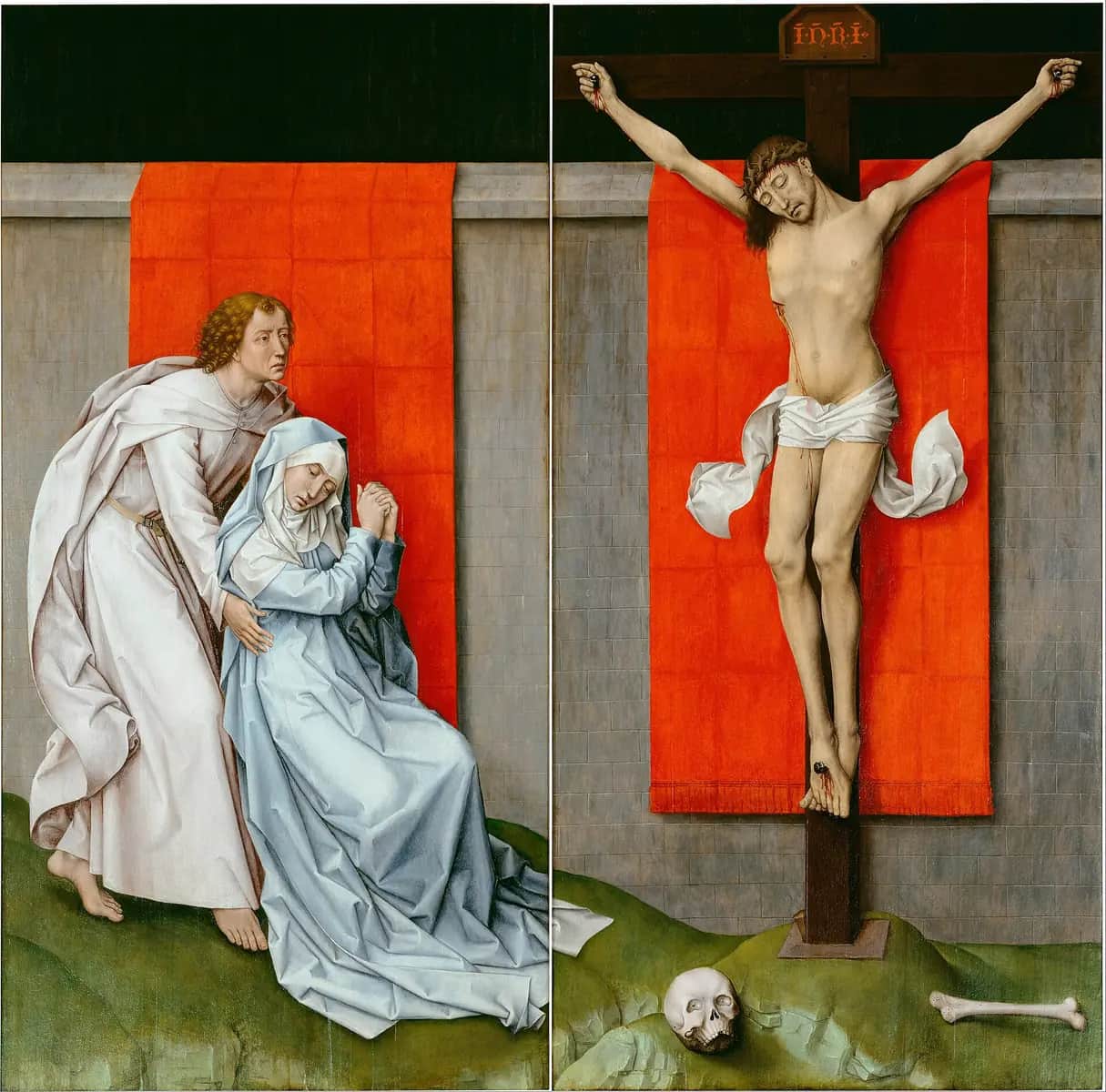
John 19:28 (WEB)
After this, Jesus, seeing that all things were now finished, that the Scripture might be fulfilled, said, “I am thirsty!”
As quoted in the map (KJV)
John 19:28 (KJV)
After this, Jesus knowing that all things were now accomplished, that the scripture might be fulfilled, saith, I thirst.
Key words
- πάντα τετέλεσταιpanta tetelestai · Greek
- 'all things were now accomplished' — the same verb as the final word 'It is finished' (tetelestai, v. 30).
- διψῶdipsō · Greek
- 'I thirst' — fulfilling Scripture (Psalm 69:21).
Why it matters
Only after giving his mother to the disciple does Jesus know that everything is accomplished and say 'It is finished.' Pitre stresses the order: the gift of Mary as mother is part of the finished work of the cross, not an afterthought. Making her Mother of the Church is one of the last things Jesus does before he dies.
Catechism · 4
Prayer in the Christian Life
“Prayer is the response of faith to the free promise of salvation and also a response of love to the thirst of the only Son of God.” — Catechism footnote: Cf. Jn 7:37-39; 19:28; Isa 12:3; 51:1; Zech 12:10; 13:1.
In the Fullness of Time
“…for they know not what they do", "Truly, I say to you, today you will be with me in Paradise", "Woman, behold your son" - "Behold your mother", "I thirst.";” — Catechism footnote: Jn 19:28.
The Mysteries of Christ's Life
“Jesus shares the life of the poor, from the cradle to the cross; he experiences hunger, thirst and privation.” — Catechism footnote: Cf. Mt 21:18; Mk 2:23-26; Jn 4:6 1; 19:28; Lk 9:58.
Jesus Died Crucified
“From the cross, just before "It is finished", he said, "I thirst."” — Catechism footnote: Jn 19:30; 19:28.
Fathers and councils · 22
Tertullian
“…actually and thoroughly suffering, suffered not for any evil action of His own, but “that the Scriptures from the mouth of the prophets might be fulfilled.”” — editor's note: See Matt. xxvi. 56; xxvii. 34, 35; John xix. 23, 24, 28, 32–37.
Read the whole comment
John Damascene
“And once again, the Gospel tells us that, He, having come into the place, said ‘I thirst’: and they gave Him some vinegar mixed with gall, and when He had tasted it He would not drink.” — editor's note: St. Matt. xxvii. 33 and 34; St. John xix. 28 and 29.
Read the whole comment
Catena Aurea on Mark
- BedeCatena Aurea on Mark
“John shews more fully the reason why the vinegar was given to the Lord to drink, saying, that Jesus said, “I thirst,” [John 19:28] that the Scriptures might be fulfilled.” — the author cites it
Read the whole comment
Augustine of Hippo
“Wished Christ to drink, when He said to the woman of Samaria, “Give Me to drink”? when He said on the Cross, “I thirst”?” — editor's note: John xix. 28. [On assimilation, compare p. 86, n. 2.—C.]
Read the whole comment“And when He was on the Cross, “I thirst,” He said, although they gave not to Him that for which He was thirsting.” — editor's note: John xix. 28.
Read the whole comment“And from the Cross when He was saying, “I thirst,” He was seeking the faith of them for whom He had said, “Father, forgive them, for they know not what they do.”” — editor's note: John xix. 28.
Read the whole comment“But how shall I understand the word “beggar,” save perhaps because He said to the Samaritan woman, “Give me to drink,” and on the Cross He said, “I thirst.”” — editor's note: John xix. 28.
Read the whole comment“Now there was set a vessel full of vinegar: and they filled a sponge with vinegar, and put it upon hyssop, and put it to His mouth.”” — editor's note: John xix. 28, 29.
Read the whole comment“The Lord, however, was found to be already dead, and the men marvelled; and they who despised Him when living, so wondered at Him when dead, that some of them said, “Truly this was the Son of God.”” — editor's note: John xix. 28–33.
Read the whole comment““And He bowed His head, and gave up the spirit.”” — editor's note: Chap. xix. 28–30.
Read the whole comment
John Chrysostom
“Ver.” — the author cites it
Read the whole comment
Catena Aurea on John
- Augustine of HippoCatena Aurea on John
He who appeared man, suffered all these things; He who was God, ordered them: After this Jesus knowing that all things were now accomplished; i. e. knowing the prophecy in the Psalms, And when I was thirsty, they…
Read the whole comment - John ChrysostomCatena Aurea on John
They were not softened at all by what they saw, but were the more enraged, and gave Him the cup to drink, as they did to criminals, i. e. with a hyssop.
Read the whole comment - Augustine of HippoCatena Aurea on John
The hyssop around which they put the spunge full of vinegar, being a mean herb, taken to purge the breast, represents the humility of Christ, which they hemmed in and thought they had circumvented. (ὑσσώπῳ…
Read the whole comment - Theophylact of OhridCatena Aurea on John
Some say that the hyssop is put here for reed, its leaves being like a reed. When Jesus therefore had received the vinegar, He said, It is finished.
Read the whole comment - Augustine of HippoCatena Aurea on John
viz. what prophecy had foretold so long before.
Read the whole comment - BedeCatena Aurea on John
It may be asked here, why it is said, When Jesus had received the vinegar, when another Evangelists says, He would not drink. (Mat. 27:34) But this is easily settled. He did not receive the vinegar, to drink it, but…
Read the whole comment - Augustine of HippoCatena Aurea on John
Then as there was nothing left Him to do before He died, it follows, And He bowed His head, and gave up the ghost, only dying when He had nothing more to do, like Him who had to lay down His life, and to take it up…
Read the whole comment - Gregory the GreatCatena Aurea on John
Ghost is put here for soul: for had the Evangelist meant any thing else by it, though the ghost departed, the soul might still have remained.
Read the whole comment - John ChrysostomCatena Aurea on John
He did not bow His head because He gave up the ghost, but He gave up the ghost because at that moment He bowed His head. Whereby the Evangelist intimates that He was Lord of all.
Read the whole comment - Augustine of HippoCatena Aurea on John
For who ever had such power to sleep when he wished, as our Lord had to die when He wished? What power must He have, for our good or evil, Who had such power dying?
Read the whole comment - Theophylact of OhridCatena Aurea on John
Our Lord gave up His ghost to God the Father, shewing that the souls of the saints do not remain in the tomb, but go into the hand of the Father of all; while sinners are reserved for the place of punishment, i. e. hell.
Read the whole comment
Cross-references · 30
Cited together in Catechism §2605.
Cited together in An Exact Exposition of the Orthodox Faith III.14.
Cited together in An Exact Exposition of the Orthodox Faith III.14.
Cited together in Catechism §2561.
Cited together in Catechism §2561.
Cited together in Catechism §2561.
Cited together in An Exact Exposition of the Orthodox Faith III.14.
Cited together in Catechism §2561.
Cited together in Catechism §2561.
Cited together in Catechism §607.
Cited together in Catechism §607.
Cited together in Catechism §607.
Cited together in An Exact Exposition of the Orthodox Faith III.14.
Cited together in Bede on John 19:28–30 (Catena Aurea) and 1 other place.
Cited together in An Exact Exposition of the Orthodox Faith III.14.
Cited together in Bede on Mark 15:33–37 (3) (Catena Aurea) and 1 other place.
Cited together in Catechism §2605 and 2 other places.
Cited together in Bede on Mark 15:33–37 (3) (Catena Aurea) and 1 other place.
Cited together in Bede on Mark 15:33–37 (3) (Catena Aurea) and 1 other place.
Cited together in Catechism §2605 and 1 other place.
Cited together in Catechism §607.
Cited together in Catechism §607.
Cited together in Harmony of the Gospels III.18.
Cited together in Harmony of the Gospels III.18.
Cited together in Catechism §2561.
Cited together in Catechism §2561.
Cited together in Catechism §2561.
Cited together in Catechism §2561.
Cited together in Catechism §607.
Cited together in Catechism §607.