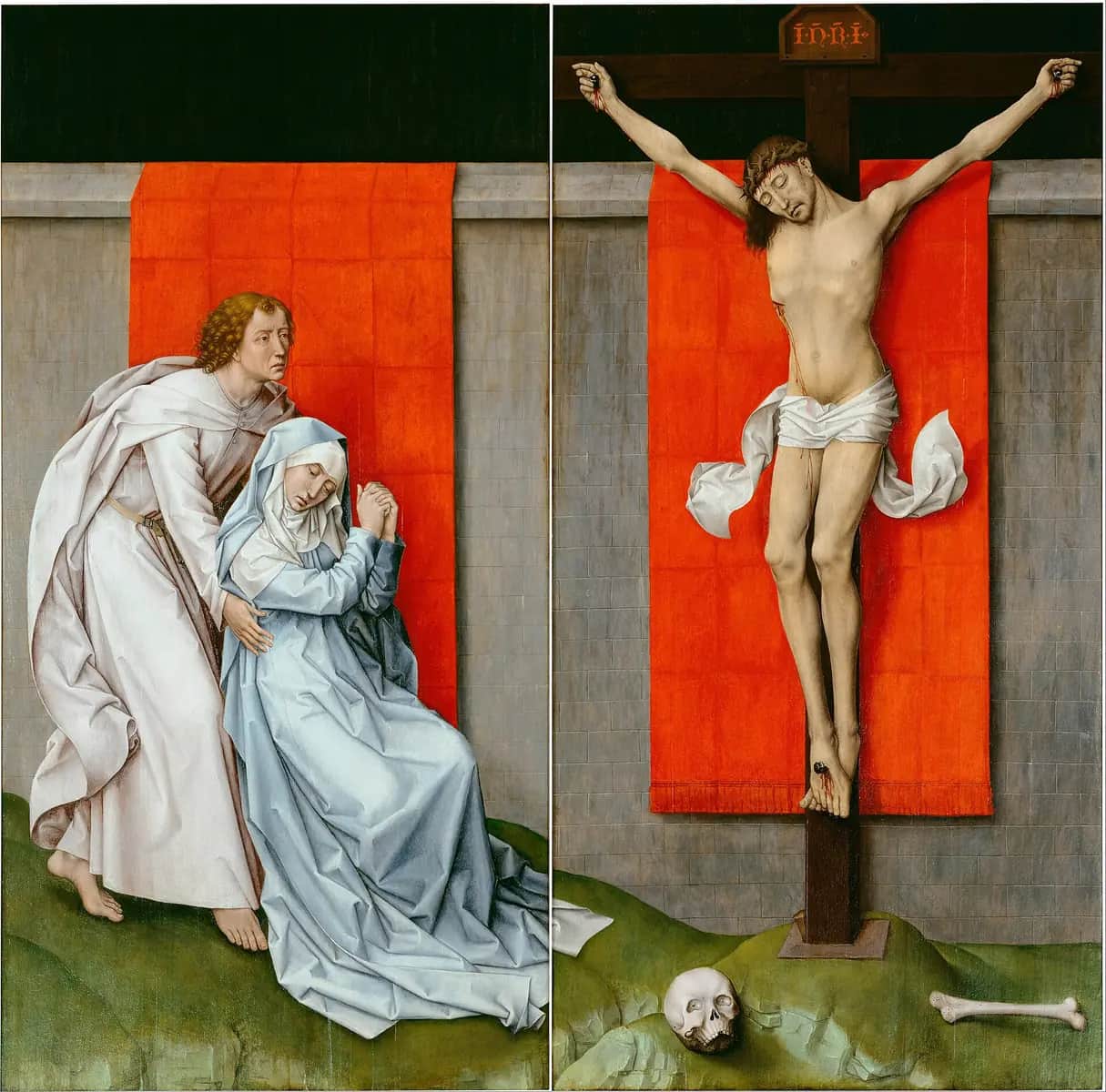
John 19:38 (WEB)
After these things, Joseph of Arimathaea, being a disciple of Jesus, but secretly for fear of the Jews, asked of Pilate that he might take away Jesus’ body. Pilate gave him permission. He came therefore and took away his body.
Catechism · 1
“Many of Jesus' deeds and words constituted a "sign of contradiction", but more so for the religious authorities in Jerusalem, whom the Gospel according to John often calls simply "the Jews",” — Catechism footnote: Cf. Jn 1:19; 2:18; 5:10; 7:13; 9:22; 18:12; 19:38; 20:19.
Fathers and councils · 28
Theodoret of Cyrus
“There laid they Jesus therefore because of the Jews’ preparation day, for the sepulchre was nigh at hand.”” — editor's note: John xix. 38–42
Read the whole comment
Augustine of Hippo
“…perceived Him: hence the blessed Apostles: hence Nathanael, in whom guile was not: hence the other Joseph, who himself too looked for the kingdom of God: hence that so great multitude who went before and followed after His beast, saying, “Blessed is He that cometh in the name of the Lord:” among whom was also…” — editor's note: John xix. 38; Luke xxiii. 51.
Read the whole comment“He came therefore, and took the body of Jesus.”” — editor's note: John xix. 38.
Read the whole comment“…praise commemorated in the Gospel, who having received His Body from the cross did carefully and with reverend honor see it wound and laid in the sepulchre.” — editor's note: John xix. 38, 39
Read the whole comment“And the Gospel speaks with commendation of those who were careful to take down His body from the cross, and wrap it lovingly in costly cerements, and see to its burial.” — editor's note: John xix. 38.
Read the whole comment“Was Joseph of Arimathea, who begged His body from Pilate, and of whom this same evangelist John testifies that he was already His disciple?” — editor's note: Chap. xix. 38.
Read the whole comment
Athanasius of Alexandria
“Am I to blame you for your refusal? or for having regard to the trials, and hiding for fear of the Jews?” — editor's note: Cf. Joh. iii. 2; xix. 38.
Read the whole comment
John Chrysostom
“Ver.” — the author cites it
Read the whole comment
Jerome
“Long before this sepulchre was hewn out by Joseph, its glory was foretold in Isaiah’s prediction, “his rest shall be glorious,” meaning that the place of the Lord’s burial should be held in universal honor.” — editor's note: I.e. Joseph of Arimathæa.—Joh. xix. 38 sqq.
Read the whole comment“Not far from this are Arimathæa, the village of Joseph who buried the Lord, and Nob, once a city of priests but now the tomb in which their slain bodies rest.” — editor's note: John xix. 38.
Read the whole comment
Catena Aurea on John
- John ChrysostomCatena Aurea on John
Joseph thinking that the hatred of the Jews would be appeased by His crucifixion, went with confidence to ask permission to take charge of His burial: And after this, Joseph of Arimathea besought Pilate.
Read the whole comment - BedeCatena Aurea on John
Arimathea is the same as Ramatha, the city of Elkanah, and Samuel. It was providentially ordered that he should be rich, in order that he might have access to the governor, and just, in order that he might merit the…
Read the whole comment - John ChrysostomCatena Aurea on John
He was not of the twelve, but of the seventy, for none of the twelve came near. Not that their fear kept them back, for Joseph was a disciple, secretly for fear of the Jews. But Joseph was a person of rank, and known…
Read the whole comment - Augustine of HippoCatena Aurea on John
In performing this last office to our Lord, he shewed a bold indifference to the Jews, though he had avoided our Lord’s company when alive, for fear of incurring their hatred.
Read the whole comment - BedeCatena Aurea on John
Their ferocity being appeased for the time by their success, he sought the body of Christ. He did not come as a disciple, but simply to perform a work of mercy, which is due to the evil as well as to the good.…
Read the whole comment - Augustine of HippoCatena Aurea on John
We must not read the words, at the first, first bringing a mixture of myrrh, but attach the first to the former clause. For Nicodemus at the first came to Jesus by night, as John relates in the former part of the…
Read the whole comment - John ChrysostomCatena Aurea on John
They bring the spices most efficacious for preserving the body from corruption, treating Him as a mere man. Yet this shews great love.
Read the whole comment - BedeCatena Aurea on John
We must observe however that it was simple ointment; for they were not allowed to mix many ingredients together. Then took they the body of Jesus, and wound it in linen clothes with the spices, as the manner of the…
Read the whole comment - Augustine of HippoCatena Aurea on John
Wherein the Evangelist intimates, that in paying the last offices of the dead, the custom of the nation is to be followed. It was the custom of the Jewish nation to embalm their dead bodies, in order that they might…
Read the whole comment - Augustine of HippoCatena Aurea on John
Nor does John here contradict the other Evangelists, who, though they are silent about Nicodemus, yet do not affirm that our Lord was buried by Joseph alone. Nor because they say that our Lord was wrapped in a linen…
Read the whole comment - BedeCatena Aurea on John
Hence hath come down the custom of the Church, of consecrating the Lord’s body not on silk or gold cloth, but in a clean linen cloth.
Read the whole comment - John ChrysostomCatena Aurea on John
But as they were pressed for time, for Christ died at the ninth hour, and after that they had gone to Pilate, and taken away the body, so that the evening was now near, they lay Him in the nearest tomb: Now in the…
Read the whole comment - Augustine of HippoCatena Aurea on John
As no one before or after Him was conceived in the womb of the Virgin Mary, so in this grave was there none buried before or after Him.
Read the whole comment - Theophylact of OhridCatena Aurea on John
In that it was a new sepulchre, we are given to understand, that we are all renewed by Christ’s death, and death and corruption destroyed. Mark too the exceeding poverty that He took up for our sakes. He had no house…
Read the whole comment - Augustine of HippoCatena Aurea on John
Implying that the burial was hastened, in order to finish it before the evening, when, on account of the preparation, which the Jews with us call more commonly in the Latin, Cæna pura, it was unlawful to do any such…
Read the whole comment - John ChrysostomCatena Aurea on John
The sepulchre was near, that the disciples might approach it more easily, and be better witnesses of what took place there, and that even enemies might be made the witnesses of the burial, being placed there as…
Read the whole comment - BedeCatena Aurea on John
Mystically, the name Joseph means, apt for the receiving of a good work; whereby we are admonished that we should make ourselves worthy of our Lord’s body, before we receive it.
Read the whole comment - Theophylact of OhridCatena Aurea on John
Even now in a certain sense Christ is put to death by the avaritious, in the person of the poor man suffering famine. Be therefore a Joseph, and cover Christ’s nakedness, and, not once, but continually by…
Read the whole comment
Cross-references · 23
Cited together in The City of God I.13.
Cited together in The City of God I.13.
Cited together in The City of God I.13.
Cited together in The City of God I.13.
Cited together in Bede on John 19:38–42 (3) (Catena Aurea).
Cited together in On Care to Be Had for the Dead Chapter 5.
Cited together in The City of God I.13 and 1 other place.
Cited together in On Care to Be Had for the Dead Chapter 5.
Cited together in On Care to Be Had for the Dead Chapter 5.
Cited together in On Care to Be Had for the Dead Chapter 5.
Cited together in The City of God I.13 and 1 other place.
Cited together in The City of God I.13 and 1 other place.
Cited together in The City of God I.13 and 1 other place.
Cited together in The City of God I.13 and 1 other place.
Cited together in Harmony of the Gospels III.23.
Cited together in Harmony of the Gospels III.23.
Cited together in Harmony of the Gospels III.23.
Cited together in Harmony of the Gospels III.23.
Cited together in Harmony of the Gospels III.23.
Cited together in Harmony of the Gospels III.23.
Cited together in Harmony of the Gospels III.23.
Cited together in Harmony of the Gospels III.23.
Cited together in Harmony of the Gospels III.23.