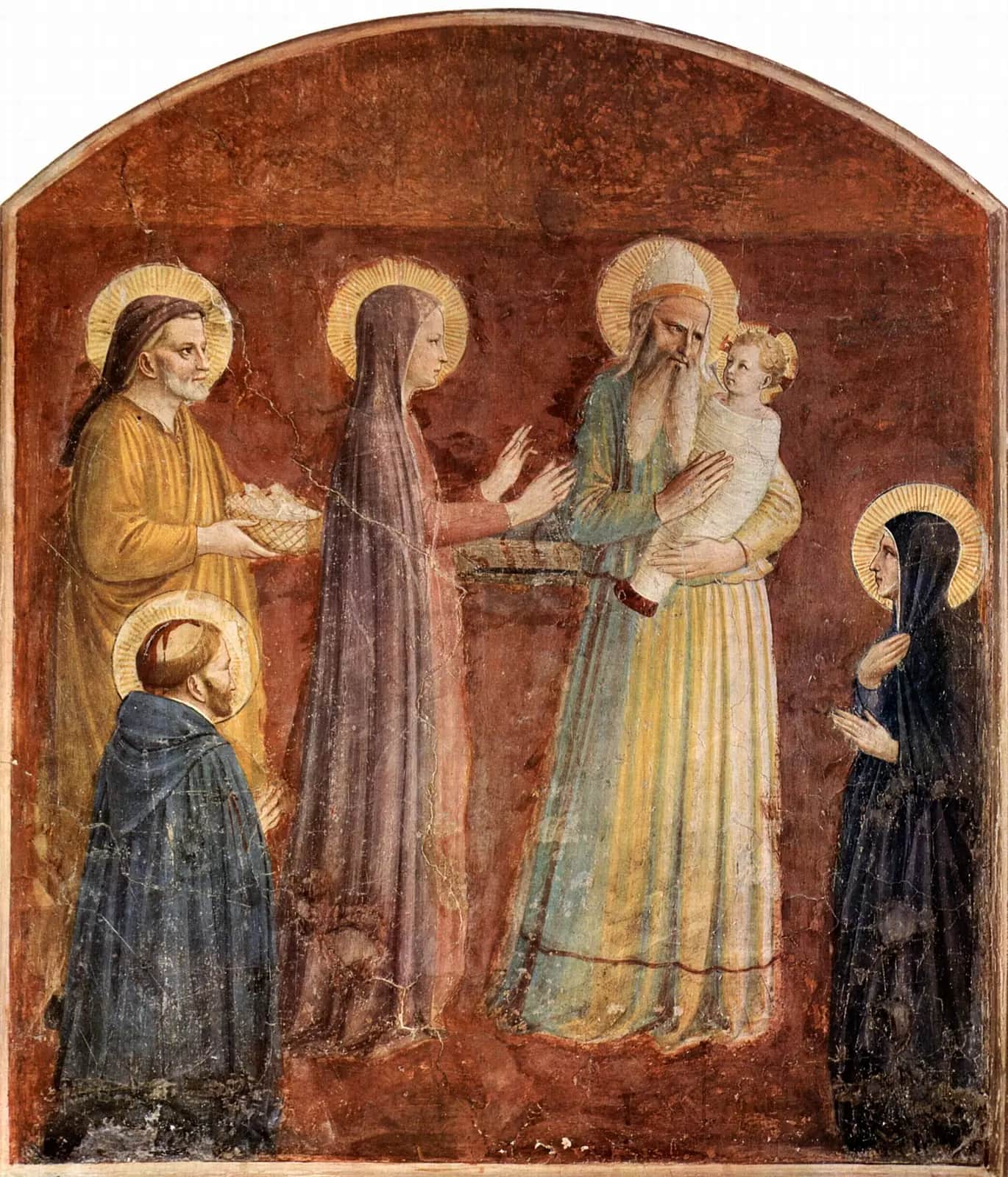
Luke 2:35 (WEB)
Yes, a sword will pierce through your own soul, that the thoughts of many hearts may be revealed.”
As quoted in the map (KJV)
Luke 2:35 (KJV)
(Yea, a sword shall pierce through thy own soul also,) that the thoughts of many hearts may be revealed.
Key words
- ῥομφαίαrhomphaia · Greek
- 'sword' — the great sword, used in the Septuagint for the flaming sword of Eden (Genesis 3:24) and the sword of divine judgment (Ezekiel 21).
- ψυχήpsychē · Greek
- 'soul' — the same word the Septuagint uses when Rachel's soul departs as she bears Benjamin (Genesis 35:18).
- διελεύσεταιdieleusetai · Greek
- 'shall pierce through' — will pass right through.
Why it matters
A sword will pass through Mary's own soul. Pitre connects this with Rachel, whose soul departed as she bore her second son, Benjamin, 'son of my sorrow.' At the cross Mary undergoes a death of the soul and in that sorrow receives a second son, the beloved disciple — the new Benjamin born of the New Rachel.
Catechism · 4
I Believe
“Throughout her life and until her last ordeal” — Catechism footnote: Cf. Lk 2:35
The Mysteries of Christ's Life
“The presentation of Jesus in the temple shows him to be the firstborn Son who belongs to the Lord.” — Catechism footnote: Cf. Lk 2:22-39; EX 13:2, 12-13.
Jesus and Israel
“It was in the Temple that Joseph and Mary presented him forty days after his birth.” — Catechism footnote: Lk 2:22-39.
Jesus Died Crucified
“This is achieved supremely in the case of his mother, who was associated more intimately than any other person in the mystery of his redemptive suffering.” — Catechism footnote: Cf. Lk 2:35.
Fathers and councils · 39
John Damascene
“…killed as a malefactor, her thoughts pierced her as a sword, and this is the meaning of this verse: Yea, a sword shall pierce through thy own soul also.” — editor's note: St. Luke ii. 35.
Read the whole comment
Cyril of Jerusalem
“By this Holy Ghost also it was revealed to just Symeon, that he should not see death, till he had seen the Lord’s Christ; and he received Him in his arms, and bore clear testimony in the Temple concerning Him.” — editor's note: Luke ii. 26–35.
Read the whole comment
Augustine of Hippo
“There is a somewhat similar expression in the Gospel, where Simeon saith unto Mary, “A sword shall pierce through thy own soul also.”” — editor's note: Luke ii. 35.
Read the whole comment“And when they had performed all things according to the law of the Lord, behold, the angel of the Lord appeared to Joseph in a dream, saying, Arise, and take the young child and His mother, and flee into Egypt, and be thou there until I bring thee word; for Herod will seek the young child to destroy Him.” — editor's note: Luke ii. 22–39.
Read the whole comment“…they had gone with Him to Jerusalem after the purification of His mother, and when those things had been performed in the temple which are recounted by Luke, inasmuch as the words which were spoken by Simeon and Anna in their prophesyings regarding Him, when publicity began to be given to them by the persons who had…” — editor's note: Luke ii. 22–39.
Read the whole comment“And Simeon and Anna were filled with the Holy Spirit, so as to acknowledge the greatness of the little child Christ.” — editor's note: Luke ii. 25–38
Read the whole comment“…in the Gospel concerning the Lord Himself newly born, that Simeon by the Holy Spirit recognized Him; that Anna the widow, a prophetess, also recognized Him; that John, who baptized Him, recognized Him; that Zacharias, being filled with the Holy Ghost, said many things; that Mary herself received the Holy Ghost to…” — editor's note: Luke ii. 25–38.
Read the whole comment“…Spirit that the prophets predicted the events of the future; nor was it so that the aged Simeon and the widowed Anna knew by the Holy Spirit the infant Lord; and that Zacharias and Elisabeth uttered by the Holy Spirit so many predictions concerning Him, when He was not yet born, but only conceived.” — editor's note: Luke ii. 25–38.
Read the whole comment“I say nothing of the aged Simeon, who believed on Him when an infant; of Anna the prophetess; of Zachariah and Elisabeth, who prophesied of Him before He was born of the Virgin; of their son John, His forerunner, the friend of the Bridegroom, who both…” — editor's note: Luke ii. 25–38.
Read the whole comment
Basil the Great
““And Simeon blessed them, and said unto Mary His mother, Behold, this Child is set for the fall and rising again of many in Israel; and for a sign which shall be spoken against; (yea, a sword shall pierce through thine own soul also,) that the thoughts of many hearts may be revealed.”” — editor's note: Luke ii. 34, 35.
Read the whole comment
Tertullian
“Spare also the babe from circumcision, that he may escape the pain thereof; nor let him be brought into the temple, lest he burden his parents with the expense of the offering; nor let him be handed to Simeon, lest the old man be saddened at the point of death.” — editor's note: Luke ii. 25–35.
Read the whole comment
Catena Aurea on Luke
- A Greek expositorCatena Aurea on Luke
The knowledge of supernatural things, as often as it is brought to the recollection, renews the miracle in the mind, and hence it is said, His father and mother marvelled at those things which were said of him.
Read the whole comment - BedeCatena Aurea on Luke
Joseph is called the father of the Saviour, not because he was (as the Photinians say) His real father, but because from regard to the reputation of Mary, all men considered him so.
Read the whole comment - Augustine of HippoCatena Aurea on Luke
He however might be called His father in that light in which he is rightly regarded as the husband of Mary, that is, not from any carnal connection, but by reason of the very bond of wedlock, a far closer…
Read the whole comment - A Greek expositorCatena Aurea on Luke
Having given praise to God, Simeon now turns to bless them that brought the Child, as it follows, And Simeon blessed them. He gave to each a blessing, but his presage of hidden things he imparts only to the mother,…
Read the whole comment - John ChrysostomCatena Aurea on Luke
As the light though it may annoy weak eyes, is still light; in like manner the Saviour endures, though many fall away, for His office is not to destroy; but their way is madness. Wherefore not only by the salvation…
Read the whole comment - Gregory of NyssaCatena Aurea on Luke
Mark the nice distinction here observed. Salvation is said to be prepared before the face of all people, but the falling and raising is of many; for the Divine purpose was the salvation and sanctification of every…
Read the whole comment - Gregory of NyssaCatena Aurea on Luke
But by this he signifies a fall to the very lowest, as if the punishment before the mystery of the incarnation, fell far short of that after the giving and preaching of the Gospel dispensation. And those spoken of…
Read the whole comment - Ambrose of MilanCatena Aurea on Luke
That is, to distinguish the merits of the just and the unjust, and according to the quality of our deeds, as a true and just Judge, to decree punishment or rewards.
Read the whole comment - John ChrysostomCatena Aurea on Luke
The resurrection is a new life and conversation. For when the sensual man becomes chaste, the covetous merciful, the cruel man gentle, a resurrection takes place. Sin being dead, righteousness rises again. It…
Read the whole comment - Basil the GreatCatena Aurea on Luke
The sign which is spoken against is called in Scripture, the cross. For Moses, it says, made a brazen serpent, and placed it for a sign. (Numb. 21:8.)
Read the whole comment - Basil the GreatCatena Aurea on Luke
For a sign betokens something marvellous and mysterious, which is seen indeed by the simple minded.
Read the whole comment - Gregory of NyssaCatena Aurea on Luke
Though these things are said of the Son, yet they have reference also to His mother, who takes each thing to herself, whether it be of danger or glory. He announces to her not only her prosperity, but her sorrows;…
Read the whole comment - Ambrose of MilanCatena Aurea on Luke
Or it shews the wisdom of Mary, that she was not ignorant of the heavenly Majesty. For the word of God is living and strong, and sharper than the sharpest sword. (Heb. 4:12.)
Read the whole comment - Gregory of NyssaCatena Aurea on Luke
But it is not meant that she alone was concerned in that passion, for it is added, that the thoughts of many hearts may be revealed. The word that marks the event; it is not used causatively; for when all these…
Read the whole comment - OrigenCatena Aurea on Luke
Both by the angel and the multitude of the heavenly host, by the shepherds also, and Simeon.
Read the whole comment - OrigenCatena Aurea on Luke
But they who look deeper into the matter may say, that since the genealogy is deduced from David to Joseph, therefore lest Joseph should seem to be mentioned for no purpose, as not being the father of the Saviour, he…
Read the whole comment - Ambrose of MilanCatena Aurea on Luke
Behold what abundant grace is extended to all men by the birth of the Lord, and how prophecy is withheld from the unbelievers, not from the righteous. Simeon also prophesies that Christ Jesus has come for the fall…
Read the whole comment - OrigenCatena Aurea on Luke
They who explain this simply, may say that He came for the fall of unbelievers, and the rising again of believers.
Read the whole comment - OrigenCatena Aurea on Luke
The careful interpreter will say, that no one falls who was not before standing. Tell me then, who were they who stood, for whose fall Christ came?
Read the whole comment - Gregory of NyssaCatena Aurea on Luke
Now from these words, you may perceive through the agreement of men’s minds on the word of prophecy, that one and the same God and lawgiver hath spoken both in the Prophets and the New Testament. For the language of…
Read the whole comment - OrigenCatena Aurea on Luke
There is also a deeper meaning aimed against those who raise their voices against their Creator, saying, Behold the God of the Law and the Prophets of what sort He is! He says, I kill, and I make alive. (Deut.…
Read the whole comment - OrigenCatena Aurea on Luke
But we must take care lest by chance the Saviour should not come to some equally for the fall and rising again; for when I stood in sin, it was first good for me to fall, and die to sin. Lastly, Prophets and Saints…
Read the whole comment - Gregory of NyssaCatena Aurea on Luke
He has joined together honour and dishonour. For to us Christians this sign is a token of honour, but it is a sign of contradiction, inasmuch by some indeed it is received as absurd and monstrous, by others with the…
Read the whole comment - OrigenCatena Aurea on Luke
But all the things which history relates of Christ are spoken against, not that those who believe on Him speak against Him, (for we know that all the things which are written of Him are true,) but that every thing…
Read the whole comment - BedeCatena Aurea on Luke
No history tells us that Mary departed this life by being slain with the sword, therefore since not the soul but the body is killed with iron, we are left to understand that sword which is mentioned, And a sword in…
Read the whole comment - Augustine of HippoCatena Aurea on Luke
Or by this is signified that Mary also, through whom was performed the mystery of the incarnation, looked with doubt and astonishment at the death of her Lord, seeing the Son of God so humbled as to come down even to…
Read the whole comment - BedeCatena Aurea on Luke
But now even down to the close of the present time, the sword of the severest tribulation ceases not to go through the soul of the Church, when with bitter sorrow she experiences the evil speaking against the sign of…
Read the whole comment - OrigenCatena Aurea on Luke
But the evil thoughts of men were revealed, that He Who died for us might slay them; for while they were hidden, it was impossible to utterly destroy them. Hence also when we have sinned we ought to say, Mine…
Read the whole comment
Cross-references · 12
Cited together in Catechism §618.
Cited together in Catechism §618.
Cited together in Gregory of Nyssa on Luke 2:33–35 (3) (Catena Aurea).
Cited together in Catechism §618.
Cited together in Catechism §618.
Cited together in Origen on Luke 2:33–35 (6) (Catena Aurea).
Cited together in Catechism §618.
Cited together in Origen on Luke 2:33–35 (5) (Catena Aurea).
Cited together in Bede on Luke 2:33–35 (2) (Catena Aurea).
Cited together in Gregory of Nyssa on Luke 2:33–35 (3) (Catena Aurea).
Cited together in Catechism §618.
Cited together in Catechism §618.