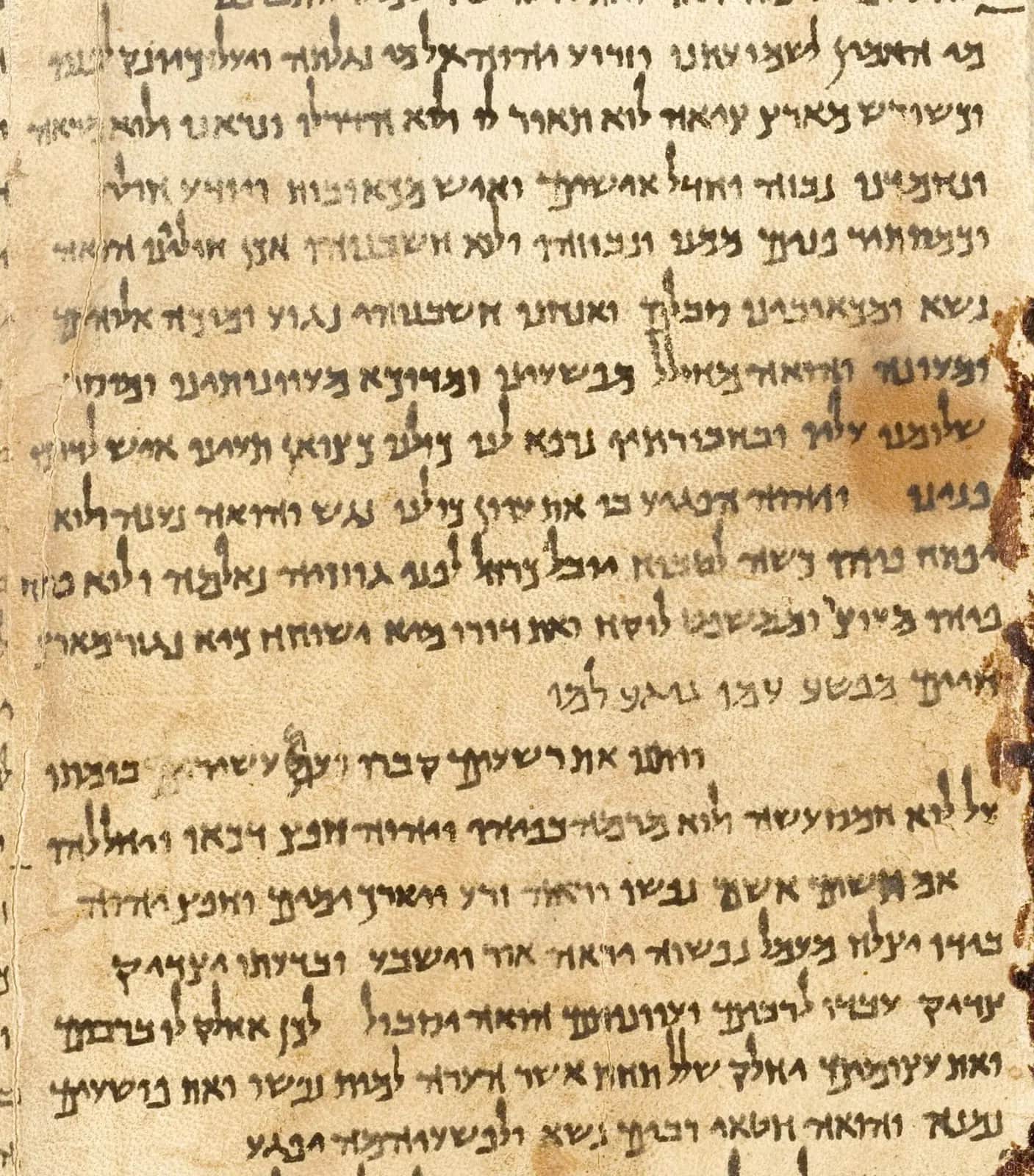
Isaiah 53:3 (WEB)
He was despised and rejected by men, a man of suffering and acquainted with disease. He was despised as one from whom men hide their face; and we didn’t respect him.
As quoted in the map (KJV)
Isaiah 53:3–6 (KJV)
3 He is despised and rejected of men; a man of sorrows, and acquainted with grief: and we hid as it were our faces from him; he was despised, and we esteemed him not. 4 Surely he hath borne our griefs, and carried our sorrows: yet we did esteem him stricken, smitten of God, and afflicted. 5 But he was wounded for our transgressions, he was bruised for our iniquities: the chastisement of our peace was upon him; and with his stripes we are healed. 6 All we like sheep have gone astray; we have turned every one to his own way; and the LORD hath laid on him the iniquity of us all.
Key words
- אִישׁ מַכְאֹבוֹתish makh'ovot · Hebrew
- 'a man of sorrows' (v. 3) — the Suffering Servant; Pitre cites the phrase as 53:4 (p 134).
- חֳלָיֵנוּ הוּא נָשָׂאcholayenu hu nasa · Hebrew
- 'he hath borne our griefs' (v. 4) — the Servant takes the pains of others on himself.
Why it matters
The Servant is a man of sorrows who carries the griefs of others. Pitre opens the chapter on Mary's birth pangs with the paradox that Jesus came not to take suffering away but to take it upon himself, alluding to this prophecy through Mark 10:45 (p 118). As Jesus is the 'man of sorrows,' Mary, the mother who shares his passion, is rightly called the Mother of Sorrows, Mater Dolorosa (pp 133–134).
Catechism · 1
The Messiah's characteristics are revealed above all in the "Servant songs." These songs proclaim the meaning of Jesus' Passion and show how he will pour out the Holy Spirit to give life to the many: not as an outsider, but by embracing our "form as slave."
Fathers and councils · 19
Origen
“And who shall describe His generation? because His life is taken away from the earth; because of the iniquities of My people was He led unto death.”” — editor's note: Cf. Isa. liii. 1–8 in the Septuagint version (Roman text).
Read the whole comment- Origen, Against Celsus VI.75Book VI
“He has no form nor glory, and we beheld Him, and He had no form nor beauty; but His form was without honour, and inferior to that of the sons of men.”” — editor's note: Cf. Isa. liii. 1–3 (LXX.). [See Bishop Pearson’s Exposition of the Creed, Art. II., note. S.]
Read the whole comment - Origen, Against Celsus VII.16Book VII
“For the prophecies do not foretell that God will be crucified, when they say of Him who should suffer, “We beheld Him, and He had no form or comeliness; but His form was dishonoured and marred more than the sons of men; He was a man of sorrows, and acquainted with grief.”” — editor's note: Isa. liii. 2, 3.
Read the whole comment
Irenaeus of Lyons
“…that all the prophets announced His two advents: the one, indeed, in which He became a man subject to stripes, and knowing what it is to bear infirmity, and sat upon the foal of an ass, and was a stone rejected by the builders, and was led as a sheep to the slaughter, and by the stretching forth of His hands…” — editor's note: Isa. liii. 3.
Read the whole comment
Tertullian
“For of Him the prophet says, “A man set in a plague, and knowing how to bear infirmity;” who “was led as a sheep for a victim; and, as a lamb before him who sheareth him, opened not His mouth.”” — editor's note: See Isa. liii. 3, 7, in LXX.; and comp. Ps. xxxviii. 17 (xxxvii. 18 in LXX.) in the “Great Bible” of 1539.
Read the whole comment“And we saw Him, and He had not attractiveness or grace; but His mien was unhonoured, deficient in comparison of the sons of men,” “a man set in the plague, and knowing how to bear infirmity:” to wit as having been set by the Father “for a stone of offence,” and “made a little lower” by Him “than angels,” He…” — editor's note: See Ps. xxxviii. 17 in the “Great Bible” (xxxvii. 18 in LXX.). Also Isa. liii. 3 in LXX.
Read the whole comment“For it is of Him that Isaiah writes: “A man of suffering, and acquainted with the bearing of weakness;” and Jeremiah: “He is a man, and who hath known Him?” and Daniel: “Upon the clouds (He came) as the Son of man.”” — editor's note: Isa. liii. 3, Sept.
Read the whole comment“…a tender plant, like a root out of a thirsty ground; He hath no form nor comeliness; and we beheld Him, and He was without beauty: His form was disfigured;” “marred more than the sons of men; a man stricken with sorrows, and knowing how to bear our infirmity;” “placed by the Father as a stone of stumbling and a…” — editor's note: Isa. liii. 2, 3, according to the Septuagint.
Read the whole comment“…Isaiah,—a man of sorrows, and acquainted with grief, who was led as a sheep to the slaughter, and who, like a lamb before the shearer, opened not His mouth; who did not struggle nor cry, nor was His voice heard in the street who broke not the bruised reed—that is, the shattered faith of the Jews—nor quenched the…” — editor's note: Isa. liii. 3, 7.
Read the whole comment
Theodoret of Cyrus
“His form was dishonoured and rejected among the sons of men,’ thus distinctly showing that the marks of indignity and the sufferings must be applied to the human but not to the divine.” — editor's note: Isaiah liii. 2, 3. Sept.
Read the whole comment““Surely he hath borne our griefs and carried our sorrows.”” — editor's note: Isaiah liii. 3 and 4
Read the whole comment
Augustine of Hippo
“Was it, O Lord Jesus Christ, that Thou wast silent, and like a sheep for a victim wast being led, and didst not open before the shearer Thy mouth, and we thought Thee to be set in smiting and in grief, and knowing how to bear weakness?” — editor's note: Isa. liii. 3.
Read the whole commentThe Fulfilment of the Prophecies Concerning Christ. 47. Wherefore let those evil applauders of Christ, who refuse to become Christians, desist from making the allegation that Christ did not teach that their gods were…
Read the whole comment
Basil the Great
“For “Thou hast made him a little lower than the angels,” and again “Who was made a little lower than the angels,” and “we saw Him and He had neither form nor comeliness, his form was deficient beyond all men.”” — editor's note: Isa. liii. 2, 3, LXX.
Read the whole comment
Athanasius of Alexandria
“They say then: “A man in stripes, and knowing how to bear weakness, for his face is turned away: he was dishonoured and held in no account.” — editor's note: Isa. liii. 3, sqq.
Read the whole comment
Clement of Alexandria
“And that the Lord Himself was uncomely in aspect, the Spirit testifies by Esaias: “And we saw Him, and He had no form nor comeliness but His form was mean, inferior to men.”” — editor's note: Isa. liii. 2, 3. [But see also Ps. xlv. 2, which was often cited by the ancients to prove the reverse. Both may be reconciled; he was a fair and comely child…
Read the whole comment“And “His appearance was inferior to all the Sons of men,” prophecy predicted.” — editor's note: Isa. liii. 3. [That is after he became the Man of Sorrows; not originally.]
Read the whole comment
Cyprian of Carthage
“And God has delivered Him for our sins; and He, because He was afflicted, opened not His mouth.”” — editor's note: Isa. liii. 1–7. [See p. 516, supra.]
Read the whole comment
Hippolytus of Rome
“…(lit. = deficient) above all men; a man smitten and familiar with bearing infirmity, (for His face was turned away); He was despised, and esteemed not.”” — editor's note: Isa. liii. 2–5.
Read the whole comment
Cross-references · 15
Cited together in On the Flesh of Christ Chapter 15.
Cited together in Against Celsus VII.16 and 1 other place.
Cited together in The Instructor III.1.
Cited together in On the Flesh of Christ Chapter 15.
Cited together in The Instructor III.1.
Cited together in The Five Books Against Marcion III.16 and 1 other place.
Cited together in The Five Books Against Marcion III.16 and 1 other place.
Cited together in Against Celsus VI.75.
Cited together in Against Celsus VI.75.
Cited together in The Five Books Against Marcion III.16.
Cited together in The Five Books Against Marcion III.16.
Cited together in The Five Books Against Marcion III.16.
Cited together in Against Celsus I.54.
Cited together in Against Celsus I.54 and 1 other place.
Cited together in Against Celsus I.54.