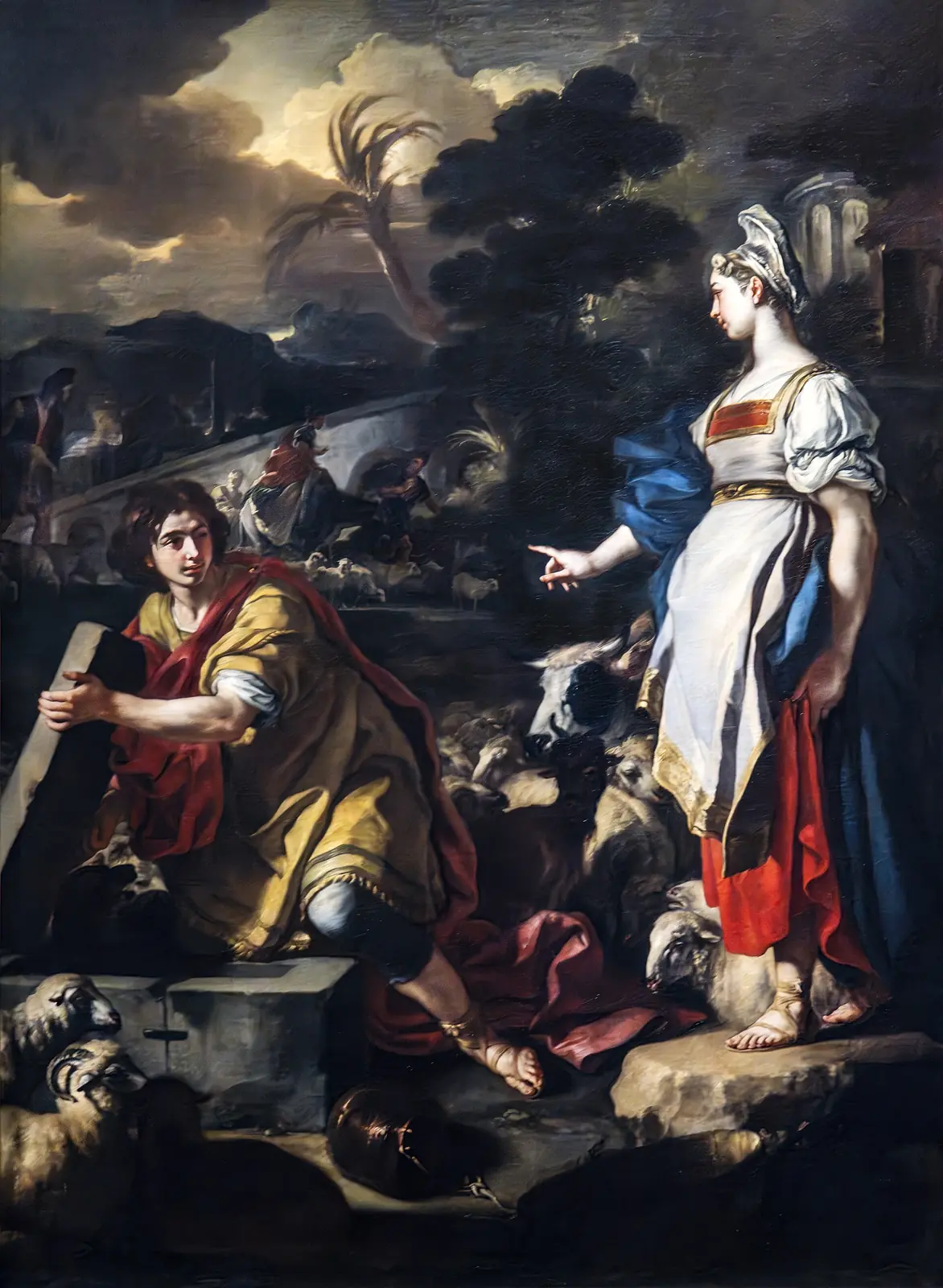
The idea
Rachel — the name means 'ewe' — was 'beautiful and lovely' and truly loved: Jacob's seven years' service 'seemed to him but a few days.' Laban tricked him into marrying Leah first; Rachel found herself barren while Leah bore sons, and the two sisters, 'locked in a struggle for favor,' each gave Jacob her maidservant, which is how he came to have twelve sons by four women (six by Leah, two by Zilpah, two by Bilhah, two by Rachel — Pitre's chart on p 144). 'The entire story of Joseph in the Old Testament hinges on one fact: that he was the firstborn son of Rachel.' Jacob favoured him because he was the firstborn of the wife he loved; his ten older brothers hated him because in their eyes he was merely the eleventh son with no claim.
Key verses
- Genesis 29:17 — 'beautiful and well favoured'; Jacob loved her.
- Genesis 29:31 — Rachel barren, Leah fruitful.
- Genesis 30:1 — 'Give me children, or else I die.'
- Genesis 30:22 — God remembers Rachel: Joseph is born.
- Genesis 37:3 — the coat — Israel loved Joseph more than all his children.
The connection
| Old Testament root | New Testament fulfilment | |
|---|---|---|
| The beloved wife, long barren, mother of the beloved son | → | The beloved mother of the beloved Son |
Everything that follows — the coat, the envy, the sale into Egypt — flows from Rachel being the beloved wife and Joseph her firstborn. The New Rachel typology begins with a mother whose love and sorrow are inseparable.
Sources
- Modern scholars Pitre cites — Astrid Beck, 'Rachel,' Anchor Bible Dictionary (p 143)