Chapter 7 — The New Rachel
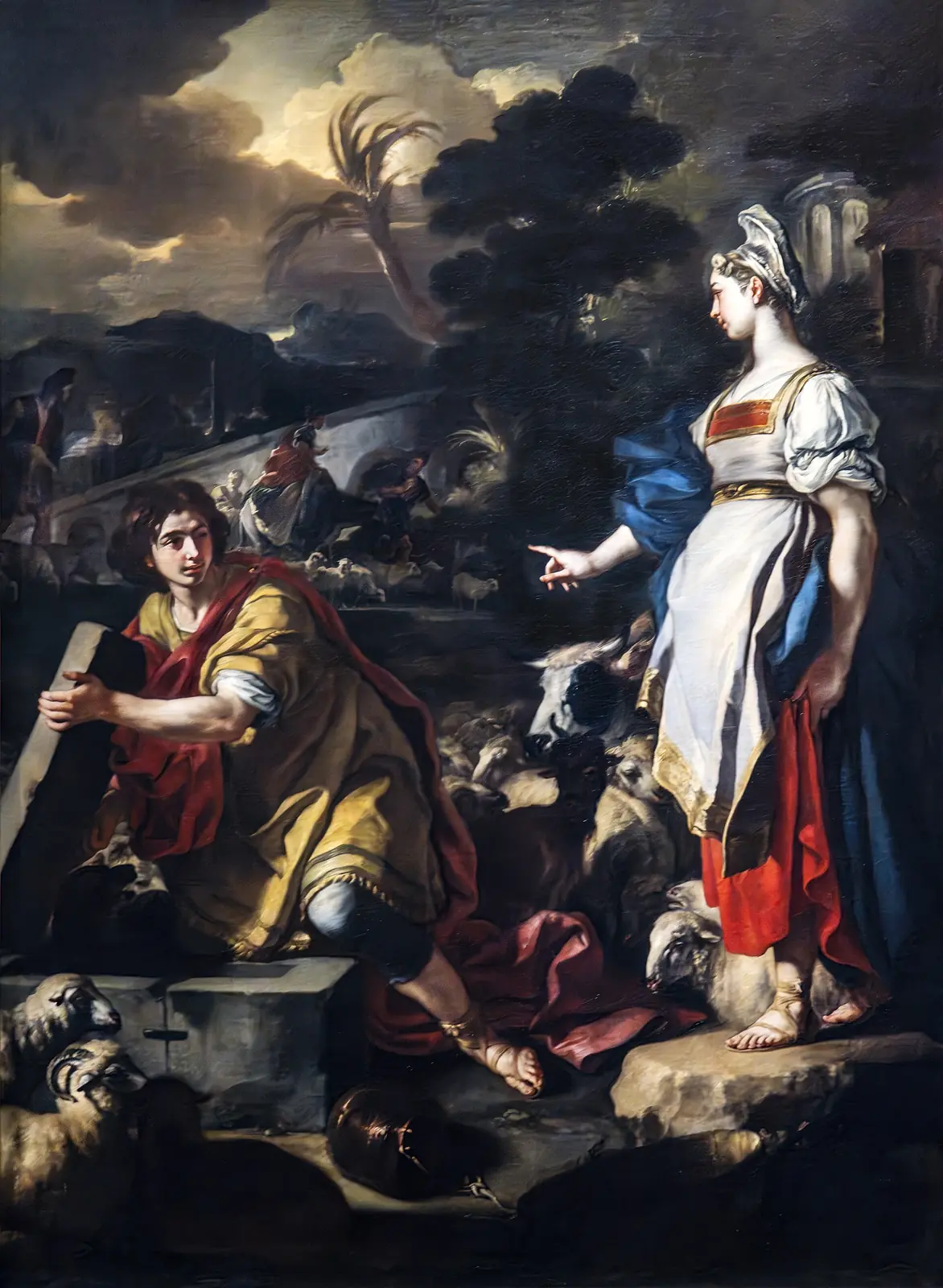
Francesco Solimena, Jacob and Rachel, c. 1710 · Gallerie dell'Accademia, Venice · Public domainFrancesco Solimena, Jacob and Rachel, c. 1710, Gallerie dell'Accademia, Venice
From Jewish Roots of Mary, based on Brant Pitre
7.0 Opening
pp 139–142
- Joseph as a type of Jesus — Aphrahat, Genesis 50:20, and the full eight-point chart
A student's question — 'isn't the life of Joseph kind of like the life of Jesus?' — sent Pitre to the Fathers, where Aphrahat had already written that 'Joseph who was persecuted was a type of the persecuted Jesus,' and to scholars who call Joseph one of the most striking biblical types of Christ. The key verse: 'you meant evil against me; but God meant it for good' — through his suffering Joseph saves Israel and the nations. The chart has eight points: the beloved son of his father; betrayed and sold for twenty pieces of silver by Judah, one of twelve brothers / for thirty by Judas, one of the Twelve; with two condemned men, one of whom is given life; thirty years old when he begins; exalted to the right hand; feeding Israel and the Gentiles with bread; honouring Benjamin, the youngest of the twelve, at a banquet / the beloved disciple at the Supper; and revealed to brothers who do not recognise him. 'If Jesus is the new Joseph, then his mother is the new Rachel.'
pp 139–141
- The Joseph–Jesus parallel underneath it.
Rachel's firstborn Joseph prefigures Jesus: beloved of his father, betrayed and sold by his brothers for silver, cast down, then exalted to save the very brothers who rejected him. If Jesus is the new Joseph, his mother is the new Rachel.
pp 139–141
- Joseph exalted — the second half of the Jesus parallel.
Rachel's son Joseph, sold for silver, is raised to Pharaoh's right hand at thirty and saves the world by giving it bread — then reveals himself to the brothers who don't recognize him. Jesus, sold for silver, is exalted to God's right hand, feeds the world the Bread of Life, and is unrecognized at first when raised.
pp 140–141
Verses introduced here: Genesis 37:3 · Genesis 37:25 · Genesis 40:20 · Genesis 41:40 · Genesis 41:46 · Genesis 41:55 · Genesis 42:8 · Genesis 43:33 · Genesis 50:20 · Matthew 3:17 · Matthew 26:15 · Luke 3:23 · Luke 23:39 · John 13:23 · Acts 2:32
- Joseph as a type of Jesus — Aphrahat, Genesis 50:20, and the full eight-point chart
7.1 Rachel in Ancient Judaism
pp 142–147
Rachel in the Old Testament: Mother of Joseph and Benjamin
- Rachel's barrenness and 'God remembered her.'
Rachel was the beloved but barren wife, in painful rivalry with Leah, until 'God remembered Rachel' and opened her womb to bear Joseph. The beloved wife whose long sorrow turns to fruitfulness prefigures Mary, whose sorrow at the cross becomes spiritual motherhood.
pp 142–143
- Rachel's story — beloved, barren, the rivalry, the twelve sons, and why the coat makes sense only if Joseph is her firstborn
Rachel — the name means 'ewe' — was 'beautiful and lovely' and truly loved: Jacob's seven years' service 'seemed to him but a few days.' Laban tricked him into marrying Leah first; Rachel found herself barren while Leah bore sons, and the two sisters, 'locked in a struggle for favor,' each gave Jacob her maidservant, which is how he came to have twelve sons by four women (six by Leah, two by Zilpah, two by Bilhah, two by Rachel — Pitre's chart on p 144). 'The entire story of Joseph in the Old Testament hinges on one fact: that he was the firstborn son of Rachel.' Jacob favoured him because he was the firstborn of the wife he loved; his ten older brothers hated him because in their eyes he was merely the eleventh son with no claim.
pp 142–144
- Who was Rachel, and why is she the pattern for Mary?
Jacob's beloved wife died giving birth to Benjamin near Bethlehem, naming him 'son of my sorrow.' The prophet pictures her weeping from the grave for Israel's exiled children — and God answers her with hope. She is the sorrowing, interceding mother tied to Bethlehem.
pp 142–145
- Rachel's tomb outside the family tomb — how can she weep centuries later?
Rachel alone among the matriarchs is not buried with Sarah and Rebekah in the family tomb; she died on the road and Jacob set a pillar on her grave near Bethlehem, a site Genesis says is known 'to this day.' That geography answers the exegetical puzzle of Jeremiah 31: how can Rachel weep centuries after her death? Her tomb lay near the place where the Babylonians staged the exiles for deportation, so the prophet pictures 'the spirit' of Rachel still living, watching her descendants suffer, 'the classic mother who mourns and intercedes for her children' — and her intercession works: in the next verses God tells her that her 'work' will be rewarded and her children will return.
pp 144–145
Rachel in Jewish Tradition: The Most Powerful Intercessor
- Three extra-biblical Rachel traditions — Josephus, Demetrius, Genesis Rabbah, and pilgrims to her tomb
Three things stand out in Jewish tradition about Rachel. She was remembered as a woman of intense suffering: Josephus says she died 'in childbirth' and that Benjamin was so named 'because of the suffering (odynē) which he had caused his mother.' The link between her tomb and Bethlehem was preserved down to the first century and beyond: Demetrius the Chronographer says Jacob came 'to Ephrath, which is Bethlehem, and there he fathered Benjamin; and Rachel died after giving birth,' and a rabbinic tradition says Jacob buried her there because he 'foresaw that the exiles would pass on from thence… so that she might pray mercy for them.' And Jews, Christians and Muslims have regarded her tomb as a place of prayer — 'in the twentieth century, we even have records of Jews visiting Rachel's tomb to light candles and ask for her prayers!'
pp 145–146
- Lamentations Rabbah 24 — Rachel outprays Abraham and Moses
In the rabbinic commentary on Lamentations, after the destruction of the Temple Abraham and Moses come to God weeping and pleading for Israel, and God does not answer. Only when 'the matriarch Rachel' intercedes does he relent: 'Forthwith the mercy of the Holy One, blessed be He, was stirred, and He said, For your sake, Rachel, I will restore Israel to their place' — and the midrash quotes Jeremiah 31:15–16 as its proof. Pitre notes that the belief in Rachel's supremely effective intercession 'is directly based on the prophecy of Jeremiah,' and quotes Jacob Neusner: her intercession 'succeeds when all other intervention fails,' because 'she speaks not of sacrifice but of love.'
pp 146–147
Verses introduced here: Genesis 29:17 · Genesis 29:31 · Genesis 30:1 · Genesis 30:22 · Genesis 35:16 · Genesis 35:18 · Genesis 35:19 · Genesis 35:20 · Jeremiah 31:15 · Jeremiah 31:16 · Jeremiah 31:17
- Rachel's barrenness and 'God remembered her.'
7.2 Mary the New Rachel
pp 147–155
- Where does the NT place Rachel's weeping — and why there?
Matthew quotes Jeremiah's Rachel at the Massacre of the Innocents in Bethlehem. Mary, the mother from Bethlehem, takes up Rachel's role — weeping for and interceding for her children, as Jewish tradition long honored Rachel doing.
pp 147–150
The Massacre of the Infants: Rachel, Mary, and Their Children
- Revelation 12:1 is Joseph's dream — the moon is Rachel; 'under her feet'; the one woman whose birth-anguish Scripture describes; Flusser and Neusner
'As scholars widely recognize, the vision of the woman in heaven is directly based on the dream of Joseph, in which the sun, moon, and stars symbolize Jacob, Rachel, and their eleven sons.' Jacob himself decodes the moon as Joseph's 'mother.' Three consequences. Since to put something 'under one's feet' is royal dominion (Psalm 8), the Woman standing on the moon is 'exalted above all Israel, including the patriarchs and matriarchs of old.' A woman 'crying out in her pangs of birth' would recall, for any first-century Jew, the one woman whose birth-anguish the Bible describes — Rachel, whose 'hard labor' killed her and whose son is in Greek 'Son of my pain.' And as Rachel was the mother of Israel's persecuted children (Jeremiah 31:15), the Woman is mother of all who believe in Jesus and are persecuted (12:17). Jewish scholars saw the Rachel–Mary link before Pitre: Flusser — Rachel's pain 'is also symbolic for the suffering of Mary' — and Neusner, who calls Rachel 'Mary's ancient Israelite counterpart'; Pitre says he knows no New Testament scholar who noticed the cross-scene parallel.
pp 148–152
The Mother of Jesus and the "Beloved" Disciple
- John the 'new Benjamin' — the heart of the Rachel typology.
As Rachel died bearing Benjamin, Mary spiritually bears a second son — the beloved disciple — through her 'dying' at the cross, her soul pierced by a sword. Benjamin was 'the beloved of the Lord'; John is 'the beloved disciple.' That is likely why John never names himself: he is the new Benjamin, beloved younger son of the new Rachel.
pp 152–154
Verses introduced here: Deuteronomy 33:12 · Psalm 8:6 · Matthew 2:16 · Matthew 2:18 · Luke 2:34
- Where does the NT place Rachel's weeping — and why there?
7.3 Mother of the Church
pp 155–159
Mother of All Disciples
- How Mary becomes Mother of the Church — Ambrose, Vatican II and the New Rachel
Our bond to Mary is not by blood but through Jesus' passion: we are children of the birth pangs she bore at the cross. Revelation names 'the rest of her offspring' — those who keep God's commandments — as her children. This is the 'Mother of the Church' section of the New Rachel chapter (pp 155–159): as Rachel was the matriarch of Israel, Mary the new Rachel is the matriarch of the Church; Ambrose hears Christ say to each of us, 'There is your mother'; John Paul II describes the Church's birth as the fruit of her labour pains at Calvary (John 11:52); and Lumen Gentium 62 teaches that, taken up into heaven, she 'continues to bring us the gifts of eternal salvation' by her intercession. The Jewish scholar Jacob Neusner closes the case: 'if Rachel, then why not Mary?'
pp 155–159
- Mother of all disciples — Ambrose, and John Paul II on the Church born from labour pains
'If Rachel was indeed the matriarch of her people… then it seems clear that Mary, the new Rachel, is the matriarch of the entire Church. This is the only plausible explanation for why the book of Revelation describes all those who bear testimony to Jesus as offspring of the mother of the Messiah.' Ambrose: 'May the Christ from the height of the cross say also to each of you: There is your mother. May he say also to the Church: There is your son.' Mary's spiritual maternity 'is not something made up by Catholics in the Middle Ages; it is something that flows directly out of the will of Jesus.' John Paul II: on Calvary Mary 'made her own maternal contribution to the work of salvation, which took the form of labour pains, the birth of the new humanity' — the evangelist himself says Jesus died 'to gather into one the children of God who are scattered abroad.' She is Mother of the Church not because she is Jesus' biological mother but because 'she willingly consented to and shared in the sufferings of Christ.'
pp 155–156
Mother of Sorrows
- 'Mary is not a doctrine but a person' — the children of Mary's sorrow
Pitre quotes David Flusser on the Mater Dolorosa: 'not a theological concept or an overpowering experience of the archetypal but primarily a real person who was inspired by her joy and never defeated by her unspeakable pain.' Then he steps outside the argument: 'at the end of the day, it's important to remember that Mary is not a doctrine or a dogma, but a person… a real, living human being who, like all of us, had to walk the long journey through this valley of tears.' As Rachel's children were the children of her sorrow, 'we are the children of Mary's sorrow.'
pp 156–157
A Maternal Intercessor in Heaven
- A maternal intercessor in heaven — the third-century prayer, Lumen Gentium 62, and Neusner's 'if Rachel, then why not Mary?'
If Mary was assumed bodily into the heavenly temple, then 'she is most certainly not dead… she is much more alive than any human on earth.' The earliest Christian prayer to her, on an Egyptian papyrus of the third or fourth century, asks exactly what Rachel's children asked: 'We take refuge in your mercy, Mother of God. Do not disregard our prayers in troubling times.' Vatican II teaches it: 'Taken up into heaven she did not lay aside this saving office but by her manifold intercession continues to bring us the gifts of eternal salvation.' And the Jewish scholar Jacob Neusner closes the chapter: 'That is why I can find in Mary a Christian, a Catholic Rachel, whose prayers count when the prayers of great men, fathers of the world, fall to the ground… So, yes, if Rachel, then why not Mary?'
pp 157–159
Verses introduced here: John 1:12 · John 11:52
- How Mary becomes Mother of the Church — Ambrose, Vatican II and the New Rachel