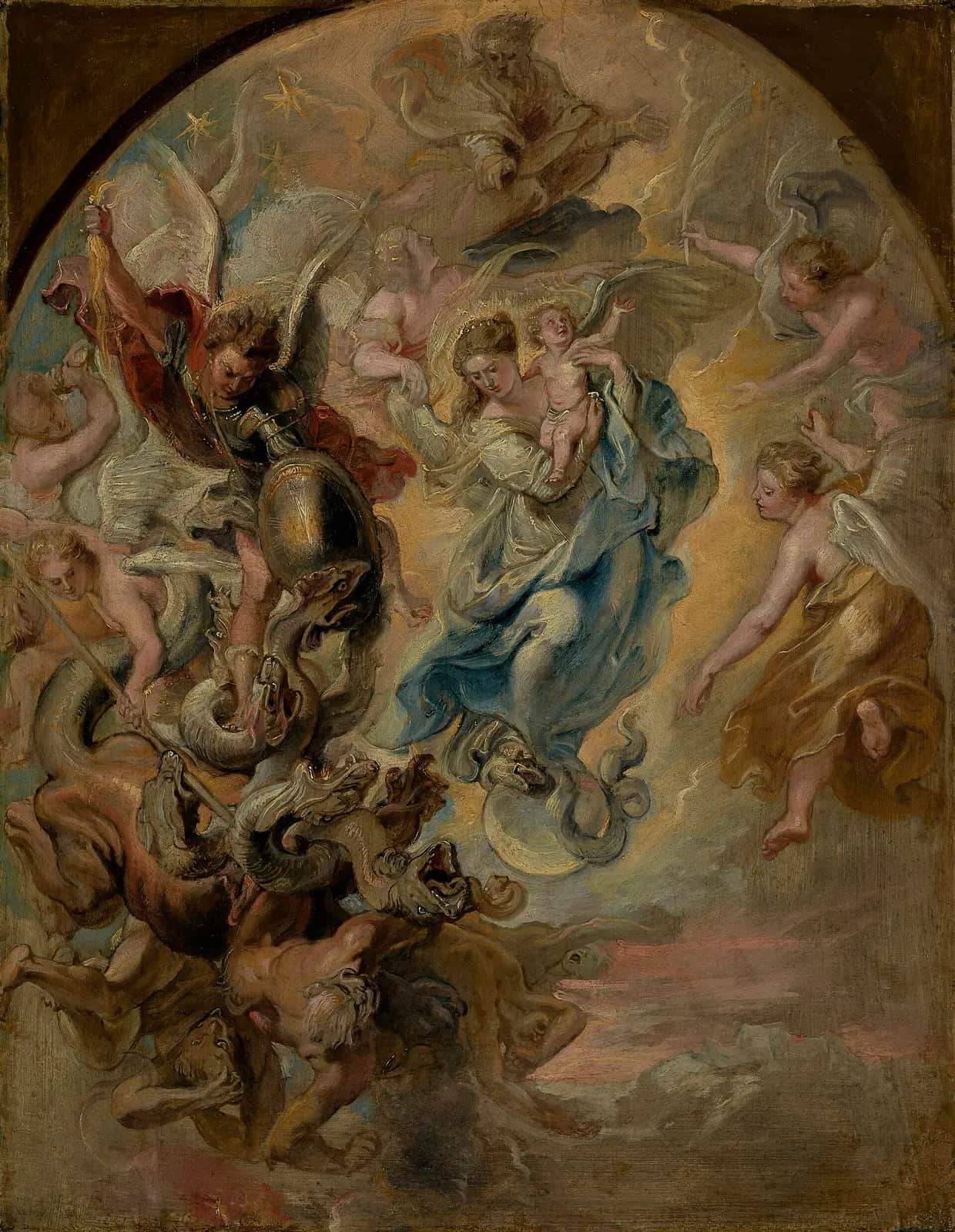
The idea
The Woman 'in anguish' to give birth is not Mary in labour at Bethlehem, for three reasons. First, the verb basanizō, 'torment,' 'is never used of childbirth' in the Septuagint, the New Testament, the Apocrypha, the papyri or the Fathers — in Revelation it is the word for torment (9:5; 11:10; 14:10; 20:10). Second, the moment the child is born he is 'caught up to God and to his throne': no infancy, no ministry — the birth is a symbolic description of death, resurrection and ascension. Third, John builds the vision on Isaiah's prophecy of the painless birth: the Greek of Isaiah 66:7 and Revelation 12:2, 6, 5 run in parallel — she was in labour (ōdinousa), she escaped (exephygen / ephygen), she bore a male (eteken arsen / eteken huion arsen). It would be a strange allusion if John wanted to stress literal pain. As Feuillet put it, 'the pains of childbirth correspond to Calvary.'
Key verses
- Revelation 12:2 — 'pained (basanizomenē) to be delivered.'
- Revelation 12:5 — the child caught up to the throne at once.
- Revelation 12:6 — 'she fled' — Isaiah's 'she escaped.'
- Isaiah 66:7 — the painless birth behind the vision.
The connection
| Old Testament root | New Testament fulfilment | |
|---|---|---|
| Isaiah 66:7 LXX: in labour, escaped, bore a male | → | Revelation 12: in labour, fled, bore a male — the torment of the cross |
The vault's existing note asserts that Mary's real pangs are at the cross; this is the argument. A word-study, a narrative gap and a Greek parallel together show that John's Woman labours at Calvary.
Sources
- Modern scholars Pitre cites — André Feuillet; Craig Koester; David Aune; G. K. Beale (pp 126–127)
- Septuagint — Isaiah 66:7 LXX (p 127) · read