Chapter 6 — The Birth of the Messiah
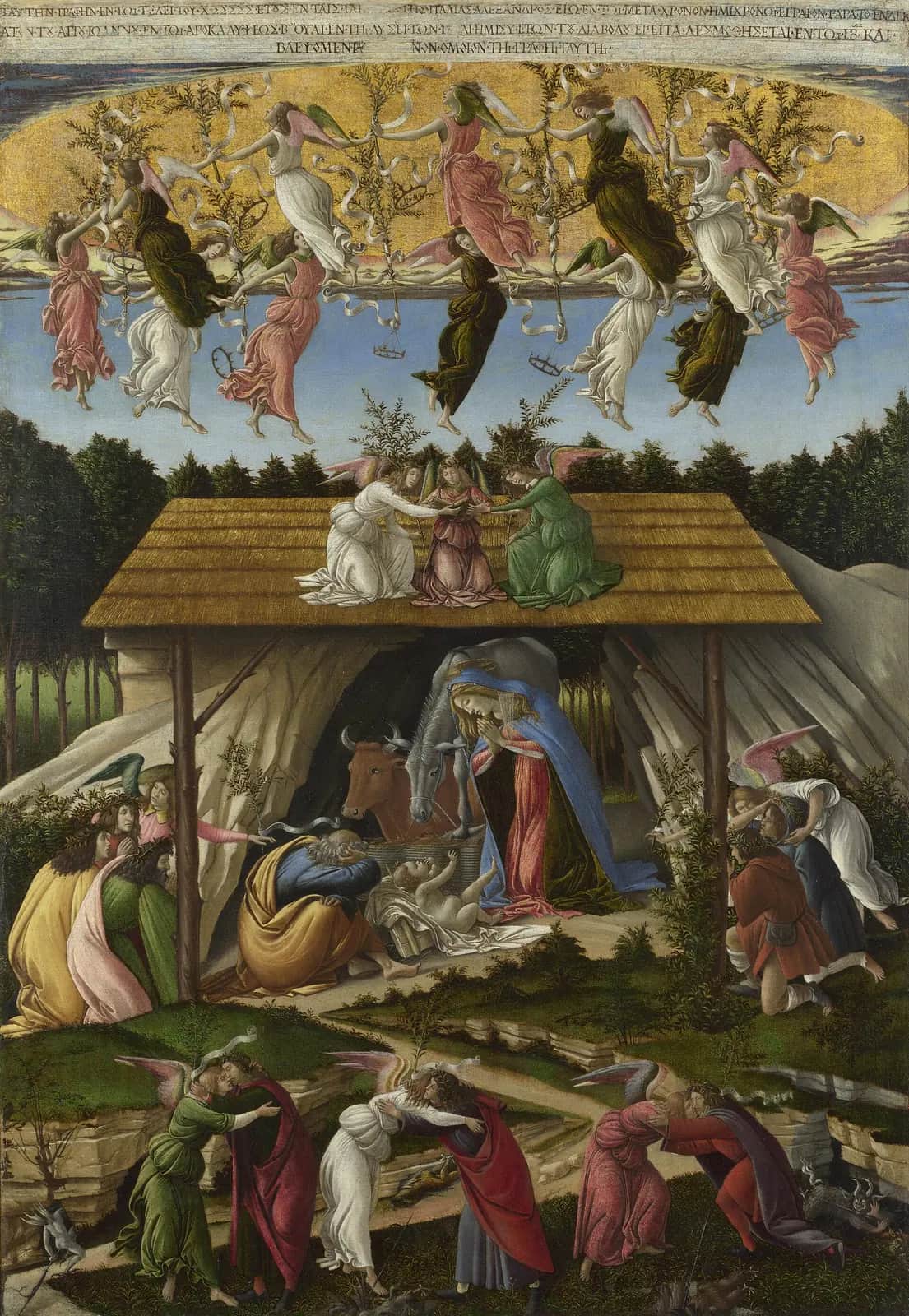
Sandro Botticelli, Mystic Nativity, c. 1500 · National Gallery, London · Public domainSandro Botticelli, Mystic Nativity, c. 1500, National Gallery, London
From Jewish Roots of Mary, based on Brant Pitre
6.0 Opening
pp 117–119
- Jesus takes suffering upon himself, not away — and Mary's life is the same paradox
Jesus' ministry looks like the abolition of suffering — he heals a woman ill for twelve years and a man paralysed for thirty-eight — but 'in the final analysis, Jesus' mission is not to take away all suffering but to take it upon himself,' as the Son of Man who gives his life 'as a ransom for many,' alluding to Isaiah's suffering Servant. Mary's life has the same shape: miracles (Gabriel, the virginal conception, the star, the Magi) and sorrows (the threat of divorce, no room at Bethlehem, the massacre, the flight, the three days' loss, the cross). The chapter's thesis in one sentence: 'Mary did not suffer labor pains at Bethlehem, but she did suffer them at Calvary.'
pp 117–119
Verses introduced here: Isaiah 53:3 · Mark 10:45 · Luke 2:35
- Jesus takes suffering upon himself, not away — and Mary's life is the same paradox
6.1 The Mother of the Messiah
pp 119–124
Isaiah's Prophecy: The Painless Birth of the Messiah
- The prophets who foretell the Mother of the Messiah.
Micah ties the ruler from Bethlehem to a mother 'in travail' who brings him forth (5:3). Isaiah pictures a woman who gives birth before her pain comes (66:7) and then Zion bearing her children (66:8), and Micah shows Israel writhing in labor before her deliverance (4:9–10). The Messiah's coming is bound up with a mother from the start.
pp 119–123
- Isaiah 66 is a new-creation oracle — woman or Zion? — and three Jewish texts on the painless birth
Three observations on 'before she travailed, she brought forth.' First, it comes immediately after the oracle of 'new heavens and a new earth' in which no one labours in vain and women do not 'bear children for calamity' — the two effects of the fall undone; the painless birth is 'an act of the new creation,' and 'unprecedented' ('Who has heard such a thing?'). Second, the mother is deliberately ambiguous: an individual woman bearing a son in verse 7, the city of Zion bearing children in verse 8. Third, Jewish writings outside the Bible consistently link the passage with the Messiah's birth: the Targum ('her king will be revealed'), Genesis Rabbah ('the light of the Messiah… the first redeemer'), and Leviticus Rabbah ('in this world a woman bears children with pain, but of the time to come…'). Pain in childbirth belongs by definition to the old creation.
pp 120–121
Micah's Prophecy: The Birth Pangs of the Messiah
- Micah's three points, and the rabbis who wanted to miss the Messiah
Micah 5:2–3 says three things: the coming ruler is a Davidic king from Bethlehem; he has a human mother, 'she who is in labor' (yoledah, the word for the sufferings of childbirth); and Israel as a whole will suffer before he comes, after which the people 'return' and he reigns 'to the ends of the earth' — the pattern of Micah 4:9–10, Jeremiah 30 and Isaiah 26. Later Judaism gave the pattern a name, 'the birth pangs of the Messiah' (heblo shel mashiah). In the Talmud, Rab reads Micah 5 of a coming period of tribulation, Ulla says, 'Let him come, but let me not see him,' and Rabbi Eleazar's disciples ask what to do 'to be spared the birth pangs of the Messiah.' Some rabbis were willing to miss the Messiah to avoid his birth pangs.
pp 122–124
- The Jewish 'birth pangs of the Messiah.'
Prophets pictured 'Daughter Zion' writhing in labor to bring forth salvation, and Judaism spoke of tribulations — 'birth pangs' — preceding the age to come. The New Testament takes up the image, so Mary's travail at the cross fits an existing pattern: labor that gives birth to a redeemed people.
pp 123–124
Verses introduced here: Isaiah 26:17 · Isaiah 65:17 · Isaiah 65:23 · Isaiah 66:8 · Micah 4:9 · Mark 13:8 · John 16:21
- The prophets who foretell the Mother of the Messiah.
6.2 Mary's Birth Pangs
pp 124–130
- So where are Mary's real birth pangs?
At the cross. Revelation's Woman 'in anguish to give birth' and Jesus' image of a woman's sorrowful 'hour' turning to joy point to Mary's true travail at Calvary, where she brings forth God's children. 'Birth pangs of the Messiah' was a Jewish term for the tribulations before the age of salvation.
pp 124–130
The Woman in Revelation: The "Birth Pangs" of the Crucifixion
- Three reasons Revelation 12 is Calvary, not Bethlehem — with the Greek parallel table
The Woman 'in anguish' to give birth is not Mary in labour at Bethlehem, for three reasons. First, the verb basanizō, 'torment,' 'is never used of childbirth' in the Septuagint, the New Testament, the Apocrypha, the papyri or the Fathers — in Revelation it is the word for torment (9:5; 11:10; 14:10; 20:10). Second, the moment the child is born he is 'caught up to God and to his throne': no infancy, no ministry — the birth is a symbolic description of death, resurrection and ascension. Third, John builds the vision on Isaiah's prophecy of the painless birth: the Greek of Isaiah 66:7 and Revelation 12:2, 6, 5 run in parallel — she was in labour (ōdinousa), she escaped (exephygen / ephygen), she bore a male (eteken arsen / eteken huion arsen). It would be a strange allusion if John wanted to stress literal pain. As Feuillet put it, 'the pains of childbirth correspond to Calvary.'
pp 125–127
The Gospel of John: The Woman's "Hour" and the Crucifixion
- The Last Supper 'woman in labour' and its fulfilment at John 19
'A little while, and ye shall not see me… A woman when she is in travail hath sorrow, because her hour is come.' Pitre charts the figure: the woman's hour, sorrow and delivery match Jesus' hour, death and resurrection; hōra is John's technical word for the passion, and Jesus says he has been speaking 'in figures.' The metaphor draws on the Jewish birth pangs of the Messiah. Then the verbal fulfilment three chapters later: at the cross the same two words return — 'Woman' (gynē) and 'from that hour' (hōra) — as Jesus gives his mother to the disciple. 'The use of these terms is not a coincidence.' Pitre adds a striking claim: Jesus' saying about the woman's hour 'may be the only reference in the New Testament that we possess to Mary's experience of Jesus' being raised from the dead.'
pp 128–130
Verses introduced here: John 16:16 · John 16:20 · Revelation 12:2 · Revelation 12:6
- So where are Mary's real birth pangs?
6.3 Mary's Womb and Jesus' Tomb
pp 130–138
- The surprising claim about Mary's birth pangs at Bethlehem.
Isaiah foretells a birth WITHOUT labor — 'before she was in labor she gave birth.' Irenaeus and Gregory of Nyssa quote that verse of Mary's birth of Jesus (pp 131–132); Ephrem reasons that one 'blessed among women' was exempt from Eve's curse (p 135); and John Damascene says it best: she 'suffered those pains, which she escaped at the birth, in the hour of the passion' (pp 132–133). Since pain in childbirth came with the fall, a painless birth signals the new creation (CCC 499).
pp 130–133
The Painless Birth of Jesus: A Fulfillment of Isaiah's Prophecy
- Painless at Bethlehem, pains at the passion — Irenaeus, Gregory of Nyssa, John Damascene; Mater Dolorosa
Belief in the miraculous birth goes back to one of the earliest writings after the New Testament, Irenaeus' summary of the apostolic faith, and both he and Gregory of Nyssa quote Isaiah 66:7 for it (CCC 499 on virginity in giving birth). Pitre knows 'of no one who has expressed this belief more beautifully' than John Damascene: Mary 'suffered those pains, which she escaped at the birth, in the hour of the passion, enduring from motherly sympathy the rending of the bowels… her thoughts pierced her as a sword' — and 'the joy of the resurrection transforms the pain.' This does not make Mary superhuman: the anguish of watching the one she knew to be the Son of God slowly asphyxiate is 'quite literally inconceivable.' As Jesus is the 'man of sorrows,' Mary is the Mother of Sorrows, Mater Dolorosa, able to identify with every mother who suffers for her children; John Paul II reads the Woman's pangs of the Mother of Jesus at the cross.
pp 131–134
The Meaning of the Miraculous Birth
- 'Mary's womb and Jesus' tomb' — the real parallel.
In ancient Judaism wombs and tombs were compared. Jesus rose from a still-sealed tomb (the angel rolled back the stone that was already in place) just as he was born from a sealed, virginal womb. Ephrem: the seal of the tomb bore witness to the seal of the womb. The virgin birth is a sign of the resurrection.
pp 134–137
- Three meanings of the miraculous birth — divinity (Leo), new creation (Ephrem), resurrection as birth (Ephrem, Romans 8:29)
First, the birth is a sign of Jesus' divinity without loss of his humanity: Leo's Tome, acclaimed at Chalcedon, says he 'is generated in a new order and a new birth' yet does not 'have a nature different from ours just because his birth was miraculous.' Second, it is a sign of the new creation: if Mary is the New Eve, it is fitting she bear the new Adam without the pain of Eve's curse — Ephrem: 'If Mary was blessed of women, she would have been exempt from the curse'; Gregory: 'the Mother of life… should give birth in joy.' Third, the resurrection is a kind of birth. The tomb was still sealed when the angel rolled the stone, and ancient Jews compared wombs and tombs (Jeremiah 20; Sirach 40:1; 51:5). Ephrem: 'the seal of the tomb witnessed in favour of the seal of the womb'; 'the womb and the sepulcher being sealed were witnesses unto you.' So the risen Jesus is 'the firstborn among many brethren' — and if he is firstborn of many, is Mary not our mother too?
pp 134–137
Verses introduced here: Sirach 40:1 · Sirach 51:5 · Jeremiah 20:15 · Jeremiah 20:17 · Matthew 27:66 · Matthew 28:2 · Romans 8:29
- The surprising claim about Mary's birth pangs at Bethlehem.