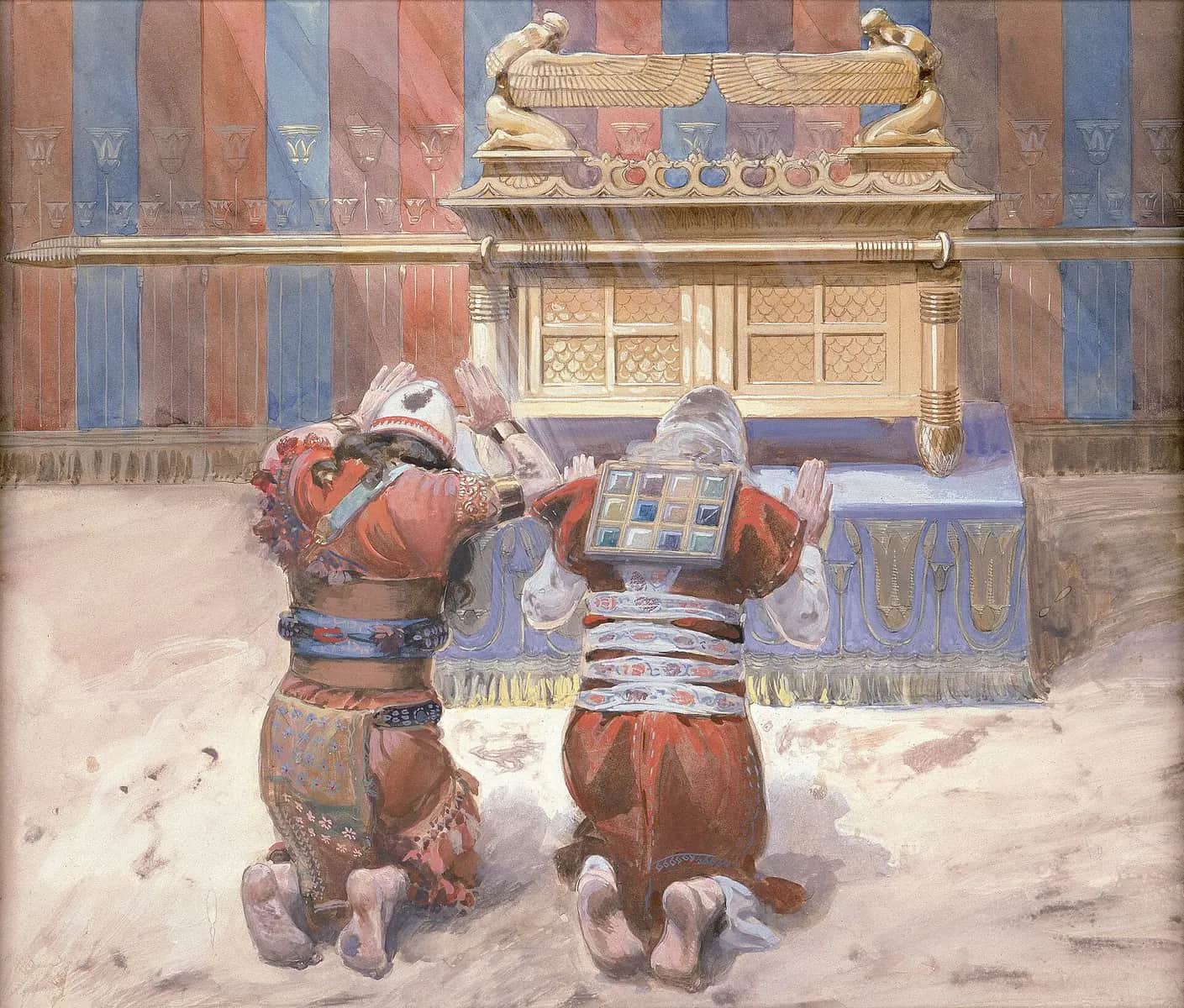
Exodus 33:20 (WEB)
He said, “You cannot see my face, for man may not see me and live.”
Catechism · 2
In the Old Testament
“Finally, taking the desert road that leads to the place where the living and true God reveals himself to his people, Elijah, like Moses before him, hides "in a cleft of he rock" until the mysterious presence of God has passed by.” — Catechism footnote: Cf. 1 Kings 19:1-14; cf. Ex 33:19-23.
The Way of Prayer
“But the one name that contains everything is the one that the Son of God received in his incarnation: JESUS. the divine name may not be spoken by human lips, but by assuming our humanity the Word of God hands it over to us and we can invoke it: "Jesus," "YHWH saves."” — Catechism footnote: Cf. Ex 3:14; 33: 19-23; Mt 1:21.
Fathers and councils · 29
Gregory of Nyssa
“And how can the word hold good, “No man hath seen God at any time” and, “Whom no man hath seen nor can see” and, “There shall no man see the face of the Lord and live” if to be inside the door, or outside, or the finding pasture, denote the essence of the Father?” — editor's note: Cf. Exod. xxxiii. 20.
Read the whole comment
Irenaeus of Lyons
“Also that which is spoken by Moses, “No man shall see God and live,” has, as they would persuade us, the same reference.” — editor's note: Ex. xxxiii. 20.
Read the whole comment“But in respect to His greatness, and His wonderful glory, “no man shall see God and live,” for the Father is incomprehensible; but in regard to His love, and kindness, and as to His infinite power, even this He grants to those who love Him, that is, to see God, which thing the prophets did also predict.” — editor's note: Ex. xxxiii. 20.
Read the whole comment
Tertullian
“When Moses in Egypt desired to see the face of the Lord, saying, “If therefore I have found grace in Thy sight, manifest Thyself unto me, that I may see Thee and know Thee,” God said, “Thou canst not see my face; for there shall no man see me, and live:” in other words, he who sees me shall die.” — editor's note: Ver. 20.
Read the whole comment“The apostle confirms this statement; for, speaking of God, he says, “Whom no man hath seen, nor can see;” because the man indeed would die who should see Him.” — editor's note: Ex. xxxiii. 20; Deut. v. 26; Judg. xiii. 22.
Read the whole comment“The Father indeed was invisible, as Philip had learnt in the law, and ought at the moment to have remembered: “No man shall see God, and live.”” — editor's note: Ex. xxxiii. 20.
Read the whole comment“For God the Father none ever saw, and lived.” — editor's note: Comp. Ex. xxxiii. 20; John i. 18; xiv. 9; Col. i. 15; Heb. i. 3.
Read the whole comment“For even in the Old Testament He had declared, “No man shall see me, and live.”” — editor's note: Ex. xxxiii. 20.
Read the whole comment“And the Lord, with like reference to the future, replied, “I will pass before thee in my glory,” etc. Then at the last He says, “And then thou shalt see my back.”” — editor's note: See Ex. xxxiii. 13–23.
Read the whole comment“He must not be regarded, however, as making any difference between a visible and an invisible God; because long before he wrote this we find a description of our God to this effect: “No man can see the Lord, and live.”” — editor's note: Ex. xxxiii. 20.
Read the whole comment
Athanasius of Alexandria
“…things originate either to see or to know, for the sight and the knowledge of Him surpasses all (since God Himself says, ‘No one shall see My face and live’), yet the Son has declared, ‘No one knoweth the Father, save the Son,’ therefore the Word is different from all things originate, in that He alone knows and…” — editor's note: Vid. Ex. xxxiii. 20.
Read the whole comment
Jerome
“And because he said that he had seen God, the Lord told him, “Thou canst not see My face.” — editor's note: Ex. xxxiii. 20.
Read the whole comment
Cyril of Jerusalem
“Now if the sight of the likeness of the glory brought fear and distress upon the prophets, any one who should attempt to behold God Himself would to a certainty lose his life, according to the saying, No man shall see My face and live.” — editor's note: Exod. xxxiii. 20.
Read the whole comment“But He saith, There shall no man see My face, and live.” — editor's note: Ex. xxxiii. 20.
Read the whole comment
John Cassian
- John Cassian, Conferences I–X I.15Conference I
“…lastingly, if anything of carnal affections still survives in him, because “thou canst not,” saith the Lord, “see My face: for no man shall see Me and live;” viz., to this world and to earthly affections.” — editor's note: Exod. xxxiii. 20.
Read the whole comment
Augustine of Hippo
“Let me die, lest I die, if only I may see Thy face.” — editor's note: Moriar ne moriar, ut eam videam. See Ex. xxxiii. 20.
Read the whole comment“…His Glory and His Face, in such wise as we can speak of God’s Face, He said unto him, “Thou canst not see My Face; for no one hath seen My Face, and lived;” but I will place thee in a clift of the rock, and will pass by, and will set My hand upon thee; and when I have passed by, thou shalt see My back parts.” — editor's note: Exod. xxxiii. 20.
Read the whole comment“…of the rock, and will cover thee with my hand while I pass by: and I will take away my hand, and thou shalt see my back parts; but my face shall not be seen.”” — editor's note: Ex. xxxiii. 11–23
Read the whole comment“For thou hast it plainly stated in the law: “And Moses spake with the Lord face to face, as a friend with his friend.”” — editor's note: Ex. xxxiii. 11, 13, 20.
Read the whole comment
Origen
- Origen, De Principiis II.4Book II
“For it is manifest that He, viz., who gave answers to Moses, said, “You shall not see My face, but My hinder parts.”” — editor's note: Ex. xxxiii. 20, cf. 23.
Read the whole comment
Theodoret of Cyrus
“…He hath declared Him,” and the great Moses, when he desired to see the invisible nature, heard the Lord God saying, “There shall no man see me and live.”” — editor's note: Exodus xxxiii. 20
Read the whole comment- Theodoret of Cyrus, Dialogues (Eranistes) Demonstrations by.2Demonstrations by Syllogisms
“If all mankind shall see the Son of man coming on the clouds of heaven, according to the Lord’s own words, and He said to Moses “No man shall see me and live,” and both are true, then He will come with the body with which He ascended into heaven.” — editor's note: Exodus xxxiii. 20
Read the whole comment “And to the great Moses He said “There shall no man see me and live.”” — editor's note: Ex. xxxiii. 20, lxx. οὐδεὶς ὄψεται
Read the whole comment
Ambrose of Milan
“But “no one,” it says, “can see My face and live.”” — editor's note: Ex. xxxiii. 20.
Read the whole comment
John Chrysostom
“And in the Old Testament, “No man shall see My face, and live.” ( Ex. xxxiii. 20.)” — the author cites it
Read the whole comment
Gregory of Nazianzus
“If He had abode upon His own eminence, if He had not condescended to infirmity, if He had remained what He was, keeping Himself unapproachable and incomprehensible, a few perhaps would have followed Him—perhaps not even a few, possibly only Moses—and He only so far as to see with difficulty the Back Parts of God.” — editor's note: Exod. xx. 21; xxxiii. 20, 23.
Read the whole comment
Leo the Great
“…nature is transformed, so that no longer “in a mirror,” nor “in a riddle,” but “face to face” it sees the very Godhead “as He is,” which no man could see; and through the unspeakable joy of eternal contemplation obtains that “which eye has not seen, nor ear heard, neither has entered into the heart of man.”” — editor's note: Exod. xxxiii. 20; John. i. 18; 1 Tim. vi. 16.
Read the whole comment
Clement of Alexandria
“To the same effect is what we find in Moses: “No man shall see My face, and live.”” — editor's note: Ex. xxxiii. 20.
Read the whole comment
Ephrem the Syrian
“But what shall we say about the Lord of the Angel, Who said to Moses,—No man shall see Me and live?” — editor's note: Exod. xxxiii. 20.
Read the whole comment
Cross-references · 39
Cited together in Against Praxeas Chapter 14.
Cited together in Against Praxeas Chapter 14.
Cited together in Against Praxeas Chapter 14.
Cited together in Against Eunomius X.1.
Cited together in Confessions I.5.
Cited together in The Five Books Against Marcion II.27.
Cited together in Against Heresies I.19.
Cited together in Confessions I.5.
Cited together in Confessions I.5.
Cited together in Against Eunomius X.1.
Cited together in Against Eunomius X.1.
Cited together in Against Eunomius X.1.
Cited together in Confessions I.5.
Cited together in Confessions I.5.
Cited together in Against Eunomius X.1.
Cited together in Confessions I.5.
Cited together in Confessions I.5.
Cited together in Against Heresies I.19.
Cited together in Against Praxeas Chapter 14.
Cited together in Against Heresies I.19.
Cited together in Against Heresies I.19.
Cited together in Against Heresies I.19.
Cited together in Catechism §2666.
Cited together in The Five Books Against Marcion II.27 and 1 other place.
Cited together in Against Praxeas Chapter 14.
Cited together in The Five Books Against Marcion II.27.
Cited together in Dialogues (Eranistes) Demonstrations by.2.
Cited together in Against Eunomius X.1.
Cited together in Catechism §2666.
Cited together in Catechism §2666.
Cited together in Catechism §2666.
Cited together in Dialogues (Eranistes) Demonstrations by.2.
Cited together in Dialogues (Eranistes) Demonstrations by.2.
Cited together in Dialogues (Eranistes) Demonstrations by.2.
Cited together in Against Heresies I.19.
Cited together in Catechism §2666.
Cited together in Against Praxeas Chapter 14.
Cited together in Catechism §2666.
Cited together in Catechism §2666.