Matthew 1:21 (WEB)
She shall give birth to a son. You shall name him Jesus, for it is he who shall save his people from their sins.”
Catechism · 6
The Anointing of the Sick
“These signs demonstrate in a special way that Jesus is truly "God who saves."” — Catechism footnote: Cf. Mt 1:21; Acts 4:12.
Sin
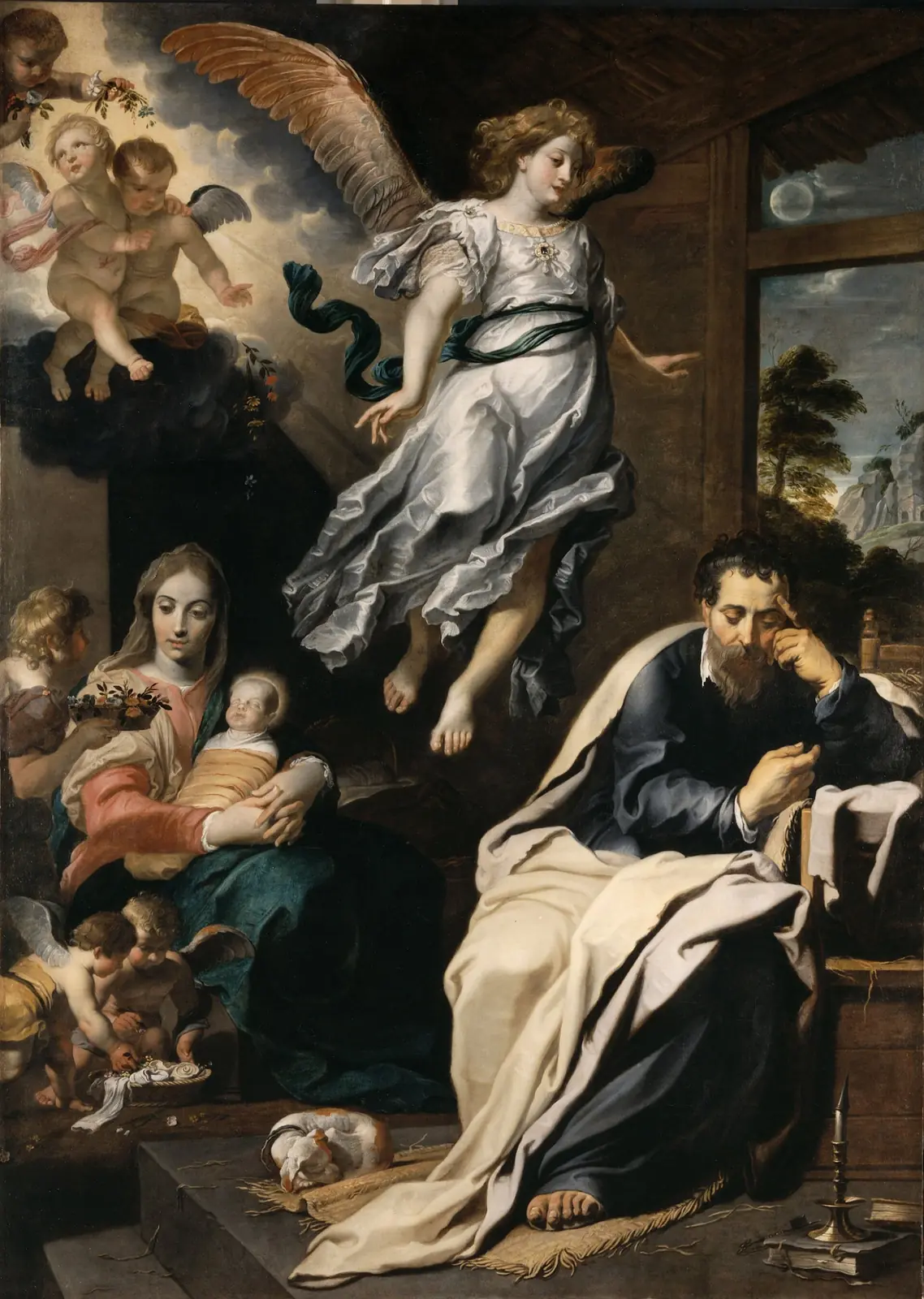
“The angel announced to Joseph: "You shall call his name Jesus, for he will save his people from their sins."” — Catechism footnote: Mt 1:21.
The Way of Prayer
“But the one name that contains everything is the one that the Son of God received in his incarnation: JESUS. the divine name may not be spoken by human lips, but by assuming our humanity the Word of God hands it over to us and we can invoke it: "Jesus," "YHWH saves."” — Catechism footnote: Cf. Ex 3:14; 33: 19-23; Mt 1:21.
The Seven Petitions
“Finally, in Jesus the name of the Holy God is revealed and given to us, in the flesh, as Savior, revealed by what he is, by his word, and by his sacrifice.” — Catechism footnote: Cf. Mt 1:21; Lk 1:31, Jn 8:28; 17:8; 17:17-19.
"And in Jesus Christ, His Only Son, Our Lord"
“Since God alone can forgive sins, it is God who, in Jesus his eternal Son made man, "will save his people from their sins".” — Catechism footnote: Mt 1:21; cf. 2:7.
"Conceived by the Power of the Holy Spirit and Born of the Virgin Mary"
- §497Paragraph 2 · "Conceived by the Power of the Holy Spirit and Born of the Virgin Mary"Read at vatican.va
“The Gospel accounts understand the virginal conception of Jesus as a divine work that surpasses all human understanding and possibility:” — Catechism footnote: Mt 1 18-25; Lk 1:26-38.
Fathers and councils · 25
John Damascene
“And she was troubled at his word, and the angel said to her, Fear not, Mary, for thou hast found favour with God, and shalt bring forth a Son and shalt call His name Jesus; for He shall save His people from their sins.” — editor's note: St. Matt. i. 21.
Read the whole comment
Theodoret of Cyrus
““For,” it is written, “Thou shalt call His name Jesus for he shall save His people from their sins,” and unto you is born this day in the city of David Christ the Lord.” — editor's note: Matt. i. 21
Read the whole comment“And, again, Gabriel says to the blessed Virgin, “Behold thou shalt conceive in thy womb, and bring forth a son and shalt call His name Jesus” “for He shall save His people from their sins.”” — editor's note: Matt. i. 21. Observe the confusion of quotation.
Read the whole comment“Jesus means Saviour; “Thou shalt call His name Jesus for He shall save His people from their sins.”” — editor's note: Matt. i. 21
Read the whole comment
Augustine of Hippo
“When He calls thee, He converts thee: when He converts thee, He healeth thee: when He hath healed thee, thou shalt see thy Converter, unto whom it is said, “Show us Thy mercy, O Lord, and grant us Thy salvation” (ver. 7): Thy salvation, that is, Thy Christ.” — editor's note: [i.e., Thy Joshua, which is inwoven with the idea of salvation everywhere in the Old Testament (see Gen. xlix. 18), till all is fixed in Christ, the true…
Read the whole comment“Now when Jesus was born in Bethlehem of Judæa, in the days of Herod the king, and so forth.” — editor's note: Matt. i. 19–21.
Read the whole comment“Why Jesus? “for He shall save His people from their sins.”” — editor's note: Matt. i. 21.
Read the whole comment“For this reason this name was given, when it was said before He was born of the virgin: “Thou shall bring forth a Son, and shalt call His name Jesus; for He shall save His people from their sins.”” — editor's note: Matt. i. 21.
Read the whole comment
John Chrysostom
“Since the Angel also said to Joseph, “Thou shalt call His name Jesus, for He shall save His people.” ( Matt. i. 21.)” — the author cites it
Read the whole comment““And she shall bring forth,” saith he, “a Son, and thou shalt call His name Jesus.”“For do not thou, because He is of the Holy Ghost, imagine that thou art an alien to the ministry of this dispensation.” — editor's note: Matt. i. 21.
Read the whole comment“For so, when the Virgin was bearing the child, he saith, “Thou shalt call His name Jesus;”and he gives the reason saying, “for He shall save His people from their sins.”” — editor's note: Matt. i. 21.
Read the whole comment
John Cassian
“For everybody knows that in Hebrew “Jesus” means “Saviour,” as the angel announced to the holy Virgin Mary, saying: “And thou shalt call His name Jesus, for He it is that shall save His people from their sins.”” — editor's note: S. Matt. i. 21.
Read the whole comment
Hilary of Poitiers
“For the angel, when speaking of Christ the Lord, Who should be born of Mary, calls Him by the name ‘Jesus:’ but to the prophets Christ the Lord is ‘Spirit.’” — editor's note: St. Matt. i. 21; St. Luke i. 31.
Read the whole comment
Tertullian
“These facts he had also received from the angel, according to our Gospel: “Wherefore that which shall be born of thee shall be called the Holy One, the Son of God;” and, “Thou shalt call his name Jesus.”” — editor's note: Matt. i. 21.
Read the whole comment
Jerome
“It turns upon the record in Matt. i. 18–25, and especially on the words, “Before they came together” (c. 4), “knew her not till, &c.” (5–8).” — the author cites it
Read the whole comment
Cyprian of Carthage
“And she shall bring forth a son, and thou shalt call His name Jesus; for He shall save His people from their sins.”” — editor's note: Matt. i. 20, 21.
Read the whole comment
Catena Aurea on Matthew
- John ChrysostomCatena Aurea on Matthew
What the Angel thus told Joseph, was beyond human thought, and the law of nature, therefore he confirms his speech not only be revealing to him what was past, but also what was to come; “She shall bring forth a Son.”
Read the whole comment - Glossa OrdinariaCatena Aurea on Matthew
That Joseph should not suppose that he was no longer needed in this wedlock, seeing the conception had taken place without his intervention, the Angel declares to him, that though there had been no need of him in the…
Read the whole comment - Pseudo-ChrysostomCatena Aurea on Matthew
He said not, “Shall bear thee a Son,” as to Zacharias, “Behold, Elisabeth thy wife shall bear thee a son.” For the woman who conceives of her husband, bears the son to her husband, because he is more of him than of…
Read the whole comment - John ChrysostomCatena Aurea on Matthew
Or, he left it unappropriated, to shew that she bare Him to the whole world.
Read the whole comment - Rabanus MaurusCatena Aurea on Matthew
“Thou shalt call His name,” he says, and not, “shalt give Him a name,” for His name had been given from all eternity.
Read the whole comment - John ChrysostomCatena Aurea on Matthew
This further shews that this birth should be wonderful, because it is God that sends down His name from above by His Angel; and that not any name, but one which is a treasure of infinite good. Therefore also the…
Read the whole comment - JeromeCatena Aurea on Matthew
Jesus is a Hebrew word, meaning Saviour. He points to the etymology of the name, saying, “For He shall save His people from this sins.”
Read the whole comment - Remigius of AuxerreCatena Aurea on Matthew
He shews the same man to be the Saviour of the whole world, and the Author of our salvation. He saves indeed not the unbelieving, but His people; that is, He saves those that believe on Him, not so much from visible…
Read the whole comment - Peter ChrysologusCatena Aurea on Matthew
Let them approach to hear this, who ask, Who is He that Mary bare? “He shall save His people;” not any other man’s people; from what? “from their sins.” That it is God that forgives sins, if you do not believe the…
Read the whole comment
Cross-references · 45
Parallel passages
Matthew 1:21 and Luke 1:31 share the same wording (9 words).
Cited together with
Cited together in Catechism §430.
Cited together in Catechism §1846.
Cited together in Catechism §1507.
Cited together in Catechism §1507.
Cited together in An Exact Exposition of the Orthodox Faith III.2.
Cited together in An Exact Exposition of the Orthodox Faith III.2.
Cited together in Catechism §430 and 2 other places.
Cited together in An Exact Exposition of the Orthodox Faith III.2.
Cited together in An Exact Exposition of the Orthodox Faith III.2 and 1 other place.
Cited together in Letters Letter 131 and 1 other place.
Cited together in The Five Books Against Marcion IV.7.
Cited together in The Five Books Against Marcion IV.7.
Cited together in The Five Books Against Marcion IV.7.
Cited together in The Five Books Against Marcion IV.7.
Cited together in The Five Books Against Marcion IV.7.
Cited together in Peter Chrysologus on Matthew 1:21 (Catena Aurea).
Cited together in Letters Letter 131.
Cited together in Catechism §2812.
Cited together in Catechism §2812.
Cited together in Catechism §2812.
Cited together in Catechism §2812.
Cited together in Catechism §2812.
Cited together in Catechism §2812.
Cited together in Catechism §2812.
Cited together in Catechism §2666.
Cited together in Catechism §1507.
Cited together in Letters Letter 131.
Cited together in Catechism §1507.
Cited together in Letters Letter 131.
Cited together in Catechism §1507.
Cited together in Letters Letter 131.
Cited together in Catechism §2812.
Cited together in An Exact Exposition of the Orthodox Faith III.2.
Cited together in Catechism §2666.
Cited together in Catechism §2666.
Cited together in Catechism §2666.
Cited together in Catechism §2666.
Cited together in Catechism §2666.
Cited together in Catechism §2666.
Cited together in On the Incarnation of the Lord, Against Nestorius IV.12.
Cited together in Catechism §2812.
Cited together in Catechism §2812.
Cited together in Catechism §2812.
Cited together in The Five Books Against Marcion IV.7.