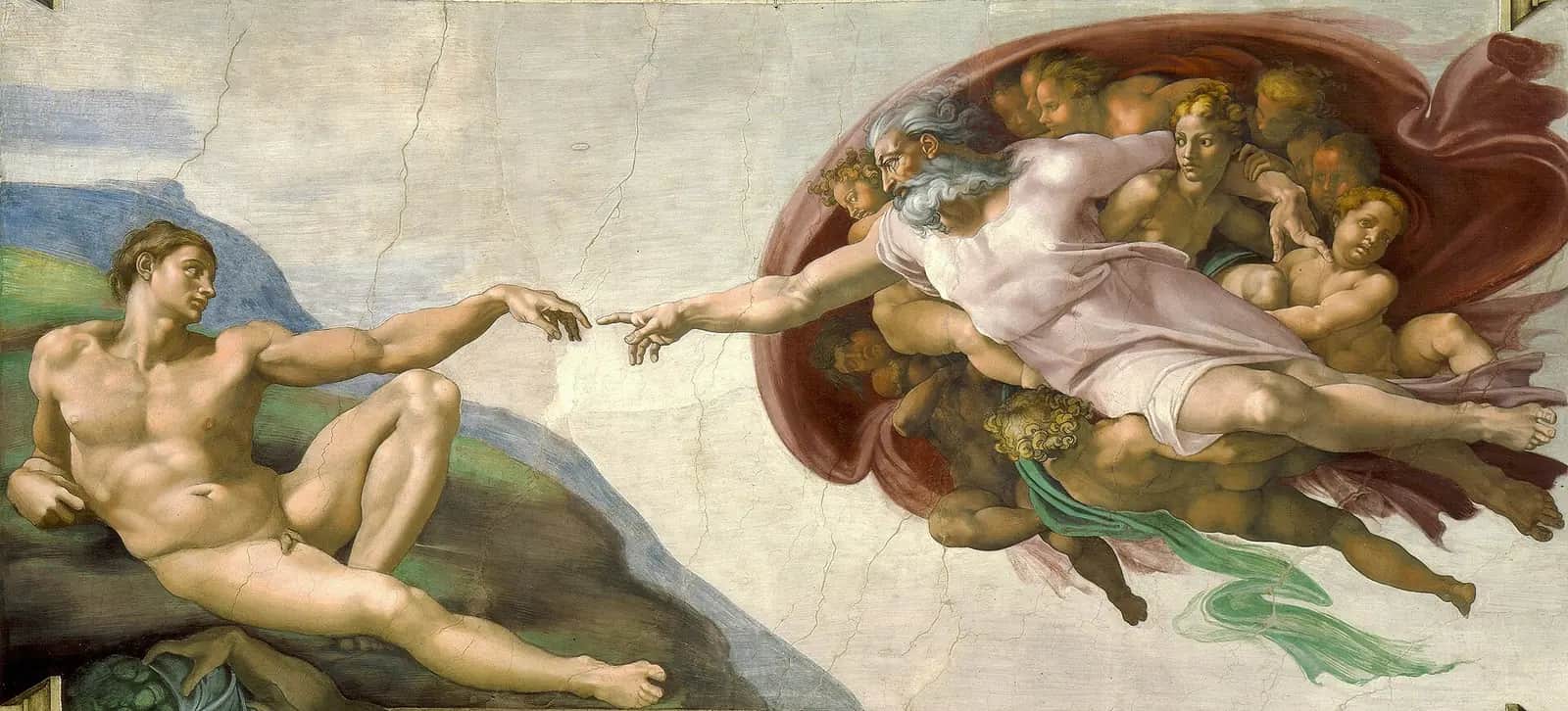
Genesis 1:28 (WEB)
God blessed them. God said to them, “Be fruitful, multiply, fill the earth, and subdue it. Have dominion over the fish of the sea, over the birds of the sky, and over every living thing that moves on the earth.”
Catechism · 10
The Sacrament of Matrimony
“It is good, very good, in the Creator's eyes. and this love which God blesses is intended to be fruitful and to be realized in the common work of watching over creation: "and God blessed them, and God said to them: 'Be fruitful and multiply, and fill the earth and subdue it.'"” — Catechism footnote: Gen 1:28; cf. 1:31.
“Their relations were distorted by mutual recriminations; their mutual attraction, the Creator's own gift, changed into a relationship of domination and lust; and the beautiful vocation of man and woman to be fruitful, multiply, and subdue the earth was burdened by the pain of childbirth and the toil of work.” — Catechism footnote: Cf. Gen 1:28; 3:16-19.
“Hence, true married love and the whole structure of family life which results from it, without diminishment of the other ends of marriage, are directed to disposing the spouses to cooperate valiantly with the love of the Creator and Savior, who through them will increase and enrich his family from day to day.” — Catechism footnote: GS 50 # 1; cf. Gen 2:18; Mt 19:4; Gen 1:28.
The Sixth Commandment
“"God created man in his own image . . . male and female he created them"; He blessed them and said, "Be fruitful and multiply";” — Catechism footnote: Gen 1:28.
The Seventh Commandment
“In the beginning God entrusted the earth and its resources to the common stewardship of mankind to take care of them, master them by labor, and enjoy their fruits.” — Catechism footnote: Cf. Gen 1:26-29.
“Human work proceeds directly from persons created in the image of God and called to prolong the work of creation by subduing the earth, both with and for one another.” — Catechism footnote: Cf. Gen 1:28; GS 34; CA 31.
The Creator
“To human beings God even gives the power of freely sharing in his providence by entrusting them with the responsibility of "subduing" the earth and having dominion over it.” — Catechism footnote: Cf. Gen 1:26-28.
Heaven and Earth
God himself created the visible world in all its richness, diversity and order. Scripture presents the work of the Creator symbolically as a succession of six days of divine "work", concluded by the "rest" of the seventh day.
Man
“In marriage God unites them in such a way that, by forming "one flesh", they can transmit human life: "Be fruitful and multiply, and fill the earth."” — Catechism footnote: Gen 1:28.
“In God's plan man and woman have the vocation of "subduing" the earth” — Catechism footnote: Gen 1:28.
Fathers and councils · 40
Tertullian
“It is the excess, not the normal state, which is immodest and unchaste: the normal condition has received a blessing from God, and is blest by Him: “Be fruitful, and multiply, (and replenish the earth.)”” — editor's note: Gen. i. 28.
Read the whole comment“Moreover, he despises God’s law in his painting, maintaining repeated marriages, alleges the law of God in defence of lust, and yet despises it in respect of his art.” — editor's note: Quoting Gen. i. 28, “Be fruitful and multiply” (Rigalt.).
Read the whole comment“…if there still remain types—sacraments of something future—for your nuptials to figure; or if even now there is room for that command, “Grow and multiply;” that is, if no other command has yet supervened: “The time is already wound up; it remains that both they who have wives act as if they had not:” for, of…” — editor's note: Gen. i. 28.
Read the whole comment“…it was that there should be a succession to the marriage of a brother if he died childless: first, because that ancient benediction, “Grow and multiply,” had still to run its course; secondly, because the sins of the fathers used to be exacted even from the sons; thirdly, because eunuchs and barren persons used…” — editor's note: Gen. i. 28. Comp. de Ex. Cast., c. vi.
Read the whole comment“…so many and so great sins of human temerity, begun by the first of the race, Adam, after the condemnation of man, together with the dowry of the world after his ejection from paradise and subjection to death—when He had hasted back to His own mercy, did from that time onward inaugurate repentance in His own…” — editor's note: Sæculi dote. With which he had been endowed. Comp. Gen. i. 28; Ps. viii. 4–8.
Read the whole comment“And from that time, ever since the blessing which was pronounced upon man’s generation, the flesh and the soul have had a simultaneous birth, without any calculable difference in time; so that the two have been even generated together in the womb, as we have shown in our Treatise on the Soul.” — editor's note: Gen. i. 28.
Read the whole comment“…nature that is to be blamed, but the extravagant use of it; according to the judgment of its founder Himself, who not only said, “Be fruitful, and multiply,” but also, “Thou shalt not commit adultery,” and, “Thou shalt not covet thy neighbour’s wife;” and who threatened with death the unchaste, sacrilegious, and…” — editor's note: Gen. i. 28.
Read the whole comment“We do not indeed forbid the union of man and woman, blest by God as the seminary of the human race, and devised for the replenishment of the earth and the furnishing of the world, and therefore permitted, yet singly.” — editor's note: Orbi. Gen. i. 28.
Read the whole comment
Gregory of Nyssa
“He Who framed the universe made the nature of man with all things in the beginning, and after Adam was made, He then appointed for men the law of generation one from another, saying, “Be fruitful and multiply.”” — editor's note: Gen. i. 28.
Read the whole comment- Gregory of Nyssa, On the Making of Man On the.23On the Making of Man
“…on man the power of increasing and multiplying; but when He divided it by sexual distinctions, then He said, “Increase and multiply, and replenish the earth.”” — editor's note: Gen. i. 28.
Read the whole comment
Irenaeus of Lyons
“For He formed him for growth and increase, as the Scripture says: “Increase and multiply.”” — editor's note: Gen. i. 28.
Read the whole comment
Jerome
“We have read God’s first command, “Be fruitful, and multiply, and replenish the earth”; but while we honour marriage we prefer virginity which is the offspring of marriage.” — editor's note: Gen. i. 28.
Read the whole comment““Be fruitful,” God says, “and multiply, and replenish the earth.”” — editor's note: Gen. i. 28.
Read the whole comment“We have read the first decree of God: ‘Be fruitful and multiply and replenish the earth.’” — editor's note: Gen. i. 28.
Read the whole comment““Be fruitful, and multiply, and replenish the earth.”” — editor's note: Gen. i. 28; ix. 7.
Read the whole comment“Let us be fruitful and multiply and replenish the earth, but let us slay no lamb and celebrate no mystic passover, for where there is no temple, the law forbids these acts.” — editor's note: Gen. i. 28.
Read the whole comment“I have learned on good authority that her wish in submitting herself to her husband was not to take advantage of God’s primitive command “Be faithful and multiply and replenish the earth” but that she only desired children that she might bring forth virgins to Christ.” — editor's note: Gen. i. 28.
Read the whole comment“He withdrew into the privacy of his own chamber when he sought to obey nature and to win God’s blessing: “Be fruitful and multiply and replenish the earth.”” — editor's note: Gen. i. 28.
Read the whole comment“…for chastity that I cannot doubt but that you would go to them even before your daughter, and would emancipate yourself from God’s first decree of the Law to put yourself under His second dispensation of the Gospel.” — editor's note: Gen. i. 28.
Read the whole comment“And if both before and after the deluge the maxim held good: “be fruitful and multiply and replenish the earth:” what has that to do with us upon whom the ends of the ages are come, unto whom it is said, “the time is short,” and “now the axe is laid unto the root of the…” — editor's note: Gen. i. 28; ix. 7.
Read the whole comment“So long as that law remained, “Be fruitful, and multiply and replenish the earth”; and “Cursed is the barren woman that beareth not seed in Israel,” they all married and were given in marriage, left father and mother, and became one flesh.” — editor's note: Gen. i. 28.
Read the whole comment
John Damascene
“In answer we shall say that “Be fruitful and multiply” does not altogether refer to the multiplying by the marriage connection.” — editor's note: Ibid. i. 28.
Read the whole comment
John Cassian
- John Cassian, Conferences XI–XVII XVII.19Conference XVII
“For up to the coming of Christ it was well that the blessing of the original sentence should be in full vigour, whereby it was said: “Increase and multiply, and fill the earth.”” — editor's note: Gen. i. 28.
Read the whole comment
Augustine of Hippo
“Behold, Thou blessest men, O Lord, that they may “be fruitful and multiply, and replenish the earth;” in this dost Thou not make a sign unto us that we may understand something?” — editor's note: Gen. i. 28.
Read the whole comment“…opinion on that question, whence could exist the progeny of the first men, whom God had blessed, saying, “Increase, and be ye multiplied, and fill the earth;” if they had not sinned, whereas their bodies by sinning deserved the condition of death, and there can be no sexual intercourse save of mortal bodies.” — editor's note: Gen. i. 28
Read the whole comment“Why then, when Scripture had said, “God made man after the image of God,” did it go on to say, “God created him; male and female created He them: and God blessed them”?” — editor's note: Gen. i. 27, 28
Read the whole comment“…committed iniquity worthy of damnation; but this original blessedness continuing until, in virtue of that benediction which said, “Increase and multiply,” the number of the predestined saints should have been completed, there would then have been bestowed that higher felicity which is enjoyed by the most blessed…” — editor's note: Gen. i. 28.
Read the whole comment“Far be it, then, from us to suppose that our first parents in Paradise felt that lust which caused them afterwards to blush and hide their nakedness, or that by its means they should have fulfilled the benediction of God, “Increase and multiply and replenish the earth;” for it was after sin that lust began.” — editor's note: Gen. i. 28.
Read the whole comment“For no sooner had Scripture said, “Male and female created He them,” than it immediately continues, “And God blessed them, and God said unto them, Increase, and multiply, and replenish the earth, and subdue it,” etc. And though…” — editor's note: Gen. i. 27, 28.
Read the whole comment“That first blessing which He pronounced before the fall, when He said, “Increase, and multiply, and replenish the earth,” He did not inhibit after man had sinned, but the fecundity originally bestowed remained in the condemned stock; and the vice of sin, which has involved us in…” — editor's note: Gen. i. 28.
Read the whole comment
Origen
- Origen, De Principiis III.7Book III
“…and then he adds the words: “So God created man in His own image: in the image of God created He him; male and female created He them, and He blessed them.”” — editor's note: Gen. i. 27, 28.
Read the whole comment
Justin Martyr
“And God blessed them, and said, Increase and multiply, and fill the earth, and have power over it.’” — editor's note: Gen. i. 26, 28.
Read the whole comment
Athanasius of Alexandria
“That lawful use which God permitted when He said, ‘Increase and multiply, and replenish the earth,’ and which the Apostle approves in the words, ‘Marriage is honourable and the bed undefiled,’ or that use which is public, yet carried on stealthily and in adulterous fashion?” — editor's note: Gen. i. 28.
Read the whole comment
Catena Aurea on Mark
- John ChrysostomCatena Aurea on Mark
“By this word which He spoke, “This is My Body”, the offerings are consecrated; and as that word which says, “Increase and multiply, and fill the earth,” [Gen 1:28] was sent forth but once, yet has its effect throughout all time, when nature does the work of generation; so also that voice was spoken once, yet…” — the author cites it
Read the whole comment
Basil the Great
“If he improperly quotes the charge “Increase and multiply,” I laugh at him, for not discerning the signs of the times.” — editor's note: Gen. i. 28.
Read the whole comment
Clement of Alexandria
“Dixit enim: “Multiplicemini;” ubi hoc subaudiendum est: “Et ea ratione fit homo Dei imago, quatenus homo co-operatur ad generationem hominis.”” — editor's note: Gen. i. 27, 28.
Read the whole comment“Nam cum ille dicat; “Crescite et multiplicamini,” oporteret vos, qui adversamini, nullo modo uti coitu.” — editor's note: Gen. i. 28, ix. 1.
Read the whole comment“As it is possible even now for man to form men, according to the original formation of Adam, He no longer now creates, on account of His having granted once for all to man the power of generating men, saying to our nature, “Increase, and multiply, and replenish the earth.”” — editor's note: Gen. i. 28.
Read the whole comment“And they constantly proclaim that command, “Increase and replenish.”” — editor's note: Gen. i. 28.
Read the whole comment
Hippolytus of Rome
“And there were given to them commandments, “Be fruitful, and multiply, and replenish the earth,” that is, Edem; for so he wishes that it had been written.” — editor's note: Gen. i. 28.
Read the whole comment
Cross-references · 90
Cited together in Catechism §1652 and 1 other place.
Cited together in To His Wife I.2.
Cited together in Catechism §1607 and 2 other places.
Cited together in Catechism §372 and 1 other place.
Cited together in Catechism §1607.
Cited together in Catechism §2427.
Cited together in Catechism §1607 and 1 other place.
Cited together in Catechism §1607 and 1 other place.
Cited together in Catechism §1607 and 1 other place.
Cited together in Catechism §1607 and 1 other place.
Cited together in Dialogue with Trypho Chapter 62.
Cited together in Catechism §2331.
Cited together in Catechism §2331.
Cited together in The Stromata, or Miscellanies II.23.
Cited together in The Five Books Against Marcion I.28.
Cited together in The Five Books Against Marcion I.28.
Cited together in On Exhortation to Chastity Chapter 5.
Cited together in Conferences XI–XVII XVII.19.
Cited together in Letters Letter 160.
Cited together in Letters Letter 160.
Cited together in Letters Letter 160.
Cited together in The Five Books Against Marcion I.28 and 1 other place.
Cited together in The Five Books Against Marcion I.28.
Cited together in The Five Books Against Marcion I.28.
Cited together in The Stromata, or Miscellanies II.23.
Cited together in On Exhortation to Chastity Chapter 5.
Cited together in On Exhortation to Chastity Chapter 5.
Cited together in The Stromata, or Miscellanies II.23.
Cited together in Dialogue with Trypho Chapter 62.
Cited together in Dialogue with Trypho Chapter 62.
Cited together in Dialogue with Trypho Chapter 62.
Cited together in Conferences XI–XVII XVII.19.
Cited together in Conferences XI–XVII XVII.19.
Cited together in Conferences XI–XVII XVII.19.
Cited together in The Stromata, or Miscellanies II.23.
Cited together in On the Holy Trinity XII.6.
Cited together in Against Heresies IV.11.
Cited together in On Repentance Chapter 2.
Cited together in On Repentance Chapter 2.
Cited together in On the Holy Trinity XII.6.
Cited together in Against Heresies IV.11.
Cited together in The City of God XXII.24.
Cited together in Festal and Personal Letters Personal Letters.3.
Cited together in The City of God XXII.24.
Cited together in The Refutation of All Heresies V.21.
Cited together in The City of God XIV.21 and 1 other place.
Cited together in Conferences XI–XVII XVII.19.
Cited together in Catechism §373.
Cited together in Letters Letter 160.
Cited together in On Repentance Chapter 2.
Cited together in The City of God XIV.10.
Cited together in On Exhortation to Chastity Chapter 5.
Cited together in Against Heresies IV.11.
Cited together in Catechism §1652 and 1 other place.
Cited together in The City of God XIV.22.
Cited together in Against Heresies IV.11.
Cited together in Against Heresies IV.11.
Cited together in On Repentance Chapter 2.
Cited together in Festal and Personal Letters Personal Letters.3.
Cited together in John Chrysostom on Mark 14:22–25 (Catena Aurea).
Cited together in John Chrysostom on Mark 14:22–25 (Catena Aurea).
Cited together in John Chrysostom on Mark 14:22–25 (Catena Aurea).
Cited together in John Chrysostom on Mark 14:22–25 (Catena Aurea).
Cited together in On Repentance Chapter 2.
Cited together in On Repentance Chapter 2.
Cited together in On Repentance Chapter 2.
Cited together in Against Eunomius III.3.
Cited together in The City of God XXII.24.
Cited together in Against Eunomius III.3.
Cited together in To His Wife I.2.
Cited together in Catechism §307.
Cited together in Letters Letter 160 and 1 other place.
Cited together in On the Resurrection of the Flesh Chapter 45.
Cited together in On the Resurrection of the Flesh Chapter 45.
Cited together in On the Resurrection of the Flesh Chapter 45.
Cited together in On the Resurrection of the Flesh Chapter 45.
Cited together in On the Resurrection of the Flesh Chapter 45.
Cited together in On the Resurrection of the Flesh Chapter 45.
Cited together in Catechism §307.
Cited together in Catechism §307.
Cited together in Catechism §307.
Cited together in Letters Letter 160.
Cited together in Catechism §2427.
Cited together in On Exhortation to Chastity Chapter 5.
Cited together in Catechism §2427.
Cited together in Against Hermogenes Chapter 1.
Cited together in To His Wife I.2.
Cited together in Catechism §1604.
Cited together in Catechism §1604.
Cited together in The Refutation of All Heresies V.21.