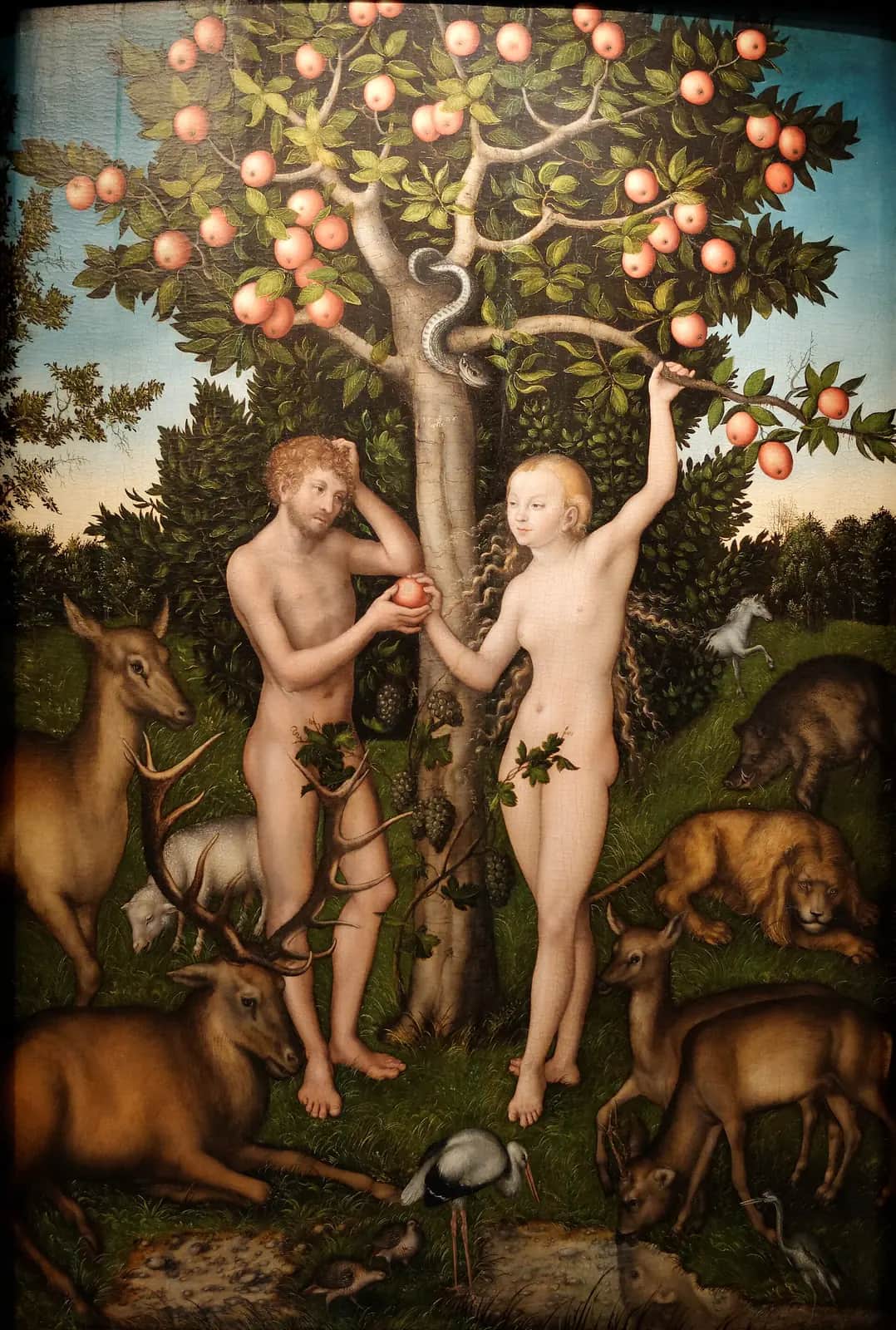
Genesis 2:16 (WEB)
The LORD God commanded the man, saying, “You may freely eat of every tree of the garden;
As quoted in the map (KJV)
Genesis 2:16–17 (KJV)
16 And the LORD God commanded the man, saying, Of every tree of the garden thou mayest freely eat: 17 But of the tree of the knowledge of good and evil, thou shalt not eat of it: for in the day that thou eatest thereof thou shalt surely die.
Key words
- אָכֹל תֹּאכֵלakhol tokhel · Hebrew
- 'thou mayest freely eat' — an emphatic Hebrew idiom; every tree, including the tree of life, is open to them.
- מוֹת תָּמוּתmot tamut · Hebrew
- 'thou shalt surely die' (v. 17) — the same emphatic form; death is the consequence of eating the forbidden tree.
Why it matters
God's first command joins a generous permission to one prohibition and a warning of death. Pitre reads the permission as including the tree of life and the warning as the announcement that death enters through sin (pp 21–23). Note that on p 23 the book attributes 'you shall surely die' to 2:16; the words are in 2:17.
Fathers and councils · 13
Tertullian
““Of every tree of the garden” He says, “ye shall freely eat;” and then again to the generation which followed next after the flood He enlarged the grant: “Every moving thing that liveth shall be meat for you; behold, as…” — editor's note: Gen. ii. 16.
Read the whole comment“Then also the Scripture added the name Lord: “And the Lord God, Deus Dominus, took the man, whom He had formed;” “And the Lord God commanded Adam.”” — editor's note: Gen. ii. 16.
Read the whole comment“For in the beginning of the world He gave to Adam himself and Eve a law, that they were not to eat of the fruit of the tree planted in the midst of paradise; but that, if they did contrariwise, by death they were to die.” — editor's note: See Gen. ii. 16, 17; iii. 2, 3.
Read the whole comment“Adam had received from God the law of not tasting “of the tree of recognition of good and evil,” with the doom of death to ensue upon tasting.” — editor's note: See Gen. ii. 16, 17.
Read the whole comment
Irenaeus of Lyons
“For the Church has been planted as a garden (paradisus) in this world; therefore says the Spirit of God, “Thou mayest freely eat from every tree of the garden,” that is, Eat ye from every Scripture of the Lord; but ye shall not eat with an uplifted mind, nor touch any heretical discord.” — editor's note: Gen. ii. 16.
Read the whole comment“…shalt eat food; but from the tree of knowledge of good and evil, from this ye shall not eat: for in the day that ye shall eat of it, ye shall die by death;” he then, lying against the Lord, tempted man, as the Scripture says that the serpent said to the woman: “Has God indeed said this, Ye shall not eat from every…” — editor's note: Gen. ii. 16, 17.
Read the whole comment
John Damascene
“And this is, in truth, what God meant by every tree, saying, Of every tree in Paradise thou mayest freely eat.” — editor's note: Gen. ii. 16.
Read the whole comment
Jerome
“But where there are rivers which admit of being seen and of being drunk, it follows that there also there will be fig-trees and other trees; and it is of these that the Lord says, “Of every tree of the garden thou mayest freely eat.”” — editor's note: Gen. ii. 16.
Read the whole comment
Athanasius of Alexandria
“Now this is that of which Holy Writ also gives warning, saying in the Person of God: “Of every tree that is in the garden, eating thou shalt eat: but of the tree of the knowledge of good and evil, ye shall not eat of it, but on the day that ye eat, dying ye shall die.”” — editor's note: Gen. ii. 16, sq.
Read the whole comment
Gregory of Nyssa
- Gregory of Nyssa, On the Making of Man On the.20On the Making of Man
“…conceive, concerning the mode of life in Paradise, this transitory and perishable nutriment: “of every tree of the garden,” He says, “thou mayest freely eat.”” — editor's note: Gen. ii. 16.
Read the whole comment
Gregory of Nazianzus
“Adam was honoured by the hand of God, and the delights of Paradise, and the first legislation: but, unless I slander the reputation of our first parent, he kept not the command.” — editor's note: Ib. ii. 16.
Read the whole comment
Hippolytus of Rome
“Now, a prohibitory law is as follows: “Of every tree that is in paradise thou mayest freely eat; but of the tree of the knowledge of good and evil thou mayest not eat.”” — editor's note: Gen. ii. 16, 17.
Read the whole comment“…the following injunction: “Of every tree that is in paradise thou mayest freely eat, but thou mayest not eat of the tree of the knowledge of good and evil,” which is Naas.” — editor's note: Gen. ii. 16, 17.
Read the whole comment
Cross-references · 30
Cited together in Against Heresies V.23.
Cited together in Against Heresies V.23.
Cited together in Against Heresies V.23.
Cited together in Against Heresies V.23.
Cited together in A Treatise on the Soul Chapter 38.
Cited together in The Refutation of All Heresies V.15.
Cited together in The Refutation of All Heresies V.15.
Cited together in The Refutation of All Heresies V.15.
Cited together in The Refutation of All Heresies V.15.
Cited together in The Refutation of All Heresies V.15.
Cited together in The Refutation of All Heresies V.15.
Cited together in An Exact Exposition of the Orthodox Faith II.11.
Cited together in On Fasting Chapter 3.
Cited together in An Exact Exposition of the Orthodox Faith II.11.
Cited together in An Exact Exposition of the Orthodox Faith II.11.
Cited together in Against Heresies V.20.
Cited together in Against Heresies V.20.
Cited together in On the Making of Man On the.20.
Cited together in On the Making of Man On the.20.
Cited together in An Exact Exposition of the Orthodox Faith II.11.
Cited together in An Exact Exposition of the Orthodox Faith II.11.
Cited together in On the Making of Man On the.20.
Cited together in Against Heresies V.23.
Cited together in Against Heresies V.20.
Cited together in Against Heresies V.20.
Cited together in Against Heresies V.20.
Cited together in On the Incarnation of the Word §2.
Cited together in Against Heresies V.23.
Cited together in The Refutation of All Heresies V.21.
Cited together in On the Incarnation of the Word §2 and 1 other place.