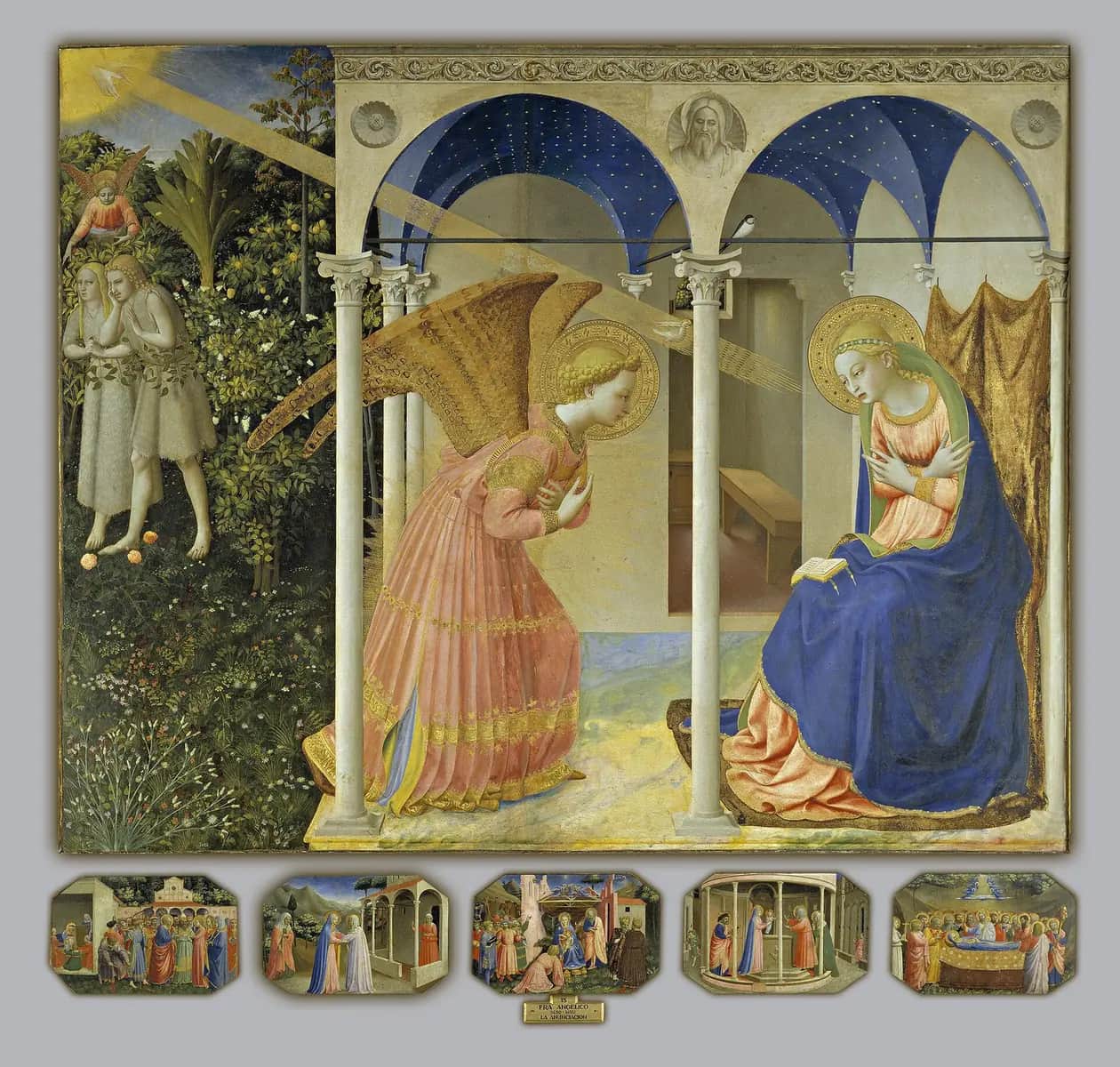
Luke 1:26 (WEB)
Now in the sixth month, the angel Gabriel was sent from God to a city of Galilee named Nazareth,
Catechism · 6
In the Old Testament
“Abraham's remarkable hospitality at Mamre foreshadows the annunciation of the true Son of the promise.” — Catechism footnote: Cf. Gen 18:1-15; Lk 1:26-38.
Heaven and Earth
“Finally, the angel Gabriel announced the birth of the Precursor and that of Jesus himself.” — Catechism footnote: Cf. Lk 1:11, 26.
"Conceived by the Power of the Holy Spirit and Born of the Virgin Mary"
- §488Paragraph 2 · "Conceived by the Power of the Holy Spirit and Born of the Virgin Mary"Read at vatican.va
“For this, from all eternity God chose for the mother of his Son a daughter of Israel, a young Jewish woman of Nazareth in Galilee, "a virgin betrothed to a man whose name was Joseph, of the house of David; and the virgin's name was Mary":” — Catechism footnote: Lk 1:26-27.
- §497Paragraph 2 · "Conceived by the Power of the Holy Spirit and Born of the Virgin Mary"Read at vatican.va
“The Gospel accounts understand the virginal conception of Jesus as a divine work that surpasses all human understanding and possibility:” — Catechism footnote: Mt 1 18-25; Lk 1:26-38.
"I Believe in the Holy Spirit"
“Against all human hope, God promises descendants to Abraham, as the fruit of faith and of the power of the Holy Spirit.” — Catechism footnote: Cf. Gen 18:1-15; Lk 1:26-38. 54-55; Jn 1:12-13; Rom 4:16-21.
“By the Holy Spirit's power and her faith, her virginity became uniquely fruitful.” — Catechism footnote: Cf. Lk 1:26-38; Rom 4:18-21; Gal 4:26-28.
Fathers and councils · 23
Irenaeus of Lyons
“And again, speaking in reference to the angel, he says: “But at that time the angel Gabriel was sent from God, who did also say to the virgin, Fear not, Mary; for thou hast found favour with God.”” — editor's note: Luke i. 26, etc.
Read the whole comment
Cyril of Jerusalem
“Mark also the accuracy of the Gospel, saying, And in the sixth month the Angel Gabriel was sent from God unto a city of Galilee, named Nazareth, to a virgin espoused to a man whose name was Joseph, and so forth.” — editor's note: Luke i. 26, 27.
Read the whole comment
Ambrose of Milan
“An angel is sent to the Virgin, a prophet to the widow.” — editor's note: S. Luke i. 26, 27.
Read the whole comment
Augustine of Hippo
“And the angel answered and said unto her, The Holy Ghost shall come upon thee, and the power of the Highest shall overshadow thee: therefore also that holy thing which shall be born shall be called the Son of God; and then follow matters not belonging to the question at present in hand.” — editor's note: Luke i. 26–34. [Ver. 34 is differently rendered in the text of the Revised Version. The Latin of Augustin would perhaps admit of the same sense, but is more…
Read the whole commentChapter IX.—Of the Question How It Can Be Shown that the Narrative of the Haul of Fishes Which Luke Has Given Us is Not to Be Identified with the Record of an Apparently Similar Incident Which John Has Reported…
Read the whole comment“But God judged it better both to take upon Him man through whom to conquer the enemy of the human race, from the race itself that had been conquered; and yet to do this of a virgin, whose conception, not flesh but spirit, not lust but faith, preceded.” — editor's note: Luke i. 26–32
Read the whole comment
Jerome
“Mary, the mother of the Lord, left the lowlands and made her way to the hill country, when, after receiving the angel’s message, she realized that she bore within her womb the Son of God.” — editor's note: Luke i. 26–31, 39.
Read the whole comment
Tertullian
“Clearly enough is the nativity announced by Gabriel.” — editor's note: Luke i. 26–38.
Read the whole comment“I recognise, too, the angel Gabriel as having been sent to “a virgin.”” — editor's note: Luke i. 26, 27.
Read the whole comment
Hippolytus of Rome
“…of this (Jesus), he expresses himself thus: That powers emanating from the second tetrad fashioned Jesus, who appeared on earth, and that the angel Gabriel filled the place of the Logos, and the Holy Spirit that of Zoe, and the “Power of the Highest” that of Anthropos, and the Virgin that of Ecclesia.” — editor's note: Luke i. 26–38.
Read the whole comment
Catena Aurea on Luke
- BedeCatena Aurea on Luke
Because either the Incarnation of Christ was to be in the sixth age of the world, or because it was to serve to the fulfilling of the law, rightly in the sixth month of John’s conception was an angel sent to Mary, to…
Read the whole comment - Basil the GreatCatena Aurea on Luke
The heavenly spirits visit us, not as it seems fit to them, but as the occasion conduces to our advantage, for they are ever looking upon the glory and fulness of the Divine Wisdom; hence it follows, The angel…
Read the whole comment - Gregory the GreatCatena Aurea on Luke
To the virgin Mary was sent, not any one of the angels, but the archangel Gabriel; for upon this service it was meet that the highest angel should come, as being the bearer of the highest of all tidings. He is…
Read the whole comment - Glossa OrdinariaCatena Aurea on Luke
But the place is also added whither he is sent, as it follows, To a city, Nazareth. For it was told that He would come a Nazarite, (i. e. the holy of the holy.)
Read the whole comment - BedeCatena Aurea on Luke
It was a fit beginning for man’s restoration, that an angel should be sent down from God to consecrate a virgin by a divine birth, for the first cause of man’s perdition was the Devil sending a serpent to deceive a…
Read the whole comment - Augustine of HippoCatena Aurea on Luke
To a virgin, for Christ could be born from virginity alone, seeing He could not have an equal in His birth. It was necessary for our Head by this mighty miracle to be born according to the flesh of a virgin, that He…
Read the whole comment - JeromeCatena Aurea on Luke
And rightly an angel is sent to the virgin, because the virgin state is ever akin to that of angels. Surely in the flesh to live beyond the flesh is not a life on earth but in heaven.
Read the whole comment - John ChrysostomCatena Aurea on Luke
The angel announces the birth to the virgin not after the conception, lest she should be thereby too much troubled, but before the conception he addresses her, not in a dream, but standing by her in visible shape.…
Read the whole comment - Ambrose of MilanCatena Aurea on Luke
Scripture has rightly mentioned that she was espoused, as well as a virgin, a virgin, that she might appear free from all connexion with man; espoused, that she might not be branded with the disgrace of sullied…
Read the whole comment - OrigenCatena Aurea on Luke
For if she had had no husband, soon would the thought have stolen into the Devil’s mind, how she who had known no man could be pregnant. It was right that the conception should be Divine, something more exalted than…
Read the whole comment - Ambrose of MilanCatena Aurea on Luke
But still more has it baffled the princes of the world, for the malice of devils soon detects even hidden things, while they who are occupied in worldly vanities, can not know the things of God. But moreover, a more…
Read the whole comment - BedeCatena Aurea on Luke
Which last applies not only to Joseph, but also to Mary, for the Law commanded that every one should take a wife out of his own tribe or family. It follows, And the virgin’s name was Mary.
Read the whole comment - BedeCatena Aurea on Luke
Maria, in Hebrew, is the star of the sea; but in Syriac it is interpreted Mistress, and well, because Mary was thought worthy to be the mother of the Lord of the whole world, and the light of endless ages.
Read the whole comment
Cross-references · 12
Cited together in Concerning Widows Chapter 1.
Cited together in Concerning Widows Chapter 1.
Cited together in Concerning Widows Chapter 1.
Cited together in On the Holy Trinity XIII.18.
Cited together in Catechism §488 and 1 other place.
Cited together in Catechism §488.
Cited together in Concerning Widows Chapter 1.
Cited together in Concerning Widows Chapter 1.
Cited together in Ambrose of Milan on Luke 1:26–27 (Catena Aurea).
Cited together in Concerning Widows Chapter 1.
Cited together in Ambrose of Milan on Luke 1:26–27 (Catena Aurea).
Cited together in Concerning Widows Chapter 1.