Luke 2:7 (WEB)
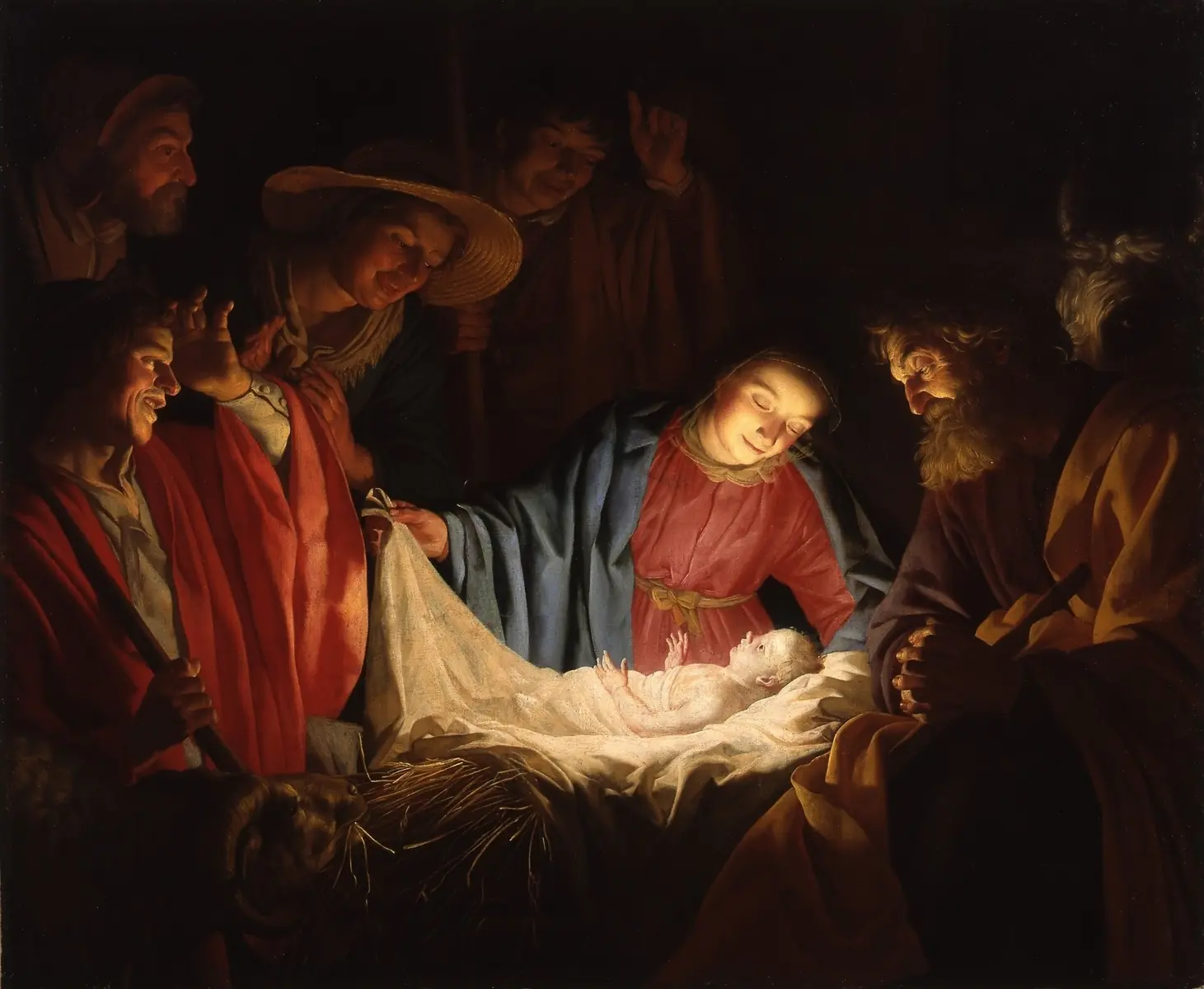
She gave birth to her firstborn son. She wrapped him in bands of cloth and laid him in a feeding trough, because there was no room for them in the inn.
Catechism · 1
“From the swaddling clothes of his birth to the vinegar of his Passion and the shroud of his Resurrection, everything in Jesus' life was a sign of his mystery.” — Catechism footnote: Cf Lk 2:7; Mt 27: 48; Jn 20:7.
Fathers and councils · 29
Gregory of Nyssa
“Surely it is clear that you speak of that from the virginity, and that “that which was conceived in her was of the Holy Ghost,” and that “the days were accomplished that she should be delivered, and she brought forth,” and none the less was her purity preserved in her child-bearing.” — editor's note: S. Luke ii. 6, 7.
Read the whole comment
Tertullian
“For He was from the native soil of Bethlehem, and from the house of David; as, among the Romans, Mary is described in the census, of whom is born Christ.” — editor's note: See Luke ii. 1–7.
Read the whole comment““Away,” says he, “with that eternal plaguey taxing of Cæsar, and the scanty inn, and the squalid swaddling-clothes, and the hard stable.” — editor's note: Luke ii. 1–7.
Read the whole comment
Hippolytus of Rome
“Chap. ii. 7 And if you please, we say that the Word was the first-born of God, who came down from heaven to the blessed Mary, and was made a first-born man in her womb, in order that the first-born of God might be manifested in union with a first-born man.” — the author cites it
Read the whole comment
Augustine of Hippo
“For the Lord was born at night from the womb of the Virgin Mary; the testimony of the shepherds doth assert this, who were “keeping watch over their flock.”” — editor's note: Luke ii. 7, 8.
Read the whole comment“Then Joseph, being raised from sleep, did as the angel of the Lord had bidden him, and took unto him his wife; and knew her not till she had brought forth her first-born son; and he called His name Jesus.” — editor's note: [The best Greek mss. read “a son” in Matt. i. 23. In Luke ii. 7 “first-born” occurs.—R.]
Read the whole comment“Again it is said, “And she brought forth a Son to him,” by which he is established to be a father, not in the flesh indeed, but in love.” — editor's note: Luke ii. 7. There seems to be no trace of any such reading anywhere else.
Read the whole comment
John Chrysostom
“And when he had taken her, “he knew her not, till she had brought forth her first-born Son.”” — editor's note: [There is no indication here of any knowledge of the reading found in the oldest authorities of every class (uncials, cursives and versions): ἔτεκεν υν,…
Read the whole comment
Jerome
“This is He who was once an infant wrapped in swaddling clothes and crying in a manger.” — editor's note: Luke ii. 7.
Read the whole comment“But, as every one praises most what is within his reach, let us pass now to the cottage-inn which sheltered Christ and Mary.” — editor's note: Luke ii. 7.
Read the whole comment“With her own hands she wrapped Him in the swaddling clothes, herself both mother and midwife, “and laid Him,” we are told, “in a manger, because there was no room for them in the inn”; a statement which, on the one hand, refutes the ravings of the…” — editor's note: S. Luke ii. 7.
Read the whole comment
Leo the Great
“The infancy of a babe is shown in the humbleness of its cradle: the greatness of the Most High is proclaimed by the angels’ voices.” — editor's note: Viz., that it was laid “in a manger:” the Gk. version has σπαργάνων, “swaddling clothes,” to represent cunarum and this meaning is adopted by Bright [and…
Read the whole comment
Gregory of Nazianzus
“This is the reason for the generation and the virgin, for the manger and Bethlehem; the generation on behalf of the creation, the virgin on behalf of the woman, Bethlehem because of Eden, the manger because of the garden, small and visible things on behalf of great and hidden things.” — editor's note: S. Luke ii. 7.
Read the whole comment
Catena Aurea on Luke
- Ambrose of MilanCatena Aurea on Luke
St. Luke has briefly explained the manner, time, and also the place in which Christ was born in the flesh; the manner, that is, in which the espoused has conceived, a virgin has born offspring.
Read the whole comment - Gregory of NyssaCatena Aurea on Luke
Though coming in the form of man, yet not in every thing is He subject to the laws of man’s nature; for while His being born of a woman, tells of human nature; virginity becoming capable of childbirth betokens…
Read the whole comment - BedeCatena Aurea on Luke
He condescended to become incarnate at that time, that after His birth He might be enrolled in Cæsar’s taxing, and in order to bring liberty to us might Himself become subject to slavery. It was well also that our…
Read the whole comment - Gregory the GreatCatena Aurea on Luke
Bethlehem is by interpretation the house of bread. For it is the Lord Himself who says, I am the bread of life which came down from heaven. (John 6:53.) The place therefore where the Lord was born was before called…
Read the whole comment - BedeCatena Aurea on Luke
But down to the very end of time, the Lord ceases not to be conceived at Nazareth, to be born at Bethlehem, whenever any of His hearers taking of the flour of the word makes himself a house of eternal bread. Daily in…
Read the whole comment - JeromeCatena Aurea on Luke
From this Helvidiusd strives to prove that no one can be called firstborn who has not brothers, as he is called only-begotten who is the only son of his parents. But we thus determine the matter. Every only-begotten…
Read the whole comment - BedeCatena Aurea on Luke
He is also only-begotten in the substance of His divinity, firstborn in the taking upon Himself humanity, firstborn in grace, only-begotten in nature.
Read the whole comment - JeromeCatena Aurea on Luke
Now here was no midwife, no tender anxiety of women; she wrapped the Child up in swaddling clothes, herself both mother and midwife.
Read the whole comment - BedeCatena Aurea on Luke
He who clothes the whole world with its varied beauty, is wrapped up in common linen, that we might be able to receive the best robe; He by Whom all things are made, is folded both hands and feet, that our hands…
Read the whole comment - A Greek expositorCatena Aurea on Luke
Oh the wonderful straitening and banishment which He underwent, Who holds the whole world in His hands! From the very beginning He seeks for poverty, and ennobles it in His own person.
Read the whole comment - John ChrysostomCatena Aurea on Luke
Surely if He had so willed it, He might have come moving the heavens, making the earth to shake, and shooting forth His thunderbolts; but such was not the way of His going forth; His desire was not to destroy, but to…
Read the whole comment - BedeCatena Aurea on Luke
He is confined in the narrow space of a rude manger, whose seat is the heavens, that He may give us ample room in the joys of His heavenly kingdom. He Who is the bread of Angels is laid down in a manger, that He…
Read the whole comment - Cyril of AlexandriaCatena Aurea on Luke
He finds man in his corrupt affections become like the beasts that perish, and therefore He is laid in the manger, in the place of food, that we changing the life of beasts, might be brought to the knowledge that…
Read the whole comment - BedeCatena Aurea on Luke
He who sits at His Father’s right hand, finds no room in an inn, that He might prepare for us in His Father’s house many mansions; (John 14:2.) He is born not in His Father’s house, but in an inn and by the way side,…
Read the whole comment - Gregory the GreatCatena Aurea on Luke
And that He might shew that on account of the human form which He took upon Him, He was born as in a strange country, not according to His power but according to His nature.
Read the whole comment - Ambrose of MilanCatena Aurea on Luke
On thy account then am I weak, in Himself is He strong. On thy account am I poor, in Himself is He rich. Consider not what thou seest, but acknowledge that thou art redeemed. I owe more, O Lord Jesus, to Thy…
Read the whole comment
Cross-references · 12
Cited together in Against Eunomius IV.1.
Cited together in Against Eunomius IV.1.
Cited together in Gregory the Great on Luke 2:6–7 (Catena Aurea).
Cited together in Catechism §515.
Cited together in Catechism §515.
Cited together in Catechism §515.
Cited together in Against Eunomius IV.1.
Cited together in Against Eunomius IV.1.
Cited together in Against Eunomius IV.1.
Cited together in Against Eunomius IV.1.
Cited together in Catechism §515.
Cited together in Catechism §515.