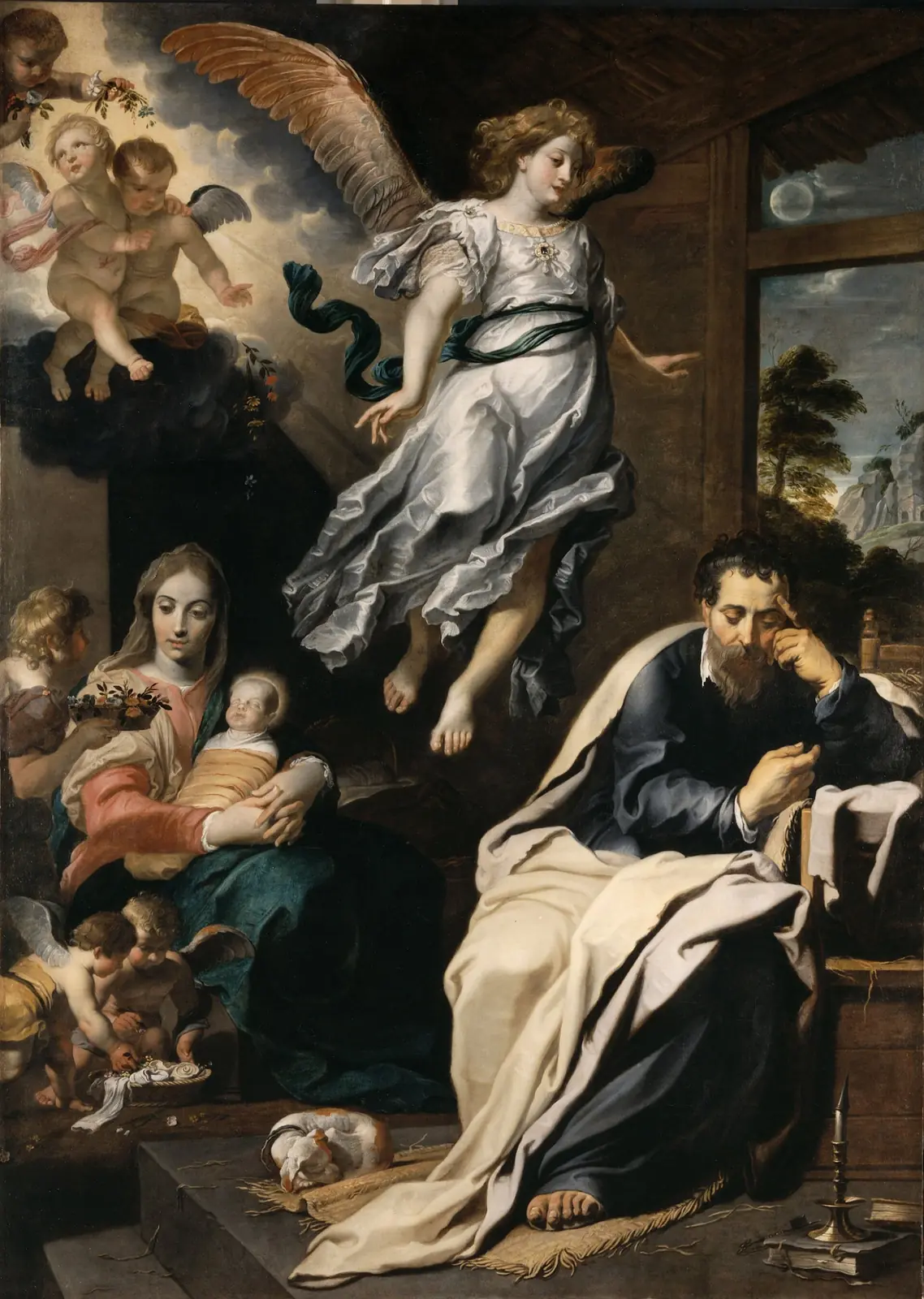
Matthew 1:20 (WEB)
But when he thought about these things, behold, an angel of the Lord appeared to him in a dream, saying, “Joseph, son of David, don’t be afraid to take to yourself Mary as your wife, for that which is conceived in her is of the Holy Spirit.
Catechism · 4
Heaven and Earth
“They protect Jesus in his infancy, serve him in the desert, strengthen him in his agony in the garden, when he could have been saved by them from the hands of his enemies as Israel had been.” — Catechism footnote: Cf. Mt 1:20; 2:13,19; 4:11; 26:53; Mk 1:13; Lk 22:43; Macc 10:29-30; 11:8.
"And in Jesus Christ, His Only Son, Our Lord"
“God called Joseph to "take Mary as your wife, for that which is conceived in her is of the Holy Spirit", so that Jesus, "who is called Christ", should be born of Joseph's spouse into the messianic lineage of David.” — Catechism footnote: Mt 1:20; cf. 1:16; Rom 1:1; 2 Tim 2:8; Rev 22:16.
"Conceived by the Power of the Holy Spirit and Born of the Virgin Mary"
- §486Paragraph 2 · "Conceived by the Power of the Holy Spirit and Born of the Virgin Mary"Read at vatican.va
“The Father's only Son, conceived as man in the womb of the Virgin Mary, is "Christ", that is to say, anointed by the Holy Spirit, from the beginning of his human existence, though the manifestation of this fact takes place only progressively: to the shepherds, to the magi, to John the Baptist, to the disciples.” — Catechism footnote: Cf. Mt 1:20; 2:1-12; Lk 1:35; 2:8-20; Jn 1:3 1-34; 2:11.
- §497Paragraph 2 · "Conceived by the Power of the Holy Spirit and Born of the Virgin Mary"Read at vatican.va
“The Gospel accounts understand the virginal conception of Jesus as a divine work that surpasses all human understanding and possibility:” — Catechism footnote: Mt 1 18-25; Lk 1:26-38.
Fathers and councils · 44
Origen
“…saying on the first occasion, “Joseph, thou son of David, fear not to take unto thee Mary thy wife; for that which is conceived in her is of the Holy Ghost;” and on the second, “Arise, and take the young Child, and His mother, and flee into Egypt; and be thou there until I bring thee word: for Herod will seek the…” — editor's note: Cf. Matt. i. 20.
Read the whole comment
Gregory of Nyssa
“Surely it is clear that you speak of that from the virginity, and that “that which was conceived in her was of the Holy Ghost,” and that “the days were accomplished that she should be delivered, and she brought forth,” and none the less was her purity preserved in her child-bearing.” — editor's note: S. Matt. i. 20
Read the whole comment
Irenaeus of Lyons
“Then again Matthew, when speaking of the angel, says, “The angel of the Lord appeared to Joseph in sleep.”” — editor's note: Matt. i. 20.
Read the whole comment“For she shall bring forth a son, and thou shalt call His name Jesus; for He shall save His people from their sins.”” — editor's note: Matt. i. 20, etc.
Read the whole comment
Cyril of Jerusalem
“And she shall bring forth a Son, and thou shalt call His name Jesus.” — editor's note: Matt. i. 20.
Read the whole comment
Theodoret of Cyrus
“He does not say “into a body hast thou changed,” but “a body hast thou prepared,” and he shows plainly that the formation of the body was wrought by the Spirit in accordance with the utterance of the gospel, “Fear not to take unto thee Mary thy wife; for that which is generated in her is of the Holy Ghost.”” — editor's note: Matt. i. 20. The rendering of γεννηθέν by “conceived” in the A.V. somewhat obscures the argument of Theodoret. The R.V. has “begotten” in the margin.
Read the whole comment
Augustine of Hippo
“Wherefore it hath been said even to Mary, “For that which is born in thee, is of the Holy Spirit.”” — editor's note: Matt. i. 20; Luke i. 35.
Read the whole comment“Now when Jesus was born in Bethlehem of Judæa, in the days of Herod the king, and so forth.” — editor's note: Matt. i. 19–21.
Read the whole comment“For the Evangelist goes on to say, “While he thought on these things, behold, the angel of the Lord appeared unto him in sleep, saying, Joseph, fear not to take unto thee Mary thy wife; for That which is conceived in her is of the Holy Ghost.” — editor's note: Matt. i. 20.
Read the whole comment“But while he thought on these things, “behold, the Angel of the Lord appeared unto him,” in sleep; and told him how it was, that she had not defiled her husband’s bed, but that she had conceived of the Holy Ghost the Lord of them both.” — editor's note: Matt. i. 20.
Read the whole comment“…was not with child by himself, he was told by the angel, “Fear not to take unto thee Mary thy wife; for that which is conceived in her is of the Holy Ghost:” that is, what thou suspectest to be begotten of another man is of the Holy Ghost.” — editor's note: Matt. i. 20
Read the whole comment“…appear to men in sleep, and make communications through dreams, as we read in the Gospel, “Behold, the angel of the Lord appeared unto him in a dream, saying”?” — editor's note: Matt. i. 20
Read the whole comment
John Chrysostom
“For it would not have been “of the Spirit” ( Matt. i. 20 ), if man had constructed it.” — the author cites it
Read the whole comment“Neither is the expression “from whom,” assigned to the Son only, but also to the Spirit; for the angel said to Joseph, “Fear not to take unto thee Mary thy wife, for that which is conceived in her is of the Holy Ghost.” ( Matt. i. 20.)” — the author cites it
Read the whole comment““While he thought on these things, an angel appeareth to Joseph in a dream.”” — editor's note: Matt. i. 20.
Read the whole comment
Tertullian
“You say that He was born through a virgin, not of a virgin, and in a womb, not of a womb, because the angel in the dream said to Joseph, “That which is born in her” (not of her) “is of the Holy Ghost.”” — editor's note: Matt. i. 20.
Read the whole comment
Basil the Great
““That which is conceived in her,” says the angel, “is of the Holy Ghost,” and the Lord says “that which is born of the spirit is spirit.”” — editor's note: Matt. i. 20.
Read the whole comment
Ambrose of Milan
“…to Matthew, the Angel said to Joseph: “Joseph, thou son of David, fear not to take Mary thy wife, for that which shall be born of her is of the Holy Spirit.”” — editor's note: S. Matt. i. 20.
Read the whole comment“And the Angel says: “That Which shall be born of her is of the Holy Spirit.”” — editor's note: S. Matt. i. 20.
Read the whole comment
John Cassian
““For that which is conceived in her,” said the angel, “is of the Holy Ghost.”” — editor's note: S. Matt. i. 20.
Read the whole comment“For Scripture says that that which was born of Mary is of the Holy Ghost.” — editor's note: S. Matt. i. 20.
Read the whole comment
Jerome
“It turns upon the record in Matt. i. 18–25, and especially on the words, “Before they came together” (c. 4), “knew her not till, &c.” (5–8).” — the author cites it
Read the whole comment
Cyprian of Carthage
“And she shall bring forth a son, and thou shalt call His name Jesus; for He shall save His people from their sins.”” — editor's note: Matt. i. 20, 21.
Read the whole comment
Catena Aurea on Matthew
- Remigius of AuxerreCatena Aurea on Matthew
Because Joseph was minded, as has been said, to put Mary away privily, which if he had done, there would have been few who would not rather have thought her a harlot than a virgin, therefore this purpose of Joseph…
Read the whole comment - Glossa OrdinariaCatena Aurea on Matthew
In this is to be noted the wise soul that desires to undertake nothing rashly.
Read the whole comment - John ChrysostomCatena Aurea on Matthew
Also observe the mercifulness of Joseph, that he imparted his suspicions to none, not even to her whom he suspected, but kept them within himself.
Read the whole comment - Augustine of HippoCatena Aurea on Matthew
Yet though Joseph think on these things, let not Mary the daughter of David be troubled; as the word of the Prophet brought pardon to David, so the Angel of the Saviour delivers Mary. Behold, again appears Gabriel…
Read the whole comment - Ambrose of MilanCatena Aurea on Matthew
In this word “appeared” is conveyed the power of Him that did appear, allowing Himself to be seen where and how He pleases.
Read the whole comment - Rabanus MaurusCatena Aurea on Matthew
How the Angel appeared to Joseph is declared in the words, “In his sleep;” that is, as Jacob saw the ladder offered by a kind of imagining to the eyes of his heart.
Read the whole comment - John ChrysostomCatena Aurea on Matthew
He did not appear so openly to Joseph as to the Shepherds, because he was faithful; the shepherds needed it, because they were ignorant. The Virgin also needed it, as she had first to be instructed in these mighty…
Read the whole comment - Glossa OrdinariaCatena Aurea on Matthew
The Angel appearing calls him by name, and adds his descent, in order to banish fear, “Joseph, son of David;” Joseph, as though he were known to him by name and his familiar friend.
Read the whole comment - Pseudo-ChrysostomCatena Aurea on Matthew
By addressing him as son of David, he sought to recall to his memory the promise of God to David, that of his seed should Christ be born.
Read the whole comment - John ChrysostomCatena Aurea on Matthew
But by saying, “Be not afraid,” he shews him to be in fear that he had offended God, by having an adulteress; for only as such would he have ever thought of putting her away.
Read the whole comment - Peter ChrysologusCatena Aurea on Matthew
As her betrothed husband also he is admonished not to be afraid; for the mind that compassionates has most fear; as though he were to say, Here is no cause of death, but of life; she that brings forth life, does not…
Read the whole comment - Pseudo-ChrysostomCatena Aurea on Matthew
Also by the words, “Fear not,” he desired to shew that he knew the heart; that by this he might have the more faith in those good things to come, which he was about to speak concerning Christ.
Read the whole comment - Ambrose of MilanCatena Aurea on Matthew
Be not troubled that he calls her his wife; for she is not herein robbed of her virginity, but her wedlock is witnessed to, and the celebration of her marriage is declared.
Read the whole comment - JeromeCatena Aurea on Matthew
But we are not to think that she ceased to be betrothed, because she is here called wife, since we know that this is the Scripture manner to call the man and woman, when espoused, husband and wife; and this is…
Read the whole comment - John ChrysostomCatena Aurea on Matthew
He says, “Fear not to take unto thee;” that is, to keep at home; for in thought she was already dismissed.
Read the whole comment - Rabanus MaurusCatena Aurea on Matthew
Or, “to take her,” that is, in marriage union and continual converse.
Read the whole comment - Pseudo-ChrysostomCatena Aurea on Matthew
There were three reasons why the Angel appeared to Joseph with this message. First, that a just man might not be led into an unjust action, with just intentions. Secondly, for the honour of the mother herself, for…
Read the whole comment - John ChrysostomCatena Aurea on Matthew
Or, The Angel appeared to Joseph when he was in this perplexity, that his wisdom might be apparent to Joseph, and that this might be a proof to him of those things that he spoke. For when he heard out of the mouth of…
Read the whole comment - Glossa OrdinariaCatena Aurea on Matthew
To be “born in her,” and “born of her,” are two different things; to be born of her is to come into the world; to be born in her, is the same as to be conceived. Or the word, “born,” is used according to the…
Read the whole comment - Augustine of HippoCatena Aurea on Matthew
But if Christ was born by the agency of the Holy Ghost, how is that said, “Wisdom hath built herself an house?” [Prov 9:1] That house may be taken in two meanings. First, the house of Christ is the Church, which He…
Read the whole comment - Augustine of HippoCatena Aurea on Matthew
But shall we therefore say that the Holy Spirit is the Father of the man Christ, that as God the Father begot the Word, so the Holy Spirit begot the man? This is such an absurdity, that the ears of the faithful…
Read the whole comment
Cross-references · 27
Parallel passages
Matthew 1:20 and Acts 7:30 share the same wording (9 words).
Cited together with
Cited together in Against Celsus I.66.
Cited together in Catechism §437 and 1 other place.
Cited together in Against Eunomius IV.1.
Cited together in Against Eunomius IV.1.
Cited together in Catechism §437.
Cited together in On the Flesh of Christ Chapter 20 and 1 other place.
Cited together in Against Eunomius IV.1.
Cited together in Against Heresies IV.23.
Cited together in Catechism §437.
Cited together in On the Incarnation of the Lord, Against Nestorius VII.17.
Cited together in Against Heresies IV.23.
Cited together in Against Heresies IV.23.
Cited together in Catechism §437.
Cited together in Augustine of Hippo on Matthew 1:20 (3) (Catena Aurea).
Cited together in Against Eunomius IV.1 and 1 other place.
Cited together in Catechism §437.
Cited together in Against Eunomius IV.1.
Cited together in Catechism §437.
Cited together in The Enchiridion Chapter 59.
Cited together in The Enchiridion Chapter 59.
Cited together in Jerome on Matthew 1:20 (Catena Aurea).
Cited together in On the Flesh of Christ Chapter 20.
Cited together in On the Flesh of Christ Chapter 20.
Cited together in Augustine of Hippo on Matthew 1:20 (2) (Catena Aurea) and 1 other place.
Cited together in Against Heresies IV.23.
Cited together in The Enchiridion Chapter 59.