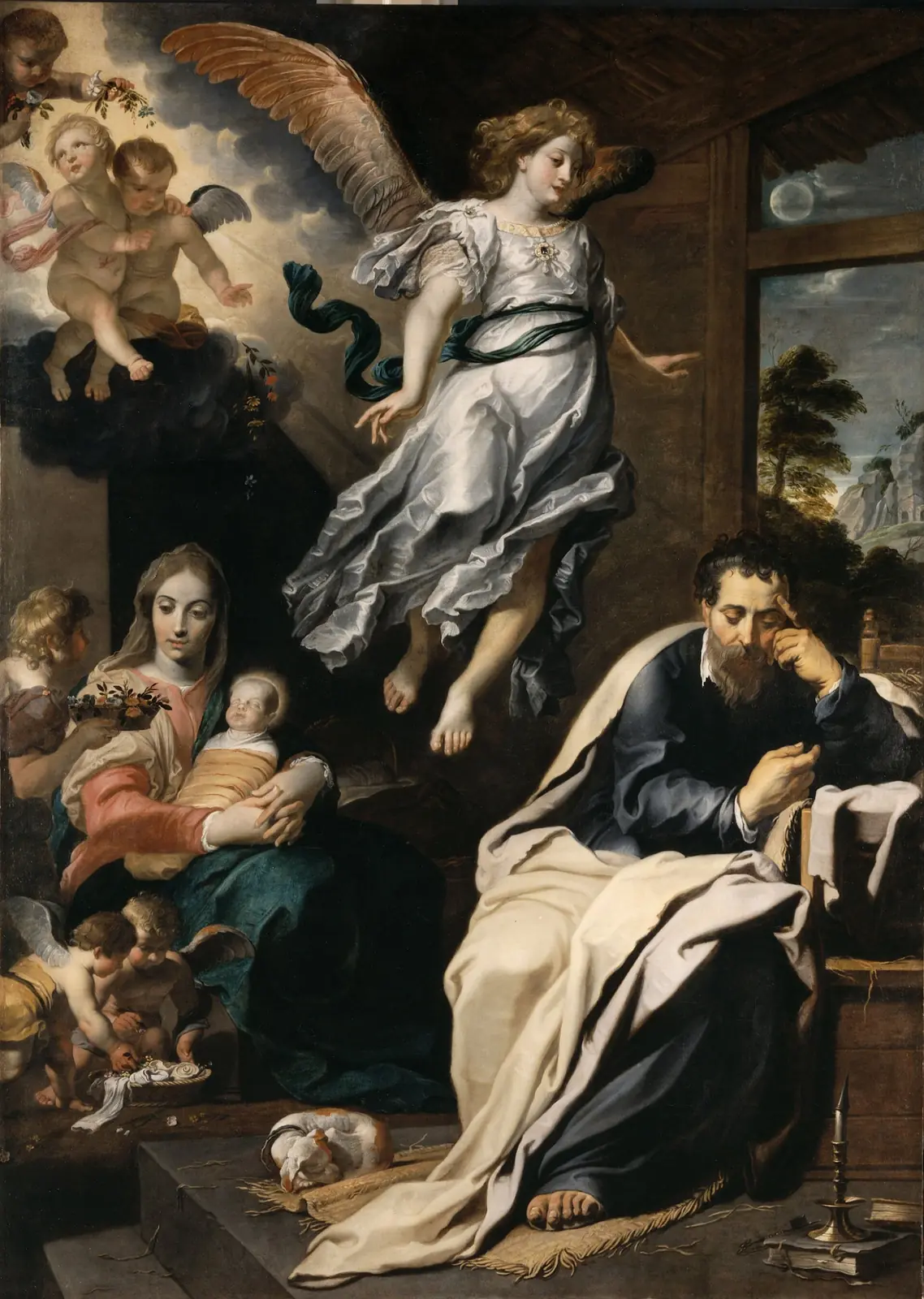
Matthew 1:18 (WEB)
Now the birth of Jesus Christ was like this: After his mother, Mary, was engaged to Joseph, before they came together, she was found pregnant by the Holy Spirit.
Catechism · 1
- §497Paragraph 2 · "Conceived by the Power of the Holy Spirit and Born of the Virgin Mary"Read at vatican.va
“The Gospel accounts understand the virginal conception of Jesus as a divine work that surpasses all human understanding and possibility:” — Catechism footnote: Mt 1 18-25; Lk 1:26-38.
Fathers and councils · 45
Irenaeus of Lyons
“Matthew, again, relates His generation as a man, saying, “The book of the generation of Jesus Christ, the son of David, the son of Abraham;” and also, “The birth of Jesus Christ was on this wise.”” — editor's note: Matt. i. 1, 18.
Read the whole comment“Then, that he might free our mind from suspicion regarding Joseph, he says: “But the birth of Christ was on this wise.” — editor's note: Matt. i. 18. It is to be observed that Irenæus here reads Christ instead of Jesus Christ, as in text. rec., thus agreeing with the reading of the Vulgate in…
Read the whole comment“…testify, [saying,] that before Joseph had come together with Mary, while she therefore remained in virginity, “she was found with child of the Holy Ghost;” and that the angel Gabriel said unto her, “The Holy Ghost shall come upon thee, and the power of the Highest shall overshadow thee; therefore also that holy…” — editor's note: Matt. i. 18.
Read the whole comment
Eusebius of Caesarea
“This James was called the brother of the Lord because he was known as a son of Joseph, and Joseph was supposed to be the father of Christ, because the Virgin, being betrothed to him, “was found with child by the Holy Ghost before they came together,” as the account of the holy Gospels shows.” — editor's note: Matt. i. 18.
Read the whole comment
Augustine of Hippo
“Whereas His mother Mary was espoused to Joseph, before they came together, she was found with child of the Holy Ghost.” — editor's note: Matt. i. 18.
Read the whole comment“And Matthew says, “She was found with child of the Holy Ghost.”” — editor's note: Matt. i. 18
Read the whole comment“Then in order to tell us how Christ was born of the Virgin Mary, he went on and said, “Now the birth of Jesus Christ was on this wise;” for by the line of the generations he had showed why Christ is called the Son of David, and the Son of Abraham.” — editor's note: Matt. i. 7–18.
Read the whole comment“Which words, when rightly understood, are all understood to be about the Lord Jesus Christ, under the name of David, on account of the form of a servant, which the same Mediator assumed from the virgin of the seed of David.” — editor's note: Matt. i. 1, 18; Luke i. 27.
Read the whole comment
John Chrysostom
“When His mother Mary was espoused to Joseph, she was found with Child of the Holy Ghost.” ( Matt. i. 18.)” — the author cites it
Read the whole comment“For it is no statement of mine, but of our fathers, wonderful and illustrious men.” — editor's note: St. Ignatius ad Ephes. xix. init. Κα λαθεν τον ρχοντα το ανο τουτο παρθενα Μαρα, κα τοκετς ατ, μοω κα θνατο το Κυρου τρα μυστρια κραυγ τινα ν συχ Θεο πρχθη.…
Read the whole comment““The birth of Jesus Christ was on this wise.”“Of what kind of birth art thou telling me, I pray thee, since thou hast already mentioned His ancestors?”” — editor's note: Matt. i. 18.
Read the whole comment
Ambrose of Milan
“For who can doubt when you find in the commencement of the Gospel that the generation of Jesus Christ was on this wise: “When Mary was espoused to Joseph, before they came together she was found with child of [ex] the Holy Spirit.”” — editor's note: S. Matt. i. 18.
Read the whole comment“And the Spirit created the whole mystery, according to that which we read, for “Mary was found with child of the Holy Spirit.”” — editor's note: S. Matt. i. 18.
Read the whole comment“For Mary conceived not of man, but was with child of the Holy Spirit, as Matthew says: “She was found with child of the Holy Spirit.”” — editor's note: S. Matt. i. 18.
Read the whole comment
Jerome
“It turns upon the record in Matt. i. 18–25, and especially on the words, “Before they came together” (c. 4), “knew her not till, &c.” (5–8).” — the author cites it
Read the whole comment
Catena Aurea on Matthew
- Pseudo-ChrysostomCatena Aurea on Matthew
Having said above, “And Jacob begat Joseph,” to whom Mary being espoused bare Jesus; that none who heard should suppose that His birth was as that of any of the forementioned fathers, he cuts off the thread of his…
Read the whole comment - John ChrysostomCatena Aurea on Matthew
He announces that he is to relate the manner of the generation, shewing therein that he is about to speak some new thing; that you may not suppose when you hear mention of Mary’s husband, that Christ was born by the…
Read the whole comment - Remigius of AuxerreCatena Aurea on Matthew
Yet it might be referred to the foregoing in this way, The generation of Christ was, as I have related, thus, “Abraham begat Isaac.”
Read the whole comment - JeromeCatena Aurea on Matthew
But why is He conceived not of a Virgin merely, but of a Virgin espoused? First, that by the descent of Joseph, Mary’s family might be made known; secondly, that she might not be stoned by the Jews as an adulteress;…
Read the whole comment - Pseudo-ChrysostomCatena Aurea on Matthew
Therefore both espoused and yet remaining at home; for as in her who should conceive in the house of her husband, is understood natural conception; so in her who conceives before she be taken to her husband, there is…
Read the whole comment - JeromeCatena Aurea on Matthew
It is to be known, that Helvidius, a certain turbulent man, having got matter of disputation, takes in hand to blaspheme against the Mother of God. His first proposition was, Matthew begins thus, “When she was…
Read the whole comment - OrigenCatena Aurea on Matthew
She was indeed espoused to Joseph, but not united in wedlock; that is to say, His mother immaculate, His mother incorrupt, His mother pure. His mother! Whose mother? The mother of God, of the Only-begotten, of the…
Read the whole comment - Cyril of AlexandriaCatena Aurea on Matthew
What will any one see in the Blessed Virgin more than in other mothers, if she be not the mother of God, but of Christ, or the Lord, as Nestorius says? For it would not be absurd should any one please to name the…
Read the whole comment - Peter ChrysologusCatena Aurea on Matthew
If you are not confounded when you hear of the birth of God, let not His conception disturb you, seeing the pure virginity of the mother removes all that might shock human reverence. And what offence against our awe…
Read the whole comment - Cyril of AlexandriaCatena Aurea on Matthew
But if we were to say that the holy Body of Christ came down from heaven, and was not made of His mother, as Valentinus does, in what sense could Mary be the Mother of God?
Read the whole comment - Glossa OrdinariaCatena Aurea on Matthew
The name of His Mother is added, “Mary.”
Read the whole comment - BedeCatena Aurea on Matthew
Mary in interpreted, ‘Star of the Sea,’ after the Hebrew; ‘Mistress,’ after the Syriac; as she bare into the world the Light of salvation, and the Lord. [ed. note, r: מִרְיָם their rebellion. S. Ambrose interprets it…
Read the whole comment - Glossa OrdinariaCatena Aurea on Matthew
And to whom she was betrothed is shewn, Joseph.
Read the whole comment - Pseudo-ChrysostomCatena Aurea on Matthew
Mary was therefore betrothed to a carpenter, because Christ the Spouse of the Church was to work the salvation of all men through the wood of the Cross.
Read the whole comment - John ChrysostomCatena Aurea on Matthew
What follows, “Before they came together,” does not mean before she was brought to the bridegroom’s house, for she was already within. For it was a frequent custom among the ancients to have their betrothed wives…
Read the whole comment - Glossa OrdinariaCatena Aurea on Matthew
But the words denote carnal knowledge.
Read the whole comment - Pseudo-ChrysostomCatena Aurea on Matthew
That He should not be born of passion, of flesh and blood, who was therefore born that He might take away all passion of flesh and blood.
Read the whole comment - Augustine of HippoCatena Aurea on Matthew
There was no carnal knowledge in this wedlock, because in sinful flesh this could not be without carnal desire which came of sin, and which He would be without, who was to be without sin; and that hence He might…
Read the whole comment - Augustine of HippoCatena Aurea on Matthew
Christ was also born of a pure virgin, because it was not holy that virtue should be born of pleasure, chastity of self-indulgence, incorruption of corruption. Nor could He come from heaven but after some new manner,…
Read the whole comment - JeromeCatena Aurea on Matthew
And found by none other than by Joseph, who knew all, as being her espoused husband.
Read the whole comment - Pseudo-ChrysostomCatena Aurea on Matthew
For, as a not incredible account relates, Joseph was absent when the things were done which Luke writes. For it is not easy to suppose that the Angel came to Mary and said those words, and Mary made her answer when…
Read the whole comment - John ChrysostomCatena Aurea on Matthew
He says exactly “was found,” for so we use to say of things not thought of. And that you should not molest the Evangelist by asking in what way was this birth of a virgin, he clears himself shortly, saying, “Of the…
Read the whole comment - Glossa OrdinariaCatena Aurea on Matthew
Therefore the words, “Is of the Holy Ghost,” were set down by the Evangelist, to the end, that when it was said that she was with child, all wrong suspicion should be removed from the minds of the hearers.
Read the whole comment - Augustine of HippoCatena Aurea on Matthew
But not, as some impiously think, are we to suppose, that the Holy Spirit was as seed, but we say that He wrought with the power and might of a Creator. [ed. note: And thus S. Hilary speaks of the sementiva ineuntis…
Read the whole comment - Ambrose of MilanCatena Aurea on Matthew
That which is of any thing is either of the substance or the power of that thing; of the substance, as the Son who is of the Father; of the power, as all things are of God, even as Mary was with Child of the Holy Spirit.
Read the whole comment - Augustine of HippoCatena Aurea on Matthew
Furthermore, this manner in which Christ was born of the Holy Spirit suggests to us the grace of God, by which man without any previous merits, in the very beginning of his nature, was united with the Word of God…
Read the whole comment - JeromeCatena Aurea on Matthew
But says Helvidius; Neither would the Evangelist have said, “Before they came together,” if they were not to come together afterwards; as none would say, Before dinner, where there was to be no dinner. As if one…
Read the whole comment - JeromeCatena Aurea on Matthew
Therefore it by no means follows that they did come together afterwards; Scripture however shews not what did happen.
Read the whole comment - Remigius of AuxerreCatena Aurea on Matthew
Or the word “come together” may not mean carnal knowledge, but may refer to the time of the nuptials, when she who was betrothed begins to be wife. Thus, “before they came together,” may mean before they solemnly…
Read the whole comment - Augustine of HippoCatena Aurea on Matthew
How this was done Matthew omits to write, but Luke relates after the conception of John, “In the sixth month the Angel was sent;” and again, “The Holy Ghost shall come upon thee.” This is what Matthew relates in…
Read the whole comment
Cross-references · 12
Cited together in On the Holy Spirit II.6.
Cited together in On the Holy Spirit II.6.
Cited together in On the Holy Spirit II.6.
Cited together in Augustine of Hippo on Matthew 1:18 (5) (Catena Aurea).
Cited together in On the Holy Spirit II.6.
Cited together in On the Holy Spirit II.6.
Cited together in On the Holy Spirit II.6.
Cited together in On the Holy Spirit II.6.
Cited together in On the Holy Spirit II.6.
Cited together in On the Holy Spirit II.6.
Cited together in On the Holy Spirit II.6.
Cited together in On the Holy Spirit II.6.