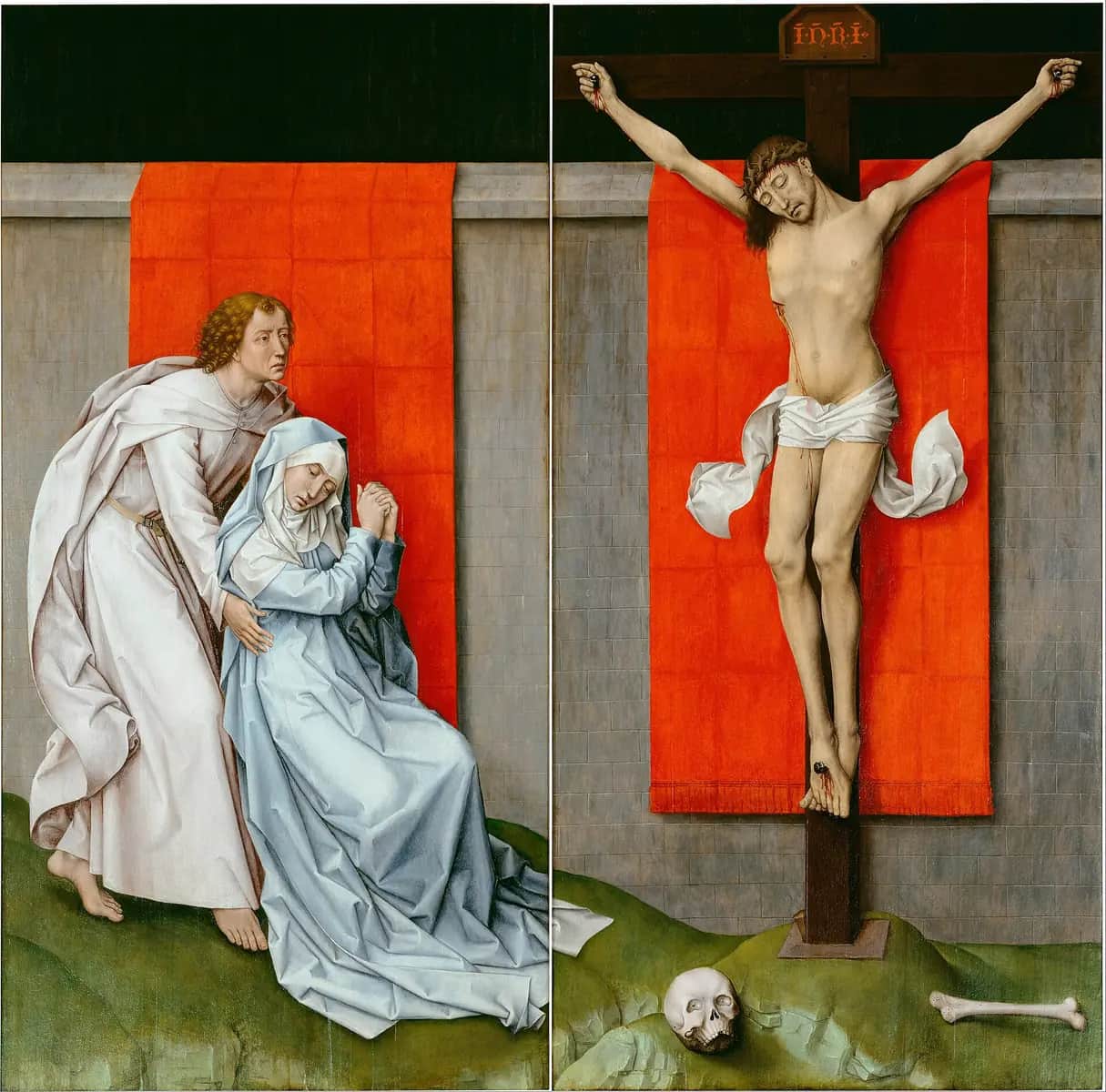
Luke 23:46 (WEB)
Jesus, crying with a loud voice, said, “Father, into your hands I commit my spirit!” Having said this, he breathed his last.
Catechism · 3
"I Believe in the Resurrection of the Body"
“Therefore the Christian can experience a desire for death like St. Paul's: "My desire is to depart and be with Christ. " He can transform his own death into an act of obedience and love towards the Father, after the example of Christ:” — Catechism footnote: Cf. Lk 23:46.
In the Fullness of Time
“"It is finished"; "Father, into your hands I commit my spirit!"” — Catechism footnote: Lk 23:46.
"I Believe in the Holy Spirit"
“At last Jesus' hour arrives: he commends his spirit into the Father's hands” — Catechism footnote: Cf. Lk 23:46; Jn 19:30.
Fathers and councils · 37
Gregory of Nyssa
“…so too, at His death (which He brought about at His will, Who separated His soul from His Body, Who said to His own Father “Into Thy hands I commend My Spirit,” Who, as He says, “had power to lay it down and had power to take it again”), He Who, because He is the Lord of glory, despised that which is shame among men,…” — editor's note: S. Luke xxiii. 46.
Read the whole comment
Tertullian
“We have, moreover, in that other Gospel a clear revelation, i.e. of the Son’s distinction from the Father, “My God, why hast Thou forsaken me?” and again, (in the third Gospel,) “Father, into Thy hands I commend my spirit.”” — editor's note: Luke xxiii. 46.
Read the whole comment“He commends His spirit into the hands of the Father.” — editor's note: Luke xxiii. 46.
Read the whole comment“In all other respects the Father did not forsake the Son, for it was into His Father’s hands that the Son commended His spirit.” — editor's note: Luke xxiii. 46.
Read the whole comment“And so the “pressure” must be maintained up to that hour in which the orb—involved from the sixth hour in a general darkness—performed for its dead Lord a sorrowful act of duty; so that we too may then return to enjoyment when the universe regained its sunshine.” — editor's note: See Matt. xxvii. 45–54; Mark xvi. 33–39; Luke xxiii. 44–47.
Read the whole comment“He calls with a loud voice to the Father, “Into Thine hands I commend my spirit,” that even when dying He might expend His last breath in fulfilling the prophets.” — editor's note: Comp. Luke xxiii. 46 with Ps. xxxi. 5.
Read the whole comment
Jerome
“And, again,“Father, into Thy hands I commend My spirit,” and“Father, forgive them, for they know not what they do.”” — editor's note: S. Luke xxiii. 46.
Read the whole comment
Cyril of Jerusalem
“He cried to the Father, saying, Father, into Thy hands I commend My spirit; I commend it, that I may take it again.” — editor's note: Luke xxiii. 46.
Read the whole comment
Justin Martyr
“For when Christ was giving up His spirit on the cross, He said, ‘Father, into Thy hands I commend my spirit,’ as I have learned also from the memoirs.” — editor's note: Luke xxiii. 46.
Read the whole comment
Theodoret of Cyrus
““That which can be mastered was mastered; that which can be crucified was crucified, but He that had power alike to dwell in it and to leave it said ‘Father into thy hands I commend my Spirit,’ not into the hands of them who were trying to hasten His death.” — editor's note: Luke xxiii. 46
Read the whole comment- Theodoret of Cyrus, Dialogues (Eranistes) Demonstrations by.3Demonstrations by Syllogisms
“When on the cross the Lord Christ said, “Father into Thy hands I commend my spirit,” this spirit is said by the Arians and the Eunomians to be the Godhead of the only-begotten, for they hold that the body which He took was without a soul, but…” — editor's note: Luke xxiii. 46
Read the whole comment
Augustine of Hippo
“For his version is thus: “And Jesus, crying with a loud voice, said, Father, into Thy hands I commend my spirit: and saying this, He gave up the ghost.”” — editor's note: Luke xxiii. 46.
Read the whole comment
Hilary of Poitiers
“For although twelve legions of angels might have come to the help of the Lord in His hour of passion, yet that He might perfectly fulfil His service of humble obedience, He surrendered Himself to suffering and weakness, only praying with the words: Father into Thy hands I commend My spirit.” — editor's note: St. Luke xxiii. 46.
Read the whole comment“…His pain to complain that He was forsaken: Who, destitute of the Father’s help, gave up the ghost with the words, Father, into Thy hands I commend My Spirit.” — editor's note: St. Luke xxiii. 46.
Read the whole comment“These impious assertions are based on the words, My soul is sorrowful even unto death, and “Father if it be possible let this cup pass away from Me”, and also, My God, My God, why hast Thou forsaken Me? to which they also add, Father into Thy hands I commend My Spirit.” — editor's note: St. Luke xxiii. 46.
Read the whole comment
Ambrose of Milan
“So, too, the Lord signified His Soul by the word Spirit, when He said: “Into Thy hands I commend My Spirit.”” — editor's note: S. Luke xxiii. 46.
Read the whole comment
Catena Aurea on John
- Theophylact of OhridCatena Aurea on John
“(Luke 23:46) you cannot understand this of an irrational soul: or again, the passage, Thou shall not leave My soul in hell.” — the author cites it
Read the whole comment
Catena Aurea on Luke
- Cyril of AlexandriaCatena Aurea on Luke
As soon as the Lord of all had been given up to be crucified, the whole framework of the world bewailed its rightful Master, and the light was darkened at mid-day, (Amos 8:9.) which was a manifest token that the…
Read the whole comment - Augustine of HippoCatena Aurea on Luke
What is here said of the darkness, the other two Evangelists, Matthew and Mark, confirm, but St. Luke adds the cause whence the darkness arose, saying, And the sun was darkened.
Read the whole comment - Augustine of HippoCatena Aurea on Luke
This darkening of the sun it is quite plain did not happen in the regular and fixed course of the heavenly bodies, because it was then the Passover, which is always celebrated at the full moon. But a regular eclipse…
Read the whole comment - A Greek expositorCatena Aurea on Luke
This miracle then took place that it might be made known, that He who had undergone death was the Ruler of the whole creation.
Read the whole comment - Ambrose of MilanCatena Aurea on Luke
The sun also is eclipsed to the sacrilegious, that it may overshadow the scene of their awful wickedness; darkness was spread over the eyes of the unbelieving, that the light of faith might rise again.
Read the whole comment - BedeCatena Aurea on Luke
But Luke, wishing to join miracle to miracle, adds, And the veil of the temple was rent in twain. This took place when our Lord expired, as Matthew and Mark bear witness, but Luke related it by anticipation.
Read the whole comment - Theophylact of OhridCatena Aurea on Luke
By this then our Lord shewed that the Holy of Holies should be no longer inaccessible, but being given over into the hands of the Romans, should be defiled, and its entrance laid open.
Read the whole comment - Ambrose of MilanCatena Aurea on Luke
The veil also is rent, by which is declared the division of the two people, and the profanation of the synagogue. The old veil is rent that the Church may hang up the new veils of faith. The covering of the synagogue…
Read the whole comment - Theophylact of OhridCatena Aurea on Luke
Whereby it is signified that the veil which kept us asunder from the holy things which are in heaven, is broken through, namely, enmity and sin.
Read the whole comment - Ambrose of MilanCatena Aurea on Luke
It took place also at that time when every mystery of Christ’s assumed mortality was fulfilled, and His immortality alone remained; as it follows, And when Jesus had cried with a loud voice, he said.
Read the whole comment - BedeCatena Aurea on Luke
By invoking the Father He declares Himself to be the Son of God, but by commending His Spirit, He signifies not the weakness of His strength, but His confidence in the same power with the Father.
Read the whole comment - Ambrose of MilanCatena Aurea on Luke
The flesh dies that the Spirit may rise again. The Spirit is commended to the Father, that heavenly things also may be loosed from the chain of iniquity, and peace be made in heaven, which earthly things should follow.
Read the whole comment - John ChrysostomCatena Aurea on Luke
Now this voice teaches us, that the souls of the saints are not henceforth shut up in hell as before, but are with God, Christ being made the beginning of this change.
Read the whole comment - Athanasius of AlexandriaCatena Aurea on Luke
For He commends to His Father through Himself all mankind quickened in Him; for we are His members; as the Apostle says, Ye are all one in Christ. (Gal. 3:28.)
Read the whole comment - Gregory of NyssaCatena Aurea on Luke
But it becomes us to enquire how our Lord distributes Himself into three parts at once; into the bowels of the earth, as He told the Pharisees; into the Paradise of God, as He told the thief; into the hands of the…
Read the whole comment - Ambrose of MilanCatena Aurea on Luke
His spirit then is commended to God, but though He is above He yet gives light to the parts below the earth, that all things may be redeemed. For Christ is all things, and in Christ are all things.
Read the whole comment - Gregory of NyssaCatena Aurea on Luke
There is another explanation, that at the time of His Passion, His Divinity being once united to His humanity, left neither part of His humanity, but of its own accord separated the soul from the body, yet shewed…
Read the whole comment - John DamasceneCatena Aurea on Luke
Or to speak more expressly, In respect of His body, He was in the grave, in respect of His soul, He was in hell, and with the thief in Paradise; but as God, on the throne with His Father and the Holy Spirit.
Read the whole comment - Theophylact of OhridCatena Aurea on Luke
But crying with a loud voice He gives up the ghost, because He had in Himself the power of laying down His life and taking it up again.
Read the whole comment - Ambrose of MilanCatena Aurea on Luke
He gave up His Spirit, because He did not lose it as one unwilling; for what a man sends forth is voluntary, what he loses, compulsory.
Read the whole comment
Cross-references · 41
Cited together in Catechism §730.
Cited together in Catechism §730.
Cited together in Theophylact of Ohrid on John 2:18–22 (4) (Catena Aurea).
Cited together in Theophylact of Ohrid on John 2:18–22 (4) (Catena Aurea) and 1 other place.
Cited together in Theophylact of Ohrid on John 2:18–22 (4) (Catena Aurea).
Cited together in Catechism §730.
Cited together in Catechism §730 and 1 other place.
Cited together in Catechism §2605.
Cited together in Catechism §2605.
Cited together in Catechism §730 and 2 other places.
Cited together in Catechism §730.
Cited together in Catechism §730.
Cited together in Catechism §730.
Cited together in Homilies on the Psalms Homily 2.
Cited together in Homilies on the Psalms Homily 2.
Cited together in Catechism §730.
Cited together in Against Eunomius V.5 and 1 other place.
Cited together in On the Holy Spirit II.6.
Cited together in Catechism §1011.
Cited together in Dialogues (Eranistes) Demonstrations by.3.
Cited together in Homilies on the Psalms Homily 2.
Cited together in Dialogue with Trypho Chapter 105.
Cited together in Dialogue with Trypho Chapter 105.
Cited together in On the Holy Spirit II.6.
Cited together in On the Holy Spirit II.6.
Cited together in Theophylact of Ohrid on John 2:18–22 (4) (Catena Aurea).
Cited together in Homilies on the Psalms Homily 2.
Cited together in Homilies on the Psalms Homily 2.
Cited together in On the Holy Spirit II.6.
Cited together in On the Holy Spirit II.6.
Cited together in On the Holy Spirit II.6.
Cited together in Gregory of Nyssa on Luke 23:44–46 (2) (Catena Aurea).
Cited together in On the Holy Spirit II.6.
Cited together in Cyril of Alexandria on Luke 23:44–46 (Catena Aurea).
Cited together in On the Holy Spirit II.6.
Cited together in On the Holy Spirit II.6.
Cited together in Dialogue with Trypho Chapter 105.
Cited together in Harmony of the Gospels III.19 and 1 other place.
Cited together in Catechism §730.
Cited together in Catechism §2605 and 1 other place.
Cited together in On the Holy Spirit II.6 and 1 other place.