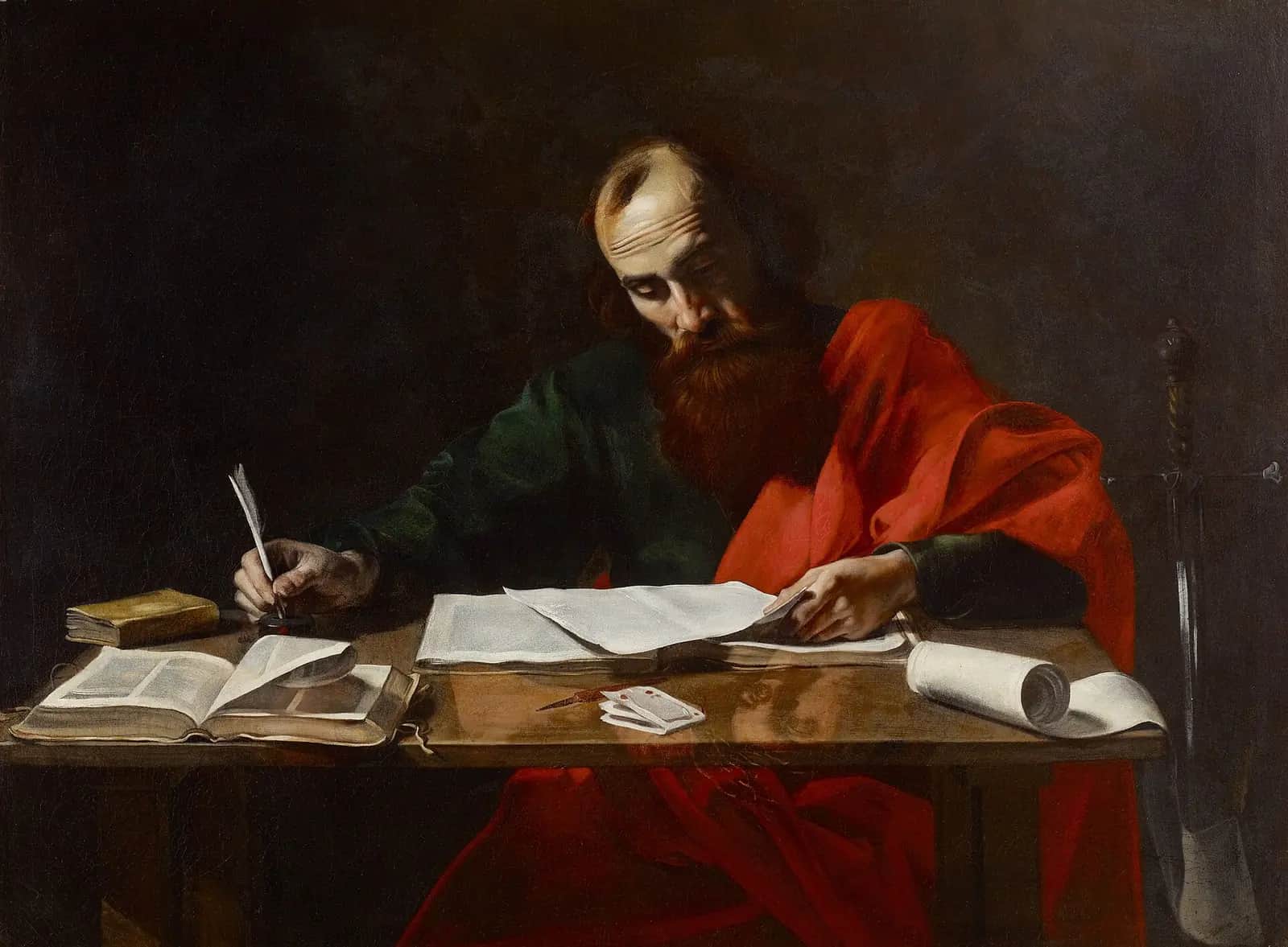
Romans 8:35 (WEB)
Who shall separate us from the love of Christ? Could oppression, or anguish, or persecution, or famine, or nakedness, or peril, or sword?
Catechism · 1
“For St. Paul, this trust is bold, founded on the prayer of the Spirit in us and on the faithful love of the Father who has given us his only Son.” — Catechism footnote: Cf. Rom 10:12-13; 8:26-39.
Fathers and councils · 34
Athanasius of Alexandria
- Athanasius of Alexandria, Against the Arians III.3Discourse III
“For what the Word has by nature, as I said, in the Father, that He wishes to be given to us through the Spirit irrevocably; which the Apostle knowing, said, ‘Who shall separate us from the love of Christ?’ for ‘the gifts of God’ and ‘grace of His calling are without repentance.’” — editor's note: Rom. viii. 35; vid. xi. 29.
Read the whole comment “Still, I exhorted them to be mindful of the apostolic boldness of speech, and to say, ‘Nothing separates us from the love of Christ; neither affliction, nor distress, nor persecution, nor famine, nor nakedness, nor peril, nor sword.’” — editor's note: Rom. viii. 35.
Read the whole comment“For constant meditation, and the remembrance of divine words, strengthens piety towards God, and produces a love to Him inseparable and not merely formal; as he, being of this mind, speaks about himself and others like-minded, saying boldly, ‘Who shall separate us from the love of God?’” — editor's note: Rom. viii. 35.
Read the whole comment“And after he had prayed, he said with a shout, Here am I, Antony; I flee not from your stripes, for even if you inflict more nothing shall separate me from the love of Christ.” — editor's note: Rom. viii. 35.
Read the whole comment“Often they would beat me with stripes, and I repeated again and again, “Nothing shall separate me from the love of Christ,” and at this they rather fell to beating one another.” — editor's note: Rom. viii. 35.
Read the whole comment
Cyril of Jerusalem
“But if any man is conscious that he is very stout-hearted, to encounter Satan, let him stand (for I do not despair of the Church’s nerves), and let him say, Who shall separate us from the love of Christ and the rest?” — editor's note: Rom. viii. 35.
Read the whole comment
Ambrose of Milan
“It is Christ Who died, yea, Who also rose again, Who is at the right hand of God, Who also maketh intercession for us.”” — editor's note: Rom. viii. 31–35.
Read the whole comment“At the same time, we must also think of the words which, after first saying “Who shall separate us from the love of Christ?” he wrote next: “Neither death, nor life, nor any other creature can separate us from the love of God, which is in Christ Jesus.”” — editor's note: Rom. viii. 35.
Read the whole comment“I am confident that neither death nor life nor angel shall do so.”” — editor's note: Rom. viii. 35, 38.
Read the whole comment
Origen
- Origen, De Principiis III.1Book III
“…able to say, “Who shall separate us from the love of God which is in Christ Jesus? shall tribulation, or anguish, or famine, or nakedness, or peril, or sword?”” — editor's note: Rom. viii. 35.
Read the whole comment
Cyprian of Carthage
“Shall tribulation, or distress, or persecution, or famine or nakedness, or peril, or sword?”” — editor's note: Rom. viii. 35.
Read the whole comment“Nay, in all these things we are more than conquerors for Him who hath loved us.”” — editor's note: Rom. viii. 35.
Read the whole comment“Nay, in all these things we overcome on account of Him who hath loved us.”” — editor's note: Rom. viii. 35–37.
Read the whole comment“But in all these things we are more than conquerors for His sake who loved us.”” — editor's note: Rom. viii. 35–37.
Read the whole comment
Augustine of Hippo
“When the Head goes before, the other members will follow; for, “Who shall separate us from the love of Christ?”” — editor's note: Rom. viii. 35.
Read the whole comment“For I am persuaded,” he says, “that neither death, nor life, nor angel, nor principality, nor things present, not things to come, nor power, nor height, nor depth, nor other creature, shall be able to separate me from the love of God, which is in Christ Jesus our Lord.”” — editor's note: Rom. viii. 35, 38, 39.
Read the whole comment“For “all His commandments are true;” He deceiveth not, He giveth us what He promised.” — editor's note: Rom. viii. 35.
Read the whole comment“See how the apostle exults concerning this very charity: “Who shall separate us from the charity of Christ? shall tribulation, or distress, or persecution, or famine, or nakedness, or peril, or sword?”” — editor's note: Rom. viii. 35.
Read the whole comment“Nay, in all these things we are more than conquerors through Him that loved us:” not through ourselves, but, “through Him that loved us.”” — editor's note: Rom. viii. 35–39
Read the whole comment“…it is now said, “Who shall separate us from the love of Christ? shall tribulation, or distress, or persecution, or famine, or nakedness, or peril, or sword?”” — editor's note: Rom. viii. 35.
Read the whole comment
John Chrysostom
“For, “who” (he says) “shall separate us from the love of Christ? shall tribulation, or distress, or persecution, or famine, or nakedness, or peril, or sword?” ( Rom. viii. 35.)” — the author cites it
Read the whole comment“Shall tribulation, or distress, or persecution, or famine, or nakedness, or peril, or sword?”” — editor's note: Rom. viii. 35.
Read the whole comment
Catena Aurea on Mark
- JeromeCatena Aurea on Mark
“But the glory of the Lord is manifested to those, who meet together on all sides, that is, through smooth ways and steep, whom nothing can “separate from the love of Christ.” [Rom 8:35]” — the author cites it
Read the whole comment
Catena Aurea on Matthew
- JeromeCatena Aurea on Matthew
“Observe, He says, “the love of many,” not ‘of all,’ for in the Apostles, and those like them, love would continue, as Paul speaks, “Who shall separate us from the love of Christ?” [Rom 8:35]” — the author cites it
Read the whole comment - Pseudo-ChrysostomCatena Aurea on Matthew
“But as the Church built by Christ cannot be thrown down, so any such Christian who has built himself upon Christ, no adversity can overthrow, according to that, “Who shall separate us from the love of Christ?” [Rom 8:35]” — the author cites it
Read the whole comment
Jerome
“…nor things to come, nor height, nor depth, nor any other creature shall be able to separate us from the love of God which is in Christ Jesus, our Lord.”” — editor's note: Rom. viii. 35, 38, 39.
Read the whole comment“As it is written, For thy sake we are killed all the day long; we are accounted as sheep for the slaughter.”” — editor's note: Rom. viii. 35, 36.
Read the whole comment
Leo the Great
“But in all these things we overcome through Him that loved us.”” — editor's note: Rom. viii. 35–37.
Read the whole comment“But in all these things we overcome on account of Him who loved us.”” — editor's note: Rom. viii. 35.
Read the whole comment“His threshold the angel of destruction does not cross, for it is marked with the Lamb’s blood and the sign of the cross.” — editor's note: Cf. Exod. xii. 23; and below, 1 Cor. v. 8, and Rom. viii. 35.
Read the whole comment
Theodoret of Cyrus
“As it is written, ‘For thy sake we are killed all the day long; we are accounted as sheep for the slaughter.’”” — editor's note: Rom. viii. 35, 36
Read the whole comment
Tertullian
“For we are persuaded, that neither death, nor life, nor power, nor height, nor depth, nor any other creature, shall be able to separate us from the love of God, which is in Christ Jesus our Lord.”” — editor's note: Rom. viii. 35.
Read the whole commentChapter XIV.—The Divine Power Shown in Christ’s Incarnation. Meaning of St. Paul’s Phrase. Likeness of Sinful Flesh. No Docetism in It. Resurrection of Our Real Bodies. A Wide Chasm Made in the Epistle by Marcion’s…
Read the whole comment
Clement of Alexandria
“Let us obtain the joy laid up, in which Paul exulting, exclaimed, “Who shall separate us from the love of Christ?”” — editor's note: Rom. viii. 35.
Read the whole comment
Cross-references · 38
Cited together in Exposition of the Christian Faith V.16.
Cited together in Exposition of the Christian Faith V.16.
Cited together in Epistles Letter 25.
Cited together in Exposition of the Christian Faith V.16.
Cited together in Exposition of the Christian Faith V.16.
Cited together in Pseudo-Chrysostom on Matthew 7:24–27 (Catena Aurea).
Cited together in Epistles Letter 25.
Cited together in Exhortation to Martyrdom, Addressed to Fortunatus Chapter 7.
Cited together in Life of Antony §6.
Cited together in Exposition of the Christian Faith V.16.
Cited together in Exposition of the Christian Faith V.16.
Cited together in Exposition of the Christian Faith V.16.
Cited together in Sermons Sermon 36.
Cited together in Sermons Sermon 36.
Cited together in Sermons Sermon 55.
Cited together in Sermons Sermon 55.
Cited together in Sermons Sermon 55.
Cited together in Sermons Sermon 55.
Cited together in Sermons Sermon 36.
Cited together in Sermons Sermon 36.
Cited together in Concerning Repentance I.3.
Cited together in Concerning Repentance I.3.
Cited together in Epistles Letter 25.
Cited together in Pseudo-Chrysostom on Matthew 7:24–27 (Catena Aurea).
Cited together in Pseudo-Chrysostom on Matthew 7:24–27 (Catena Aurea).
Cited together in Epistles Letter 25.
Cited together in Epistles Letter 25 and 2 other places.
Cited together in Epistles Letter 25 and 2 other places.
Cited together in Jerome on Matthew 24:9–14 (Catena Aurea).
Cited together in Jerome on Matthew 24:9–14 (Catena Aurea).
Cited together in Jerome on Matthew 24:9–14 (Catena Aurea).
Cited together in Exposition of the Christian Faith V.16.
Cited together in Jerome on Mark 1:40–45 (2) (Catena Aurea).
Cited together in Jerome on Mark 1:40–45 (2) (Catena Aurea).
Cited together in Jerome on Mark 1:40–45 (2) (Catena Aurea).
Cited together in Jerome on Mark 1:40–45 (2) (Catena Aurea).
Cited together in Jerome on Mark 1:40–45 (2) (Catena Aurea).
Cited together in Exposition of the Christian Faith V.16.