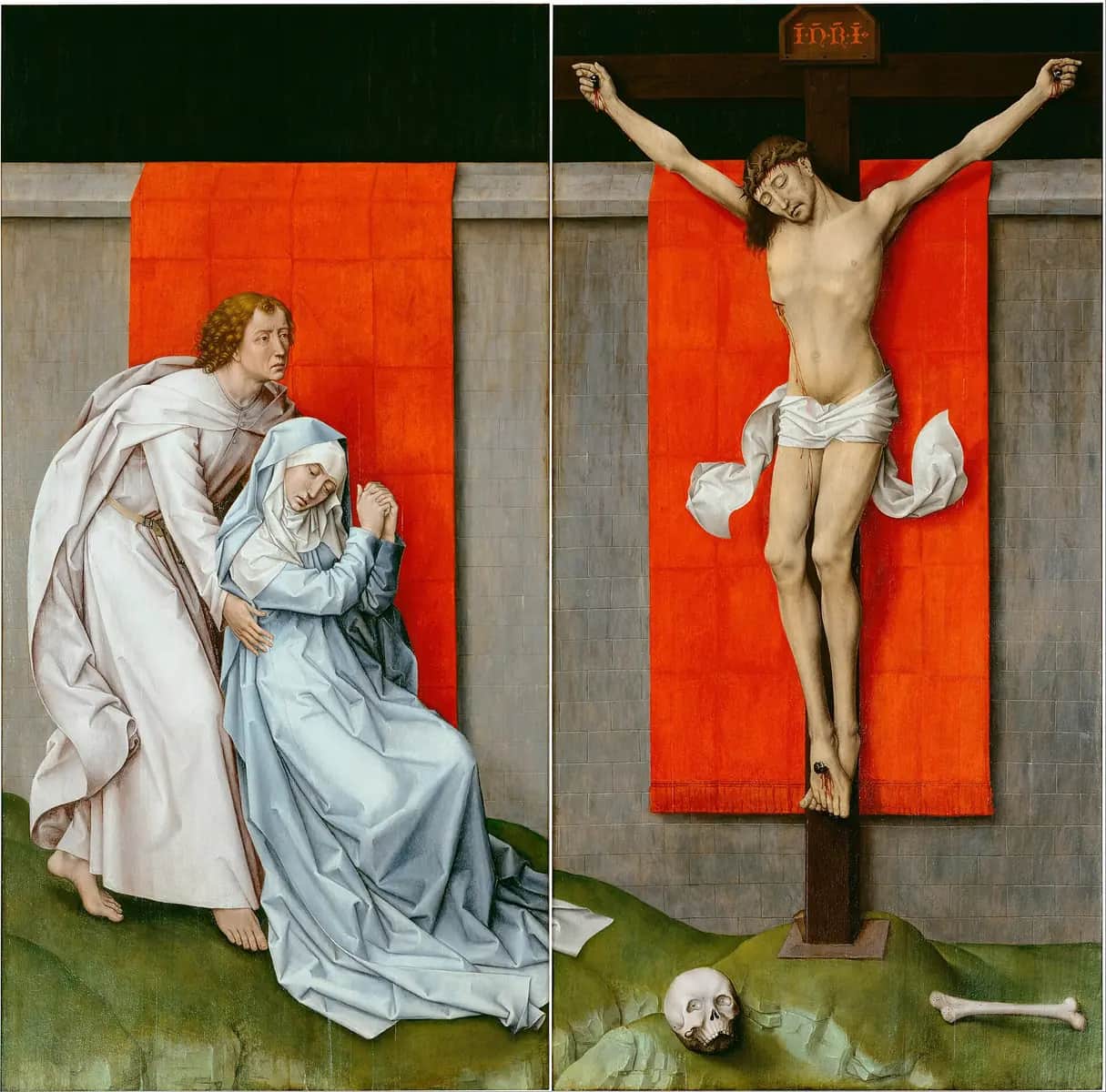
The idea
Last words 'reveal the heart of a person.' Jesus speaks seven times from the cross, and 'Woman, behold your son… Behold your mother' are 'the only words that are directly addressed to a follower of his' — spoken at the cost of pulling himself up on the nails, since crucifixion was death by asphyxiation. Pitre's first historical point: in the ancient world a condemned man 'was legally able to bequeath his possessions by simply declaring his will from the cross.' Jesus has no money, no land, no home, not even his clothes, which the soldiers have divided by lot. 'Thus, the only earthly possession Jesus has left is his mother. And he even gives her away. As a result, he dies in complete poverty.'
Key verses
- John 19:23 — the soldiers take his garments and cast lots for his tunic.
- John 19:26 — the only words from the cross addressed to a disciple.
- John 19:27 — 'Behold thy mother.'
The connection
| Old Testament root | New Testament fulfilment | |
|---|---|---|
| A condemned man's will declared from the cross | → | Jesus bequeaths his last possession — his mother |
The scene is a legal act, not a tender aside. Read as a will, the gift of Mary is the last thing Jesus owns and the last thing he gives.
Sources
- Modern scholars Pitre cites — Martin Hengel; Craig Keener; Scot McKnight (pp 161–162)