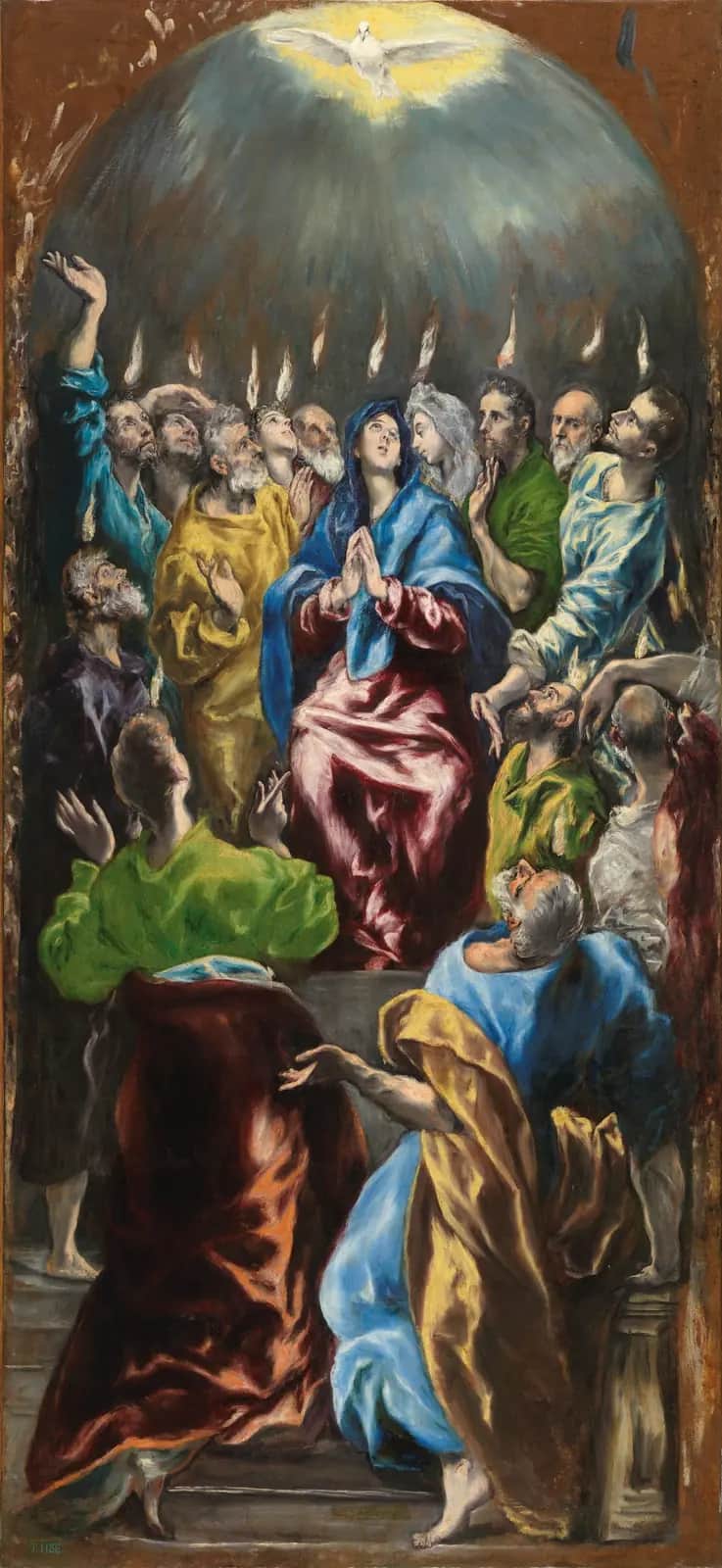
Definition
From the cross Jesus gave his mother to the beloved disciple and the disciple to his mother, and in that disciple to everyone who follows him. Mary is the mother of all who are born of the Church's labour, as Rachel is mother of Israel and weeps for her children. Paul VI proclaimed the title Mater Ecclesiae at the close of the third session of Vatican II (1964); Lumen Gentium 53 and 61–63 and Catechism §§963–970 set out the teaching, and John Paul II developed it in Redemptoris Mater.
Start here
Begin with "Behold your mother" and what Jesus actually does from the cross, then "he took her to his own", then the Rachel typology that stands behind it.
From Jewish Roots of Mary
- 1.John the 'new Benjamin' — the heart of the Rachel typology.
As Rachel died bearing Benjamin, Mary spiritually bears a second son — the beloved disciple — through her 'dying' at the cross, her soul pierced by a sword. Benjamin was 'the beloved of the Lord'; John is 'the beloved disciple.' That is likely why John never names himself: he is the new Benjamin, beloved younger son of the new Rachel.
- 2.How Mary becomes Mother of the Church — Ambrose, Vatican II and the New Rachel
Our bond to Mary is not by blood but through Jesus' passion: we are children of the birth pangs she bore at the cross. Revelation names 'the rest of her offspring' — those who keep God's commandments — as her children. This is the 'Mother of the Church' section of the New Rachel chapter (pp 155–159): as Rachel was the matriarch of Israel, Mary the new Rachel is the matriarch of the Church; Ambrose hears Christ say to each of us, 'There is your mother'; John Paul II describes the Church's birth as the fruit of her labour pains at Calvary (John 11:52); and Lumen Gentium 62 teaches that, taken up into heaven, she 'continues to bring us the gifts of eternal salvation' by her intercession. The Jewish scholar Jacob Neusner closes the case: 'if Rachel, then why not Mary?'
- 3.Mother of all disciples — Ambrose, and John Paul II on the Church born from labour pains
'If Rachel was indeed the matriarch of her people… then it seems clear that Mary, the new Rachel, is the matriarch of the entire Church. This is the only plausible explanation for why the book of Revelation describes all those who bear testimony to Jesus as offspring of the mother of the Messiah.' Ambrose: 'May the Christ from the height of the cross say also to each of you: There is your mother. May he say also to the Church: There is your son.' Mary's spiritual maternity 'is not something made up by Catholics in the Middle Ages; it is something that flows directly out of the will of Jesus.' John Paul II: on Calvary Mary 'made her own maternal contribution to the work of salvation, which took the form of labour pains, the birth of the new humanity' — the evangelist himself says Jesus died 'to gather into one the children of God who are scattered abroad.' She is Mother of the Church not because she is Jesus' biological mother but because 'she willingly consented to and shared in the sufferings of Christ.'
- 4.'Mary is not a doctrine but a person' — the children of Mary's sorrow
Pitre quotes David Flusser on the Mater Dolorosa: 'not a theological concept or an overpowering experience of the archetypal but primarily a real person who was inspired by her joy and never defeated by her unspeakable pain.' Then he steps outside the argument: 'at the end of the day, it's important to remember that Mary is not a doctrine or a dogma, but a person… a real, living human being who, like all of us, had to walk the long journey through this valley of tears.' As Rachel's children were the children of her sorrow, 'we are the children of Mary's sorrow.'
- 5.Cana and Calvary — the two bookends of John's Gospel.
Mary appears only twice in John — at Cana and at the cross — and both times Jesus calls her 'Woman' and speaks of his 'hour.' At Cana the hour 'has not yet come'; at the cross it has. This inclusio frames his whole ministry and marks Mary as the New Eve from the first sign to the finished work.
- 6.
- 7.
- 8.
- 9.
- 10.
- 11.
- 12.