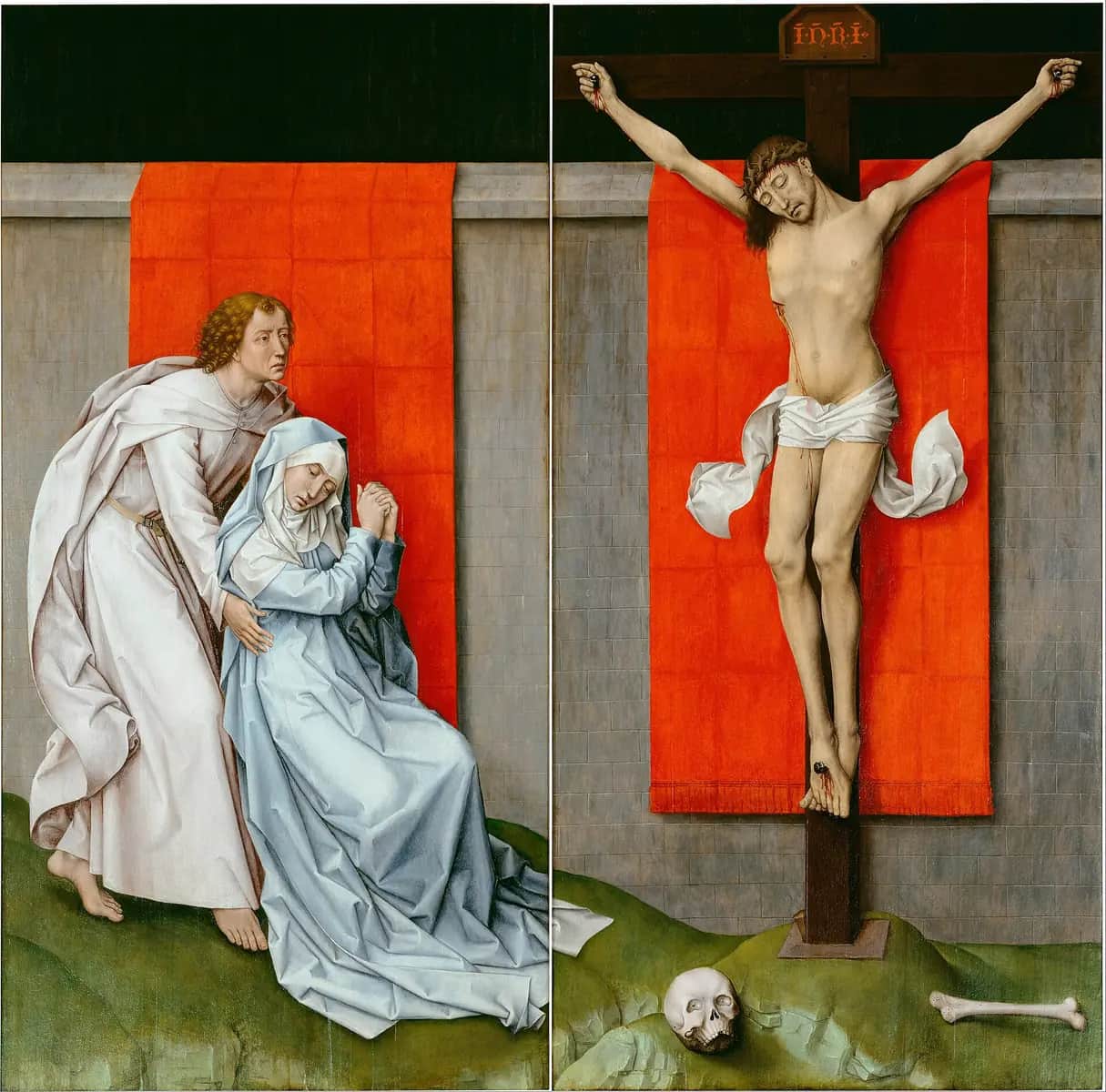
John 19:23 (WEB)
Then the soldiers, when they had crucified Jesus, took his garments and made four parts, to every soldier a part; and also the tunic. Now the tunic was without seam, woven from the top throughout.
As quoted in the map (KJV)
John 19:23–24 (KJV)
23 Then the soldiers, when they had crucified Jesus, took his garments, and made four parts, to every soldier a part; and also his coat: now the coat was without seam, woven from the top throughout. 24 They said therefore among themselves, Let us not rend it, but cast lots for it, whose it shall be: that the scripture might be fulfilled, which saith, They parted my raiment among them, and for my vesture they did cast lots. These things therefore the soldiers did.
Key words
- ἔλαβον τὰ ἱμάτια αὐτοῦelabon ta himatia autou · Greek
- 'took his garments' — the soldiers strip him of his last possessions.
- χιτὼν ἄραφοςchitōn araphos · Greek
- 'the coat… without seam' — woven in one piece, for which they cast lots (Psalm 22:18).
Why it matters
The soldiers divide Jesus' clothes and cast lots for his tunic. Pitre uses the scene to set up Jesus' last words (pp 161–162): a condemned man could declare his will from the cross, and Jesus has nothing left — no money, no land, not even his clothes. His only remaining earthly 'possession' is his mother, and he gives her away too, dying in complete poverty.
Fathers and councils · 22
Gregory of Nyssa
“Those cast lots, as the Scripture tells us, for the Lord’s vesture, who were unwilling to rend His garment, but disposed to make it over to that one of their number in whose favour the lot should decide.” — editor's note: Cf. S. John xix. 23, 24.
Read the whole comment
Tertullian
“…actually and thoroughly suffering, suffered not for any evil action of His own, but “that the Scriptures from the mouth of the prophets might be fulfilled.”” — editor's note: See Matt. xxvi. 56; xxvii. 34, 35; John xix. 23, 24, 28, 32–37.
Read the whole comment
Catena Aurea on Matthew
- Augustine of HippoCatena Aurea on Matthew
““The soldiers, when they had crucified him, took his garments, and made four parts, to every soldier a part; and also his coat; now the coat was without seam.” [John 19:23]” — the author cites it
Read the whole comment
Augustine of Hippo
“…My feet, they numbered all My bones; but they themselves regarded and beheld Me; they divided among them My garments, and upon My vesture they cast the lot;” but ye see that which was in the same Psalm foretold, and now is clearly fulfilled; “All the ends of the earth shall remember and be turned unto the Lord, and…” — editor's note: Ps xxii. 16, 17, 18; John xix. 23, 24
Read the whole comment“They said therefore among themselves, Let us not rend it, but cast lots for it, whose it shall be: that the Scripture might be fulfilled, which saith, They parted my garments, and for my vesture they did cast lots.”” — editor's note: John xix. 23, 24.
Read the whole comment“But, inasmuch as he was quite aware of the fact that the Lord was suspended [on the cross] by the soldiers, and not by the Jews, as John most plainly affirms, his hidden object [in bringing in the said clause] was to convey the idea that those parties who cried out that He should be crucified were the Lord’s real…” — editor's note: John xix. 23.
Read the whole comment“For it is more clearly stated afterwards, “When the soldiers therefore had crucified Him,” although the evangelist properly does so even when he attributes the whole to the Jews, for they it was that received what they had with the utmost greediness demanded, and they it was that did all that they compelled to be done.” — editor's note: Chap. xix. 23.
Read the whole comment
Ambrose of Milan
“For example, in the twenty-first psalm you have read: “Fat bulls (of Bashan) have beset me,” and again: “They parted My garments among them.”” — editor's note: Ps. xxii. 19. Cf. S. Matt. xxvii. 35; S. Mark xv. 24; S. Luke xxiii. 34; S. John xix. 23–24.
Read the whole comment
John Chrysostom
“The soldiers parted the garments, but not the coat.” — editor's note: Ver. 23, 24. “Then the soldiers, when they had crucified Jesus, took His garments, and made four parts, to every soldier a part; and also His coat; now the…
Read the whole comment
Jerome
“…by the long-standing feuds, subsisting between its peoples, is bit by bit tearing into shreds the seamless vest of the Lord, “woven from the top throughout,” since the foxes are destroying the vineyard of Christ, and since among the broken cisterns that hold no water it is hard to discover “the sealed fountain” and…” — editor's note: Joh. xix. 23.
Read the whole comment“Let those stitch coats to themselves who have lost the coat woven from the top throughout; who delight in the cries of infants which, as soon as they see the light, lament that they are born.” — editor's note: Joh. xix. 23.
Read the whole comment“Recall to mind how even the soldiers did not rend the coat of the Saviour.” — editor's note: Joh. xix. 23, 24.
Read the whole comment
Cyprian of Carthage
“Holy Scripture speaks, saying, “But of the coat, because it was not sewed, but woven from the top throughout, they said one to another, Let us not rend it, but cast lots whose it shall be.”” — editor's note: John xix. 23, 24.
Read the whole comment
Catena Aurea on Mark
- Theophylact of OhridCatena Aurea on Mark
“And John’s Gospel shews this more clearly, for the soldiers, though they divided every thing else into four parts, according to their number, cast lots for the coat, which “was without seam, woven from the top throughout.” [John 19:23]” — the author cites it
Read the whole comment
Catena Aurea on John
- John ChrysostomCatena Aurea on John
The Evangelist describes the tunic, to shew that it was of an inferior kind, the tunics commonly worn in Palestine being made of two pieces.
Read the whole comment - Theophylact of OhridCatena Aurea on John
Others say that they did not weave in Palestine, as we do, the shuttle being driven upwards through the warp; so that among them the woof was not carried upwards but downwardsb.
Read the whole comment - Augustine of HippoCatena Aurea on John
Why they cast lots for it, next appears: They said therefore among themselves, Let us not rend it, but cast lots for it whose it should be. It seems then that the other garments were made up of equal parts, as it was…
Read the whole comment - John ChrysostomCatena Aurea on John
Behold the sureness of prophecy. The Prophet foretold not only what they would part, but what they would not. They parted the raiment, but cast lots for the vesture.
Read the whole comment - Augustine of HippoCatena Aurea on John
Matthew in saying, They parted His garments, casting lots, (Mat. 27:35.) means us to understand the whole division of the garments, including the tunic also for which they cast lots. Luke says the same: They parted…
Read the whole comment - John ChrysostomCatena Aurea on John
According to some, The tunic without seam, woven from above throughout, is an allegory shewing that He who was crucified was not simply man, but also had Divinity from above.
Read the whole comment - Theophylact of OhridCatena Aurea on John
The garment without seam denotes the body of Christ, which was woven from above; for the Holy Ghost came upon the Virgin, and the power of the Highest overshadowed her. This holy body of Christ then is indivisible:…
Read the whole comment - Augustine of HippoCatena Aurea on John
Nor let any one say that these things had no good signification, because they were done by wicked men; for if so, what shall we say of the cross itself? For that was made by ungodly men, and yet certainly by it were…
Read the whole comment
Cross-references · 21
Cited together in Tractates on the Gospel of John Tractate 116.
Cited together in Tractates on the Gospel of John Tractate 116.
Cited together in Augustine of Hippo on Matthew 27:35–38 (3) (Catena Aurea) and 2 other places.
Cited together in Augustine of Hippo on Matthew 27:35–38 (3) (Catena Aurea) and 1 other place.
Cited together in Augustine of Hippo on Matthew 27:35–38 (3) (Catena Aurea).
Cited together in Augustine of Hippo on Matthew 27:35–38 (3) (Catena Aurea).
Cited together in Tractates on the Gospel of John Tractate 116.
Cited together in Tractates on the Gospel of John Tractate 116.
Cited together in Theophylact of Ohrid on Mark 15:20–28 (3) (Catena Aurea).
Cited together in Theophylact of Ohrid on Mark 15:20–28 (3) (Catena Aurea).
Cited together in Theophylact of Ohrid on Mark 15:20–28 (3) (Catena Aurea).
Cited together in Theophylact of Ohrid on Mark 15:20–28 (3) (Catena Aurea) and 2 other places.
Cited together in Theophylact of Ohrid on Mark 15:20–28 (3) (Catena Aurea) and 1 other place.
Cited together in Theophylact of Ohrid on Mark 15:20–28 (3) (Catena Aurea).
Cited together in Theophylact of Ohrid on Mark 15:20–28 (3) (Catena Aurea).
Cited together in Theophylact of Ohrid on Mark 15:20–28 (3) (Catena Aurea).
Cited together in Tractates on the Gospel of John Tractate 116.
Cited together in Tractates on the Gospel of John Tractate 116.
Cited together in Tractates on the Gospel of John Tractate 116.
Cited together in Augustine of Hippo on John 19:23–24 (2) (Catena Aurea) and 1 other place.
Cited together in Harmony of the Gospels III.13.