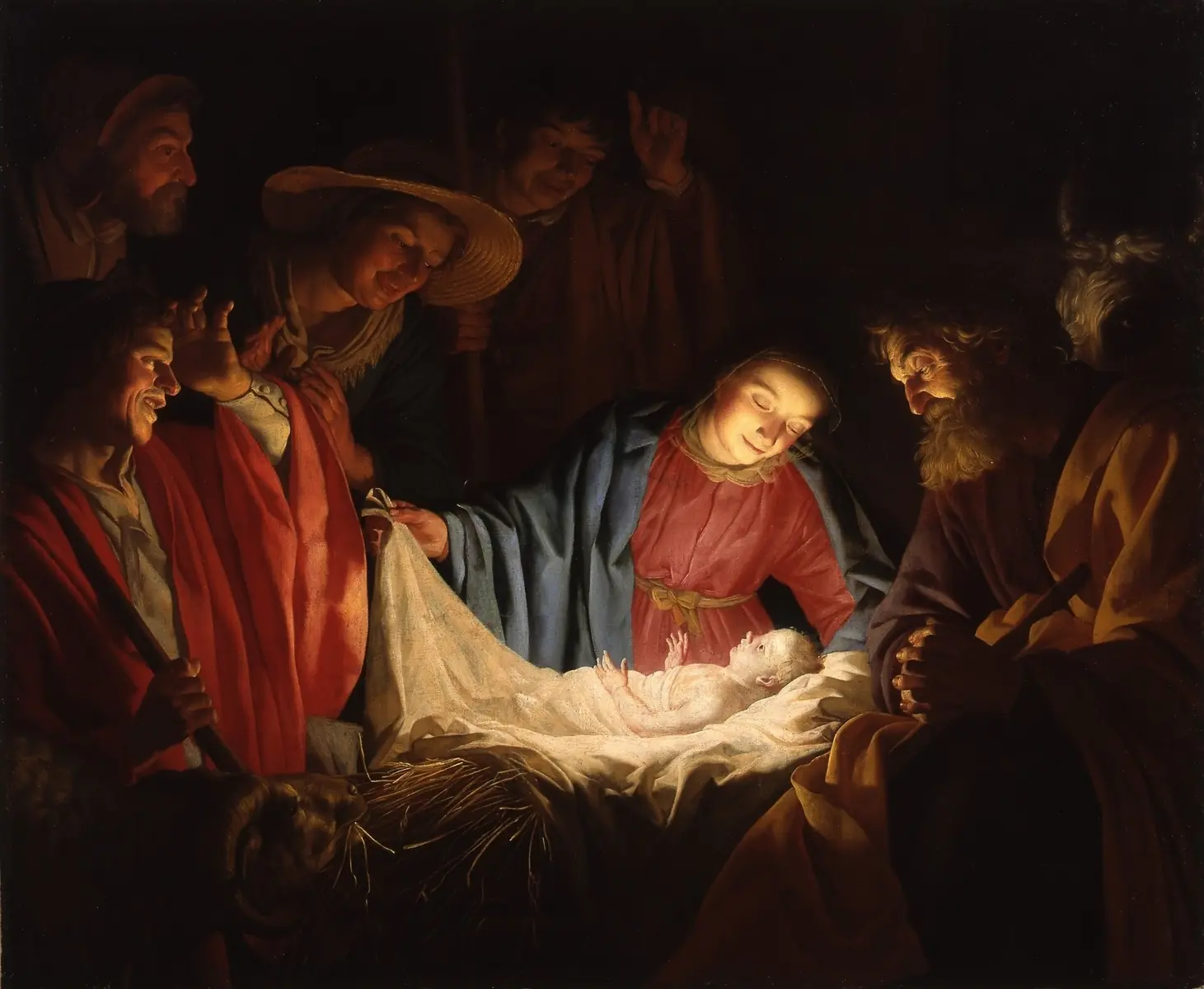
Luke 2:11 (WEB)
For there is born to you today, in David’s city, a Savior, who is Christ the Lord.
Catechism · 6
Heaven and Earth
“Again, it is the angels who "evangelize" by proclaiming the Good News of Christ's Incarnation and Resurrection.” — Catechism footnote: Cf. Lk 2:8-14; Mk 16:5-7.
"And in Jesus Christ, His Only Son, Our Lord"
“To the shepherds, the angel announced the birth of Jesus as the Messiah promised to Israel: "To you is born this day in the city of David a Saviour, who is Christ the Lord."” — Catechism footnote: Lk 2:11.
“At the prompting of the Holy Spirit, "Lord" expresses the recognition of the divine mystery of Jesus.” — Catechism footnote: Cf. Lk 1:43; 2:11.
"Conceived by the Power of the Holy Spirit and Born of the Virgin Mary"
- §486Paragraph 2 · "Conceived by the Power of the Holy Spirit and Born of the Virgin Mary"Read at vatican.va
“The Father's only Son, conceived as man in the womb of the Virgin Mary, is "Christ", that is to say, anointed by the Holy Spirit, from the beginning of his human existence, though the manifestation of this fact takes place only progressively: to the shepherds, to the magi, to John the Baptist, to the disciples.” — Catechism footnote: Cf. Mt 1:20; 2:1-12; Lk 1:35; 2:8-20; Jn 1:3 1-34; 2:11.
The Mysteries of Christ's Life
“In this poverty heaven's glory was made manifest.” — Catechism footnote: Cf. Lk 2:8-20.
"I Believe in the Holy Spirit"
“The Virgin Mary conceived Christ by the Holy Spirit who, through the angel, proclaimed him the Christ at his birth, and prompted Simeon to come to the temple to see the Christ of the Lord.” — Catechism footnote: Cf. Lk 2:11, 26-27.
Fathers and councils · 23
Irenaeus of Lyons
“And the angel of the Lord, he says, appeared to the shepherds, proclaiming joy to them: “For there is born in the house of David, a Saviour, which is Christ the Lord.” — editor's note: Luke ii. 11, etc.
Read the whole comment
Cyril of Jerusalem
“Christ the Lord is He who was born in the city of David.” — editor's note: Luke ii. 11.
Read the whole comment
Theodoret of Cyrus
““For,” it is written, “Thou shalt call His name Jesus for he shall save His people from their sins,” and unto you is born this day in the city of David Christ the Lord.” — editor's note: Luke ii. 11 τίκτεται is substituted for ἐτέχθη, in addition to the omission of “a Saviour which is.” In this verse the mss. do not vary.
Read the whole comment“For, after the incarnation, God the Word, the only begotten Son of God is called Jesus Christ; for “Behold” He says “unto you is born this day Christ the Lord” and because others had been called christs, priests, kings, and prophets, lest any one should suppose Him to be like unto them, the angels conjoined the title…” — editor's note: Luke ii. 11
Read the whole comment“Moreover the chorus of the angels announced to the shepherds “Unto you is born this day in the city of David…Christ the Lord.”” — editor's note: Luke ii. 11
Read the whole comment
Ambrose of Milan
“Again we find it thus recorded, how that the angel, when he spoke to the shepherds, said that He had been born: “Who is this day born to us a Saviour, Who is Christ the Lord, in the city of David.”” — editor's note: S. Luke ii. 11.
Read the whole comment
Augustine of Hippo
Chapter V.—A Statement of the Manner in Which Luke’s Procedure is Proved to Be in Harmony with Matthew’s in Those Matters Concerning the Conception and the Infancy or Boyhood of Christ, Which are Omitted by the One…
Read the whole comment
John Cassian
““There is born,” he says, “to you this day in the city of David a Saviour who is Christ the Lord.”” — editor's note: S. Luke ii. 11.
Read the whole comment“And in order that you may not deny that God appeared from Mary, he at once adds the name of Saviour, on purpose that you may believe that He who is born of Mary is God, whom you cannot deny to have been born a Saviour, in accordance with this passage: “For to you is born to-day a Saviour.”” — editor's note: S. Luke ii. 11.
Read the whole comment“For Christ who was born of Mary is without the slightest doubt called Saviour, as it is said, “For to you is born this day a Saviour, which is Christ the Lord.”” — editor's note: S. Luke ii. 11.
Read the whole comment“Although holy Scripture has already shown by many and clear tokens, who is here spoken of, yet it has most plainly pointed to the name of Christ by using the name of Saviour: for surely the Saviour is the same as Christ, as the angel says: “For to you is born this day a Saviour who is Christ the Lord.”” — editor's note: S. Luke ii. 11.
Read the whole comment
Cyprian of Carthage
“Also in the same place, the angel said to the shepherds: “Fear not; for, behold, I bring you tidings that unto you is born this day in the city of David a Saviour, which is Christ Jesus.”” — editor's note: Luke ii. 10, 11.
Read the whole comment
Catena Aurea on Luke
- Ambrose of MilanCatena Aurea on Luke
Observe with what care God builds up our faith. An Angel teaches Mary; an Angel teaches Joseph; an Angel the shepherds also, of whom it is said, And there were in the same country shepherds abiding in the field.
Read the whole comment - John ChrysostomCatena Aurea on Luke
To Joseph the Angel appeared in a dream, as to one who might be easily brought to believe, but to the shepherds in visible shape as to men of a ruder nature. But the Angel went not to Jerusalem, sought not for…
Read the whole comment - BedeCatena Aurea on Luke
No where in the whole course of the Old Testament do we find that the Angels who so constantly appear to the Patriarchs, came with light. This privilege was rightly kept for this time when there arose in the darkness…
Read the whole comment - A Greek expositorCatena Aurea on Luke
They were alarmed at the miracle, as it follows, And they were afraid, &c. But the Angel dispels their rising fears. He not only soothes their terrors, but pours gladness into their hearts; for it follows, For,…
Read the whole comment - Cyril of AlexandriaCatena Aurea on Luke
But that which is in the middle, namely, Christ, has reference to the adoration, and signifies not the nature, but the compound substance of two natures. For on Christ our Saviour we confess the anointing to have…
Read the whole comment - A Greek expositorCatena Aurea on Luke
He marks the time of our Lord’s nativity, when he says, To-day, and the place when he adds, In the city of David; and the signs thereof when it follows, And there shall be a sign, &c. Now the Angels bring tidings to…
Read the whole comment - BedeCatena Aurea on Luke
The infancy of the Saviour was impressed upon us, both by frequent heraldings of Angels and testimonies of Evangelists, that we might be the more deeply penetrated in our hearts by what has been done for us. And we…
Read the whole comment - Maximus the ConfessorCatena Aurea on Luke
But if perhaps the swaddling clothes are mean in thy eyes, admire the Angels singing praises together. If thou despisest the manger, raise thy eyes a little, and behold the new star in heaven proclaiming to the world…
Read the whole comment - Gregory the GreatCatena Aurea on Luke
It was in a mystery that the Angel appeared to the shepherds while they were watching, and the glory of the Lord shone round about them, implying that they are thought worthy above the rest to see sublime things who…
Read the whole comment - BedeCatena Aurea on Luke
For in a mystery, those shepherds, and their flocks, signify all teachers and guides of faithful souls. The night in which they were keeping watch over their flocks, indicates the dangerous temptations from which…
Read the whole comment - OrigenCatena Aurea on Luke
But if we would rise to a more hidden meaning, I should say, that there were certain shepherd angels, who direct the affairs of men, and while each one of them was keeping his watch, an angel came at the birth of the…
Read the whole comment
Cross-references · 26
Cited together in Letters Letter 131.
Cited together in Exposition of the Christian Faith III.8 and 1 other place.
Cited together in Catechism §437.
Cited together in Catechism §448.
Cited together in Catechism §448.
Cited together in Letters Letter 131.
Cited together in Letters Letter 131.
Cited together in Catechism §437.
Cited together in Letters Letter 131.
Cited together in Catechism §437.
Cited together in On the Incarnation of the Lord, Against Nestorius II.4.
Cited together in On the Incarnation of the Lord, Against Nestorius II.4.
Cited together in On the Incarnation of the Lord, Against Nestorius IV.4.
Cited together in Catechism §437.
Cited together in On the Incarnation of the Lord, Against Nestorius IV.12.
Cited together in Bede on Luke 2:8–12 (Catena Aurea).
Cited together in Exposition of the Christian Faith III.8.
Cited together in Catechism §437.
Cited together in Catechism §437.
Cited together in Letters Letter 131 and 1 other place.
Cited together in On the Incarnation of the Lord, Against Nestorius II.4.
Cited together in Catechism §448.
Cited together in Catechism §448.
Cited together in Catechism §448.
Cited together in Catechism §437 and 1 other place.
Cited together in Catechism §448.