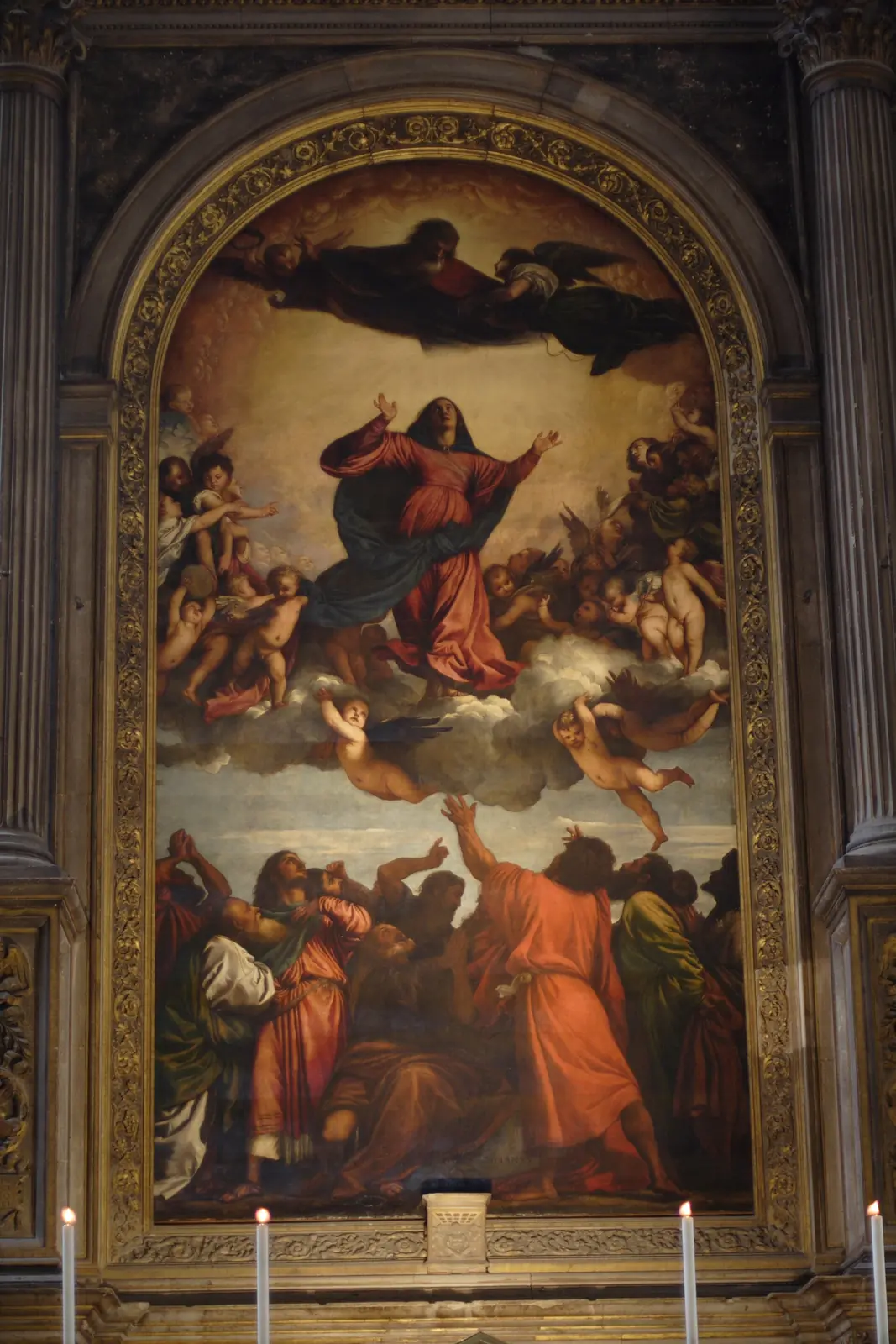
The idea
John sees the heavenly temple opened and 'the ark of his covenant' — then immediately a woman in heaven. As David brought the Ark up to Jerusalem and set it inside the tent he had pitched for it (2 Samuel 6:17), Christ the new David brings the true Ark — his mother — into the heavenly temple. The Ark was built of what the Septuagint calls 'incorruptible wood' (Exodus 25:5 LXX), so the body of the new Ark is kept from the corruption of the grave; Pius XII quoted exactly that typology from Modestus of Jerusalem and John Damascene when he defined the dogma (Munificentissimus Deus 26, p 63). Pitre notes the order of the evidence: the earliest texts on Mary's being taken up argue from the Woman 'in heaven' of Revelation 12; later writers linked it to the Ark (pp 62–63).
Key verses
- Revelation 11:19 — 'the ark… was seen' → 'a woman clothed with the sun.'
- Psalm 132:8 — 'Arise, O Lord… you and the ark of your might.'
- 2 Samuel 6:17 — David sets the Ark inside the tent in Jerusalem.
- Exodus 25:5 — 'incorruptible wood' (LXX).
The connection
| Old Testament root | New Testament fulfilment | |
|---|---|---|
| The incorruptible Ark brought to the temple | → | Mary assumed, body and soul |
As David brought the Ark up into the sanctuary, Christ the new David brings the true Ark — his mother — into the heavenly temple. The earliest witnesses to the Assumption argued from Revelation 12; the later Fathers, and Pius XII in defining the dogma, drew it from the Ark's incorruptible holiness. Benedict XVI adds that the living Ark is Mary's body, not only her soul (p 64).
Sources
- Modestus of Jerusalem — Encomium on the Dormition 4 (p 63) · read
- John Damascene — On the Dormition II.2 (p 63) · read
- Munificentissimus Deus (Pius XII, 1950) — §26 (p 63) · read
- Benedict XVI — Assumption homily, 2011 (p 64) · read
- Paschasius Radbertus — on Revelation 11:19 (p 60) · read