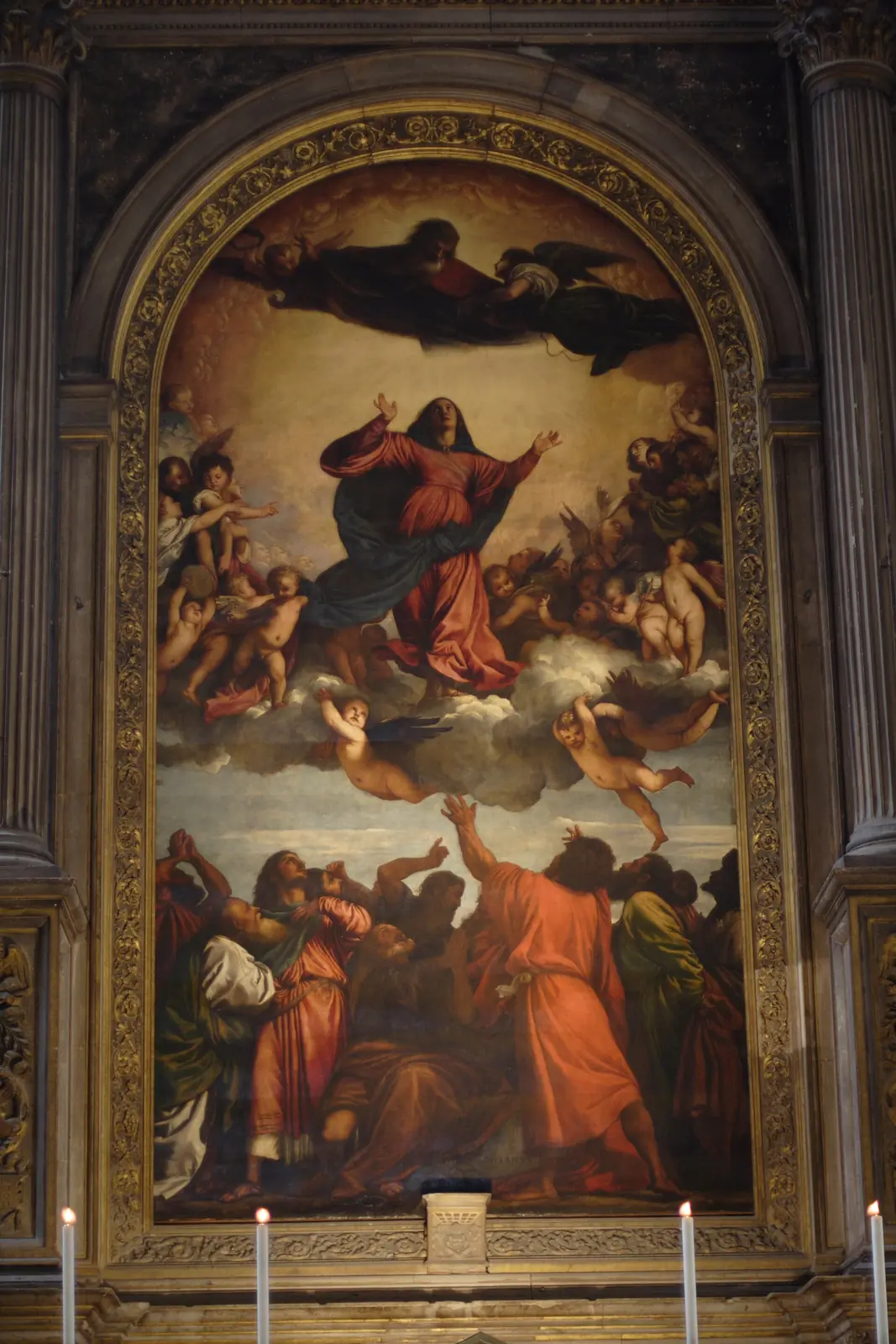
Definition
Mary, when the course of her earthly life was finished, was taken up body and soul into heavenly glory. Pius XII defined it in Munificentissimus Deus (1950; Catechism §966). The teaching follows from what Mary is. The Ark of the covenant was made of incorruptible wood and went up to God's resting place (Psalm 132:8); the Ark that was lost at the exile is seen again in heaven in John's vision, and in the next verse John sees a Woman clothed with the sun (Revelation 11:19–12:1). What was true of the sign is true of the one it pointed to.
Start here
Begin with the Ark typology, then read Revelation 11:19 and 12:1 as one scene, then the three-step argument that puts them together.
From Jewish Roots of Mary
- 1.Jesus the new Moses — three parallels, and an exodus that ends in heaven
Following the book's rule, the Ark chapter begins with Jesus. Moses fasted forty days on Sinai; Jesus fasts forty days in the desert. Moses fed Israel with bread from heaven; Jesus feeds the multitudes. Moses sealed the covenant with the twelve tribes; Jesus makes a new covenant with the twelve apostles. But there is a difference: 'the word exodus means journey,' and while Moses' exodus ran from Egypt to the promised land, Luke's runs from Jerusalem to heaven — Moses and Elijah speak of the 'exodus' Jesus will accomplish at Jerusalem, and the Gospel ends as he is 'carried up into heaven.' 'For Jesus the earthly promised land is just the point of departure — not the ultimate destination.'
- 2.Why the Ark of Revelation 11:19 is the Woman of 12:1 — one sentence, one temple, 'appeared' twice, John's dual symbols
Four textual arguments. First, the chapter break is not original: 'the contemporary system of chapters and verses was not added to the Bible until the thirteenth century,' and experts agree the verse in which the Ark appears introduces the vision of the Woman. Second, both stand in the heavenly temple, in imagery drawn from Isaiah 66:6–7, where a voice from the temple precedes the birth. Third, the verb 'appeared' (ōphthē) is repeated — the Ark appears, the Woman appears — linking the two (Koester). Fourth, John habitually uses two symbols for one reality: dragon and serpent for the devil, male child and Lamb for Christ; so Ark and Woman for Mary. Paschasius Radbertus said it plainly: 'This certainly was not the Ark made by Moses, but is the Blessed Virgin.'
- 3.How the Ark typology points to the Assumption.
John sees the heavenly temple opened and 'the ark of his covenant' — then immediately a woman in heaven. As David brought the Ark up to Jerusalem and set it inside the tent he had pitched for it (2 Samuel 6:17), Christ the new David brings the true Ark — his mother — into the heavenly temple. The Ark was built of what the Septuagint calls 'incorruptible wood' (Exodus 25:5 LXX), so the body of the new Ark is kept from the corruption of the grave; Pius XII quoted exactly that typology from Modestus of Jerusalem and John Damascene when he defined the dogma (Munificentissimus Deus 26, p 63). Pitre notes the order of the evidence: the earliest texts on Mary's being taken up argue from the Woman 'in heaven' of Revelation 12; later writers linked it to the Ark (pp 62–63).
- 4.The Assumption in three steps — and which came first, Revelation 12 or the Ark
Step one: the New Testament presents Jesus as the new David (Matthew 1:1). Step two: once David was king, one of his first acts was to bring the Ark up to Jerusalem and place it inside the tent he had pitched for it (2 Samuel 6:17), remembered in Psalm 132:8. Step three: 'if Jesus is the new David, who has ascended into the heavenly Jerusalem, then it makes sense that he would likewise bring the true Ark of the Covenant — his mother — into the heavenly Temple.' Pitre is careful about history: the earliest references to Mary being taken up argue from the Woman 'in heaven' of Revelation 12; later writers such as Modestus of Jerusalem and John Damascene linked it with the Ark — 'not carried like Moses' ark of old, drawn by oxen, but escorted by heaven's holy angels.' Benedict XVI adds the point of the body: the living Ark is not Mary's soul only but her body, in which the Word became flesh.
- 5.'Incorruptible wood' — Exodus 25:5 in the Septuagint, Josephus, and Munificentissimus Deus 26
God specifies acacia (shittim) for the Ark, a wood regarded as sacred in Egypt and extremely durable. The Septuagint translates it as 'incorruptible wood' (xyla asēpta), and Josephus confirms the Ark was made of wood 'naturally strong, and could not be corrupted.' This is the detail the Assumption argument rests on. Pius XII, defining the dogma in 1950, named Modestus of Jerusalem and John Damascene as ancient writers who 'looked upon the Ark of the Covenant, built of incorruptible wood and placed in the Lord's temple, as a type of the most pure body of the Virgin Mary, preserved and exempt from all the corruption of the tomb and raised up to such glory in heaven.' Pitre's a fortiori: if the old Ark's wood was holy and incorruptible, how much more the body of the new Ark.
- 6.
- 7.