New Ark
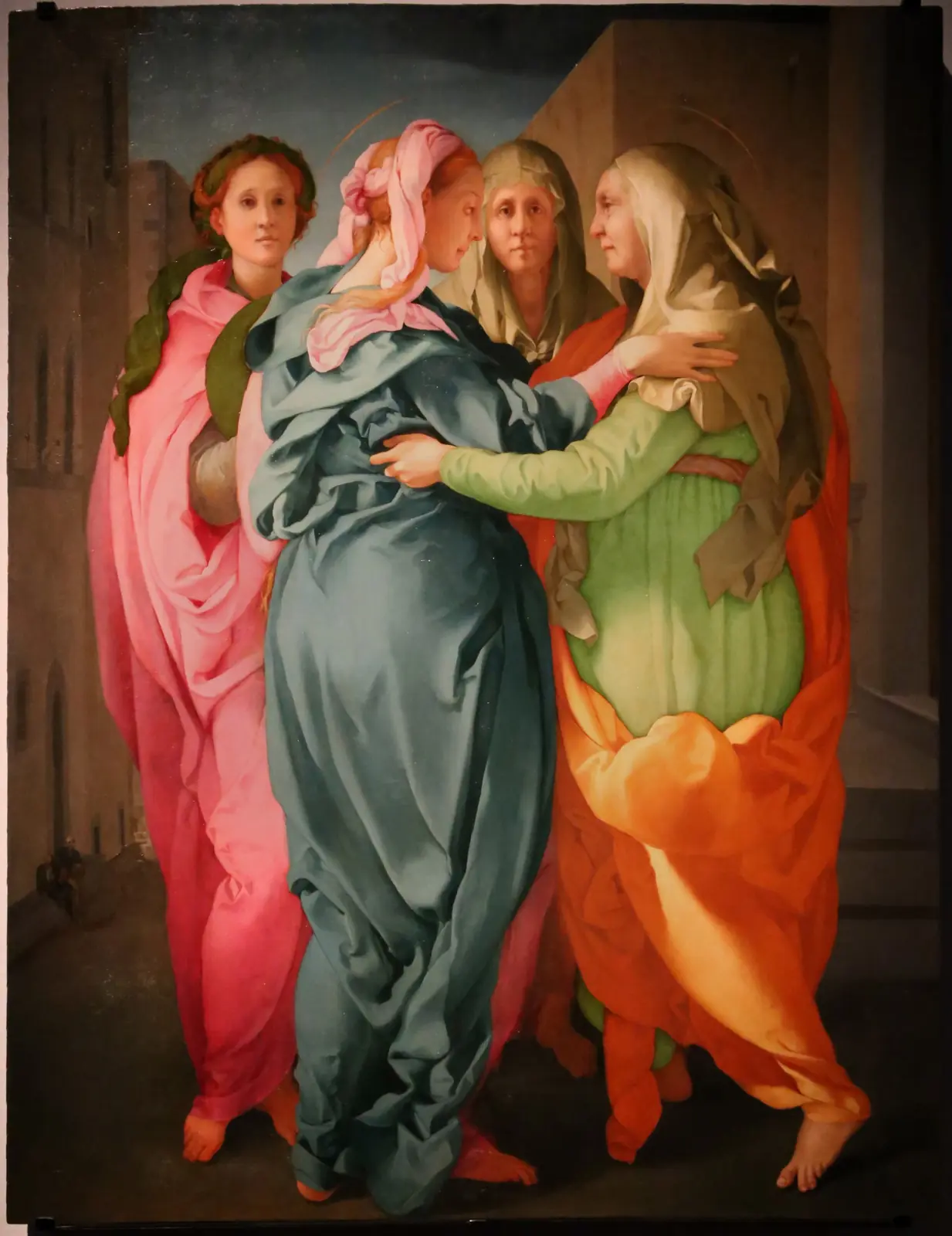
Pontormo, The Visitation, c. 1528–1529 · San Michele, Carmignano · CC BY 3.0Pontormo, The Visitation, c. 1528–1529, San Michele, Carmignano
From Jewish Roots of Mary, based on Brant Pitre
Arguments
Chapter 3
Following the book's rule, the Ark chapter begins with Jesus. Moses fasted forty days on Sinai; Jesus fasts forty days in the desert. Moses fed Israel with bread from heaven; Jesus feeds the multitudes. Moses sealed the covenant with the twelve tribes; Jesus makes a new covenant with the twelve apostles. But there is a difference: 'the word exodus means journey,' and while Moses' exodus ran from Egypt to the promised land, Luke's runs from Jerusalem to heaven — Moses and Elijah speak of the 'exodus' Jesus will accomplish at Jerusalem, and the Gospel ends as he is 'carried up into heaven.' 'For Jesus the earthly promised land is just the point of departure — not the ultimate destination.'
Pitre numbers the Ark's features. (1) It is where God meets and speaks with his people, from the mercy seat between the cherubim — and, for readers who think all statues are unbiblical, God commands two golden statues of angels. (2) It is a chest ('aron, simply a box) for the 'testimony,' the tablets, later joined by the manna and Aaron's rod. (3) It is made of acacia, which the Septuagint calls 'incorruptible wood.' (4) It is overlaid with 'pure' (tahor) gold, free from impurity, a sign of absolute holiness — carried only by its poles and veiled in blue before it moves. (5) It is the place the glory cloud descends.
The Ark of pure gold held the tablets (God's word), the manna (bread from heaven), and Aaron's rod (the priesthood). Mary bears the reality of all three: Jesus the Word made flesh, the Bread of Life, and the true High Priest. So the new Ark, like the old, must be wholly holy.
The Ark was where God said he would 'dwell' among his people; it was overlaid with pure gold inside and out, and so holy that the holy things could not be touched on pain of death. If the new Ark is the dwelling of God in the flesh, it too must be pure and wholly holy — Mary.
The Ark's history is a history of God's presence in battle and procession. With the Ark in their midst Israel took Jericho; without it they were defeated (Numbers 14). It moved from sanctuary to sanctuary, was captured by the Philistines until a plague of tumours — 'hemorrhoids' in the New American Bible — persuaded them to send it back, and was then moved by David's men on an ox-cart instead of by its poles, 'a plan which proves fatal for a man named Uzzah.' Left three months with Obed-edom, it blessed his house, so David resumed the procession the right way, carried by its poles with sacrifice, dancing 'with all his might' and 'with shouting, and with the sound of the horn.'
David's men moved the Ark on an ox-cart instead of carrying it by its poles as the Law required, and when Uzzah reached out to steady it he was struck dead (p 48). David recoiled: 'How shall the ark of the LORD come to me?' That same holy dread is what Elizabeth voices before Mary. The Ark's untouchable holiness is the backdrop for reverence toward the new Ark.
Psalm 132, a Psalm of Ascents sung by pilgrims going up to Jerusalem, remembers David's oath to find a dwelling for the Ark and God's answer: 'This is my rest for ever; here will I dwell.' 'For the Psalmist, where the Ark goes, the presence of the LORD goes. Why? Because of the glory cloud.' The proof is Solomon's dedication: only after the priests carry the Ark into the Holy of Holies does the cloud come down and the glory of the LORD fill the Temple. 'Now that the Ark is where it belongs, God can once again dwell with his people.'
'If Jesus is the new Moses, then where is the new Ark?' First-century Jews knew what their Temple lacked. The glory cloud had left before the Babylonian destruction (Ezekiel 10–11), and the Ark itself was gone. Two independent witnesses confirm the emptiness: Josephus says of the inmost sanctuary, 'In this there was nothing at all… it was called the Holy of Holies,' and Tacitus reports that when Pompey entered it 'the place was empty and the secret shrine contained nothing.' Jews were waiting 'for the revelation of the location of the Ark and the return of the glory cloud' — and the premise of Raiders of the Lost Ark, Pitre notes, is deeply Jewish.
Pitre clears away the common theories. The Bible's own inventory of what Babylon took from the Temple does not list the Ark. The claim that it sits in a church in Ethiopia cannot be checked, since only the guardian monks may enter — 'making it impossible for outsiders to verify or falsify the claim.' The oldest evidence we possess is 2 Maccabees, in the Catholic Old Testament: the prophet Jeremiah, himself a priest, took the tent and the Ark to the mountain where Moses had seen the promised land, sealed them in a cave, and declared that the place would stay unknown 'until God gathers his people together again and shows his mercy. And then the Lord will disclose these things, and the glory of the Lord and the cloud will appear.'
The verb Gabriel uses (episkiazō) is the same word the Greek Old Testament uses when the glory-cloud overshadowed the tabernacle and filled it with God's presence. Mary is overshadowed as the sanctuary was: she becomes the dwelling place of God.
The prophecy in 2 Maccabees gives a test: 'you will know where the Ark is when you see it overshadowed by the cloud of the glory of the Lord.' Luke's Annunciation passes it. Gabriel's verb for the Spirit's descent on Mary, episkiazō, 'overshadow,' is the Septuagint's word for the cloud that overshadowed the tabernacle when the glory filled it. Pitre's table lays the two side by side — the cloud and the glory on the tent, the Spirit and the power of the Most High on Mary — and the Jewish expectation supplies the meaning: the return of the glory cloud is the return of the Ark.
Luke paints Mary's journey as David's procession bringing the Ark to Jerusalem — a deliberate, point-for-point echo identifying Mary as the new Ark. Pitre's table (pp 55–56) has five rows; the first is the Annunciation itself, where the Spirit 'overshadows' Mary as the cloud overshadowed the tabernacle (Exodus 40:35; Luke 1:35), and the other four are the Visitation parallels below. Even the odd 'three months' detail is an Ark allusion — Pitre asks why Luke did not simply say Mary stayed 'until John was born' (p 57).
Pitre names three failure modes. 'Many books and commentaries simply ignore the parallels between Mary and the Ark, as if they do not exist. Others acknowledge that the parallels are present, but fail to provide a plausible explanation for their existence. Still others, after picking out one parallel and dismissing it as too subtle, proceed as if they have explained away the presence of all of the parallels.' The simplest explanation is the right one: Luke intends them. His clinching detail is Luke's oddly specific 'three months' — 'Why doesn't Luke just say Mary stayed until the birth of John?' — which only the Ark's three months at Obed-edom's house explains. Max Thurian, a Protestant, saw it: Elizabeth 'cannot withhold the great cry of ecstasy which characterized the appearance of the Ark.'
Four textual arguments. First, the chapter break is not original: 'the contemporary system of chapters and verses was not added to the Bible until the thirteenth century,' and experts agree the verse in which the Ark appears introduces the vision of the Woman. Second, both stand in the heavenly temple, in imagery drawn from Isaiah 66:6–7, where a voice from the temple precedes the birth. Third, the verb 'appeared' (ōphthē) is repeated — the Ark appears, the Woman appears — linking the two (Koester). Fourth, John habitually uses two symbols for one reality: dragon and serpent for the devil, male child and Lamb for Christ; so Ark and Woman for Mary. Paschasius Radbertus said it plainly: 'This certainly was not the Ark made by Moses, but is the Blessed Virgin.'
John sees the heavenly temple opened and 'the ark of his covenant' — then immediately a woman in heaven. As David brought the Ark up to Jerusalem and set it inside the tent he had pitched for it (2 Samuel 6:17), Christ the new David brings the true Ark — his mother — into the heavenly temple. The Ark was built of what the Septuagint calls 'incorruptible wood' (Exodus 25:5 LXX), so the body of the new Ark is kept from the corruption of the grave; Pius XII quoted exactly that typology from Modestus of Jerusalem and John Damascene when he defined the dogma (Munificentissimus Deus 26, p 63). Pitre notes the order of the evidence: the earliest texts on Mary's being taken up argue from the Woman 'in heaven' of Revelation 12; later writers linked it to the Ark (pp 62–63).
'If Mary is the new Ark, and the Ark is the dwelling place of God on earth, then, by implication, Jesus is God on earth.' The typology about Mary illuminates the deeper mystery of her Son's divinity, and three Fathers 'writing in Rome, Egypt, and Syria' saw it. Hippolytus: Christ's human nature 'of incorruptible wood, that is to say, of the Virgin and the Holy Spirit, overlaid within and without… by purest gold of the word of God.' Athanasius: 'O Ark of the New Covenant, clothed with purity instead of gold!… the flesh in which divinity resides.' Jacob of Serug: 'that maiden was the Ark of the Godhead,' before whom John leaped as David danced. They got this from the Old Testament, and they based what they believed about Mary on what they believed about Christ (CCC 2676).
Step one: the New Testament presents Jesus as the new David (Matthew 1:1). Step two: once David was king, one of his first acts was to bring the Ark up to Jerusalem and place it inside the tent he had pitched for it (2 Samuel 6:17), remembered in Psalm 132:8. Step three: 'if Jesus is the new David, who has ascended into the heavenly Jerusalem, then it makes sense that he would likewise bring the true Ark of the Covenant — his mother — into the heavenly Temple.' Pitre is careful about history: the earliest references to Mary being taken up argue from the Woman 'in heaven' of Revelation 12; later writers such as Modestus of Jerusalem and John Damascene linked it with the Ark — 'not carried like Moses' ark of old, drawn by oxen, but escorted by heaven's holy angels.' Benedict XVI adds the point of the body: the living Ark is not Mary's soul only but her body, in which the Word became flesh.
God specifies acacia (shittim) for the Ark, a wood regarded as sacred in Egypt and extremely durable. The Septuagint translates it as 'incorruptible wood' (xyla asēpta), and Josephus confirms the Ark was made of wood 'naturally strong, and could not be corrupted.' This is the detail the Assumption argument rests on. Pius XII, defining the dogma in 1950, named Modestus of Jerusalem and John Damascene as ancient writers who 'looked upon the Ark of the Covenant, built of incorruptible wood and placed in the Lord's temple, as a type of the most pure body of the Virgin Mary, preserved and exempt from all the corruption of the tomb and raised up to such glory in heaven.' Pitre's a fortiori: if the old Ark's wood was holy and incorruptible, how much more the body of the new Ark.
The quest for the lost Ark ends with a prophecy: in the future age the Ark 'shall not come to mind, or be remembered, or missed; it shall not be made again.' It will not be missed because the New Testament tells us where the true Ark is — in heaven. Then the chapter's application. Jesus died and rose 'so that the body of every person can be transformed by grace into a temple of the holy spirit.' Mary is 'just a human being,' given a unique share in her Son's glory; her assumption 'shows us that bodily resurrection and ascension into heaven aren't just for Jesus. They are for us too.'
Around this entry
Open the whole map- Themes
- Arguments
- Favorites
- prefigures → fulfilled
- taught → disciple · succeeded →
Hover to trace, click to select, double-click to open.