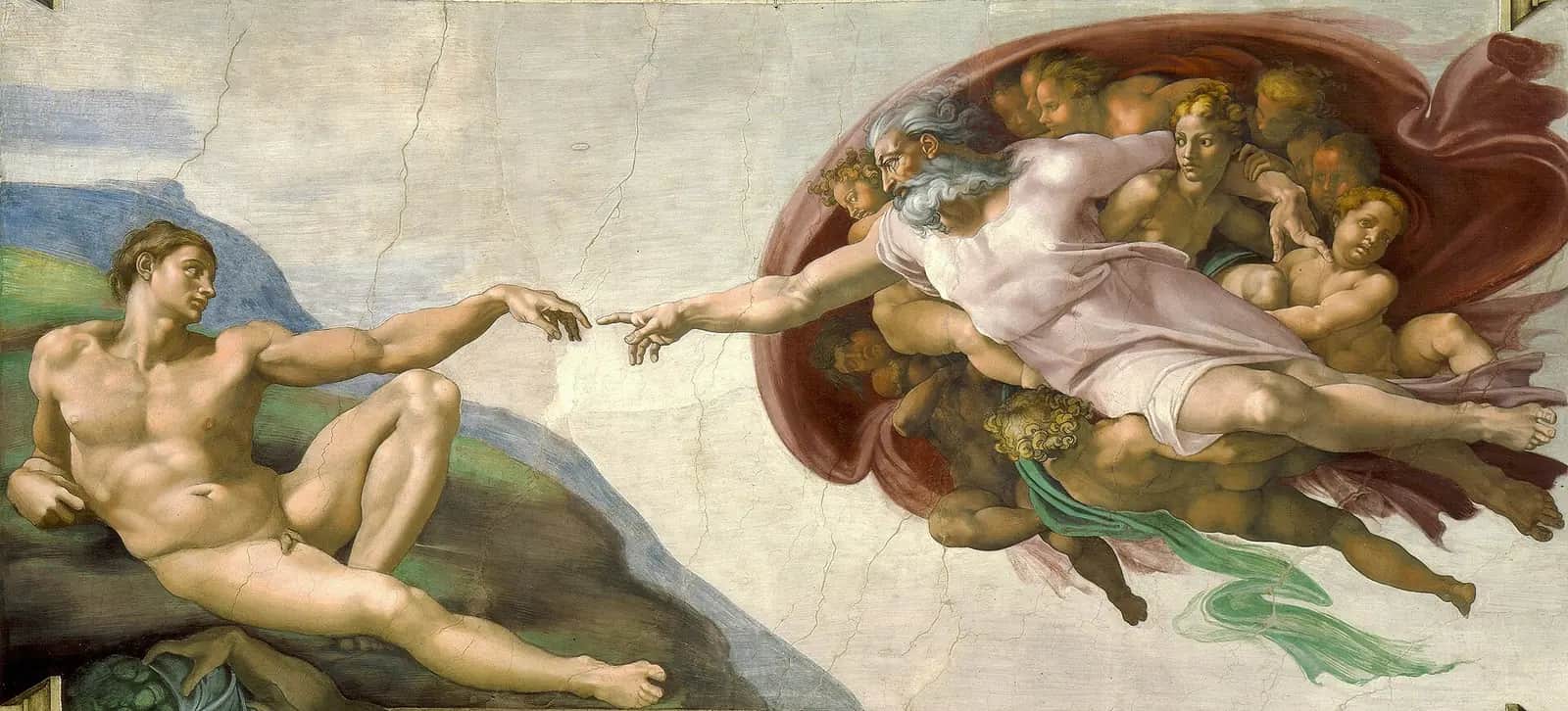
Genesis 1:26 (WEB)
God said, “Let’s make man in our image, after our likeness. Let them have dominion over the fish of the sea, and over the birds of the sky, and over the livestock, and over all the earth, and over every creeping thing that creeps on the earth.”
Catechism · 8
The Sacrament of Matrimony
“Sacred Scripture begins with the creation of man and woman in the image and likeness of God and concludes with a vision of "the wedding-feast of the Lamb."” — Catechism footnote: Rev 19:7, 9; cf. Gen 1:26-27.
I Believe in God
“It means knowing the unity and true dignity of all men: everyone is made in the image and likeness of God.” — Catechism footnote: Gen 1:26.
The Seventh Commandment
“In the beginning God entrusted the earth and its resources to the common stewardship of mankind to take care of them, master them by labor, and enjoy their fruits.” — Catechism footnote: Cf. Gen 1:26-29.
The Eighth Commandment
“Created "in the image of God,"” — Catechism footnote: Gen 1:26.
The Seven Petitions
“In making man in his image and likeness, God "crowned him with glory and honor," but by sinning, man fell "short of the glory of God."” — Catechism footnote: Ps 8:5; Rom 3:23; cf. Gen 1:26.
The Creator
“The universe, created in and by the eternal Word, the "image of the invisible God", is destined for and addressed to man, himself created in the "image of God" and called to a personal relationship with God.” — Catechism footnote: Col 1:15, Gen 1:26.
“To human beings God even gives the power of freely sharing in his providence by entrusting them with the responsibility of "subduing" the earth and having dominion over it.” — Catechism footnote: Cf. Gen 1:26-28.
Heaven and Earth
God himself created the visible world in all its richness, diversity and order. Scripture presents the work of the Creator symbolically as a succession of six days of divine "work", concluded by the "rest" of the seventh day.
Fathers and councils · 81
Tertullian
“For in the very preamble of this one production, “Let us make man,” man’s whole posterity was declared and described in a plural phrase, “Let them have dominion over the fish of the sea,” etc. And no wonder: in the seed lies the promise and earnest of the crop.” — editor's note: Ver. 26.
Read the whole comment“And that you may the more readily understand this, consider first of all, from your own self, who are made “in the image and likeness of God,” for what purpose it is that you also possess reason in yourself, who are a rational creature, as being not only made by a rational Artificer, but actually…” — editor's note: Gen. i. 26.
Read the whole comment“…for a Being who is merely and absolutely One and Singular, to speak in plural phrase, saying, “Let us make man in our own image, and after our own likeness;” whereas He ought to have said, “Let me make man in my own image, and after my own likeness,” as being a unique and singular Being?” — editor's note: Gen. i. 26.
Read the whole comment“…to Cæsar what are Cæsar’s, and what are God’s to God;” that is, the image of Cæsar, which is on the coin, to Cæsar, and the image of God, which is on man, to God; so as to render to Cæsar indeed money, to God yourself.” — editor's note: See Gen. i. 26, 27; ix. 6; and comp. 1 Cor. xi. 7.
Read the whole comment““And God made man; (conformable) to the image and likeness of God made He him.”” — editor's note: Comp. Gen. i. 26, 27.
Read the whole comment““Let us make man,” said He, before He created him, and added, “with our hand,” for the sake of his pre-eminence, that so he might not be compared with the rest of creation.” — editor's note: Gen. i. 26.
Read the whole comment“For so did the Father previously say to the Son: “Let us make man in our own image, after our likeness.”” — editor's note: Gen. i. 26.
Read the whole comment“That image was wrought out by a goodness even more operative than its wont, with no imperious word, but with friendly hand preceded by an almost affable utterance: “Let us make man in our image, after our likeness.”” — editor's note: Gen. i. 26.
Read the whole comment“Since then he is the image of the Creator (for He, when looking on Christ His Word, who was to become man, said, “Let us make man in our own image, after our likeness”), how can I possibly have another head but Him whose image I am?” — editor's note: Gen. i. 26.
Read the whole comment
Origen
- Origen, Against Celsus IV.30Book IV
“It appears to me that Celsus has also misunderstood this statement, “Let Us make man in Our image and likeness;” and has therefore represented the “worms” as saying that, being created by God, we altogether resemble Him.” — editor's note: Cf. Gen. i. 26.
Read the whole comment “For the holy Scriptures know Him to be the most ancient of all the works of creation; for it was to Him that God said regarding the creation of man, “Let Us make man in Our image, after Our likeness.”” — editor's note: Cf. Gen. i. 26.
Read the whole comment- Origen, Against Celsus VI.49Book VI
“Celsus has also expressed his opinion that the narrative of the creation of man is “exceedingly silly,” without stating any proofs, or endeavouring to answer our arguments; for he had no evidence, in my judgment, which was fitted to overthrow the statement that “man has been made in the image of God.”” — editor's note: Cf. Gen. i. 26.
Read the whole comment - Origen, De Principiis III.7Book III
“…all other philosophers, when he describes the first creation of man in these words: “And God said, Let Us make man in Our own image, and after Our likeness;” and then he adds the words: “So God created man in His own image: in the image of God created He him; male and female created He them, and He blessed them.”” — editor's note: Gen. i. 26.
Read the whole comment
Gregory of Nyssa
“Again, in the inspired Scriptures, we are told of another kind of resemblance by Him Who said, “Let us make man in our image, after our likeness;” but I do not suppose that Eunomius would discern this kind of likeness between the Father and the Son, so as to make out the Only-begotten God to be identical with man.” — editor's note: Gen. i. 26.
Read the whole comment“For the being to whom Holy Scripture in the history of the creation gave the name of “man” (ἄνθρωπος), a word of human devising, that same being Job calls “mortal” (βροτός), while of profane writers, some call him “human being” (φώς), and others…” — editor's note: Gen. i. 26.
Read the whole comment- Gregory of Nyssa, On the Making of Man On the.4On the Making of Man
“…our likeness, and let them have dominion over the fish of the sea, and the beasts of the earth, and the fowls of the heaven, and the cattle, and all the earth.”” — editor's note: Gen. i. 26, not exactly from the LXX.
Read the whole comment - Gregory of Nyssa, On the Making of Man On the.7On the Making of Man
“…human nature these operations to be as it were significant characters, with reference to their models in Himself: for He says, “Let us make man in our image.”” — editor's note: Gen. i. 26.
Read the whole comment - Gregory of Nyssa, On the Making of Man On the.12On the Making of Man
“But I find the solution of these difficulties by recourse to the very utterance of God; for He says, “Let us make man in our image, after our likeness.”” — editor's note: Gen. i. 26.
Read the whole comment - Gregory of Nyssa, On the Making of Man On the.17On the Making of Man
“Let us now resume our consideration of the Divine word, “Let us make man in our image, after our likeness.”” — editor's note: Gen. i. 26.
Read the whole comment - Gregory of Nyssa, On the Making of Man On the.23On the Making of Man
“I take up then once more in my argument our first text:—God says, “Let us make man in our image, after our likeness, and God created man, in the image of God created He him.”” — editor's note: Gen. i. 26, 27.
Read the whole comment
Irenaeus of Lyons
“Man, too, was the workmanship of angels, a shining image bursting forth below from the presence of the supreme power; and when they could not, he says, keep hold of this, because it immediately darted upwards again, they exhorted each other, saying, “Let us make man after our image and likeness.”” — editor's note: Gen. i. 26.
Read the whole comment“Then, as all were disturbed by this new voice, and by the unexpected proclamation, and as they were inquiring whence the noise proceeded, in order to lead them away and attract them to himself, they affirm that Ialdabaoth exclaimed, “Come, let us make man after our image.”” — editor's note: Gen. i. 26.
Read the whole comment“But this is Adam, if the truth should be told, the first formed man, of whom the Scripture says that the Lord spake, “Let Us make man after Our own image and likeness;” and we are all from him: and as we are from him, therefore have we all inherited his title.” — editor's note: Gen. i. 26.
Read the whole comment“…the Spirit, by whom and in whom, freely and spontaneously, He made all things, to whom also He speaks, saying, “Let Us make man after Our image and likeness;” He taking from Himself the substance of the creatures [formed], and the pattern of things made, and the type of all the adornments in the world.” — editor's note: Gen. i. 26.
Read the whole comment
Athanasius of Alexandria
“…as indiscriminate with ‘He made,’ and these men should have a pretence for saying, ‘Moses tells us indeed that God said from the beginning, “Let Us make man,”’ but he soon after says himself, ‘God that begat thee thou didst desert,’ as if the terms were indifferent; for offspring and work are the same.” — editor's note: Gen. i. 26.
Read the whole comment
John Damascene
“For this is what is the meaning of in our image, after our likeness.” — editor's note: Gen. i. 26.
Read the whole comment“But since some find fault with us for worshipping and honouring the image of our Saviour and that of our Lady, and those, too, of the rest of the saints and servants of Christ, let them remember that in the beginning God created man after His own image.” — editor's note: Gen. i. 26.
Read the whole comment
Cyril of Jerusalem
“Go to the first book, Genesis: God saith, Let us make man, not ‘in My image,’ but, in Our image.” — editor's note: Gen. i. 26.
Read the whole comment“For He who said, Let us make man in our image and after our likeness, was certainly speaking to some one present.” — editor's note: Gen. i. 26.
Read the whole comment“The sun was formed by a mere command, but man by God’s hands: Let us make man after our image, and after our likeness.” — editor's note: Gen. i. 26.
Read the whole comment“At that time God said, let us make man after our image and after our likeness.” — editor's note: Gen. i. 26. “The ancient Church very accurately distinguished between εἰκών (image) and ὁμοίωσις (likeness), and the Greek Church does the same in its…
Read the whole comment
Eusebius of Caesarea
““For,” says he, “God said, Let us make man in our image and in our likeness.”” — editor's note: Gen. i. 26.
Read the whole comment
John Cassian
- John Cassian, Conferences I–X X.3Conference X
“…all the brethren how the Catholic Churches throughout the East interpreted the passage in Genesis where it says “Let us make man after our image and likeness.”” — editor's note: Gen. i. 26.
Read the whole comment - John Cassian, Conferences I–X X.5Conference X
“…been stained with the superstition of the heathen world, under the colour of this passage where it is said “Let us make man after our image and our likeness,” ignorance and simplicity being its authors, so that actually there has arisen owing to this hateful interpretation a heresy called that of the…” — editor's note: Gen. i. 26.
Read the whole comment
Augustine of Hippo
“But so soon as I understood, withal, that man made “after the image of Him that created him” was not so understood by Thy spiritual sons (whom of the Catholic mother Thou hadst begotten again through grace), as though they believed and imagined Thee to…” — editor's note: Col. iii. 10, and Gen. i. 26, 27. And because we are created in the image of God, Augustin argues (Serm. lxxxviii. 6), we have the ability to see and know Him,…
Read the whole comment“…living after the example of a better man (for Thou hast not said, “Let man be made after his kind,” but, “Let us make man in our image, after our likeness”), that we may prove what Thy will is.” — editor's note: Gen. i. 26.
Read the whole comment“For man was made after the image and likeness of God, which he defaced by sin: therefore it is his true and eternal good, if by a new birth he be stamped.” — editor's note: Gen. i. 26.
Read the whole comment“In what “Image,” save that of Him who said, “Let Us make man in Our Image, after Our Likeness.”” — editor's note: Gen. i. 26.
Read the whole comment“The image of God is within, is not in the body; is not in these ears which ye see, and eyes, and nostrils, and palate, and hands, and feet; but is made nevertheless:…” — editor's note: Gen. i. 26.
Read the whole comment“For in many things by beasts we are surpassed: but when a man knoweth himself to have been made after the image of God, therein something in himself he acknowledgeth to be more than hath been given to dumb animals.” — editor's note: Gen. i. 26.
Read the whole comment“He that together with thee hath been made, is thy fellow; and all men have been made after the image of God, unless with earthly coverings they efface that which He hath formed.” — editor's note: Gen. i. 26.
Read the whole comment“…so that he said this, in “lighten Thy countenance upon us:” Thou hast imprinted Thy countenance upon us; Thou hast made us after Thine image and Thy likeness, Thou hast made us Thy coin; but Thine image ought not in darkness to remain: send a ray of Thy wisdom, let it dispel our darkness, and let there shine in us…” — editor's note: Gen. i. 26.
Read the whole comment“…from the earth, he hath received a reasonable soul; by the vivacity of that very reason, he is placed before all beasts, cattle, birds that fly, and fishes.” — editor's note: Gen. i. 26.
Read the whole comment“What reward wilt thou give the Lord, for His having created thee above all the cattle; and above all the fowls of the air, in His image and likeness?” — editor's note: Gen. i. 26, 27.
Read the whole comment““And let him have power over the fishes of the sea, and over the fowl of the heaven, and over all cattle which move upon the earth.”” — editor's note: Gen. i. 26.
Read the whole comment“For if the Father alone had made man without the Son, it would not have been written, “Let us make man in our image, after our likeness.”” — editor's note: Gen. i. 26
Read the whole comment“Sometimes the meaning is altogether latent, as in Genesis: “Let us make man after our image and likeness.”” — editor's note: Gen. i. 26
Read the whole comment“For God said, “Let us make man in our image, after our likeness;” and a little after it is said, “So God created man in the image of God.”” — editor's note: Gen. i. 26, 27
Read the whole comment“But in respect to that image indeed, of which it is said, “Let us make man after our image and likeness,” we believe,—and, after the utmost search we have been able to make, understand,—that man was made after the image of the Trinity, because it is not said, After my, or After thy image.” — editor's note: Gen. i. 26
Read the whole comment“So then the Father doth not act without the Son, nor the Son without the Father.” — editor's note: Gen. i. 26.
Read the whole comment““Let Us make,” He saith; I hear the Plurality; “after Our image;” again I hear the Plurality.” — editor's note: Gen. i. 26.
Read the whole comment“For “let them,” He says, “have dominion over the fish of the sea, and over the fowl of the air, and over every creeping thing which creepeth on the earth.”” — editor's note: Gen. i. 26.
Read the whole comment“And yet this Trinity, being one God, even after saying “Let us make,” goes on to say, “And God made man in His image,” and not “Gods made,” or “in their image.”” — editor's note: Gen. i. 26.
Read the whole comment
Justin Martyr
“And God blessed them, and said, Increase and multiply, and fill the earth, and have power over it.’” — editor's note: Gen. i. 26, 28.
Read the whole comment
Theodoret of Cyrus
“At first he understood in an absurd sense the passage “Let us make man in our image, after our likeness.”” — editor's note: Gen. i. 26
Read the whole comment
Clement of Alexandria
“…of light; and the image of the Word is the true man, the mind which is in man, who is therefore said to have been made “in the image and likeness of God,” assimilated to the Divine Word in the affections of the soul, and therefore rational; but effigies sculptured in human form, the earthly image of that part of…” — editor's note: Gen. i. 26.
Read the whole comment“…man into a holy and heavenly being by His advent, He might fulfil to the utmost that divine utterance, “Let Us make man in Our own image and likeness.”” — editor's note: Gen. i. 26.
Read the whole comment“And the poets call the elect in their pages godlike and gods, and equal to the gods, and equal in sagacity to Zeus, and having counsels like the gods, and resembling the gods,—nibbling, as seems to me, at the expression, “in the image and likeness.”” — editor's note: Gen. i. 26.
Read the whole comment“And some, in worshipping God, make a representation of heaven containing the stars; and so worship, although Scripture says, “Let Us make man in Our image and likeness.”” — editor's note: Gen. i. 26.
Read the whole comment
Ambrose of Milan
“So also you may read in Genesis: “And God said,—and God made,” and, lower down, “And God made man in the image of God;” yet it was not two gods, but one God, that made [man].” — editor's note: Gen. i. 26, 27.
Read the whole comment“For the Father said, “Let us make man in Our image and likeness.”” — editor's note: Gen. i. 26.
Read the whole comment“To whom doth the Father say, “Let us make man?” save to Him Whom He knew to be His true Son?” — editor's note: Gen. i. 26.
Read the whole comment“He will reply: “Then have I lied, I, Who said to the Son, ‘Let us make man in Our image and likeness.’”” — editor's note: Gen. i. 26.
Read the whole comment“But in the church I only know of one Image, that is the Image of the unseen God, of Which God has said: “Let us make man in Our image and Our likeness;” that Image of Which it is written, that Christ is the Brightness of His glory and the Image of His Person.” — editor's note: Gen. i. 26.
Read the whole comment“For Moses wrote that God said: “Let us make man in our image, after our likeness, and let them have dominion over the fish of the sea, and over the fowl of the air, and over the cattle, and over every creeping thing that creepeth upon the earth.”” — editor's note: Gen. i. 26.
Read the whole comment“For every creature exists both of the will, and through the operation and in the power of the Trinity, as it is written: “Let Us make man after Our image and likeness;” and elsewhere: “By the word of the Lord were the heavens established, and all their power by the Spirit of His mouth.”” — editor's note: Gen. i. 26.
Read the whole comment“And in the Old Testament the Father, by saying, “Let Us make,” showed that the Son was to be worshipped with Himself as the Maker of all things.” — editor's note: Gen. i. 26.
Read the whole comment
Basil the Great
“And God said “Let us make man.”” — editor's note: Gen. i. 26.
Read the whole comment
John Chrysostom
““Let Us make man in Our Image, after Our Likeness” ( Gen. i. 26 ), was said to the Son.” — the author cites it
Read the whole comment““Let Us make,” It saith, “man.” ( Gen. i. 26 .)” — the author cites it
Read the whole comment
Jerome
“For created as we are in the image of God and after His likeness, it is our own wickedness which makes us assume masks.” — editor's note: Gen. i. 26.
Read the whole comment“…“And Adam lived two hundred and thirty years, and knew Eve his wife, and she bare him a son in his image and after his likeness, and called his name Seth.”” — editor's note: Gen. iv. 25; v. 3; i. 26.
Read the whole comment
Hilary of Poitiers
“XIII. “If any man says Let us make manwas not spoken by the Father to the Son, but by God to Himself: let him be anathema.” — editor's note: Gen. i. 26.
Read the whole comment“Disturb not this likeness; make no separation where truth shews no variance, for He Who said, Let us make man after our image and likeness, by those words Our likeness revealed the existence of Beings, Each like the Other.” — editor's note: Gen. i. 26.
Read the whole comment“When the world was complete and its inhabitant was to be created, the words spoken concerning him were, Let Us make man after Our image and likeness.” — editor's note: Gen. i. 26.
Read the whole comment
Cyprian of Carthage
“God says, “Let us make man in our image and likeness;” and does any one dare to alter and to change what God has made?” — editor's note: Gen. i. 26.
Read the whole comment
Gregory of Nazianzus
“But the scope of our art is to provide the soul with wings, to rescue it from the world and give it to God, and to watch over that which is in His image, if it abides, to take it by the hand, if it is in danger, or restore it, if ruined, to make Christ to dwell in the heart by the Spirit: and, in short, to…” — editor's note: Gen. i. 26.
Read the whole comment“…comparing our wrongdoings with our benefits, and striking thought with thought, and scrutinising action with action, and calling us to account for the image which has been blurred and spoilt by wickedness, till at last He leads us away self-convicted and self-condemned, no longer able to say that we are being…” — editor's note: Gen. i. 26.
Read the whole comment
Catena Aurea on John
- OrigenCatena Aurea on John
“Some moreover contend from Genesis, (Gen. 1:26) Let us make man after our image, that man means whatever is made after the image and similitude of God.” — the author cites it
Read the whole comment
Catena Aurea on Luke
- OrigenCatena Aurea on Luke
“For there are two images in man, one which he received from God, as it is written, Let us make man in our own image: (Gen. 1:26.) another from the enemy, which he has contracted through disobedience and sin, allured and won by the enticing baits of the prince of this world.” — the author cites it
Read the whole comment
Hippolytus of Rome
“There had appeared above from (the Being of) absolute sway, a brilliant image; and when (the angels) were not able to detain this, on account of its immediately, he says, returning with rapidity upwards, they exhorted one another, saying, “Let us make man in our likeness and image.”” — editor's note: Gen. i. 26.
Read the whole comment
Cross-references · 103
Cited together in On the Duties of the Clergy I.28 and 1 other place.
Cited together in On the Duties of the Clergy I.28.
Cited together in Dialogue with Trypho Chapter 62 and 1 other place.
Cited together in Against Celsus VI.49.
Cited together in On the Making of Man On the.17.
Cited together in An Exact Exposition of the Orthodox Faith IV.16.
Cited together in The City of God XVI.6.
Cited together in An Exact Exposition of the Orthodox Faith IV.16.
Cited together in An Exact Exposition of the Orthodox Faith IV.16.
Cited together in An Exact Exposition of the Orthodox Faith IV.16.
Cited together in Origen on Luke 20:19–26 (Catena Aurea).
Cited together in Dialogue with Trypho Chapter 62.
Cited together in Dialogue with Trypho Chapter 62.
Cited together in Dialogue with Trypho Chapter 62.
Cited together in Catechism §299.
Cited together in On the Holy Trinity XII.6.
Cited together in Catechism §2809.
Cited together in On the Duties of the Clergy I.28.
Cited together in On the Duties of the Clergy I.28.
Cited together in On the Holy Trinity XII.6.
Cited together in Catechism §299.
Cited together in Catechism §299.
Cited together in Catechism §299.
Cited together in Catechism §299.
Cited together in The Five Books Against Marcion II.4.
Cited together in On the Holy Trinity XII.6.
Cited together in Letters Letter 43.
Cited together in Letters Letter 43.
Cited together in An Exact Exposition of the Orthodox Faith III.14.
Cited together in On the Making of Man On the.7.
Cited together in Confessions VI.3.
Cited together in Catechism §2501.
Cited together in Catechism §2501.
Cited together in Catechism §299.
Cited together in Exposition of the Christian Faith I.18.
Cited together in Catechism §2809.
Cited together in An Exact Exposition of the Orthodox Faith III.14.
Cited together in On the Holy Trinity XIV.19.
Cited together in Against Heresies I.24.
Cited together in Against Heresies I.24.
Cited together in Against Heresies I.24.
Cited together in Against Heresies I.24.
Cited together in Ecclesiastical History IV.9.
Cited together in Exposition of the Christian Faith I.18.
Cited together in Conferences I–X X.5.
Cited together in The Stromata, or Miscellanies V.5.
Cited together in Confessions XIII.22.
Cited together in An Exact Exposition of the Orthodox Faith III.14.
Cited together in Against Celsus IV.30.
Cited together in Exposition of the Christian Faith I.18.
Cited together in The Stromata, or Miscellanies V.5.
Cited together in Against Celsus IV.30.
Cited together in On the Making of Man On the.17.
Cited together in An Exact Exposition of the Orthodox Faith III.14.
Cited together in An Exact Exposition of the Orthodox Faith III.14.
Cited together in Ecclesiastical History IV.9.
Cited together in An Exact Exposition of the Orthodox Faith III.14.
Cited together in The Stromata, or Miscellanies V.5.
Cited together in On the Duties of the Clergy I.28.
Cited together in The Stromata, or Miscellanies V.5.
Cited together in Origen on Luke 20:19–26 (Catena Aurea).
Cited together in Origen on Luke 20:19–26 (Catena Aurea).
Cited together in Origen on Luke 20:19–26 (Catena Aurea).
Cited together in Origen on Luke 20:19–26 (Catena Aurea).
Cited together in Origen on Luke 20:19–26 (Catena Aurea).
Cited together in Origen on Luke 20:19–26 (Catena Aurea).
Cited together in On the Resurrection of the Flesh Chapter 5 and 2 other places.
Cited together in On the Holy Trinity XIV.19.
Cited together in Exposition of the Christian Faith II.14.
Cited together in Exposition of the Christian Faith I.18 and 1 other place.
Cited together in Letters Letter 43.
Cited together in Exposition of the Christian Faith II.14.
Cited together in An Exact Exposition of the Orthodox Faith III.14.
Cited together in Against Celsus IV.30 and 1 other place.
Cited together in On the Making of Man On the.12.
Cited together in Confessions XIII.22 and 1 other place.
Cited together in Confessions XIII.22.
Cited together in Catechism §307.
Cited together in Confessions XIII.22.
Cited together in Catechism §1602.
Cited together in An Exact Exposition of the Orthodox Faith IV.16.
Cited together in On the Holy Trinity VII.6.
Cited together in Against Heresies I.30.
Cited together in Exposition of the Christian Faith I.18.
Cited together in Catechism §1602.
Cited together in Catechism §1602.
Cited together in On the Resurrection of the Flesh Chapter 6 and 1 other place.
Cited together in Catechism §299.
Cited together in Catechism §307.
Cited together in Catechism §2809 and 2 other places.
Cited together in Catechism §307.
Cited together in Confessions XIII.22.
Cited together in Catechism §307.
Cited together in An Exact Exposition of the Orthodox Faith IV.16.
Cited together in Against Heresies I.24.
Cited together in Confessions VI.3.
Cited together in An Exact Exposition of the Orthodox Faith IV.16.
Cited together in An Exact Exposition of the Orthodox Faith IV.16.
Cited together in The City of God XIX.15.
Cited together in Exposition of the Christian Faith I.18.
Cited together in The Stromata, or Miscellanies V.5.
Cited together in Catechism §1602.
Cited together in Catechism §1602.