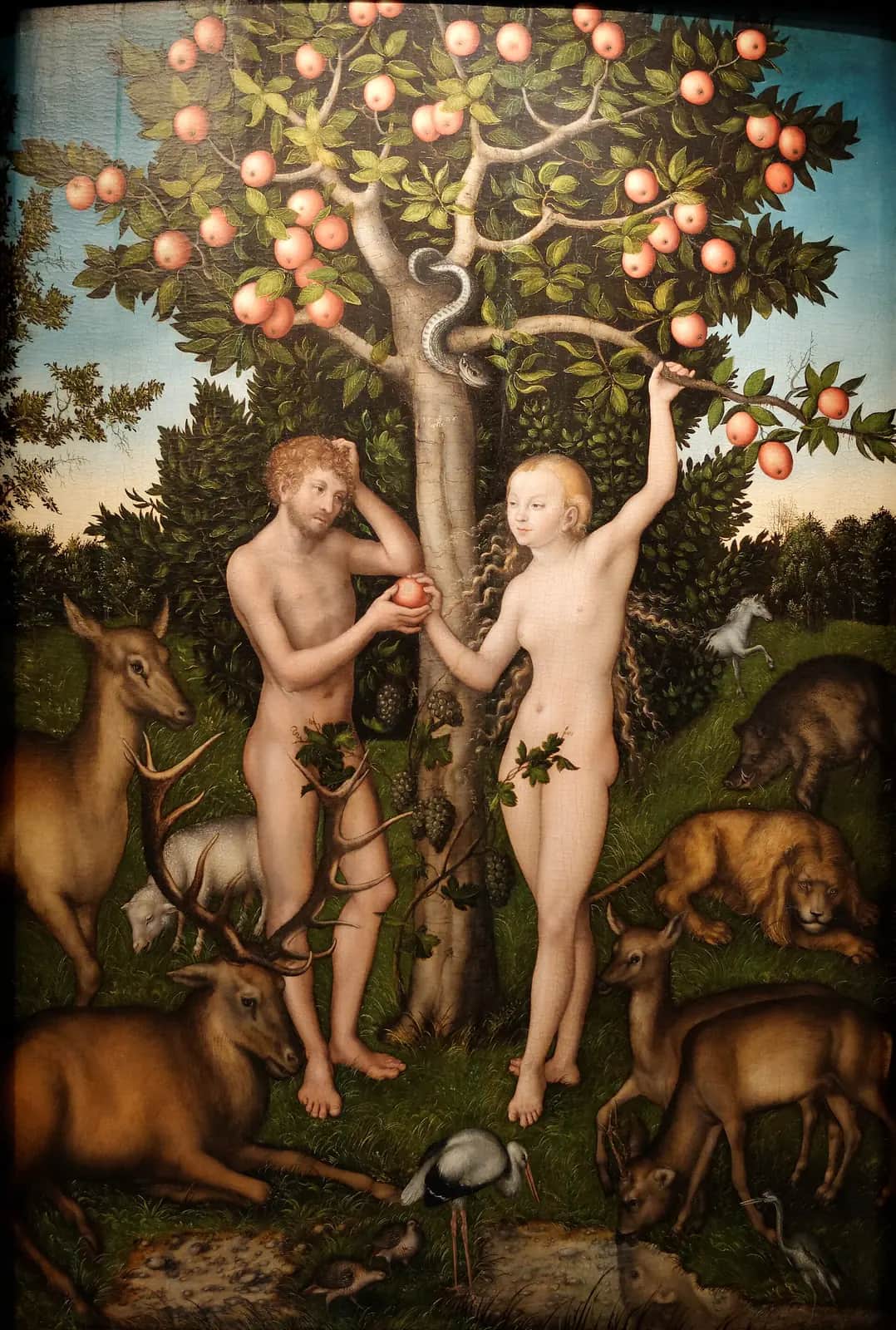
Genesis 2:23 (WEB)
The man said, “This is now bone of my bones, and flesh of my flesh. She will be called ‘woman,’ because she was taken out of Man.”
As quoted in the map (KJV)
Genesis 2:23 (KJV)
And Adam said, This is now bone of my bones, and flesh of my flesh: she shall be called Woman, because she was taken out of Man.
Key words
- אִשָּׁהishshah · Hebrew
- 'Woman,' formed from ish (אִישׁ), 'man.' Before the fall she has no personal name — she is simply 'Woman.'
- γυνήgynē · Greek (LXX)
- 'woman' — the same word Jesus uses when he addresses his mother as 'Woman' (gynai) at Cana and the cross.
Why it matters
The first woman is called only 'Woman' until after the fall; she is named 'Eve' only in Genesis 3:20, once sin has entered. Pitre notes that when Jesus addresses Mary as 'Woman' in John, he reaches back to this unfallen figure. Mary is the 'Woman' of the new creation — what the first woman was before she fell.
Catechism · 2
The Sacrament of Matrimony
“The woman, "flesh of his flesh," i.e., his counterpart, his equal, his nearest in all things, is given to him by God as a "helpmate"; she thus represents God from whom comes our help.” — Catechism footnote: Cf. Gen 2:18-25.
Man
“The woman God "fashions" from the man's rib and brings to him elicits on the man's part a cry of wonder, an exclamation of love and communion: "This at last is bone of my bones and flesh of my flesh."” — Catechism footnote: Gen 2:23
Fathers and councils · 14
Tertullian
“Therefore shall a man leave his father and mother, and he shall cleave unto his wife; and they two shall be one flesh.”” — editor's note: Gen. ii. 23, 24.
Read the whole comment“Now, although it here mentions the nostrils, it does not say that they were made by God; so again it speaks of skin and bones, and flesh and eyes, and sweat and blood, in subsequent passages, and yet it never intimated that they had been created by God.” — editor's note: See Gen. ii. 21, 23; iii. 5, 19; iv. 10.
Read the whole comment“…himself at that time, reverting to the condition of a Psychic after the spiritual ecstasy in which he had prophetically interpreted that “great sacrament” with reference to Christ and the Church, and no longer being “capable of the things which were the Spirit’s,” yielded more readily to his belly than to God,…” — editor's note: Comp. Eph. v. 32 with Gen. ii. 23, 24.
Read the whole comment“Adultery is (this): when, the two having been—in whatsoever way—disjoined, other—nay, rather alien—flesh is mingled (with either): flesh concerning which it cannot be affirmed, “This is flesh out of my flesh, and this bone out of my bones.”” — editor's note: Gen. ii. 23, in reversed order again.
Read the whole comment“Here they find it to be the name of the sex, not a class of the sex: if, that is, God gave to Eve, when she had not yet known a man, the surname “woman” and “female”—(“female,” whereby the sex generally; “woman,” hereby a class of the sex, is marked).” — editor's note: Gen. ii. 23. In the LXX. and in the Eng. ver. there is but the one word “woman.”
Read the whole comment“No sober woman even, or heroine of any note, would have adventured her shoulders beneath the hide of such a beast, unless after long softening and smoothening down and deodorization (which in…” — editor's note: Viraginis; but perhaps =virginis. See the Vulg. in Gen. ii. 23.
Read the whole comment“…Adam had already recognised the flesh which was in the woman as the propagation of his own substance (“This is now bone of my bone, and flesh of my flesh”), and the very taking of the woman out of the man was supplemented with flesh; but it ought, I should suppose, to have been made good with clay, if Adam was…” — editor's note: Gen. ii. 23.
Read the whole comment“If “the woman is of the man,” and “for the sake of the man,” that rib of Adam was first a virgin.” — editor's note: Gen. ii. 23.
Read the whole comment“So likewise Adam, while still intact, is surnamed in Genesis man: “She shall be called,” says he, “woman, because she hath been taken from her own man.”” — editor's note: See Gen. ii. 23.
Read the whole comment
John Damascene
“Indeed, Divine Scripture tells that both Adam and Eve were naked and were not ashamed.” — editor's note: Gen. ii. 23.
Read the whole comment
Catena Aurea on John
- Augustine of HippoCatena Aurea on John
“(Gen. 2:23) The flesh therefore is put for the wife, as the spirit sometimes is for the husband; because that the one ought to govern, the other to obey.” — the author cites it
Read the whole comment
Jerome
“…and the disobedience, and the fall from paradise, Adam speaks not in an allegory, but literally, thus: “This is now bone of my bones and flesh of my flesh;” or what is the ground of the divine narrative, “And the Lord God caused a deep sleep to fall upon Adam, and he slept; and he took one of his ribs, and closed…” — editor's note: Gen. ii. 23.
Read the whole comment
Clement of Alexandria
“Dicit enim: Hoc nunc os ex ossibus meis, et caro ex came mea.”” — editor's note: Gen. ii. 23.
Read the whole comment
Augustine of Hippo
“The apostle puts flesh for woman; because, when she was made of his rib, Adam said, “This is now bone of my bone, and flesh of my flesh.”” — editor's note: Gen. ii. 23.
Read the whole comment
Cross-references · 27
Cited together in Against Hermogenes Chapter 31.
Cited together in On the Veiling of Virgins Chapter 7.
Cited together in On the Veiling of Virgins Chapter 7.
Cited together in On Fasting Chapter 3.
Cited together in A Treatise on the Soul Chapter 21.
Cited together in A Treatise on the Soul Chapter 21.
Cited together in A Treatise on the Soul Chapter 21.
Cited together in On Monogamy Chapter 9.
Cited together in Catechism §1605 and 1 other place.
Cited together in On Monogamy Chapter 9.
Cited together in On Monogamy Chapter 9.
Cited together in On Monogamy Chapter 9.
Cited together in A Treatise on the Soul Chapter 21.
Cited together in A Treatise on the Soul Chapter 21.
Cited together in On Monogamy Chapter 9.
Cited together in On the Resurrection of the Flesh Chapter 7.
Cited together in On the Pallium Chapter 4.
Cited together in A Treatise on the Soul Chapter 21.
Cited together in On the Veiling of Virgins Chapter 7 and 1 other place.
Cited together in On the Veiling of Virgins Chapter 7.
Cited together in On the Veiling of Virgins Chapter 7.
Cited together in On the Veiling of Virgins Chapter 7.
Cited together in On the Veiling of Virgins Chapter 8.
Cited together in A Treatise on the Soul Chapter 21.
Cited together in A Treatise on the Soul Chapter 21.
Cited together in A Treatise on the Soul Chapter 21 and 1 other place.
Cited together in On the Resurrection of the Flesh Chapter 7.