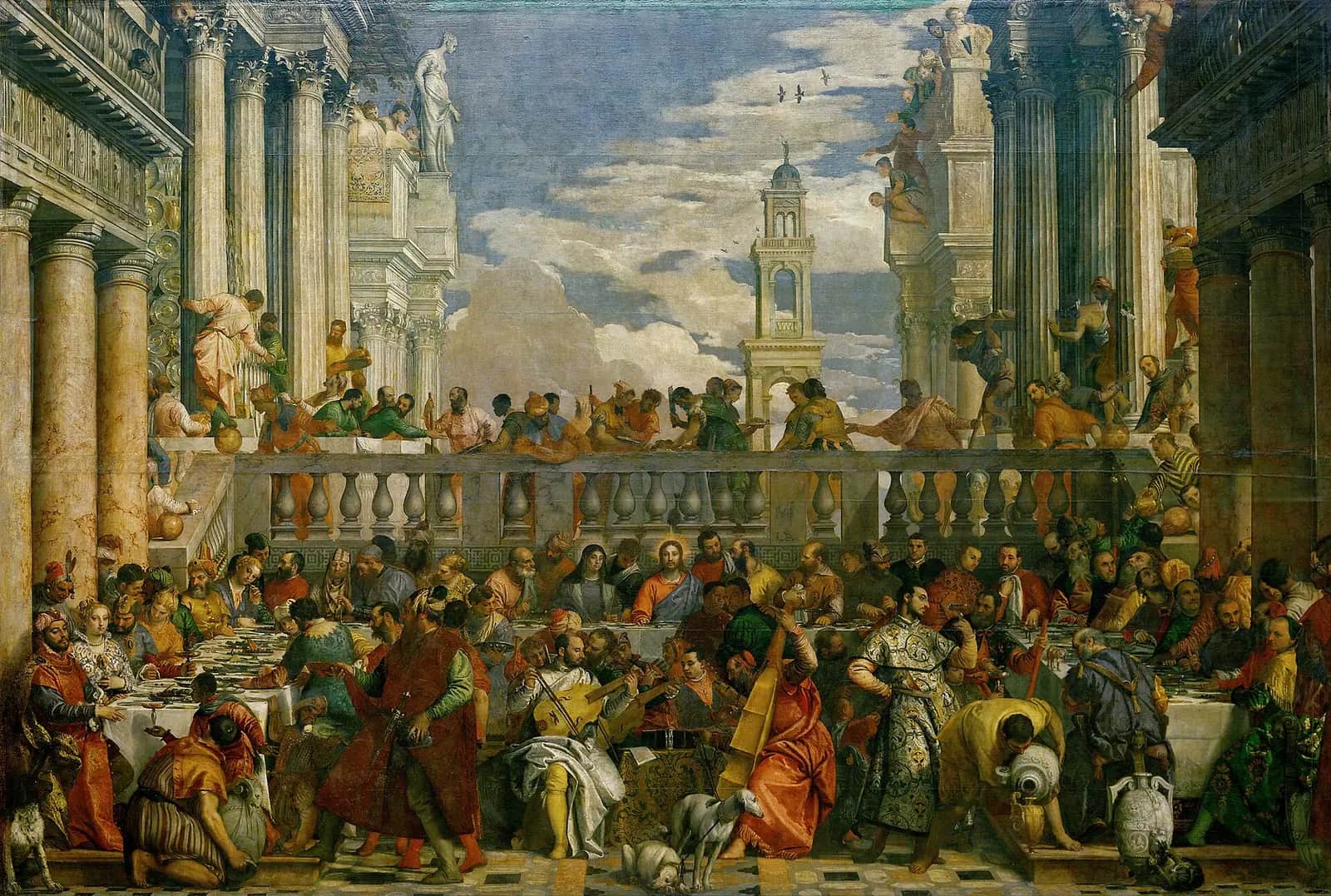
John 2:1 (WEB)
The third day, there was a wedding in Cana of Galilee. Jesus’ mother was there.
As quoted in the map (KJV)
John 2:1 (KJV)
And the third day there was a marriage in Cana of Galilee; and the mother of Jesus was there:
Key words
- τῇ ἡμέρᾳ τῇ τρίτῃtē hēmera tē tritē · Greek
- 'the third day' — counting from the days marked in 1:29, 35 and 43, Cana falls on the seventh day of John's opening week.
- γάμοςgamos · Greek
- 'marriage' — a wedding; Genesis' creation week likewise ends with the wedding of the first man and woman.
- ἡ μήτηρ τοῦ Ἰησοῦhē mētēr tou Iēsou · Greek
- 'the mother of Jesus' — John never calls her by name.
Why it matters
John opens with 'In the beginning,' like Genesis, then counts off days until a wedding on 'the third day' — the seventh day of a new creation week. Pitre reads Cana as a new-creation scene in which the Woman of the new creation appears at a wedding, as Eve did at the first. It is the first of the two scenes in John where Jesus calls his mother 'Woman.'
Catechism · 3
The Sacrament of Matrimony
“On the threshold of his public life Jesus performs his first sign - at his mother's request - during a wedding feast.” — Catechism footnote: Cf. Jn 2:1-11.
In the Fullness of Time
The Gospel reveals to us how Mary prays and intercedes in faith. At Cana, The mother of Jesus asks her son for the needs of a wedding feast; this is the sign of another feast - that of the wedding of the Lamb where he…
"Conceived by the Power of the Holy Spirit and Born of the Virgin Mary"
- §495Paragraph 2 · "Conceived by the Power of the Holy Spirit and Born of the Virgin Mary"Read at vatican.va
“Called in the Gospels "the mother of Jesus", Mary is acclaimed by Elizabeth, at the prompting of the Spirit and even before the birth of her son, as "the mother of my Lord".” — Catechism footnote: Lk 1:43; Jn 2:1; 19:25; cf. Mt 13:55; et al.
Fathers and councils · 31
Tertullian
“He was truly both seen and heard upon the mount; true and real was the draught of that wine at the marriage of (Cana in) Galilee; true and real also was the touch of the then believing Thomas.” — editor's note: John ii. 1–10.
Read the whole comment“…without water: if, that is, He is Himself baptized in water; inaugurates in water the first rudimentary displays of His power, when invited to the nuptials; invites the thirsty, when He makes a discourse, to His own sempiternal water; approves, when teaching concerning love, among works of charity, the cup of water…” — editor's note: John ii. 1–11.
Read the whole comment“…that “man gluttonous and toping,” the “frequenter of luncheons and suppers, in the company of publicans and sinners,” sups once for all at a single marriage, though, of course, many were marrying (around Him); for He willed to attend (marriages) only so often as (He willed) them to be.” — editor's note: See John ii. 1–11.
Read the whole comment
Gregory of Nyssa
“…our Lord Jesus Christ, Who comforteth us in all our tribulation”; and John, in one of his Catholic Epistles, expressly gives to the Son the name of Comforter.” — editor's note: 1 S. John ii. 1. (The word is in the A.V. rendered “advocate.”)
Read the whole comment
John Damascene
“This we say without speaking ill of marriage: God forbid! (for we know that the Lord blessed marriage by His presence, and we know him who said, Marriage is honourable and the bed undefiled), but knowing that virginity is better than marriage, however good.” — editor's note: St. John ii. 1.
Read the whole comment
Augustine of Hippo
“Further, he informs us that on the third day, when He was yet in Galilee, Jesus wrought the miracle of the turning of the water into wine at Cana.” — editor's note: John ii. 1–11.
Read the whole comment“…He left that district and returned to the land of Judæa, and there baptized a multitude about the Jordan, previous to the time when John was imprisoned.” — editor's note: John ii. 1, 12, iii. 22–24.
Read the whole comment“This account of the multitude of sellers who were cast out of the temple is given by all the evangelists; but John introduces it in a remarkably different order.” — editor's note: Matt. xxi. 10–13; Mark xi. 15–17; Luke xix. 45, 46; John ii. 1–17.
Read the whole comment“And there, although the evangelist himself mentions His mother by that very name, He nevertheless addresses her thus: “Woman, what have I to do with thee?”” — editor's note: John ii. 1–11.
Read the whole comment
John Chrysostom
“Chap. ii. ver. 1, 2.” — the author cites it
Read the whole comment“Which He did also at the marriage.” — editor's note: John ii. 1–11.
Read the whole comment
Jerome
“Not far off Cana will be visible, where the water was turned into wine.” — editor's note: Joh. ii. 1–11.
Read the whole comment“In describing our Lord’s visit to the marriage at Cana in Galilee, after some other remarks I have added these: “He who went but once to a marriage has taught us that a woman should marry but once; and this fact might tell…” — editor's note: Joh. ii. 1, 2.
Read the whole comment“Water is the matter of His first miracle and it is from a well that the Samaritan woman is bidden to slake her thirst.” — editor's note: The turning of the water into wine at Cana (Joh. ii. 1, 11).
Read the whole comment
Gregory of Nazianzus
“He who turned the water into wine, who is the destroyer of the bitter taste, who is Sweetness and altogether desire.” — editor's note: John ii. 1–11.
Read the whole comment“I will imitate Christ, the pure Grooms-man and Bridegroom, as He both wrought a miracle at a wedding, and honours wedlock with His Presence.” — editor's note: John ii. 1–11.
Read the whole comment
Hippolytus of Rome
“This, he says, is the mighty and true beginning of miracles which Jesus performed in Cana of Galilee, and (thus) manifested the kingdom of heaven.” — editor's note: John ii. 1–11.
Read the whole comment
Catena Aurea on John
- John ChrysostomCatena Aurea on John
Our Lord being known in Galilee, they invite Him to a marriage: And the third day there was a marriage in Cana of Galilee.
Read the whole comment - Alcuin of YorkCatena Aurea on John
Galilee is a province; Cana a village in it.
Read the whole comment - John ChrysostomCatena Aurea on John
They invite our Lord to the marriage, not as a great person, but merely as one they knew, one of the many; for which reason the Evangelist says, And the mother of Jesus was there. As they invited the mother, so they…
Read the whole comment - Augustine of HippoCatena Aurea on John
Let the proud man blush to see the humility of God. Lo, among other things, the Son of the Virgin comes to a marriage; He who, when He was with the Father, instituted marriage.
Read the whole comment - BedeCatena Aurea on John
His condescension in coming to the marriage, and the miracle He wrought there, are, even considering them in the letter only, a strong confirmation of the faith. Therein too are condemned the errors of Tatian,…
Read the whole comment - Augustine of HippoCatena Aurea on John
What marvel, if He went to that house to a marriage, Who came into this world to a marriage. For here He has His spouse whom He redeemed with His own blood, to whom He gave the pledge of the Spirit, and whom He…
Read the whole comment - BedeCatena Aurea on John
Nor is it without some mysterious allusion, that the marriage is related as taking-place on the third day. The first age of the world, before the giving of the Law, was enlightened by the example of the Patriarchs;…
Read the whole comment - John ChrysostomCatena Aurea on John
But how came it into the mother’s mind to expect so great a thing from her Son? for he had done no miracle as yet: as we read afterwards, This beginning of miracles did Jesus. His real nature, however, was beginning…
Read the whole comment - Alcuin of YorkCatena Aurea on John
She represents here the Synagogue, which challenges Christ to perform a miracle. It was customary with the Jews to ask for miracles. Jesus saith unto her, Woman, what have I to do with thee?
Read the whole comment - Augustine of HippoCatena Aurea on John
Some who derogate from the Gospel, and say that Jesus was not born of the Virgin Mary, try to draw an argument for their error from this place; for, how, say they, could she be His mother to whom He said, What have I…
Read the whole comment - John ChrysostomCatena Aurea on John
That He greatly venerated His mother, we know from St. Luke, who tells us that He was subject unto His parents. For where parents throw no obstacle in the way of God’s commands, it is our duty to be subject to them;…
Read the whole comment - Augustine of HippoCatena Aurea on John
To mark a distinction between His Godhead and manhood, that according to His manhood He was inferior and subject, but according to His Godhead supreme, He saith, Woman, what have I to do with thee?
Read the whole comment - John ChrysostomCatena Aurea on John
And for another reason, viz. to prevent any suspicion attaching to His miracles: for these it was proper should be asked for by those who wanted them, not by His mother. He wished to shew them that He would perform…
Read the whole comment - Augustine of HippoCatena Aurea on John
Or it was because our Lord as God had not a mother, though as man He had, and the miracle He was about to work was the act of His Divinity, not of human infirmity. When therefore His mother demanded a miracle, He, as…
Read the whole comment
Cross-references · 8
Cited together in Augustine of Hippo on John 2:1–4 (5) (Catena Aurea).
Cited together in Catechism §495 and 1 other place.
Cited together in Catechism §2618.
Cited together in Catechism §2618.
Cited together in Augustine of Hippo on John 2:1–4 (2) (Catena Aurea).
Cited together in Catechism §495.
Cited together in Catechism §495.
Cited together in John Chrysostom on John 2:1–4 (3) (Catena Aurea).