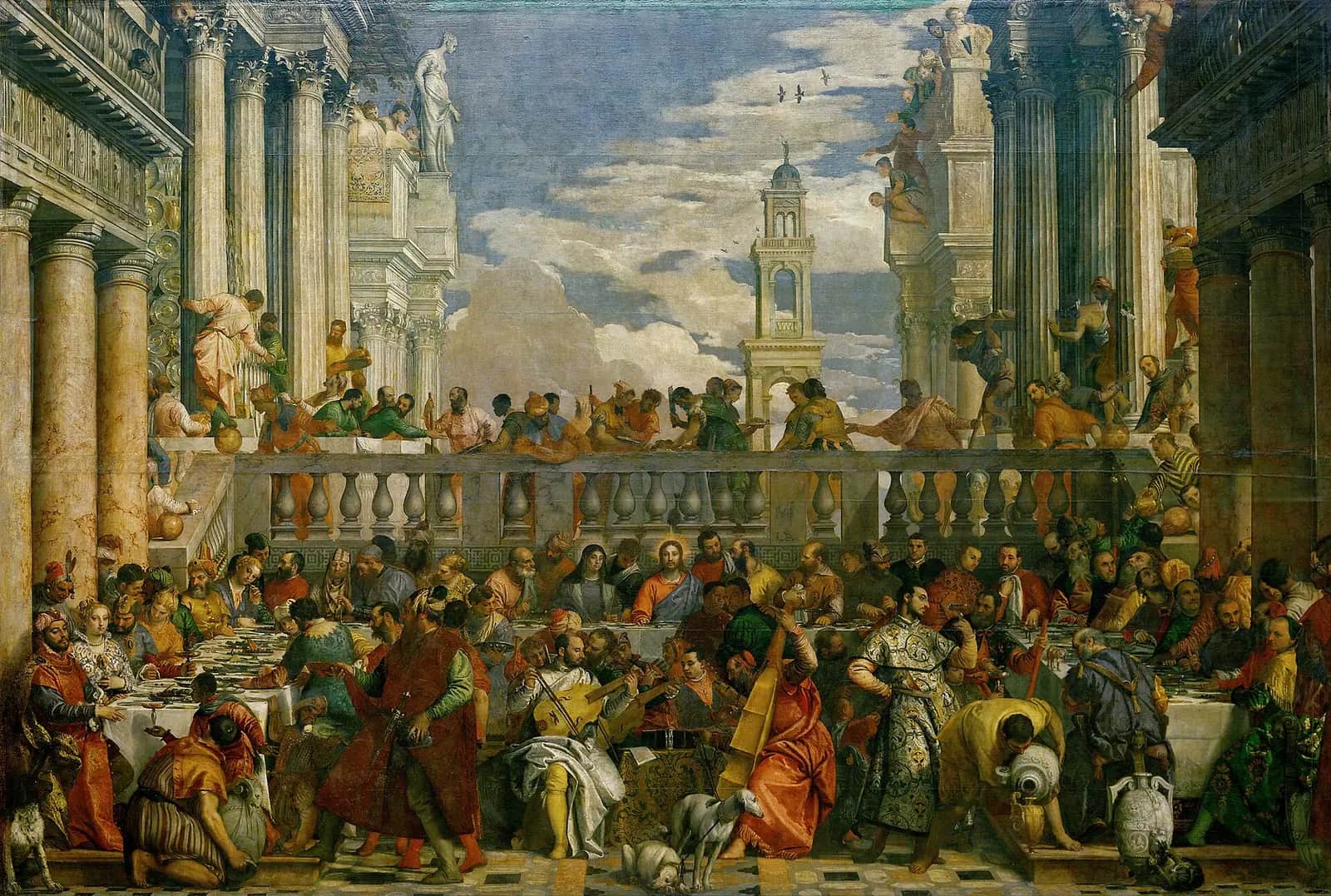
John 2:5 (WEB)
His mother said to the servants, “Whatever he says to you, do it.”
As quoted in the map (KJV)
John 2:5 (KJV)
His mother saith unto the servants, Whatsoever he saith unto you, do it.
Key words
- ὅ τι ἂν λέγῃ ὑμῖν ποιήσατεho ti an legē hymin poiēsate · Greek
- 'Whatsoever he saith unto you, do it.' The wording echoes Pharaoh's command about Joseph in the Septuagint: 'Go to Joseph; whatever he says to you, do' (Genesis 41:55).
Why it matters
Mary's last recorded words direct the servants to obey her Son. Pitre sees the New Eve in action: where Eve led Adam into disobedience, Mary leads others to obedience, and where the queen mother brings petitions to the king, Mary brings the wedding's need to Jesus and he acts. Her intercession at Cana is the model of Marian intercession — it ends in 'do whatever he tells you.'
Catechism · 2
The Sacrament of Matrimony
“On the threshold of his public life Jesus performs his first sign - at his mother's request - during a wedding feast.” — Catechism footnote: Cf. Jn 2:1-11.
In the Fullness of Time
The Gospel reveals to us how Mary prays and intercedes in faith. At Cana, The mother of Jesus asks her son for the needs of a wedding feast; this is the sign of another feast - that of the wedding of the Lamb where he…
Fathers and councils · 32
Tertullian
“He was truly both seen and heard upon the mount; true and real was the draught of that wine at the marriage of (Cana in) Galilee; true and real also was the touch of the then believing Thomas.” — editor's note: John ii. 1–10.
Read the whole comment“…without water: if, that is, He is Himself baptized in water; inaugurates in water the first rudimentary displays of His power, when invited to the nuptials; invites the thirsty, when He makes a discourse, to His own sempiternal water; approves, when teaching concerning love, among works of charity, the cup of water…” — editor's note: John ii. 1–11.
Read the whole comment“The comparison with this law of that definition, “Unless a man have been reborn of water and Spirit, he shall not enter into the kingdom of the heavens,” has tied faith to the necessity of baptism.” — editor's note: John ii. 5: “shall not” for “cannot;” “kingdom of the heavens”—an expression only occurring in Matthew—for “kingdom of God.”
Read the whole comment“…that “man gluttonous and toping,” the “frequenter of luncheons and suppers, in the company of publicans and sinners,” sups once for all at a single marriage, though, of course, many were marrying (around Him); for He willed to attend (marriages) only so often as (He willed) them to be.” — editor's note: See John ii. 1–11.
Read the whole comment
Augustine of Hippo
“Further, he informs us that on the third day, when He was yet in Galilee, Jesus wrought the miracle of the turning of the water into wine at Cana.” — editor's note: John ii. 1–11.
Read the whole comment“This account of the multitude of sellers who were cast out of the temple is given by all the evangelists; but John introduces it in a remarkably different order.” — editor's note: Matt. xxi. 10–13; Mark xi. 15–17; Luke xix. 45, 46; John ii. 1–17.
Read the whole comment“And there, although the evangelist himself mentions His mother by that very name, He nevertheless addresses her thus: “Woman, what have I to do with thee?”” — editor's note: John ii. 1–11.
Read the whole comment
John Chrysostom
“Ver.” — the author cites it
Read the whole comment“Which He did also at the marriage.” — editor's note: John ii. 1–11.
Read the whole comment
Jerome
“Not far off Cana will be visible, where the water was turned into wine.” — editor's note: Joh. ii. 1–11.
Read the whole comment
Gregory of Nazianzus
“He who turned the water into wine, who is the destroyer of the bitter taste, who is Sweetness and altogether desire.” — editor's note: John ii. 1–11.
Read the whole comment“I will imitate Christ, the pure Grooms-man and Bridegroom, as He both wrought a miracle at a wedding, and honours wedlock with His Presence.” — editor's note: John ii. 1–11.
Read the whole comment
Hippolytus of Rome
“This, he says, is the mighty and true beginning of miracles which Jesus performed in Cana of Galilee, and (thus) manifested the kingdom of heaven.” — editor's note: John ii. 1–11.
Read the whole comment
Catena Aurea on John
- John ChrysostomCatena Aurea on John
Although He had said, Mine hour is not yet come, He afterwards did what His mother told Him, in order to shew plainly, that He was not under subjection to the hour. For if He was, how could He have done this miracle…
Read the whole comment - BedeCatena Aurea on John
As if she said, Though He appear to refuse, He will do it nevertheless. She knew His pity and mercifulness. And there were set there six waterpots of stone, after the manner of the purifying of the Jews, containing…
Read the whole comment - Alcuin of YorkCatena Aurea on John
Vessels to hold water were there, after the manner of the purifying of Jews. Among other traditions of the Pharisees, they observed frequent washings.
Read the whole comment - John ChrysostomCatena Aurea on John
Palestine being a dry country, with few fountains or wells, they used to fill waterpots with water, to prevent the necessity of going to the river, if they were unclean, and to have materials for washing at hand. To…
Read the whole comment - Augustine of HippoCatena Aurea on John
A firkin is a certain measure; as urn, amphora, and the like. Metron is the Greek for measure: whence metretæ1. Two or three, is not to be taken to mean some holding two, others three, but the same vessels holding…
Read the whole comment - John ChrysostomCatena Aurea on John
But why did He not work the miracle before they had filled the waterpots, which would have been much more wonderful; inasmuch as it is one thing to change the quality of some existing substance, another to make it…
Read the whole comment - Alcuin of YorkCatena Aurea on John
The Triclinium is a circle of three couches, cline signifying couch: the ancients used to recline upon couches. And the Architriclinus is the one at the head of the Triclinium, i. e. the chief of the guests. Some say…
Read the whole comment - John ChrysostomCatena Aurea on John
Or thus; It might be said that the guests were drunken, and could not, in the confusion of their senses, tell whether it were water or wine. But this objection could not be brought against the attendants, who must…
Read the whole comment - Hilary of PoitiersCatena Aurea on John
Water is poured into the waterpots; wine is drawn out into the chalices; the senses of the drawer out agree not with the knowledge of the pourer in. The pourer in thinks that water is drawn out; the drawer out thinks…
Read the whole comment - John ChrysostomCatena Aurea on John
Our Lord wished the power of His miracles to be seen gradually; and therefore He did not reveal what He had done Himself, nor did the ruler of the feast call upon the servants to do so; (for no credit would have been…
Read the whole comment - John ChrysostomCatena Aurea on John
Should any say that there is not sufficient proof of this being the beginning of miracles, because it is added, in Cana of Galilee, as if some had been preferred elsewhere: we answer, as we did before, that John says…
Read the whole comment - Augustine of HippoCatena Aurea on John
This miracle of our Lord’s, turning the water into wine, is no miracle to those who know that God worked it. For the Same that day made wine in the waterpots, Who every year makes wine in the vine: only the latter is…
Read the whole comment - Alcuin of YorkCatena Aurea on John
He was the King of glory, and changed the elements because He was their Lord.
Read the whole comment - John ChrysostomCatena Aurea on John
He manifests His glory, as far as related to His own act; and if at the time many knew it not, yet was it afterwards to be heard and known of all. And His disciples believed on Him. It was probable that these would…
Read the whole comment - Augustine of HippoCatena Aurea on John
If now for the first time they believed on Him, they were not His disciples when they came to the marriage. This however is a form of speech, such as saying that the Apostle Paul was born in Tarsus of Cilicia; not…
Read the whole comment - Augustine of HippoCatena Aurea on John
But see the mysteries which lie hid in that miracle of our Lord. It was necessary that all things should be fulfilled in Christ which were written of Him: those Scriptures were the water. He made the water wine when…
Read the whole comment - BedeCatena Aurea on John
At the time of our Lord’s appearing in the flesh, the sweet vinous taste of the law had been weakened by the carnal interpretations of the Pharisees.
Read the whole comment - Augustine of HippoCatena Aurea on John
Now if He ordered the water to be poured out, and then introduced the wine from the hidden recesses1 of creation, He would seem to have rejected the Old Testament. But converting, as He did, the water into wine, He…
Read the whole comment - Alcuin of YorkCatena Aurea on John
The servants are the doctors of the New Testament, who interpret the holy Scripture to others spiritually; the ruler of the feast is some lawyer, as Nicodemus, Gamaliel, or Saul. When to the former then is committed…
Read the whole comment
Cross-references · 11
Cited together in Homilies on John Homily 21.
Cited together in Homilies on John Homily 21.
Cited together in Homilies on John Homily 21.
Cited together in Homilies on John Homily 21.
Cited together in Homilies on John Homily 21.
Cited together in Catechism §2618.
Cited together in Catechism §2618.
Cited together in Catechism §2618.
Cited together in Homilies on John Homily 21.
Cited together in Homilies on John Homily 21.
Cited together in Homilies on John Homily 21.