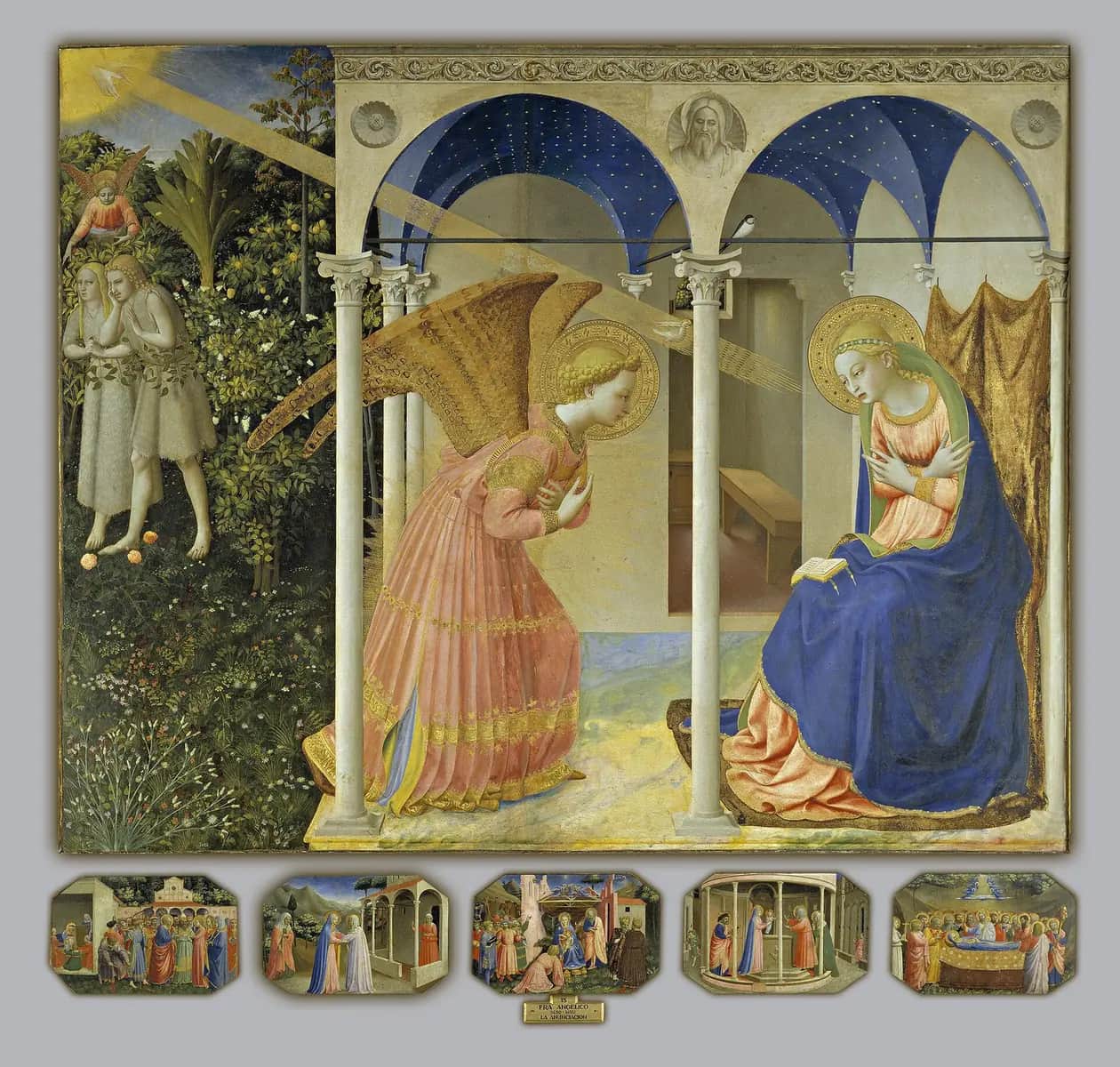
Luke 1:31 (WEB)
Behold, you will conceive in your womb and give birth to a son, and shall name him ‘Jesus.’
As quoted in the map (KJV)
Luke 1:31 (KJV)
And, behold, thou shalt conceive in thy womb, and bring forth a son, and shalt call his name JESUS.
Key words
- συλλήμψῃ ἐν γαστρὶ καὶ τέξῃ υἱόνsyllēmpsē en gastri kai texē huion · Greek
- 'thou shalt conceive in thy womb, and bring forth a son' — future tense; Gabriel does not say the conception has happened or will happen at once.
Why it matters
Gabriel promises a future conception. Pitre points out that the angel says only that Mary 'will' conceive, not that she already has (pp 93–94). A betrothed woman told she would have a son would assume it would come after the marriage was consummated — which is exactly what Mary does not assume. Her 'How shall this be?' therefore implies she did not intend ordinary married life.
Catechism · 7
In the Old Testament
“Abraham's remarkable hospitality at Mamre foreshadows the annunciation of the true Son of the promise.” — Catechism footnote: Cf. Gen 18:1-15; Lk 1:26-38.
The Seven Petitions
“Finally, in Jesus the name of the Holy God is revealed and given to us, in the flesh, as Savior, revealed by what he is, by his word, and by his sacrifice.” — Catechism footnote: Cf. Mt 1:21; Lk 1:31, Jn 8:28; 17:8; 17:17-19.
"And in Jesus Christ, His Only Son, Our Lord"
“At the annunciation, the angel Gabriel gave him the name Jesus as his proper name, which expresses both his identity and his mission.” — Catechism footnote: Cf. Lk 1:31.
"Conceived by the Power of the Holy Spirit and Born of the Virgin Mary"
- §494Paragraph 2 · "Conceived by the Power of the Holy Spirit and Born of the Virgin Mary"Read at vatican.va
“At the announcement that she would give birth to "the Son of the Most High" without knowing man, by the power of the Holy Spirit, Mary responded with the obedience of faith, certain that "with God nothing will be impossible": "Behold, I am the handmaid of the Lord; let it be [done] to me according to your word."” — Catechism footnote: Lk 1:28-38; cf. Rom 1:5.
- §497Paragraph 2 · "Conceived by the Power of the Holy Spirit and Born of the Virgin Mary"Read at vatican.va
“The Gospel accounts understand the virginal conception of Jesus as a divine work that surpasses all human understanding and possibility:” — Catechism footnote: Mt 1 18-25; Lk 1:26-38.
"I Believe in the Holy Spirit"
Against all human hope, God promises descendants to Abraham, as the fruit of faith and of the power of the Holy Spirit. In Abraham's progeny all the nations of the earth will be blessed.
“By the Holy Spirit's power and her faith, her virginity became uniquely fruitful.” — Catechism footnote: Cf. Lk 1:26-38; Rom 4:18-21; Gal 4:26-28.
Fathers and councils · 37
John Damascene
“And she was troubled at his word, and the angel said to her, Fear not, Mary, for thou hast found favour with God, and shalt bring forth a Son and shalt call His name Jesus; for He shall save His people from their sins.” — editor's note: Ibid. 30, 31.
Read the whole comment
Augustine of Hippo
““My hand shall hold Him fast, and My arm shall strengthen Him” (ver. 21): because there was a taking up of man; because flesh was assumed in the Virgin’s womb, because by Him who in the form of God is coequal with the Father, the form of a servant was taken, and He became obedient unto death, even the death of the…” — editor's note: Luke i. 31.
Read the whole comment“And the angel answered and said unto her, The Holy Ghost shall come upon thee, and the power of the Highest shall overshadow thee: therefore also that holy thing which shall be born shall be called the Son of God; and then follow matters not belonging to the question at present in hand.” — editor's note: Luke i. 26–34. [Ver. 34 is differently rendered in the text of the Revised Version. The Latin of Augustin would perhaps admit of the same sense, but is more…
Read the whole commentChapter IX.—Of the Question How It Can Be Shown that the Narrative of the Haul of Fishes Which Luke Has Given Us is Not to Be Identified with the Record of an Apparently Similar Incident Which John Has Reported…
Read the whole comment“But God judged it better both to take upon Him man through whom to conquer the enemy of the human race, from the race itself that had been conquered; and yet to do this of a virgin, whose conception, not flesh but spirit, not lust but faith, preceded.” — editor's note: Luke i. 26–32
Read the whole comment“She had given birth to Christ—the Angel had come to her, and said, “Behold, thou shall conceive in thy womb, and bring forth a Son, and shalt call His name Jesus.” — editor's note: Luke i. 31.
Read the whole comment
Basil the Great
“Thus, the deep is not a multitude of hostile powers, as has been imagined; nor “darkness” an evil sovereign force in enmity with good.” — editor's note: i.e. by those who would identify the ἄβυσσος (Tehôm) of Gen. i. 2 with that of Luke i. 31, and understand it to mean the abode in prison of evil spirits. The…
Read the whole comment
Theodoret of Cyrus
“And, again, Gabriel says to the blessed Virgin, “Behold thou shalt conceive in thy womb, and bring forth a son and shalt call His name Jesus” “for He shall save His people from their sins.”” — editor's note: Luke i. 31
Read the whole comment
Jerome
“Mary, the mother of the Lord, left the lowlands and made her way to the hill country, when, after receiving the angel’s message, she realized that she bore within her womb the Son of God.” — editor's note: Luke i. 26–31, 39.
Read the whole comment
Tertullian
“Clearly enough is the nativity announced by Gabriel.” — editor's note: Luke i. 26–38.
Read the whole comment“Will not the angel’s announcement also be subverted, that the virgin should “conceive in her womb and bring forth a son?”” — editor's note: Luke i. 31.
Read the whole comment
Hilary of Poitiers
“For the angel, when speaking of Christ the Lord, Who should be born of Mary, calls Him by the name ‘Jesus:’ but to the prophets Christ the Lord is ‘Spirit.’” — editor's note: St. Matt. i. 21; St. Luke i. 31.
Read the whole comment
Hippolytus of Rome
“…of this (Jesus), he expresses himself thus: That powers emanating from the second tetrad fashioned Jesus, who appeared on earth, and that the angel Gabriel filled the place of the Logos, and the Holy Spirit that of Zoe, and the “Power of the Highest” that of Anthropos, and the Virgin that of Ecclesia.” — editor's note: Luke i. 26–38.
Read the whole comment
Cyprian of Carthage
“The same shall be great, and He shall be called the Son of the Highest; and the Lord God shall give Him the throne of His father David, and He shall reign over the house of Jacob for ever, and of His kingdom there shall be no end.”” — editor's note: Luke i. 30–33.
Read the whole comment
Catena Aurea on Luke
- A Greek expositorCatena Aurea on Luke
As if he said, I came not to deceive you, nay rather to bring down deliverance from deception; I came not to rob you of your inviolable virginity, but to open a dwelling-place for the Author and Guardian of thy…
Read the whole comment - John ChrysostomCatena Aurea on Luke
But he who earns favour in the sight of God has nothing to fear. Hence it follows, For thou hast found favour before God. But how shall any one find it, except through the means of his humility. For God giveth grace…
Read the whole comment - A Greek expositorCatena Aurea on Luke
For the Virgin found favour with God, in that decking her own soul in the bright robes of chastity, she prepared a dwelling-place pleasing to God. Not only did she retain her virginity inviolate, but her conscience…
Read the whole comment - A Greek expositorCatena Aurea on Luke
By the word behold, he denotes rapidity and actual presence, implying that with the utterance of the word the conception is accomplished.
Read the whole comment - A Greek expositorCatena Aurea on Luke
Thou shalt conceive in thy womb, that he might shew that our Lord from the very Virgin’s womb, and of our substance, took our flesh upon Him. For the Divine Word came to purify man’s nature and birth, and the first…
Read the whole comment - A Greek expositorCatena Aurea on Luke
But since it happens also that to the spiritual mind is given in an especial manner to conceive the Divine Spirit, and bring forth the Spirit of salvation, as says the Prophet; therefore he added, And thou shalt…
Read the whole comment - Ambrose of MilanCatena Aurea on Luke
But all are not as Mary, that when they conceive the word of the Holy Spirit, they bring forth; for some put forth the word prematurely, others have Christ in the womb, but not yet formed.
Read the whole comment - Gregory of NyssaCatena Aurea on Luke
While the expectation of child-birth strikes a woman with terror, the sweet mention of her offspring calms her, as it is added, And thou shall call his name Jesus. The coming of the Saviour is the banishing of all fear.
Read the whole comment - BedeCatena Aurea on Luke
Jesus is interpreted Saviour, or Healing.
Read the whole comment - A Greek expositorCatena Aurea on Luke
And he says, Thou shalt call, not His father shall call, for He is without a father as regards His lower birth, as He is without a mother in respect of the higher.
Read the whole comment - Cyril of AlexandriaCatena Aurea on Luke
But this name was given anew to the Word in adaptation to His nativity in the flesh; as that prophecy saith, Thou shalt be called by a new name which the mouth of the Lord hath named. (Is. 62:2.)
Read the whole comment - A Greek expositorCatena Aurea on Luke
But as this name was common to Him with the successor of Moses, the angel therefore implying that He should not be after Joshua’s likeness, adds, He shall be great. (Josh. 1.)
Read the whole comment - Ambrose of MilanCatena Aurea on Luke
It was said also of John, that he shall be great, but of him indeed as of a great man, of Christ, as of the great God. For abundantly is poured forth the power of God; widely the greatness of the heavenly substance…
Read the whole comment - OrigenCatena Aurea on Luke
See then the greatness of the Saviour, how it is diffused over the whole world. Go up to heaven, see there how it has filled the heavenly places; carry thy thoughts down to the deep, behold, there too He has…
Read the whole comment - A Greek expositorCatena Aurea on Luke
The assumption of our flesh does not diminish ought from the loftiness of the Deity, but rather exalts the lowness of man’s nature. Hence it follows, And he shall be called the Son of the Highest. Not, Thou shalt…
Read the whole comment - John ChrysostomCatena Aurea on Luke
But since it seems shocking or unworthy to some men that God should inhabit a body, is the Sun, I would ask, the heat whereof is felt by each body that receives its rays, at all sullied as to its natural purity? Much…
Read the whole comment - A Greek expositorCatena Aurea on Luke
And to make the Virgin mindful of the prophets, he adds, And the Lord God shall give unto him the seat of David, that she might know clearly, that He Who is to be born of her is that very Christ, Whom the prophets…
Read the whole comment - Cyril of AlexandriaCatena Aurea on Luke
Not however from Joseph proceeded the most pure descent of Christ. For from one and the same line of connexion had sprung both Joseph and the Virgin, and from this the only-begotten had taken the form of man.
Read the whole comment - Basil the GreatCatena Aurea on Luke
Our Lord sat not on the earthly throne of David, the Jewish kingdom having been transferred to Herod. The seat of David is that on which our Lord reestablished His spiritual kingdom which should never be destroyed.…
Read the whole comment - John ChrysostomCatena Aurea on Luke
Now He assigns to the present house of Jacob all those who were of the number of the Jews that believed on Him. For as Paul says, They are not all Israel which are of Israel, but the children of the promise are…
Read the whole comment - BedeCatena Aurea on Luke
Or by the house of Jacob he means the whole Church which either sprang from a good root, or though formerly a wild olive branch, has yet been for a reward of its faith grafted into the good olive tree. (Rom. 11:17.)
Read the whole comment - A Greek expositorCatena Aurea on Luke
But to reign for ever is of none save God alone; and hence though because of the incarnation Christ is said to receive the seat of David, yet as being Himself God He is acknowledged to be the eternal King. It…
Read the whole comment - BedeCatena Aurea on Luke
Let Nestorius then cease to say that the Virgin’s Son is only man, and to deny that He is taken up by the Word of God into the unity of the Person. For the Angel when he says that the very same has David for His…
Read the whole comment
Cross-references · 21
Cited together with
Cited together in Letters Letter 131.
Cited together in Catechism §2812.
Cited together in Catechism §2812.
Cited together in Catechism §2812.
Cited together in Catechism §2812.
Cited together in Catechism §2812.
Cited together in Catechism §2812.
Cited together in Catechism §2812.
Cited together in On the Flesh of Christ Chapter 21.
Cited together in Letters Letter 131.
Cited together in Letters Letter 131.
Cited together in Catechism §494.
Cited together in Letters Letter 131.
Cited together in An Exact Exposition of the Orthodox Faith III.2.
Cited together in Cyril of Alexandria on Luke 1:30–33 (Catena Aurea).
Cited together in Catechism §2812.
Cited together in Catechism §2812.
Cited together in Catechism §2812.
Cited together in Catechism §430 and 2 other places.
Cited together in Catechism §430.
Parallel passages
Matthew 1:21 and Luke 1:31 share the same wording (9 words).