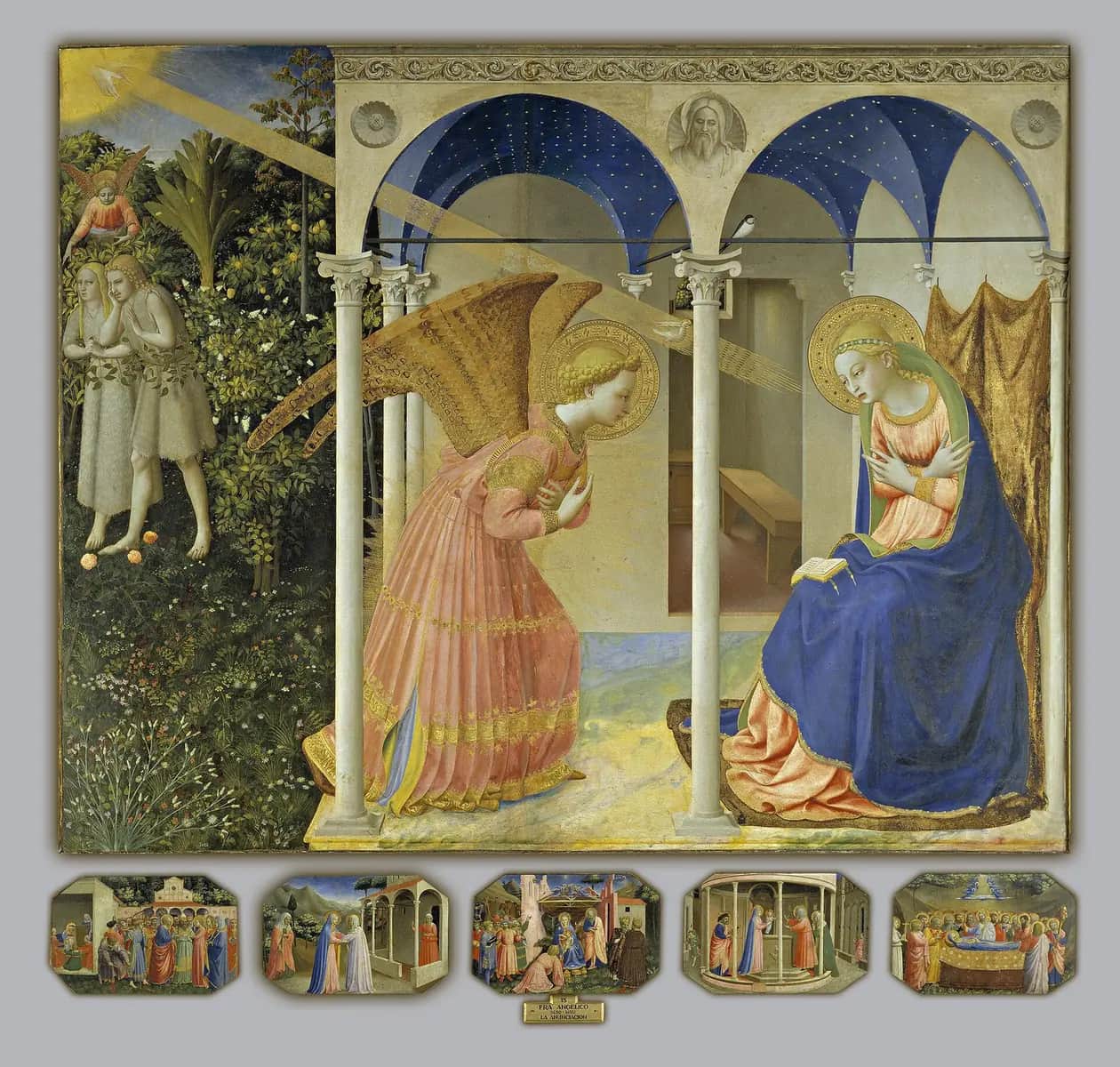
Luke 1:34 (WEB)
Mary said to the angel, “How can this be, seeing I am a virgin?”
As quoted in the map (KJV)
Luke 1:34 (KJV)
Then said Mary unto the angel, How shall this be, seeing I know not a man?
Key words
- πῶς ἔσται τοῦτοpōs estai touto · Greek
- 'How shall this be?' — not doubt (contrast Zechariah in 1:18) but a question about the manner.
- ἐπεὶ ἄνδρα οὐ γινώσκωepei andra ou ginōskō · Greek
- 'seeing I know not a man' — present tense, 'I am not knowing a man,' describing a standing condition rather than only her past. 'Know' is the Hebrew idiom for marital relations.
Why it matters
Mary, a betrothed woman, asks how she will conceive since she does not know man. Pitre's first evidence for a vow of virginity is that the question makes no sense for a bride expecting ordinary married life; it makes sense only if she intended to remain a virgin. Augustine and many others read it the same way, and the present tense of the Greek supports a settled resolve.
Catechism · 7
In the Old Testament
“Abraham's remarkable hospitality at Mamre foreshadows the annunciation of the true Son of the promise.” — Catechism footnote: Cf. Gen 18:1-15; Lk 1:26-38.
"Conceived by the Power of the Holy Spirit and Born of the Virgin Mary"
- §484Paragraph 2 · "Conceived by the Power of the Holy Spirit and Born of the Virgin Mary"Read at vatican.va
“The divine response to her question, "How can this be, since I know not man?", was given by the power of the Spirit: "The Holy Spirit will come upon you."” — Catechism footnote: Lk 1:34-35 (Greek).
- §494Paragraph 2 · "Conceived by the Power of the Holy Spirit and Born of the Virgin Mary"Read at vatican.va
“At the announcement that she would give birth to "the Son of the Most High" without knowing man, by the power of the Holy Spirit, Mary responded with the obedience of faith, certain that "with God nothing will be impossible": "Behold, I am the handmaid of the Lord; let it be [done] to me according to your word."” — Catechism footnote: Lk 1:28-38; cf. Rom 1:5.
- §497Paragraph 2 · "Conceived by the Power of the Holy Spirit and Born of the Virgin Mary"Read at vatican.va
“The Gospel accounts understand the virginal conception of Jesus as a divine work that surpasses all human understanding and possibility:” — Catechism footnote: Mt 1 18-25; Lk 1:26-38.
- §505Paragraph 2 · "Conceived by the Power of the Holy Spirit and Born of the Virgin Mary"Read at vatican.va
By his virginal conception, Jesus, the New Adam, ushers in the new birth of children adopted in the Holy Spirit through faith. "How can this be?"
"I Believe in the Holy Spirit"
Against all human hope, God promises descendants to Abraham, as the fruit of faith and of the power of the Holy Spirit. In Abraham's progeny all the nations of the earth will be blessed.
“By the Holy Spirit's power and her faith, her virginity became uniquely fruitful.” — Catechism footnote: Cf. Lk 1:26-38; Rom 4:18-21; Gal 4:26-28.
Fathers and councils · 31
John Damascene
“And when she asked in her perplexity, How can this be, seeing I know not a man? the angel again answered her, The Holy Spirit shall come upon thee, and the power of the Highest shall overshadow thee.” — editor's note: St. Luke i. 34.
Read the whole comment“And the archangel Gabriel answered her: The Holy Spirit shall come upon thee, and the power of the Highest shall overshadow thee.” — editor's note: St. Luke i. 34, 35.
Read the whole comment
Cyril of Jerusalem
“But he says, The Holy Ghost shall came upon thee, and the power of the Highest shall overshadow thee: wherefore also the holy thing which is to be born shall be called the Son of God.” — editor's note: Luke i. 34, 35.
Read the whole comment
Augustine of Hippo
“…of grace, the Angel was speaking, to her enquiring in what manner it could come to pass that she was announced as going to bear, seeing she knew not a man:…he saith, “The Holy Spirit shall come over upon thee, and the virtue of the Most Highest shall overshadow thee,” that is, shall make a shadow for thee,…” — editor's note: Luke i. 34.
Read the whole comment“And the angel answered and said unto her, The Holy Ghost shall come upon thee, and the power of the Highest shall overshadow thee: therefore also that holy thing which shall be born shall be called the Son of God; and then follow matters not belonging to the question at present in hand.” — editor's note: Luke i. 26–34. [Ver. 34 is differently rendered in the text of the Revised Version. The Latin of Augustin would perhaps admit of the same sense, but is more…
Read the whole commentChapter IX.—Of the Question How It Can Be Shown that the Narrative of the Haul of Fishes Which Luke Has Given Us is Not to Be Identified with the Record of an Apparently Similar Incident Which John Has Reported…
Read the whole comment“This is shown by the words which Mary spake in answer to the Angel announcing to her her conception; “How,” saith she, “shall this be, seeing I know not a man?”” — editor's note: Luke i. 34
Read the whole comment““The Holy Ghost shall come upon thee, and the power of the Highest shall overshadow thee.”” — editor's note: Luke i. 34, 35
Read the whole comment“…know the manner of those things which he had believed, just as it is not for lack of faith the Virgin Mary says, “How shall this be, seeing I know not a man?” for she inquired as to the way in which that should take place which she was certain would come to pass.” — editor's note: Luke i. 34.
Read the whole comment“…“How shall this be, seeing I know not a man?” said, “The Holy Ghost shall come upon thee, and the power [virtue] of the highest shall overshadow thee;” and our Lord Himself when giving His disciples the promise of the Spirit, said, “But tarry ye in the city, until ye be endued with power [virtue] from on…” — editor's note: Luke i. 34, 35.
Read the whole comment
John Chrysostom
“Since if she herself, who was to receive so great a favor, is affected somewhat after the manner of man, and saith, “How shall this be, seeing I know not a man?”much more would he have doubted; and especially when hearing it from the woman who was under suspicion.” — editor's note: Luke i. 34.
Read the whole comment
Basil the Great
“It is said of Rebekah “She was a virgin, neither had any man known her,” and “How shall this be seeing I know not a man?”” — editor's note: Luke i. 34.
Read the whole comment
Tertullian
“Clearly enough is the nativity announced by Gabriel.” — editor's note: Luke i. 26–38.
Read the whole comment
Jerome
“Observe also what Mary herself, who had replied to Gabriel with the words, “How shall this be, seeing I know not a man?” says concerning Joseph, “Son, why hast thou thus dealt with us? behold, thy father and I sought thee sorrowing.”” — editor's note: ib. i. 34.
Read the whole comment
Hippolytus of Rome
“…of this (Jesus), he expresses himself thus: That powers emanating from the second tetrad fashioned Jesus, who appeared on earth, and that the angel Gabriel filled the place of the Logos, and the Holy Spirit that of Zoe, and the “Power of the Highest” that of Anthropos, and the Virgin that of Ecclesia.” — editor's note: Luke i. 26–38.
Read the whole comment
Catena Aurea on Luke
- Ambrose of MilanCatena Aurea on Luke
It was Mary’s part neither to refuse belief in the Angel, nor too hastily take unto herself the divine message. How subdued her answer is, compared with the words of the Priest. Then said Mary to the Angel, How shall…
Read the whole comment - Basil the GreatCatena Aurea on Luke
Knowledge is spoken of in various ways. The wisdom of our Creator is called knowledge, and an acquaintance with His mighty works, the keeping also of His commandments, and the constant drawing near to Him; and…
Read the whole comment - Gregory of NyssaCatena Aurea on Luke
Hear the chaste words of the Virgin. The Angel tells her she shall bear a son, but she rests upon her virginity, deeming her inviolability a more precious thing than the Angel’s declaration. Hence she says, Seeing…
Read the whole comment - Gregory of NyssaCatena Aurea on Luke
These words of Mary are a token of what she was pondering in the secrets of her heart; for if for the sake of the marriage union she had wished to be espoused to Joseph, why was she seized with astonishment when the…
Read the whole comment - A Greek expositorCatena Aurea on Luke
But mark, how the Angel solves the Virgin’s doubts, and shews to her the unstained marriage and the unspeakable birth. And the Angel answered, and said unto her, The Holy Spirit shall come upon thee.
Read the whole comment - Gregory of NyssaCatena Aurea on Luke
Moreover, the power of the Highest shall overshadow thee. Christ is the power of the most high King, who by the coming of the Holy Spirit is formed in the Virgin.
Read the whole comment - BedeCatena Aurea on Luke
Thou shalt conceive then not by the seed of man whom thou knowest not, but by the operation of the Holy Spirit, with which thou art filled. There shall be no flame of desire in thee when the Holy Spirit shall…
Read the whole comment - Athanasius of AlexandriaCatena Aurea on Luke
For we confess that which then was taken up from Mary to be of the nature of man and a most real body, the very same also according to nature with our own body. For Mary is our sister, seeing we have all descended…
Read the whole comment - Gregory the GreatCatena Aurea on Luke
To distinguish His holiness from ours, Jesus is stated in an especial manner to be born holy. For we although indeed made holy, are not born so, for we are constrained by the very condition of our corruptible nature…
Read the whole comment - John ChrysostomCatena Aurea on Luke
As if he said, Look not for the order of nature in things which transcend and overpower nature. Dost thou say, How shall this be, seeing I know not a man? Nay rather, shall it happen to thee for this very reason,…
Read the whole comment - Gregory of NyssaCatena Aurea on Luke
O blessed is that womb which because of the overflowing purity of the Virgin Mary has drawn to itself the gift of life! For in others scarcely indeed shall a pure soul obtain the presence of the Holy Spirit, but in…
Read the whole comment - Gregory of NyssaCatena Aurea on Luke
For the tables of our nature which guilt had broken, the true Lawgiver has formed anew to Himself from our dust without cohabitation, creating a body capable of taking His divinity, which the finger of God hath…
Read the whole comment - Gregory the GreatCatena Aurea on Luke
By the term overshadowing, both natures of the Incarnate God are signified. For shadow is formed by light and matter. But the Lord by His Divine nature is light. Because then immaterial light was to be embodied in…
Read the whole comment - Gregory of NyssaCatena Aurea on Luke
Or he says, overshadow thee, because as a shadow takes its shape from the character of those bodies which go before it, so the signs of the Son’s Deity will appear from the power of the Father. (non occ. in Greg.…
Read the whole comment - Basil the GreatCatena Aurea on Luke
Hence also, St. Paul says, God sent forth his Son, born not (through a woman) but of a woman. For the words through a woman might convey only a notion of birth as a passing through, but when it is said, of a woman,…
Read the whole comment - A Greek expositorCatena Aurea on Luke
But observe, how the Angel has declared the whole Trinity to the Virgin, making mention of the Holy Spirit, the Power, and the Most High, for the Trinity is indivisible.c
Read the whole comment
Cross-references · 15
Cited together in Catechism §505.
Cited together in Catechism §505.
Cited together in Catechism §494.
Cited together in Letters Letter 235.
Cited together in Letters Letter 235.
Cited together in Letters Letter 235.
Cited together in Catechism §505.
Cited together in Letters Letter 235.
Cited together in Catechism §484 and 1 other place.
Cited together in Catechism §484.
Cited together in An Exact Exposition of the Orthodox Faith III.2.
Cited together in Letters Letter 235.
Cited together in Gregory the Great on Luke 1:34–35 (Catena Aurea).
Cited together in Gregory the Great on Luke 1:34–35 (2) (Catena Aurea).
Cited together in An Exact Exposition of the Orthodox Faith III.2.