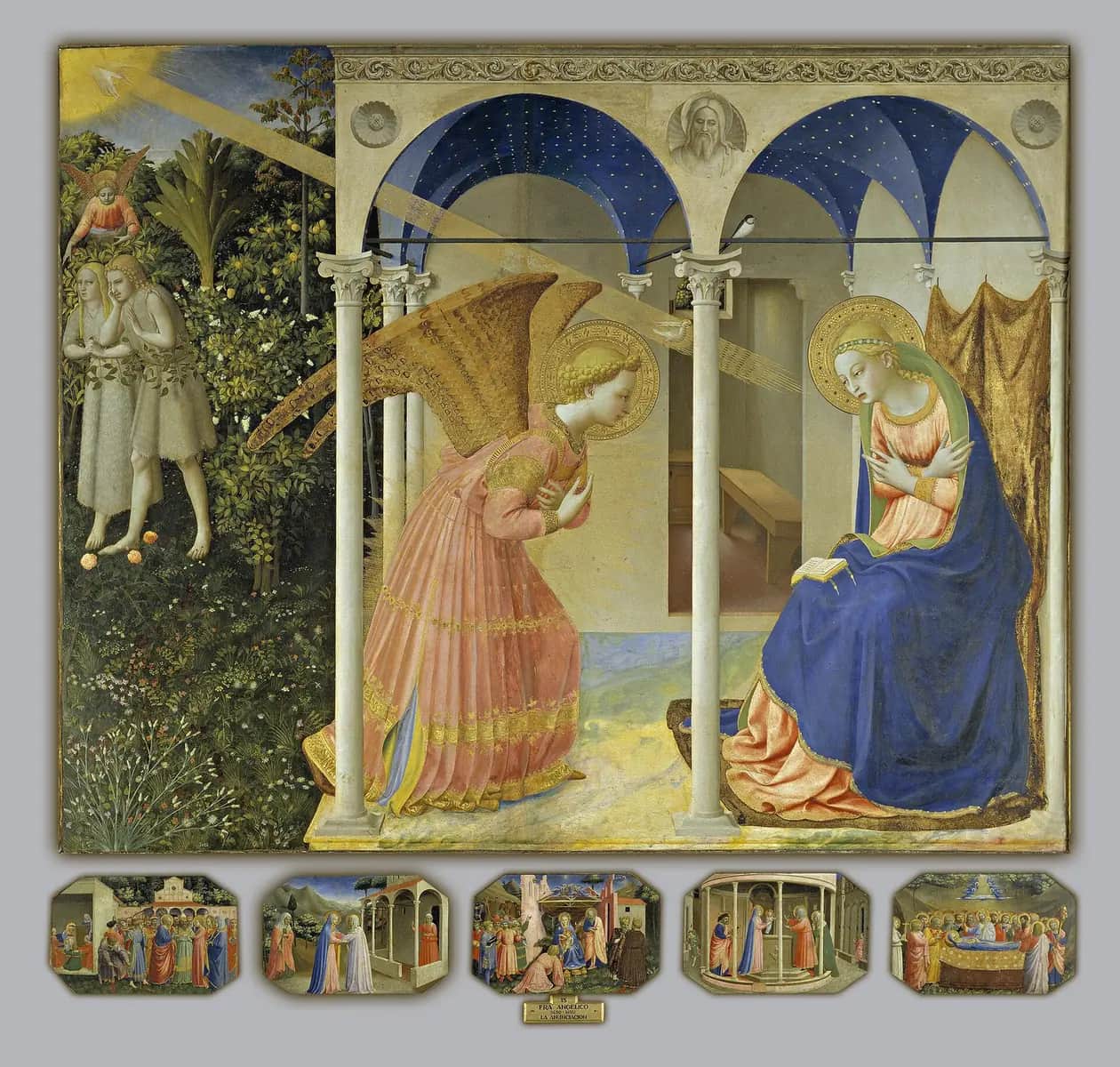
The idea
Gabriel says Mary 'will conceive' — not that she has, nor that it will happen at once; a betrothed woman would assume the child would come after the marriage was consummated. 'But this is precisely what Mary does not do.' Some versions mistranslate her reply as 'since I am a virgin' (NIV) or 'since I have no husband' (RSV) — 'downright false, since Mary does have a husband.' The Greek is 'since I do not know man,' with 'know' the biblical euphemism (Genesis 4:1), in the present tense: as 'I do not smoke' means 'I do not smoke now and do not intend to,' so her words state a fixed principle of life — the Protestant Greek expert J. Gresham Machen concedes 'no objection can be raised… from a linguistic point of view.' And unlike Zechariah, Mary does not doubt; she asks how, and only then does Gabriel explain that the conception will be virginal.
Key verses
- Luke 1:31 — 'thou shalt conceive' — future.
- Luke 1:34 — 'seeing I know not a man' — present.
- Genesis 4:1 — 'Adam knew Eve his wife' — the idiom.
- Luke 1:27 — already betrothed — legally a wife.
The connection
| Old Testament root | New Testament fulfilment | |
|---|---|---|
| A bride's expected question: none | → | Mary's question: an intention to remain a virgin |
The first of Pitre's three evidences depends on reading the Greek exactly: a future promise, a present-tense refusal, and a euphemism whose meaning Genesis fixes. Interpreters who call the question 'absurd' or 'a literary device' have, he says, failed to explain the text as it stands.
Sources
- Modern scholars Pitre cites — J. Gresham Machen (p 95)
- Augustine of Hippo — On Holy Virginity 4.4 (p 113) · read