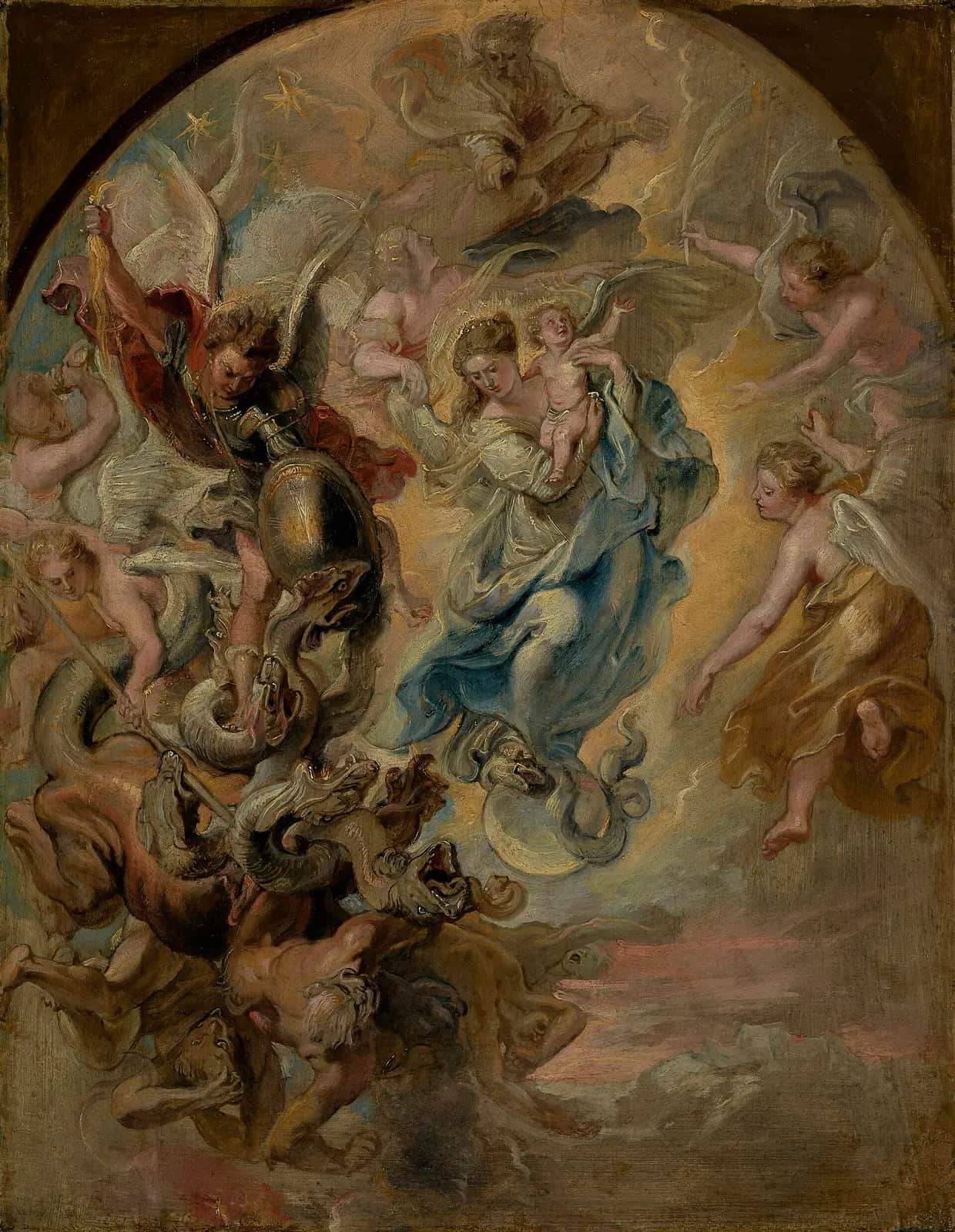
The idea
'If Rachel was indeed the matriarch of her people… then it seems clear that Mary, the new Rachel, is the matriarch of the entire Church. This is the only plausible explanation for why the book of Revelation describes all those who bear testimony to Jesus as offspring of the mother of the Messiah.' Ambrose: 'May the Christ from the height of the cross say also to each of you: There is your mother. May he say also to the Church: There is your son.' Mary's spiritual maternity 'is not something made up by Catholics in the Middle Ages; it is something that flows directly out of the will of Jesus.' John Paul II: on Calvary Mary 'made her own maternal contribution to the work of salvation, which took the form of labour pains, the birth of the new humanity' — the evangelist himself says Jesus died 'to gather into one the children of God who are scattered abroad.' She is Mother of the Church not because she is Jesus' biological mother but because 'she willingly consented to and shared in the sufferings of Christ.'
Key verses
- Revelation 12:17 — 'the rest of her seed.'
- John 19:26 — 'Behold thy son.'
- John 11:52 — to gather the scattered children of God into one.
The connection
| Old Testament root | New Testament fulfilment | |
|---|---|---|
| Rachel, matriarch of Israel's children | → | Mary, matriarch of the Church, by her share in the cross |
Mother of the Church is the conclusion of the New Rachel chapter, not of the cross chapter: Mary's motherhood of believers rests on her consent to and share in her Son's passion, the labour from which the Church is born.
Sources
- Ambrose of Milan — On Luke 7.5 (p 155) · read
- John Paul II — General Audience, 17 September 1997 (p 156) · read