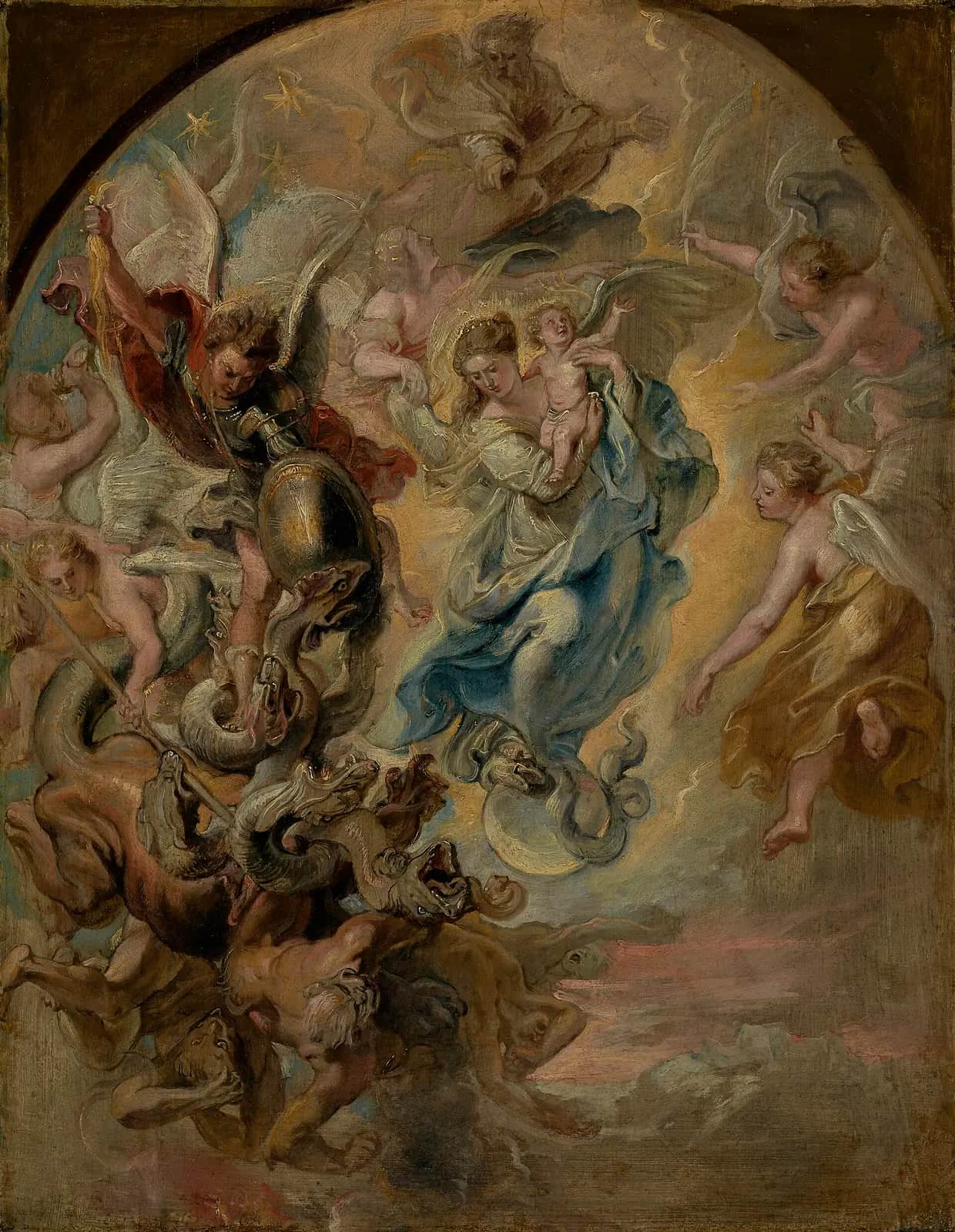
Revelation 12:17 (WEB)
The dragon grew angry with the woman, and went away to make war with the rest of her offspring, who keep God’s commandments and hold Jesus’ testimony.
As quoted in the map (KJV)
Revelation 12:17 (KJV)
And the dragon was wroth with the woman, and went to make war with the remnant of her seed, which keep the commandments of God, and have the testimony of Jesus Christ.
Key words
- τῶν λοιπῶν τοῦ σπέρματος αὐτῆςtōn loipōn tou spermatos autēs · Greek
- 'the remnant of her seed' — the rest of her offspring. Sperma is the Septuagint's word for the woman's 'seed' in Genesis 3:15.
- τηρούντων τὰς ἐντολάςtērountōn tas entolas · Greek
- 'which keep the commandments' — Christians are identified as the Woman's other children.
Why it matters
The dragon, defeated in his attack on the Woman and her Son, goes to war against 'the rest of her offspring,' those who keep God's commandments and hold the testimony of Jesus. Pitre uses this as Scripture's own statement that Mary has other children besides Jesus — not by blood, but the Church. The enmity of Genesis 3:15 continues between the serpent and the Woman's seed, and her seed includes us.
Catechism · 3
The Seven Petitions
“"Then the dragon was angry with the woman, and went off to make war on the rest of her offspring."” — Catechism footnote: Rev 12:17.
"Conceived by the Power of the Holy Spirit and Born of the Virgin Mary"
- §501Paragraph 2 · "Conceived by the Power of the Holy Spirit and Born of the Virgin Mary"Read at vatican.va
“Jesus is Mary's only son, but her spiritual motherhood extends to all men whom indeed he came to save: "The Son whom she brought forth is he whom God placed as the first-born among many brethren, that is, the faithful in whose generation and formation she co-operates with a mother's love."” — Catechism footnote: LG 63; cf. Jn 19:26-27; Rom 8:29; Rev 12:17.
The Church in God's Plan
“It is she whom Christ 'loved and for whom he delivered himself up that he might sanctify her.' It is she whom he unites to himself by an unbreakable alliance, and whom he constantly 'nourishes and cherishes.'"” — Catechism footnote: LG 6; Cf. Gal 4:26; Rev 12:17; 19:7; 21:2, 9; 22:17; Eph 5:25-26, 29.
Fathers and councils · 1
“Henceforth thou art planted in the invisible Paradise.” — editor's note: Gr. νοητόν, i.e. the true Paradise, to be seen by the mind, not by the eye. Apoc. xii. 7, 17.
Read the whole comment
Cross-references · 13
Cited together in Catechism §757.
Cited together in Catechism §757.
Cited together in Catechism §757.
Cited together in Catechism §757 and 1 other place.
Cited together in Catechism §2853.
Cited together in Catechism §2853.
Cited together in Catechism §501.
Cited together in Catechism §501.
Cited together in Catechism §501.
Cited together in Catechism §757.
Cited together in Catechism §757.
Cited together in Catechism §757.
Cited together in Catechism §757.