Chapter 5 — The Perpetual Virgin
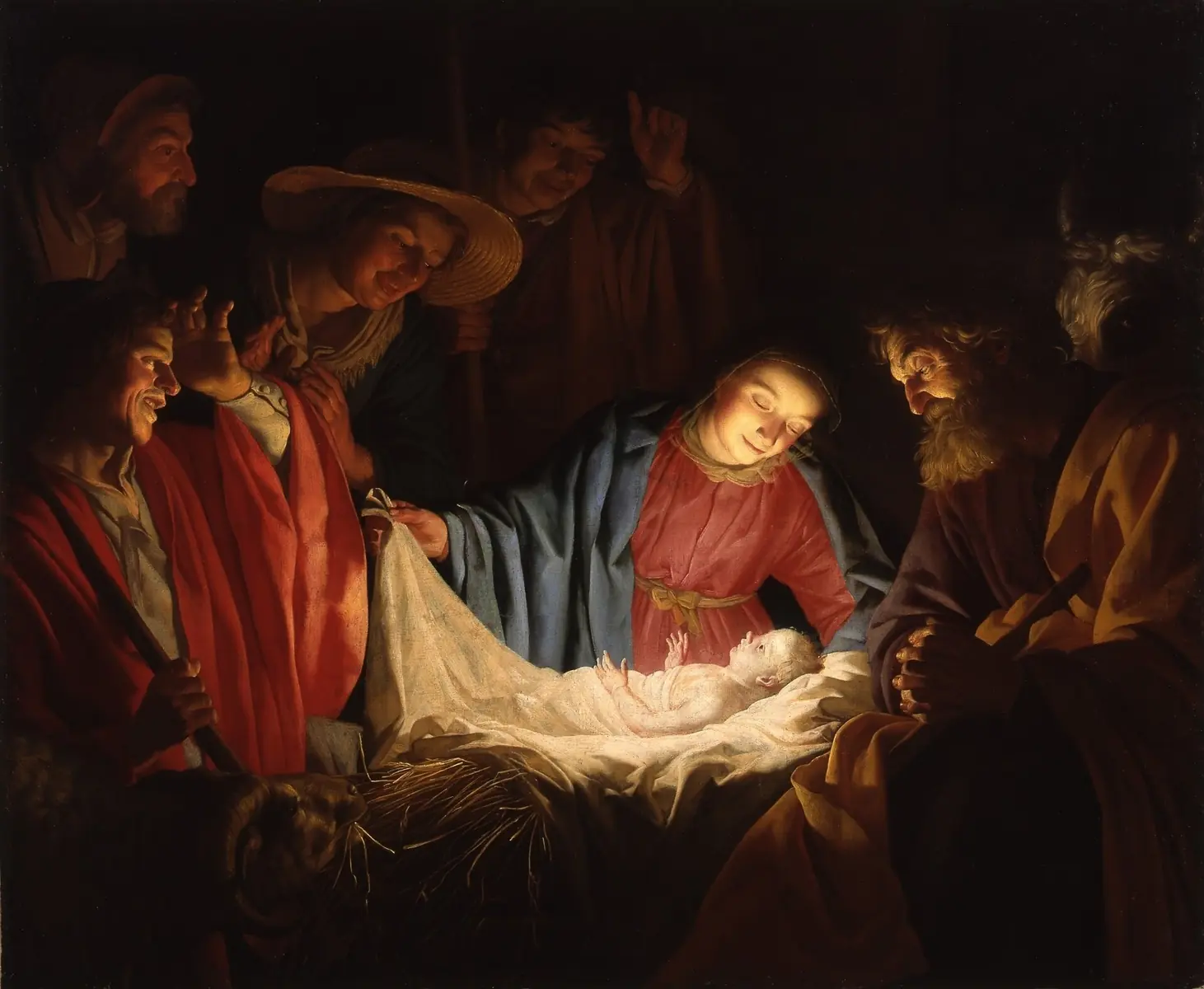
Gerard van Honthorst, Adoration of the Shepherds, 1622 · Wallraf-Richartz Museum, Cologne · Public domainGerard van Honthorst, Adoration of the Shepherds, 1622, Wallraf-Richartz Museum, Cologne
From Jewish Roots of Mary, based on Brant Pitre
5.0 Opening
pp 90–92
No stops yet.
5.1 Mary's Jewish Vow
pp 92–103
Mary's Response to Gabriel: An Implicit Vow of Virginity
- The three evidences that Mary took a vow of virginity.
Pitre stacks three clues that Mary meant to remain a virgin for life: (1) her reply to Gabriel, 'How shall this be, since I do not know man?' — a strange thing for a betrothed woman to say unless she had already resolved on virginity; (2) the Law's provision letting a married woman take a binding vow of abstinence her husband upholds — Joseph's role; and (3) the couple's abstinence on the wedding night and all through the pregnancy.
pp 92–103
- Reading Luke 1:34 closely — a future conception, two mistranslations, 'I do not know man' like 'I do not smoke', and how not doubt
Gabriel says Mary 'will conceive' — not that she has, nor that it will happen at once; a betrothed woman would assume the child would come after the marriage was consummated. 'But this is precisely what Mary does not do.' Some versions mistranslate her reply as 'since I am a virgin' (NIV) or 'since I have no husband' (RSV) — 'downright false, since Mary does have a husband.' The Greek is 'since I do not know man,' with 'know' the biblical euphemism (Genesis 4:1), in the present tense: as 'I do not smoke' means 'I do not smoke now and do not intend to,' so her words state a fixed principle of life — the Protestant Greek expert J. Gresham Machen concedes 'no objection can be raised… from a linguistic point of view.' And unlike Zechariah, Mary does not doubt; she asks how, and only then does Gabriel explain that the conception will be virginal.
pp 93–96
- Why 'betrothed' sharpens Mary's question to Gabriel.
In Jewish law betrothal was already legal marriage — violating a betrothed woman counted as adultery. So Mary is effectively Joseph's wife when Gabriel comes. That makes 'How shall this be, since I do not know man?' pointed: an ordinary wife would expect children, so her words imply an intention to remain a virgin.
pp 93–94
- Two skeptics who concede Mary's question is absurd for a bride — Lüdemann and Bultmann
Pitre calls hostile witnesses. Gerd Lüdemann, whom he labels 'the atheist scholar': 'Mary's question is hard to reconcile with v. 27: a fiancée can hardly be surprised at the promise of a child even if she has as yet had no sexual intercourse with her fiancé.' Rudolf Bultmann: the question is 'an absurd one for a bride.' Both see the problem and neither accepts the obvious solution. Pitre names the two escape hatches: declare the question 'absurd,' or call it 'a literary device' to prompt Gabriel — 'they totally fail to explain the text as we have it.' The remaining question, why a woman intending virginity would marry at all, is answered by Numbers 30.
pp 94–96
- Numbers 30 in detail — 'afflict herself' includes abstinence, three classes of women, and why the vows must be permanent
The evidence 'is not hidden in some obscure Dead Sea Scroll' but in the Law. Numbers 30 concerns a woman's vow 'to afflict herself' ('annoth naphesh). The phrase usually means fasting, but Leviticus 16:29 uses it for the Day of Atonement, and Jacob Milgrom shows the oldest interpretations understood that self-affliction to include abstinence from marital relations (Mishnah, Yoma 8:1). Read that way 'the whole chapter on women's vows makes sense': it legislates for unmarried women (vv. 3–5), married women (vv. 6–8, 13–15) and widows or divorcees (vv. 9–12), and in each case the vow stands if the father or husband hears it and says nothing. The vows must be permanent — a temporary vow of abstinence means nothing for a virgin in her father's house, and a widow would be released from a temporary vow by her husband's death (think of Anna). And why legislate at all, unless wives were making such vows?
pp 96–99
The Book of Numbers: Vows of Abstinence for Married Women
- Anna and the value of consecrated celibacy.
Pitre brings in Anna at one precise point (p 98): to show that the vows of Numbers 30 must be permanent. A widow's vow of abstinence from her husband would be void the moment he died, so the Law must have lifelong vows in view — and Luke's Anna, widowed after seven years and never leaving the temple, is the picture of such a life. Pitre's evidence that vowed abstinence existed in Mary's world comes from elsewhere: Josephus on the Essenes, Philo on the Therapeutae, and the Mishnah's rules for married people who vowed abstinence (p 99). Jesus' praise of 'eunuchs for the kingdom' and his teaching that there is no marriage in the resurrection explain why such a life was honoured (pp 91, 115).
pp 98–99
- Essenes, Therapeutae and the Mishnah — Jewish celibacy outside the Bible
To the objection that a first-century Jewish woman would never vow abstinence, Pitre answers with three Jewish witnesses. Josephus reports married Essenes who 'would voluntarily abstain from relations for up to three years at a time.' Philo describes the Therapeutae, including 'aged virgins, who have kept their chastity not under compulsion, like some of the Greek priestesses, but of their own free will.' And the Mishnah 'contains explicit references to married Jewish men and women taking vows to abstain from ordinary marital relations' — so common that excessive vows could be grounds for divorce (Ketuboth 7:3–7; Nedarim 11:1–12).
pp 99
The Evidence for Joseph's Abstinence
- Joseph the righteous man was bound by Numbers 30:15
Numbers 30:15 says that a husband who annuls his wife's vow after having let it stand 'shall bear her iniquity.' Matthew tells us Joseph was 'a righteous man,' obedient to the Law. So if Mary had taken a vow of abstinence and Joseph accepted it at their betrothal, 'he would have been bound by Mosaic Law to honor her vow of sexual abstinence under the penalty of sin.' Joseph's part in the perpetual virginity is not a pious guess but a legal consequence.
pp 100
- What 'until' does and does not mean — Michal, Matthew 22:44, 28:20; and Matthew 1:25 as paternity proof
'Joseph knew her not until she had borne a son.' 'The Greek word until (heōs) simply describes a certain period of time, and does not imply anything about what happens afterward.' Three parallels: 'Sit at my right hand, until I put your enemies under your feet'; 'I am with you always, until the end of the age'; and 'the most striking example of all,' Michal 'had no child until the day of her death' — 'obviously, the use of until here doesn't imply that Michal began having children after she died!' Protestant and Catholic scholars agree; one Protestant Matthew expert calls it 'indisputable.' Matthew's reason for stressing Joseph's abstinence is not to strike at later belief in Mary's virginity but to show that Jesus could not have been Joseph's son.
pp 101–102
- The wedding night nobody consummated
'Unlike an ordinary Jewish couple, Joseph and Mary did not consummate their marriage on their wedding night. Although it is easy to fly right by this point, it demands some scrutiny.' In ancient Judaism the climax of a wedding was the consummation in the bridal chamber (Matthew 9:15; 25:1–13). And 'nothing in the virginal conception of Jesus would prohibit them from having ordinary marital relations.' So: 'The only plausible explanation for the abstinence of Joseph and Mary on their wedding night is that Mary had taken a vow of abstinence, in accordance with Numbers 30, and Joseph had accepted it.' Taken together, the three evidences give the best explanation; this one, Pitre says, gives the only plausible one.
pp 102
- If Mary is the Ark, Joseph's abstinence follows
Why would Joseph agree to a lifetime of abstinence? Pitre flags this as speculation — 'The Bible itself does not say' — and then reasons a fortiori twice. If Joseph had 'even the slightest clue' that Mary had been overshadowed by the power of the Most High, that she was in some way a new Ark, he would have regarded her as consecrated to God. 'If the old Ark of the Covenant was so holy that a Levite could not even touch it and live, then how much more the new Ark? If the earthly Temple in Jerusalem was so holy that even the priests were required to refrain from sexual relations before entering it, then how much more Mary's body, the new dwelling place of God?'
pp 103
Verses introduced here: Genesis 4:1 · Exodus 19:15 · Leviticus 16:29 · Numbers 30:6 · Numbers 30:13 · Numbers 30:15 · Deuteronomy 22:23 · Deuteronomy 22:25 · 1 Samuel 21:4 · 2 Samuel 6:23 · Matthew 1:19 · Matthew 19:12 · Matthew 22:44 · Matthew 28:20 · Luke 1:27 · Luke 1:31 · Luke 2:36 · Luke 20:34
- The three evidences that Mary took a vow of virginity.
5.2 The Brothers of Jesus
pp 103–112
- The 'brothers of Jesus' — Pitre's lead argument.
His strongest point: the named brothers James and Joses have a DIFFERENT mother. Mark calls her 'Mary the mother of James and Joses'; Matthew literally calls her 'the other Mary.' She is alive at the resurrection, so she can't be a dead first wife of Joseph either. Pitre concedes that the ordinary meaning of adelphos is a blood brother (p 104) and argues from context: 'brother' covers cousins in Genesis 31:37 and 1 Chronicles 23:22 (LXX) and in Josephus, and Jesus himself calls the Nazareth 'brothers' his kin (Mark 6:4). John names the other Mary 'Mary the wife of Clopas' (19:25), and Hegesippus, the first Church historian, records that James and Simon, the first bishops of Jerusalem, were the Lord's cousins, sons of Clopas, Joseph's brother (pp 108–111).
pp 103–111
The "Brothers" of Jesus = Sons of a Different Mary
- When 'brothers' means cousins — Pitre's concession, Genesis 31, 1 Chronicles 23, Josephus, and Mark 6:4
Pitre concedes at the outset: 'As any Greek dictionary will tell you, the most common meaning of the word brother is the same as in English: a male from the same womb,' and if all we had were Mark 6:3 'it would be reasonable to assume they were his blood brothers.' The argument is contextual. Three texts show the stretched sense: Jacob calls Laban's sons 'my brothers' though they are his cousins (Genesis 31:36–37 LXX); the daughters of Eleazar marry 'the sons of Kish, their brothers,' their first cousins (1 Chronicles 23:21–22 LXX); and Josephus uses adelphoi and syngeneis as synonyms in one passage. Then the clincher: in the same Nazareth episode Jesus says a prophet is without honour 'among his own kin' (syngeneusin) — 'Maybe because, according to the Gospel of Mark, they are his cousins.'
pp 104–107
- Mark already knows how to name Jesus' mother; Bauckham on 'James'; why Joseph cannot be a widower
The other Mary appears three times in Mark's passion narrative — 'Mary the mother of James the younger and Joses,' 'Mary the mother of Joses,' 'Mary the mother of James' — and 'Mark would never refer to the mother of Jesus as the mother of James and Joses,' having already called her Jesus' 'mother' twice (3:31, 32). Luke's 'Mary the mother of James' carries Richard Bauckham's point: 'Normally in the early church only James the Lord's brother could be called James without risk of ambiguity' (Galatians 1:19; Acts 12:17; 1 Corinthians 15:7). And the widower theory — that the brothers were Joseph's sons by an earlier wife — fails because 'Mary the mother of James and Joseph is obviously still alive at the time of the resurrection.' Pitre's endnote adds that the theory rests on the apocryphal Protoevangelium of James, and would make Joseph a polygamist and Jesus not his heir.
pp 105–106
The Other Mary = Mary the Wife of Clopas
- Two sisters both named Mary? — Mary of Clopas
John lists among the women at the cross 'his mother's sister, Mary the wife of Clopas.' 'It seems extremely unlikely that Mary's parents would have given both her and her sister the name Mary. However, the text makes perfect sense if John is using the word sister (adelphē) to refer to a close relative' — independent proof that John, like Mark, stretches sibling words. And if Mary of Clopas is the woman Matthew and Mark place at the cross and the tomb, then James and Joses 'are not the sons of Jesus' mother. Nor are they the sons of Joseph by a previous marriage. Instead, they would be the sons of another man — a man named Clopas.' Pitre notes he does not need Jerome's identification of Clopas with Alphaeus.
pp 108–109
- The cross-scene detail that argues Mary had no other sons.
In an ancient Jewish context failing to care for one's aging parents was a grave sin — one Jesus himself describes as a capital offence (Mark 7:9–13, p 109). Jesus entrusting Mary to the beloved disciple therefore only makes sense if she had no other sons. Behind it lies the value of virginity itself: it anticipates the resurrection life, where there is no marriage.
pp 109
The "Brothers" of Jesus = The First Bishops of Jerusalem
- Hegesippus — the 'brothers' were the first bishops of Jerusalem and known cousins, sons of Clopas
'According to the ancient Christian historian Hegesippus — who was apparently the first person to write a history of the Church — two of the so-called brothers of Jesus (James and Simon) also happened to be the first two bishops of Jerusalem,' and both 'were widely known to be Jesus' cousins' (anepsioi). Eusebius preserves him: 'Simon, his cousin, the son of Clopas, was appointed bishop… because he was another cousin of the Lord,' and 'Hegesippus records that Clopas was a brother of Joseph.' Pitre stresses motive: 'There is no evidence that he is attempting to defend Mary's perpetual virginity. To the contrary, Hegesippus is simply reporting the history of the bishops in Jerusalem.' This testimony 'is frequently just ignored' — including by scholars who claim the cousin theory was 'made up' by Jerome two centuries later.
pp 110–111
Verses introduced here: Genesis 31:36 · 1 Chronicles 23:21 · Matthew 27:56 · Matthew 27:61 · Mark 6:3 · Mark 6:4 · Mark 7:9 · Mark 15:40 · Mark 16:1 · Luke 24:10 · Galatians 1:19
- The 'brothers of Jesus' — Pitre's lead argument.
5.3 Ever-Virgin
pp 112–116
The Perpetual Virginity of Mary in Ancient Christianity
- The Fathers on the same three texts; Helvidius vs Jerome; Constantinople II and 'Aeiparthenos'
Pitre chooses patristic witnesses who name their biblical grounds — the same three texts he used. Athanasius on the cross: 'If she had had other children, the Savior would not have ignored them and entrusted his Mother to someone else.' Chrysostom on 'until': it 'need not lead you to believe that Joseph knew her subsequently.' Augustine on Luke 1:34: 'she certainly would not have responded in such a way if she had not already made a vow of virginity.' Origen and Basil show the belief was a mark of orthodoxy. When the Roman writer Helvidius claimed the 'brothers' were Mary's children, Jerome answered: 'We believe that God was born of a Virgin, because we read it. That Mary was married after she brought forth, we do not believe, because we do not read it.' At the Second Council of Constantinople (553) Mary was titled Ever-Virgin, Aeiparthenos.
pp 112–114
The Perpetual Virginity of Mary: Why Does It Matter?
- Why virginity matters — the resurrection life, the new creation, and Mary as icon of the Church
The chapter opens with The Da Vinci Code and the question whether Jesus was married; it matters because a married Jesus 'makes him more this-worldly,' and because Jesus taught that in the resurrection people 'neither marry nor are given in marriage.' Disciples who embrace virginity now 'begin to live out the future life of the resurrection in the present.' At the close Pitre gives three reasons the perpetual virginity matters: it makes the best sense of the most evidence, rival theories having 'gaping holes'; if Mary is the New Eve of the new creation, it fits that she lives 'the virginal life of the resurrection'; and as ever-virgin she becomes 'a symbol of the Church, who is both the virgin bride of Christ and the fruitful mother of all Christians' — Ambrose: 'A Virgin conceived us of the Spirit, a Virgin brings us forth without travail.'
pp 114–115
- The Fathers on the same three texts; Helvidius vs Jerome; Constantinople II and 'Aeiparthenos'