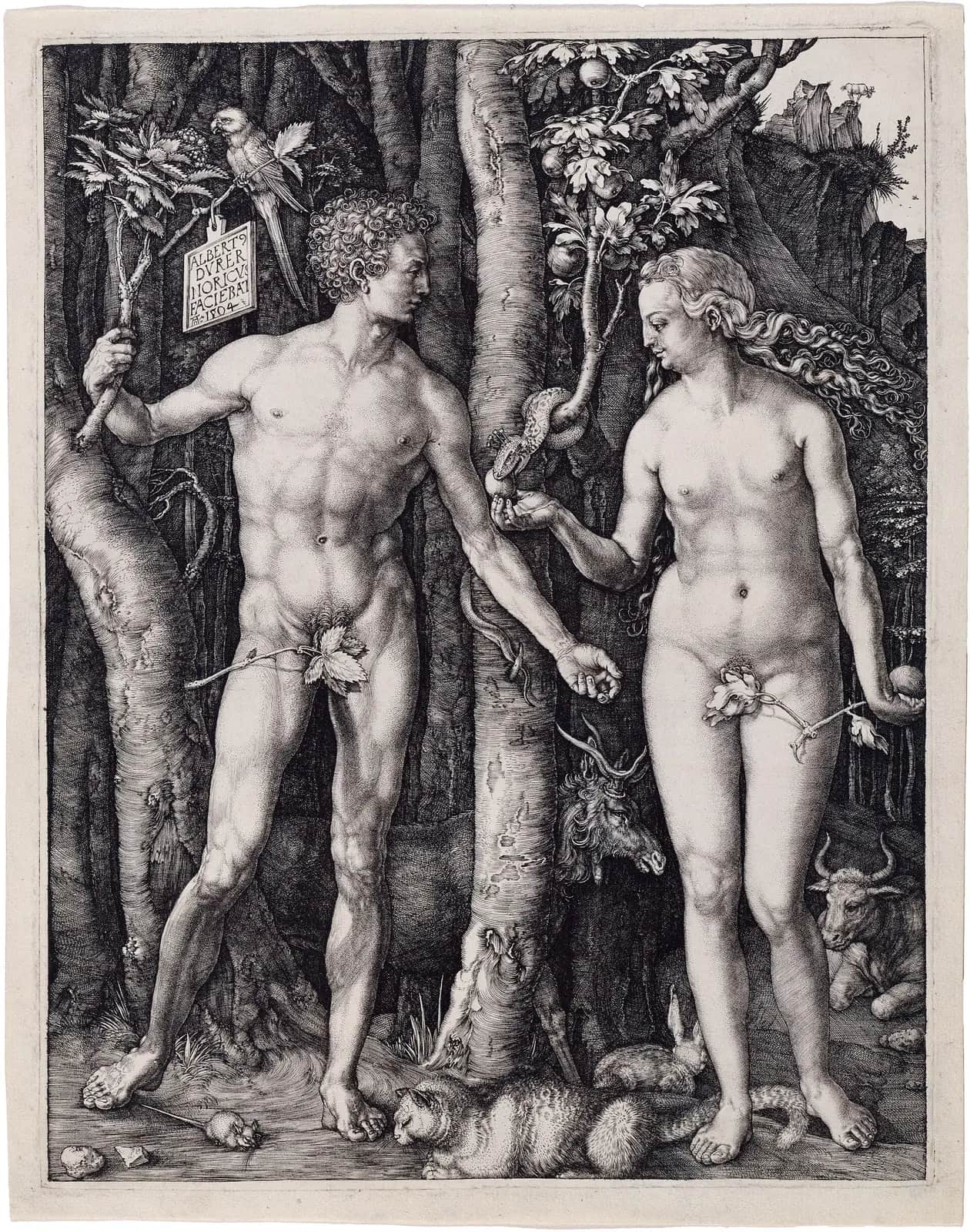
Genesis 3:6 (WEB)
When the woman saw that the tree was good for food, and that it was a delight to the eyes, and that the tree was to be desired to make one wise, she took some of its fruit, and ate. Then she gave some to her husband with her, and he ate it, too.
As quoted in the map (KJV)
Genesis 3:6 (KJV)
And when the woman saw that the tree was good for food, and that it was pleasant to the eyes, and a tree to be desired to make one wise, she took of the fruit thereof, and did eat, and gave also unto her husband with her; and he did eat.
Key words
- עִמָּהּimmah · Hebrew
- 'with her' — Adam is standing beside Eve when she eats; the text says she gave the fruit 'unto her husband with her.'
- נֶחְמָדnechmad · Hebrew
- 'to be desired' — the tree was desired 'to make one wise'; the sin is a grasping at wisdom apart from God.
Why it matters
Eve is not alone at the tree: the Hebrew says Adam was 'with her.' Pitre's second point about Eve (pp 22–23) is that the first sin is a joint act — Eve cooperates with Adam and Adam with Eve. That is what makes the New Eve typology possible: as the first woman stood with the first man at the tree of the fall, Mary stands with the new Adam at the tree of the cross (John 19:25).
Catechism · 4
The Tenth Commandment
“The God of the promises always warned man against seduction by what from the beginning has seemed "good for food . . . a delight to the eyes . . . to be desired to make one wise."” — Catechism footnote: Gen 3:6.
The Seven Petitions
“Finally, discernment unmasks the lie of temptation, whose object appears to be good, a "delight to the eyes" and desirable,” — Catechism footnote: Cf. Gen 3:6.
The Fall
“This is what man's first sin consisted of.” — Catechism footnote: Cf. Gen 3:1-11 ; Rom 5:19.
“They become afraid of the God of whom they have conceived a distorted image - that of a God jealous of his prerogatives.” — Catechism footnote: Cf. Gen 3:5-10.
Fathers and councils · 17
Origen
- Origen, Against Celsus VII.39Book VII
“…it is said of the woman, “The woman saw that the tree was good for food, and that it was pleasant to the eyes, and a tree to be desired to make one wise;” and again not seeing, as when he introduces the serpent saying to the woman, as if she and her husband had been blind, “God knows that on the day that ye eat…” — editor's note: Gen. iii. 6.
Read the whole comment
Augustine of Hippo
“But moreover because through iniquity man fell from the substance wherein he was made (for iniquity itself is no substance; for iniquity is not a nature which God formed, but a perverseness which man made); the Son of God came to the clay of the…” — editor's note: Gen. iii. 6.
Read the whole comment“For if an angel is able to use air, mist, cloud, fire, and any other natural substance or corporal species; and man to use face, tongue, hand, pen, letters, or any other significants, for the purpose of intimating the secret things of his own mind: in a word, if,…” — editor's note: [Judg. xiii. 20. This mysterious subject may be illustrated from Holy Scripture so as to justify our author’s very broad statement. It throws light on Gen.…
Read the whole comment“The serpent suggesting, and the woman transgressing, he touched the forbidden fruit, he forgot the commandment: his heart was smitten as it deserved, and withered like grass, since he forgot to eat his bread.” — editor's note: Gen. iii. 6.
Read the whole comment“Who even in the case of Job, kept for him his wife, that by her the husband might be, not comforted, but tempted?” — editor's note: Gen. iii. 1–6.
Read the whole comment“…and the woman did not eat alone, but gave to her husband, and they eat together; although she alone spoke with the serpent, and she alone was led away by him: so also in the case of that hidden and secret kind of wedlock, which is transacted and discerned in a single human being, the carnal, or as I may say, since it…” — editor's note: Gen. iii. 1–6
Read the whole comment“For they were not created blind, as the unenlightened vulgar fancy; for Adam saw the animals to whom he gave names, and of Eve we read, “The woman saw that the tree was good for food, and that it was pleasant to the eyes.”” — editor's note: Gen. iii. 6.
Read the whole comment“But to let us know that the wrong lies not with any creature of God, but with obstinate disobedience and inordinate desire, it was not in swine’s flesh that the first man found death, but in an apple; and it was not for a fowl, but for a dish of pottage, that Esau lost his birthright.” — editor's note: Gen. iii. 6.
Read the whole comment
Jerome
“Perchance, mindful of his old trick, he will try to tempt Bonosus with hunger.” — editor's note: Gen. iii. 1–6; Matt. iv. 1–4.
Read the whole comment
Ambrose of Milan
“For even Adam was overthrown by Eve, whereby it came to pass that he erred from the Divine commandments.” — editor's note: Gen. iii. 6.
Read the whole comment
Tertullian
“It was still, up to that time, accounted as being in Adam, with its own vicious nature, easily indulging concupiscence after whatever it had seen to be “attractive to the sight,” and looking back at the lower things, and checking its itching with fig-leaves.” — editor's note: See Gen. iii. 6; and comp. 1 John ii. 16.
Read the whole comment“For both Eve and Adam, when it befell them to be “wise,” forthwith veiled what they had learnt to know.” — editor's note: Gen. iii. 6.
Read the whole comment
Gregory of Nyssa
- Gregory of Nyssa, On the Making of Man On the.21On the Making of Man
“…it says, “that the tree was good for food, and that it was pleasant to the eyes to behold, and fair to see; and she took of the fruit thereof and did eat,” and that eating became the mother of death to men.” — editor's note: Gen. iii. 5, 6 (LXX.).
Read the whole comment
Gregory of Nazianzus
“This is why the heathen rage and the peoples imagine vain things; why tree is set over against tree, hands against hand, the one stretched out in self indulgence, the others in generosity; the one unrestrained, the others fixed by nails, the one expelling Adam, the other reconciling the ends of the earth.” — editor's note: Gen. iii. 6–23.
Read the whole comment“If thou enquire into the worse—The Woman Sinned, and so did Adam.” — editor's note: Gen. iii. 6.
Read the whole comment
Catena Aurea on Matthew
- Rabanus MaurusCatena Aurea on Matthew
“Otherwise; The man who had the withered hand denotes the human race in its barrenness of good works dried up by the hand which was stretched out to the fruit; [margin note: Gen 3:6] this was healed by the stretching out of the innocent hand on the Cross.” — the author cites it
Read the whole comment
Aphrahat
“For it was through Eve that he came in upon Adam, and Adam was enticed because of his inexperience.” — editor's note: Gen. iii. 6.
Read the whole comment
Cross-references · 38
Cited together in Tractates on the Gospel of John Tractate 73.
Cited together in On the Making of Man On the.21.
Cited together in Tractates on the Gospel of John Tractate 73.
Cited together in Letters Letter 5.
Cited together in Letters Letter 5.
Cited together in Letters Letter 5.
Cited together in Letters Letter 5.
Cited together in Letters Letter 5.
Cited together in Letters Letter 5.
Cited together in Letters Letter 5.
Cited together in Letters Letter 5.
Cited together in Letters Letter 5.
Cited together in On the Holy Trinity XII.12 and 1 other place.
Cited together in Rabanus Maurus on Matthew 12:9–13 (2) (Catena Aurea).
Cited together in Rabanus Maurus on Matthew 12:9–13 (2) (Catena Aurea).
Cited together in Rabanus Maurus on Matthew 12:9–13 (2) (Catena Aurea).
Cited together in Letters Letter 5.
Cited together in Letters Letter 5.
Cited together in Catechism §2847.
Cited together in Catechism §2847.
Cited together in Catechism §2847.
Cited together in Against Celsus VII.39.
Cited together in On the Holy Trinity XII.12.
Cited together in Catechism §2847.
Cited together in Catechism §399.
Cited together in Catechism §2847.
Cited together in Catechism §2847.
Cited together in Catechism §2847.
Cited together in Catechism §397.
Cited together in On the Holy Trinity XII.12.
Cited together in Tractates on the Gospel of John Tractate 73.
Cited together in Tractates on the Gospel of John Tractate 73.
Cited together in Letters Letter 5.
Cited together in Catechism §2847.
Cited together in Catechism §2847 and 1 other place.
Cited together in Catechism §2847.
Cited together in Tractates on the Gospel of John Tractate 73.
Cited together in The City of God XIV.17.