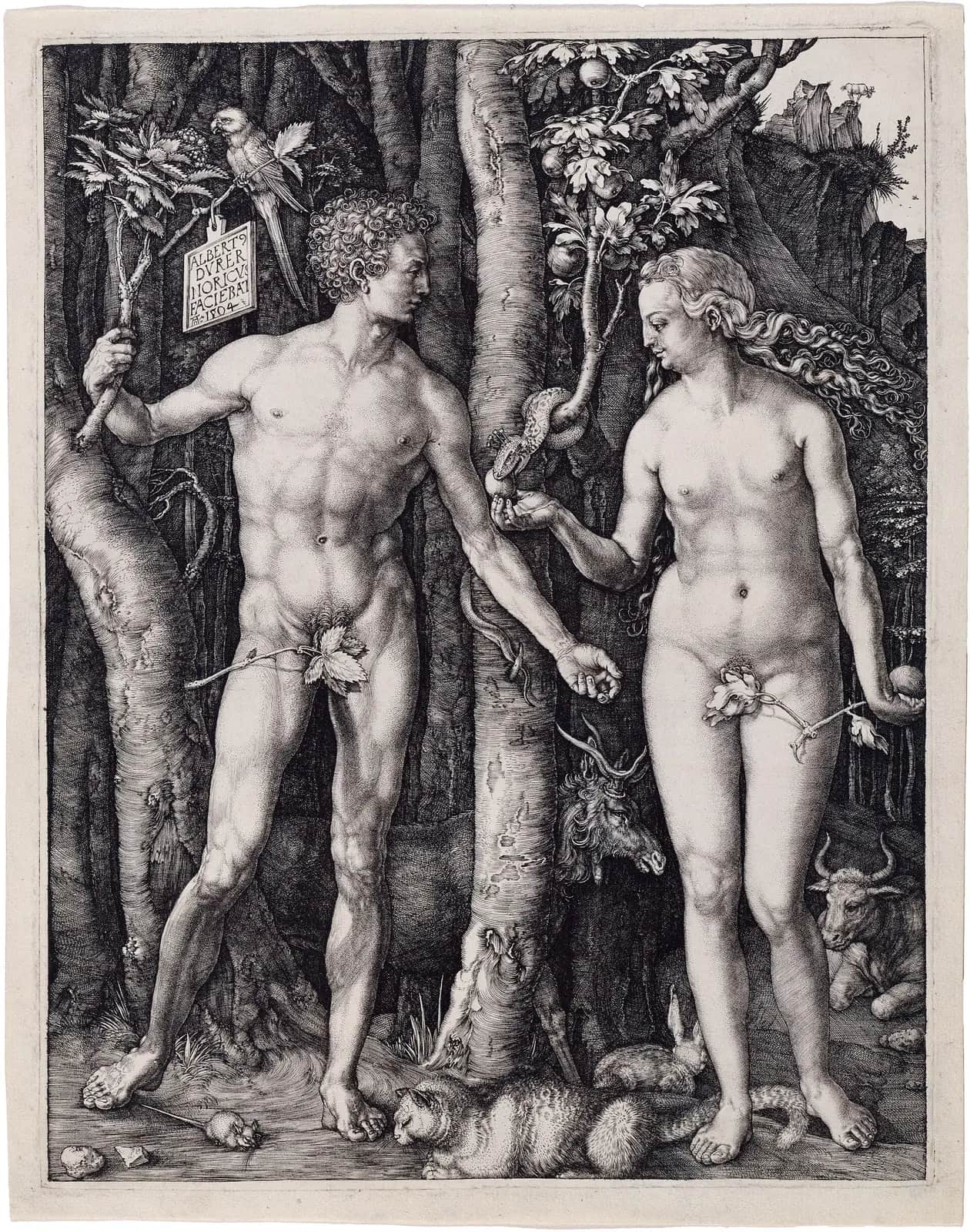
Genesis 3:7 (WEB)
Their eyes were opened, and they both knew that they were naked. They sewed fig leaves together, and made coverings for themselves.
Catechism · 3
“This is what man's first sin consisted of.” — Catechism footnote: Cf. Gen 3:1-11 ; Rom 5:19.
“They become afraid of the God of whom they have conceived a distorted image - that of a God jealous of his prerogatives.” — Catechism footnote: Cf. Gen 3:5-10.
“The harmony in which they had found themselves, thanks to original justice, is now destroyed: the control of the soul's spiritual faculties over the body is shattered; the union of man and woman becomes subject to tensions, their relations henceforth marked by lust and domination.” — Catechism footnote: Cf. Gen 3:7-16.
Fathers and councils · 16
Origen
- Origen, Against Celsus VII.39Book VII
“…“God knows that on the day that ye eat thereof your eyes shall be opened;” and also when it is said, “They did eat, and the eyes of both of them were opened.”” — editor's note: Gen. iii. 7.
Read the whole comment
John Damascene
“…stripped of grace and put off his confidence with God, and covered himself with the asperities of a toilsome life (for this is the meaning of the fig-leaves); and was clothed about with death, that is, mortality and the grossness of flesh (for this is what the garment of skins signifies); and was banished from…” — editor's note: Gen. iii. 7; cf. Greg. Naz., Orat. 38 and 42; Greg. Nyss., Orat. Catech. c. 8.
Read the whole comment
Augustine of Hippo
“…vision of peace in the Holy Church.…Or haply are the gates of death the bodily senses and eyes, which were opened when the man tasted of the forbidden tree,… and are the gates of the daughter of Sion the sacraments and beginnings of faith, which are opened to them that knock, that they may arrive at the hidden…” — editor's note: Gen. iii. 7.
Read the whole comment“For if an angel is able to use air, mist, cloud, fire, and any other natural substance or corporal species; and man to use face, tongue, hand, pen, letters, or any other significants, for the purpose of intimating the secret things of his own mind: in a word, if,…” — editor's note: [Judg. xiii. 20. This mysterious subject may be illustrated from Holy Scripture so as to justify our author’s very broad statement. It throws light on Gen.…
Read the whole comment“…saw God with the eyes of his body; especially as it is a great question what manner of eyes it was that were opened when they tasted the forbidden fruit; for before they had tasted, these eyes were closed.” — editor's note: Gen. iii. 7
Read the whole comment“When he first sinned, he made himself aprons of fig-leaves, signifying by these leaves the irritations of lust to which he had been reduced by sinning.” — editor's note: Gen. iii. 7.
Read the whole comment“For when the first man sinned, he covered his nakedness with fig-leaves; covered those members, from which we derive our birth.” — editor's note: Gen. iii. 7.
Read the whole comment“For with these leaves they covered their nakedness when they blushed for their sin; and what God had made them for members, they made for themselves occasions of shame.” — editor's note: Gen. iii. 7.
Read the whole comment“For they were not created blind, as the unenlightened vulgar fancy; for Adam saw the animals to whom he gave names, and of Eve we read, “The woman saw that the tree was good for food, and that it was pleasant to the eyes.”” — editor's note: An error which arose from the words, The eyes of them both were opened, Gen. iii. 7.—See De Genesi ad lit. ii. 40.
Read the whole comment“In the beginning of the human race, when Adam and Eve had sinned, they made themselves girdles of fig leaves.” — editor's note: Gen. iii. 7.
Read the whole comment
Jerome
“Or what bodies can Adam and Eve have covered with fig-leaves after eating of the forbidden tree?” — editor's note: Gen. iii. 7.
Read the whole comment
Tertullian
“It was still, up to that time, accounted as being in Adam, with its own vicious nature, easily indulging concupiscence after whatever it had seen to be “attractive to the sight,” and looking back at the lower things, and checking its itching with fig-leaves.” — editor's note: See Gen. iii. 7.
Read the whole comment“For both Eve and Adam, when it befell them to be “wise,” forthwith veiled what they had learnt to know.” — editor's note: Gen. ii. 27 (or in the LXX. iii. 1), and iii. 7, 10, 11.
Read the whole comment“Then and there hastening to forecover what, in his newly made body, it was not yet due to modesty (to forecover), he surrounds himself meantime with fig-leaves: subsequently, on being driven from the confines of his birthplace because he had sinned, he went, skinclad, to the world as to a mine.” — editor's note: i.e., a place which he was to work, as condemned criminals worked mines. Comp. de Pu., c. xxii. sub init.; and see Gen. ii. 25 (in LXX. iii. 1), iii. 7, 21–24.
Read the whole comment“Thus they each marked their intelligence of their own sex by a covering.” — editor's note: Gen. ii. 25; iii. 7 (in LXX. iii. 1, iii. 7).
Read the whole comment
Gregory of Nazianzus
“This is why the heathen rage and the peoples imagine vain things; why tree is set over against tree, hands against hand, the one stretched out in self indulgence, the others in generosity; the one unrestrained, the others fixed by nails, the one expelling Adam, the other reconciling the ends of the earth.” — editor's note: Gen. iii. 6–23.
Read the whole comment
Cross-references · 25
Cited together in An Exact Exposition of the Orthodox Faith III.1.
Cited together in An Exact Exposition of the Orthodox Faith III.1.
Cited together in An Exact Exposition of the Orthodox Faith III.1.
Cited together in An Exact Exposition of the Orthodox Faith III.1.
Cited together in On the Veiling of Virgins Chapter 11.
Cited together in On the Veiling of Virgins Chapter 11.
Cited together in On the Veiling of Virgins Chapter 11.
Cited together in On the Veiling of Virgins Chapter 11.
Cited together in On the Veiling of Virgins Chapter 11.
Cited together in On the Veiling of Virgins Chapter 11.
Cited together in On the Veiling of Virgins Chapter 11.
Cited together in On the Veiling of Virgins Chapter 11.
Cited together in On the Veiling of Virgins Chapter 11.
Cited together in On the Veiling of Virgins Chapter 11.
Cited together in On the Veiling of Virgins Chapter 11.
Cited together in An Exact Exposition of the Orthodox Faith III.1.
Cited together in An Exact Exposition of the Orthodox Faith III.1.
Cited together in An Exact Exposition of the Orthodox Faith III.1.
Cited together in Against Celsus VII.39.
Cited together in Catechism §399.
Cited together in Catechism §400.
Cited together in Catechism §397.
Cited together in Catechism §400.
Cited together in Catechism §400.
Cited together in The City of God XIV.17 and 2 other places.