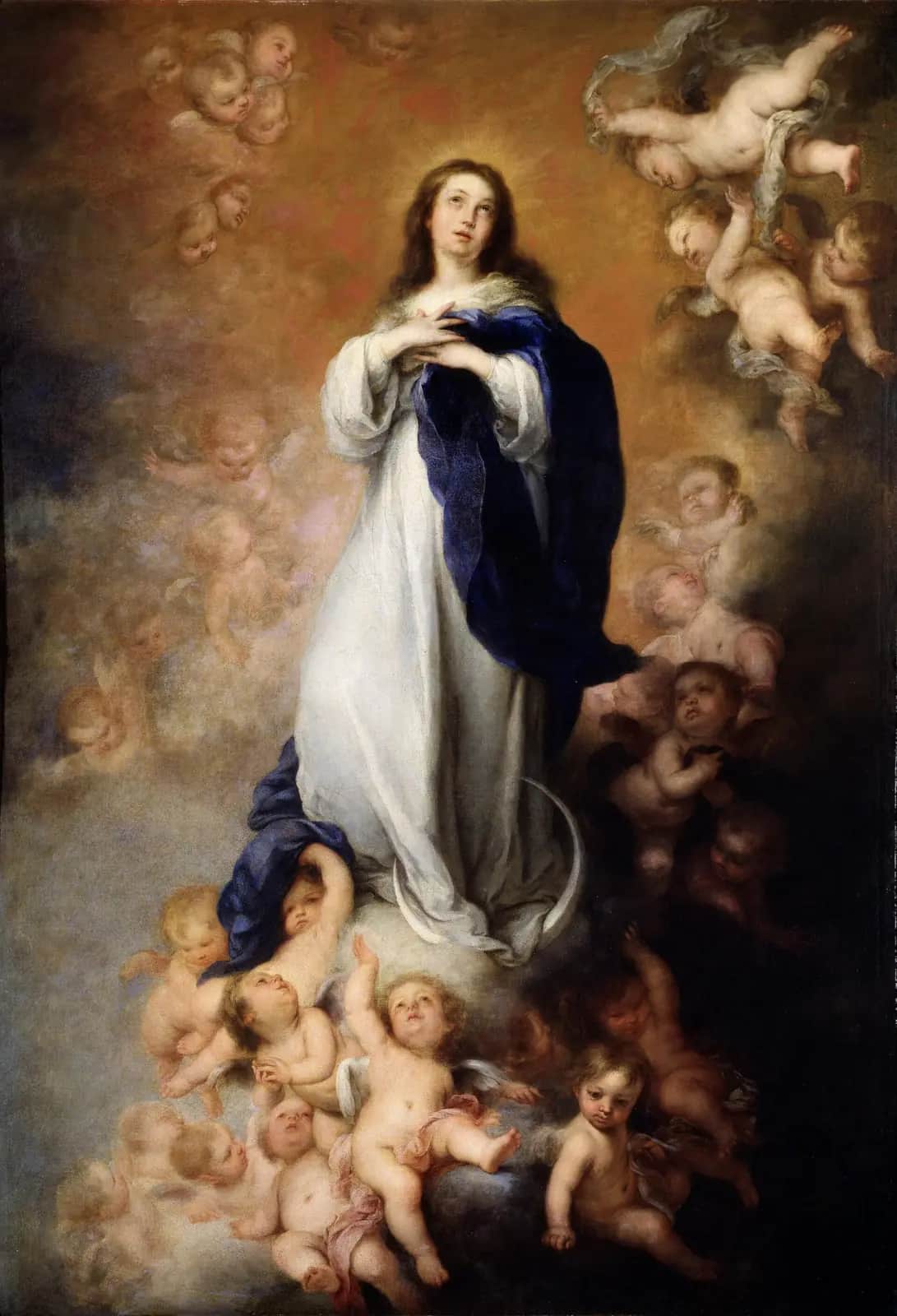
Definition
Mary, from the first moment of her conception, was preserved free from all stain of original sin by a singular grace of God, in view of the merits of Jesus Christ. Pius IX defined it in Ineffabilis Deus (1854). The doctrine rests on Mary as the New Eve: as the first woman began without sin, so the Woman whose seed crushes the serpent begins in grace.
Start here
Begin with the New Eve typology from Genesis 3:15 and the Fathers who first drew the Eve–Mary parallel, then the definition itself.
From Jewish Roots of Mary
- 1.Created immortal as well as sinless — the tree of life
Pitre treats immortality as a second gift alongside moral goodness. God tells the couple they may 'freely eat' of every tree, which includes the tree of life whose fruit lets them 'live for ever.' Only after the fall are they barred from it. So Adam and Eve before the fall were fully human, sinless, and offered unending life; death is a loss, not the design. The point returns twice: a sinless Mary is no less human than unfallen Eve (p 39), and the incorruptible Ark points to a body kept from the grave (pp 46, 63).
- 2.Eve was created 'very good' — why that matters for Mary.
Genesis says the first humans were made 'very good' — a Hebrew phrase meaning morally good, without sin — and given the tree of life. Tellingly, the woman is named 'Eve' only after the fall; before it she is simply 'Woman.' The New Eve is likewise 'Woman,' made in that original grace.
- 3.Mary as the New Eve — the founding text and its logic.
God sets enmity between the serpent and 'the woman,' whose seed will crush his head — fulfilled when Mary's Son conquers Satan by the cross. Ancient Jewish tradition already held that death came into the world through a woman; the New Eve reverses it, paired with Christ the New Adam.
- 4.The full Eve–Mary parallel
Pitre lays the two women side by side: (1) each is called 'woman' — Eve eleven times in Genesis, Mary twice in John; (2) each draws the man to an act — Eve to the first sin, Mary to Jesus' first sign; (3) each stands beside him at the decisive moment — Eve with Adam at the Fall, Mary with Jesus at the crucifixion; (4) each is bound to the 'offspring' who defeats the serpent. And it is at the cross, the very hour the devil is 'cast out,' that Jesus calls her 'Woman' again.
- 5.How the New Eve typology grounds the Immaculate Conception.
Pitre does NOT rest this on 'full of grace' (p 13). His argument runs in two steps. First, ancient Christians everywhere — Justin, Irenaeus, Ephrem, Cyril of Jerusalem, Chrysostom, Jerome, Augustine, writing in Greek, Latin and Syriac — saw Mary as the New Eve (pp 36–37). Second, 'it is a basic rule of Scripture that Old Testament types are never greater than their New Testament fulfillments': Adam was not greater than Jesus, David was not greater than Christ, so if Mary is the New Eve she must be greater than Eve — created without sin as Eve was and, unlike Eve, never sinning, or the old Eve would outrank the new (pp 37–38). Irenaeus' 'the knot of Eve's disobedience was loosed by the obedience of Mary' is the Fathers' way of saying the same.
- 6.
- 7.
- 8.