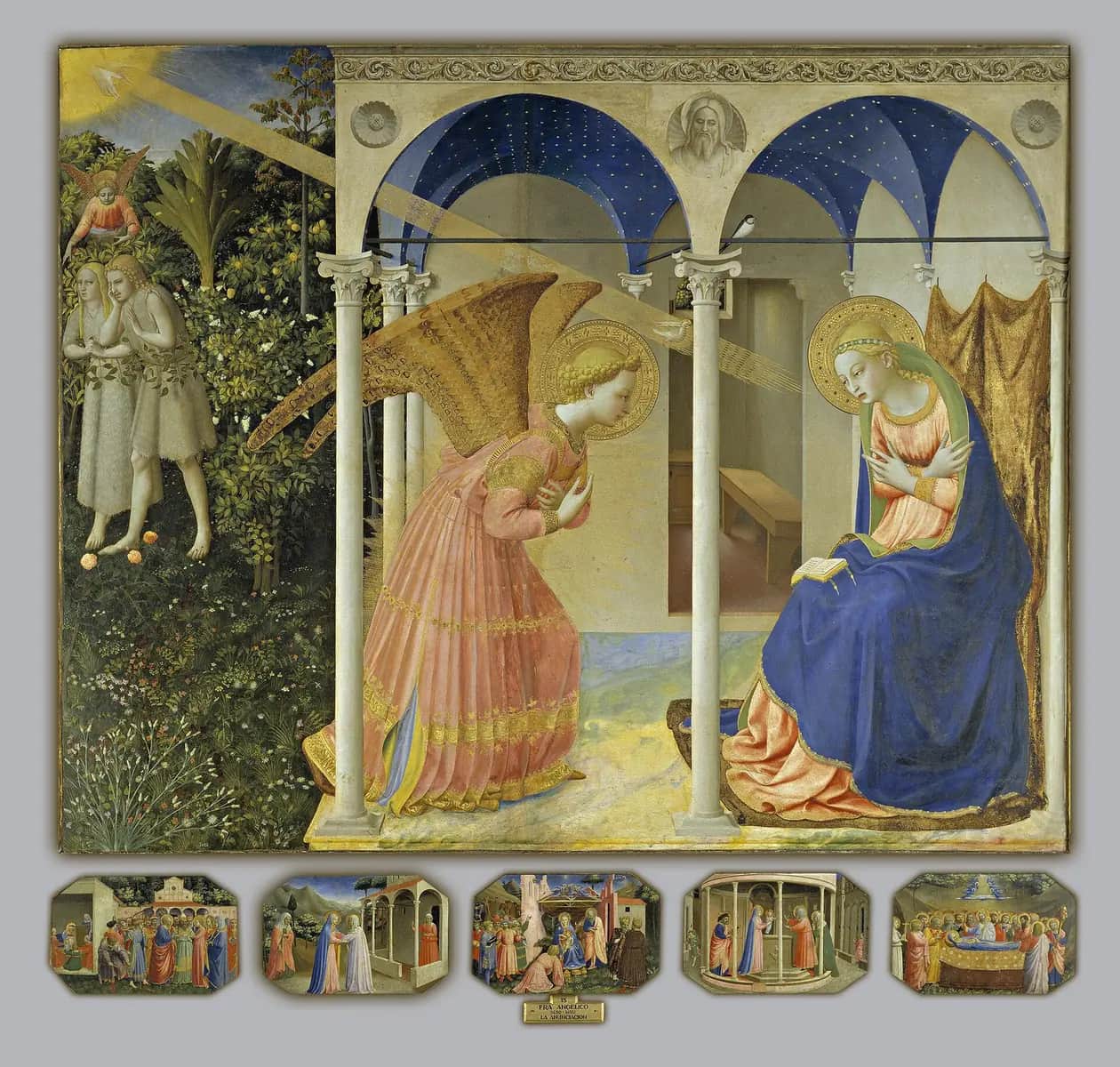
Luke 1:28 (WEB)
Having come in, the angel said to her, “Rejoice, you highly favored one! The Lord is with you. Blessed are you among women!”
As quoted in the map (KJV)
Luke 1:28 (KJV)
And the angel came in unto her, and said, Hail, thou that art highly favoured, the Lord is with thee: blessed art thou among women.
Key words
- χαῖρεchaire · Greek
- 'Hail' — literally 'rejoice,' the greeting the prophets address to Daughter Zion (Zephaniah 3:14 LXX; Zechariah 9:9 LXX).
- κεχαριτωμένηkecharitōmenē · Greek
- 'highly favoured' — a perfect passive participle of charitoō, 'to grace': 'you who have been graced,' a completed state of grace still in effect. The Latin gratia plena, 'full of grace,' and the Hail Mary come from here.
- ὁ κύριος μετὰ σοῦho kyrios meta sou · Greek
- 'the Lord is with thee' — the assurance given to those chosen for a mission (Gideon, Judges 6:12).
Why it matters
Gabriel greets Mary as one already 'graced' and tells her the Lord is with her. Pitre notes the force of the Greek but deliberately does not rest the Immaculate Conception on this phrase alone; he grounds it in the New Eve typology the Fathers drew from Genesis 3:15. Read in that light, the greeting is what one would expect said to the sinless Woman of the new creation.
Catechism · 7
In the Old Testament
“Abraham's remarkable hospitality at Mamre foreshadows the annunciation of the true Son of the promise.” — Catechism footnote: Cf. Gen 18:1-15; Lk 1:26-38.
"Conceived by the Power of the Holy Spirit and Born of the Virgin Mary"
- §490Paragraph 2 · "Conceived by the Power of the Holy Spirit and Born of the Virgin Mary"Read at vatican.va
“The angel Gabriel at the moment of the annunciation salutes her as "full of grace".” — Catechism footnote: Lk 1:28.
- §491Paragraph 2 · "Conceived by the Power of the Holy Spirit and Born of the Virgin Mary"Read at vatican.va
“Through the centuries the Church has become ever more aware that Mary, "full of grace" through God,” — Catechism footnote: Lk 1:28.
- §494Paragraph 2 · "Conceived by the Power of the Holy Spirit and Born of the Virgin Mary"Read at vatican.va
“At the announcement that she would give birth to "the Son of the Most High" without knowing man, by the power of the Holy Spirit, Mary responded with the obedience of faith, certain that "with God nothing will be impossible": "Behold, I am the handmaid of the Lord; let it be [done] to me according to your word."” — Catechism footnote: Lk 1:28-38; cf. Rom 1:5.
- §497Paragraph 2 · "Conceived by the Power of the Holy Spirit and Born of the Virgin Mary"Read at vatican.va
“The Gospel accounts understand the virginal conception of Jesus as a divine work that surpasses all human understanding and possibility:” — Catechism footnote: Mt 1 18-25; Lk 1:26-38.
"I Believe in the Holy Spirit"
Against all human hope, God promises descendants to Abraham, as the fruit of faith and of the power of the Holy Spirit. In Abraham's progeny all the nations of the earth will be blessed.
“By the Holy Spirit's power and her faith, her virginity became uniquely fruitful.” — Catechism footnote: Cf. Lk 1:26-38; Rom 4:18-21; Gal 4:26-28.
Fathers and councils · 24
John Damascene
“And bearing glad tidings to her, he said, Hail thou highly favoured one, the Lord is with thee.” — editor's note: St. Luke i. 28.
Read the whole comment
Ambrose of Milan
“And so, too, when Gabriel visited her, did he find her, and Mary trembled, being disturbed, as though at the form of a man, but on hearing his name recognized him as one not unknown to her.” — editor's note: S. Luke i. 28.
Read the whole comment“But since not only must we celebrate their praises but also follow their manner of life, let us remember where Susanna, and Anna, and Mary are found, and observe how each is spoken of with her special commendation, and where each is mentioned, she that is married in the garden, the widow in the…” — editor's note: S. Luke i. 28.
Read the whole comment“Lastly, Gabriel himself, when sent to Mary, said: “Hail, full of grace,” plainly declaring the grace of the Spirit which was in her, because the Holy Spirit had come upon her, and she was about to have her womb full of grace with the heavenly Word.” — editor's note: S. Luke i. 28.
Read the whole comment
Augustine of Hippo
“And the angel answered and said unto her, The Holy Ghost shall come upon thee, and the power of the Highest shall overshadow thee: therefore also that holy thing which shall be born shall be called the Son of God; and then follow matters not belonging to the question at present in hand.” — editor's note: Luke i. 26–34. [Ver. 34 is differently rendered in the text of the Revised Version. The Latin of Augustin would perhaps admit of the same sense, but is more…
Read the whole commentChapter IX.—Of the Question How It Can Be Shown that the Narrative of the Haul of Fishes Which Luke Has Given Us is Not to Be Identified with the Record of an Apparently Similar Incident Which John Has Reported…
Read the whole comment“…His word; thus we praise the good of Susanna in married chastity, but yet we set before her the good of the widow Anna, and, much more, of the Virgin Mary.” — editor's note: Luke i. 27, 28
Read the whole comment“But God judged it better both to take upon Him man through whom to conquer the enemy of the human race, from the race itself that had been conquered; and yet to do this of a virgin, whose conception, not flesh but spirit, not lust but faith, preceded.” — editor's note: Luke i. 26–32
Read the whole comment“And so the angel, when he announced to Christ’s mother the coming birth, saluted her thus: “Hail, thou that art full of grace;” and shortly afterwards, “Thou hast found grace with God.”” — editor's note: Luke i. 28 (“thou that are highly favored,” A.V.).
Read the whole comment
Theodoret of Cyrus
“For this reason the Virgin is honoured and called “full of grace.”” — editor's note: Luke i. 28
Read the whole comment
Jerome
“When the angel Gabriel came down to her, in the form of a man, and said: “Hail, thou that art highly favored; the Lord is with thee,” she was terror-stricken and unable to reply, for she had never been saluted by a man before.” — editor's note: Luke i. 28.
Read the whole comment“Mary, the mother of the Lord, left the lowlands and made her way to the hill country, when, after receiving the angel’s message, she realized that she bore within her womb the Son of God.” — editor's note: Luke i. 26–31, 39.
Read the whole comment
Tertullian
“Clearly enough is the nativity announced by Gabriel.” — editor's note: Luke i. 26–38.
Read the whole comment
Hippolytus of Rome
“…of this (Jesus), he expresses himself thus: That powers emanating from the second tetrad fashioned Jesus, who appeared on earth, and that the angel Gabriel filled the place of the Logos, and the Holy Spirit that of Zoe, and the “Power of the Highest” that of Anthropos, and the Virgin that of Ecclesia.” — editor's note: Luke i. 26–38.
Read the whole comment
Catena Aurea on Luke
- Ambrose of MilanCatena Aurea on Luke
Mark the virgin by her manner of life. Alone in an inner chamber, unseen by the eyes of men, discovered only by an angel; as it is said, And the angel came in unto her. That she might not be dishonoured by any…
Read the whole comment - A Greek expositorCatena Aurea on Luke
But that she was judged worthy of the nuptials is attested by his saying, Full of grace. For it is signified as a kind of token or marriage gift of the bridegroom, that she was fruitful in graces. For of the things…
Read the whole comment - A Greek expositorCatena Aurea on Luke
But this is the sum of the whole message. The Word of God, as the Bridegroom, effecting an incomprehensible union, Himself, as it were, the same both planting, and being planted, hath moulded the whole nature of man…
Read the whole comment - Ambrose of MilanCatena Aurea on Luke
She wondered also at the new form of blessing, unheard of before, reserved for Mary alone.
Read the whole comment - Augustine of HippoCatena Aurea on Luke
More than with me, for He Himself is in thy heart, He is (made) in thy womb, He fills thy soul, He fills thy womb.
Read the whole comment - Ambrose of MilanCatena Aurea on Luke
But mark the Virgin by her bashfulness, for she was afraid, as it follows; And when she heard, she was troubled, It is the habit of virgins to tremble, and to be ever afraid at the presence of man, and to be shy when…
Read the whole comment - Gregory of NyssaCatena Aurea on Luke
Far different then to the news formerly addressed to the woman, is the announcement now made to the Virgin. In the former, the cause of sin was punished by the pains of childbirth; in the latter, through gladness,…
Read the whole comment - JeromeCatena Aurea on Luke
And it is well said, Full of grace, for to others, grace comes in part; into Mary at once the fulness of grace wholly infused itself. She truly is full of grace through whom has been poured forth upon every creature…
Read the whole comment - A Greek expositorCatena Aurea on Luke
But as she might be accustomed to these visions, the Evangelist ascribes her agitation not to the vision, but to the things told her, saying, she was troubled at his words. Now observe both the modesty and wisdom of…
Read the whole comment - OrigenCatena Aurea on Luke
For if Mary had known that similar words had been addressed to others, such a salutation would never have appeared to her so strange and alarming.
Read the whole comment
Cross-references · 25
Cited together in Concerning Virgins II.2.
Cited together in Concerning Widows Chapter 4.
Cited together in Concerning Widows Chapter 4 and 1 other place.
Cited together in Concerning Widows Chapter 4.
Cited together in On the Holy Spirit I.7.
Cited together in On the Holy Spirit I.7.
Cited together in Concerning Virgins II.2.
Cited together in Concerning Virgins II.2.
Cited together in On the Holy Spirit I.7.
Cited together in On the Holy Spirit I.7.
Cited together in Catechism §494.
Cited together in On the Good of Marriage Chapter 8.
Cited together in On the Holy Trinity XIII.18.
Cited together in On the Good of Marriage Chapter 8.
Cited together in On the Holy Spirit I.7.
Cited together in An Exact Exposition of the Orthodox Faith III.2.
Cited together in Concerning Virgins II.2.
Cited together in On the Holy Spirit I.7.
Cited together in Concerning Virgins II.2.
Cited together in Concerning Virgins II.2.
Cited together in On the Holy Spirit I.7.
Cited together in On the Holy Spirit I.7.
Cited together in On the Holy Spirit I.7.
Cited together in On the Holy Spirit I.7.
Cited together in On the Holy Spirit I.7.