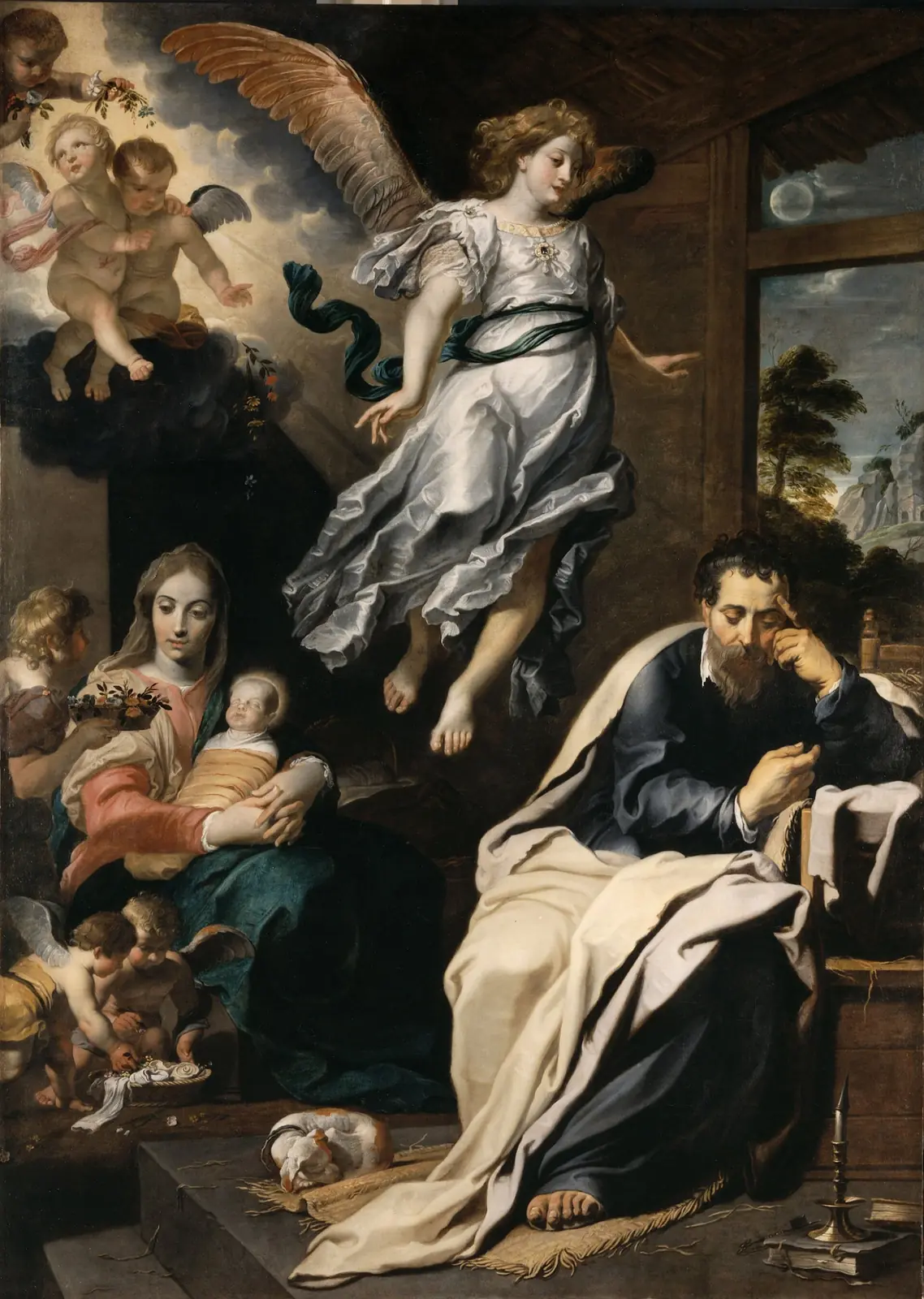
Matthew 1:23 (WEB)
“Behold, the virgin shall be with child, and shall give birth to a son. They shall call his name Immanuel,” which is, being interpreted, “God with us.”
As quoted in the map (KJV)
Matthew 1:23 (KJV)
Behold, a virgin shall be with child, and shall bring forth a son, and they shall call his name Emmanuel, which being interpreted is, God with us.
Key words
- παρθένοςparthenos · Greek
- 'virgin' — Matthew quotes the Septuagint of Isaiah 7:14, which chose the unambiguous word for a virgin.
- ἘμμανουήλEmmanouēl · Greek
- 'Emmanuel,' which Matthew translates for his readers: meth' hēmōn ho theos (μεθ᾽ ἡμῶν ὁ θεός), 'God with us.'
Why it matters
Matthew declares that the virgin's child is Emmanuel, 'God with us.' Pitre's argument for calling Mary 'Mother of God' runs straight through this verse: if her son is God-with-us, she is the mother of God-with-us. The title protects the identity of Jesus, and honouring Mary because of it is not worship — Epiphanius condemned those who worshiped her while insisting she be honoured.
Catechism · 1
- §497Paragraph 2 · "Conceived by the Power of the Holy Spirit and Born of the Virgin Mary"Read at vatican.va
“The Gospel accounts understand the virginal conception of Jesus as a divine work that surpasses all human understanding and possibility:” — Catechism footnote: Mt 1 18-25; Lk 1:26-38.
Fathers and councils · 46
Origen
“Behold, a virgin shall conceive, and bear a son, and shall call His name Immanuel, which is, being interpreted, God with us.”” — editor's note: Cf. Isa. vii. 10–14 with Matt. i. 23.
Read the whole comment
Irenaeus of Lyons
““Behold, a virgin shall conceive, and shall bring forth a son, and they shall call his name Emmanuel; which is, being interpreted, God with us.”” — editor's note: Matt. i. 23.
Read the whole comment“…angel said to Joseph in a dream, “Now this was done, that it might be fulfilled which was spoken by Isaiah the prophet, Behold, a virgin shall be with child.”” — editor's note: Matt. i. 23.
Read the whole comment
Tertullian
“That, therefore, had to be born which was conceived and was to be brought forth; that is to say, the Spirit, whose “name should be called Emmanuel which, being interpreted, is, God with us.”” — editor's note: Matt. i. 23.
Read the whole comment“…Himself will give you a sign; Behold, the virgin shall conceive, and bear a son, and ye shall call his name Emmanuel” (which is, interpreted, “God with us”): “butter and honey shall he eat;”: “since, ere the child learn to call father or mother, he shall receive the power of Damascus and the spoils of Samaria, in…” — editor's note: See Matt. i. 23.
Read the whole comment“Accordingly, a virgin did conceive and bear “Emmanuel, God with us.”” — editor's note: Matt. i. 23.
Read the whole comment““Behold,” says he, “a virgin shall conceive in the womb.”” — editor's note: Isa. vii. 14; Matt. i. 23.
Read the whole comment“For it was not figuratively that the Virgin conceived in her womb; nor in a trope did she bear Emmanuel, that is, Jesus, God with us.” — editor's note: Isa. vii. 14; Matt. i. 23.
Read the whole comment
Athanasius of Alexandria
“…one of themselves is said, ‘Behold, the Virgin shall conceive, and bear a Son, and they shall call his Name Emmanuel, which is being interpreted, God with us;’ and that, ‘A prophet shall the Lord your God raise up to you,’ is spoken of one of the Prophets; and who, as to the words, ‘He was led as a sheep to the…” — editor's note: Is. vii. 14; Matt. i. 23.
Read the whole comment“For if He were not God in the Body, how came He, upon proceeding from Mary, straightway to be called ‘Emmanuel, which is being interpreted God with us?’” — editor's note: Matt. i. 23.
Read the whole comment“For the Prophets say: ‘Send out Thy Word and Thy Truth,’ and ‘Behold the Virgin shall conceive and bear a son, and they shall call His name Emmanuel, which is being interpreted God with us.’” — editor's note: Matt. i. 23, and Isa. vii. 14.
Read the whole comment“For prophets proclaimed beforehand concerning the wonder of the Virgin and the birth from her, saying: “Lo, the Virgin shall be with child, and shall bring forth a Son, and they shall call his name Emmanuel, which is, being interpreted, God with us.”” — editor's note: Matt. i. 23; Isa. vii. 14.
Read the whole comment
John Damascene
“…to the prophecy of Isaiah, who said, Behold a virgin shall conceive and bare a Son and shall call His name Emmanuel, which is, being interpreted, ‘God with us,’ in order that he who taketh the wise in their own craftinessmay deceive him who always glorieth in his wisdom, the maiden is given in marriage to Joseph by…” — editor's note: Is. vii. 14; St. Matt. i. 23.
Read the whole comment
Cyril of Jerusalem
“For the Father begot the Son Very God, called Emmanuel; and Emmanuel being interpreted is, God with us.” — editor's note: Matt. i. 23.
Read the whole comment
Eusebius of Caesarea
“…giving the sign of the virgin; but not as some say, who now venture to translate the Scripture, ‘Behold, a young woman shall conceive and bring forth a son,’ as Theodotion of Ephesus and Aquila of Pontus, both of them Jewish proselytes, interpreted; following whom, the Ebionites say that he was begotten by Joseph.”” — editor's note: Isa. vii. 14. The original Hebrew has עַלְמָה, which means simply a “young woman,” not distinctively a “virgin.” The LXX, followed by Matt. i. 23, wrongly…
Read the whole comment
Augustine of Hippo
“For this also receive ye to have been foretold by the Prophet; “Behold, a Virgin shall conceive in the womb, and shall bring forth a Son, and they shall call His Name Emmanuel, which is, being interpreted, God with us.”” — editor's note: Is. vii. 14; Matt. i. 23
Read the whole comment“For by interpretation, Emmanuel means, “God with us.”” — editor's note: Isa. vii. 14; Matt. i. 23.
Read the whole comment“Then Joseph, being raised from sleep, did as the angel of the Lord had bidden him, and took unto him his wife; and knew her not till she had brought forth her first-born son; and he called His name Jesus.” — editor's note: [The best Greek mss. read “a son” in Matt. i. 23. In Luke ii. 7 “first-born” occurs.—R.]
Read the whole comment“For so had the prophet foretold: “Behold, a virgin shall conceive in the womb, and bring forth a Son, and they shall call His name Immanuel, which, being interpreted, is, God with us.”” — editor's note: Isa. vii. 14, as in Matt. i. 23.
Read the whole comment
Theodoret of Cyrus
“Orth.—The term Christ in the case of our Lord and Saviour signifies the incarnate Word the Immanuel, God with us, both God and man, but the term “God the Word” so said signifies the simple nature before the world, superior to time, and incorporeal.” — editor's note: Matt. i. 23
Read the whole comment“The name Emmanuel, however, indicates both God and man, for it is interpreted in the Gospel to mean “God with us,” that is to say “God in man,” God in our nature.” — editor's note: Matt. i. 23
Read the whole comment
John Chrysostom
“Matt. I. 22, 23.” — the author cites it
Read the whole comment“Both when He was born,and when the children sung that wondrous hymn to Him, and when He sat on the ass,and in very many more instances He worked this same fulfillment: all which things must have been unfulfilled, if He had not come.” — editor's note: Matt. i. 22, 23.
Read the whole comment
Leo the Great
“Isaiah’s prophecy also he might have grasped by a closer attention to what he says, “Behold, a virgin shall conceive and bear a Son and they shall call His name Immanuel,” which is interpreted “God with us.”” — editor's note: Is. vii. 14. and S. Matt. i. 23.
Read the whole comment“…prophet, saying, behold the virgin shall conceive in the womb, and shall bear a son, and they shall call his name Emmanuel, which is interpreted, God with us.”” — editor's note: S. Matt. i. 22, 23.
Read the whole comment“For not in vain had the Holy Ghost said by Isaiah: “Behold! a virgin shall conceive and shall bear a Son, and they shall call His name Emmanuel, which is, being interpreted, God with us.”” — editor's note: Is. vii. 14 ; S. Matt. i. 23.
Read the whole comment
Jerome
“The same Matthew says:—“Now all this was done that it might be fulfilled which was spoken of the Lord by the prophet saying, Behold a virgin shall be with child and shall bring forth a son and they shall call his name Emmanuel.”” — editor's note: Matt. i. 22, 23; Isa. vii. 14.
Read the whole comment“It turns upon the record in Matt. i. 18–25, and especially on the words, “Before they came together” (c. 4), “knew her not till, &c.” (5–8).” — the author cites it
Read the whole comment
Hilary of Poitiers
“Thus Emmanuel is His name, which is God with us, that God might not be lowered to the level of man, but man raised to that of God.” — editor's note: St. Matt. i. 23.
Read the whole comment
Aphrahat
“And that He was born as a child, Isaiah again said:—Lo, the virgin shall conceive and bear; and His name shall be called Immanuel, which is, our God with us.” — editor's note: Is. vii. 14; Matt. i. 23.
Read the whole comment
Cyprian of Carthage
“Also in the Gospel according to Matthew: “And ye shall call His name Emmanuel, which is, being interpreted, God with us.”” — editor's note: Matt. i. 23.
Read the whole comment
Catena Aurea on Matthew
- Remigius of AuxerreCatena Aurea on Matthew
It is the custom of the Evangelist to confirm what he says out of the Old Testament, for the sake of those Jews who believed on Christ, that they might recognize as fulfilled in the grace of the Gospel, the things…
Read the whole comment - Glossa OrdinariaCatena Aurea on Matthew
Or, he says, “all this was done,” meaning, the Virgin was betrothed, she was kept chaste, she was found with child, the revelation was made by the Angel, that it might be fulfilled which was spoken. For that the…
Read the whole comment - Glossa OrdinariaCatena Aurea on Matthew
Or it may be said, that the word “that” does not here denote the cause; for the prophecy was not fulfilled merely because it was to be fulfilled. But it is put consecutively, as in Genesis, “He hung the other on the…
Read the whole comment - John ChrysostomCatena Aurea on Matthew
Otherwise; the Angel seeing the depths of the Divine mercy, the laws of nature broken through and reconciliation made, He who was above all made lower than all; all these wonders, all this he comprises in that one…
Read the whole comment - Leo the GreatCatena Aurea on Matthew
The conception was by the Holy Spirit within the womb of the Virgin; who, as she conceived in perfect chastity, in like manner brought forth her Son.
Read the whole comment - Augustine of HippoCatena Aurea on Matthew
He, who by a touch could heal the severed limbs of others, how much more could He, in His own birth, preserve whole that which He found whole? In this parturition, soundness of the Mother’s body was rather…
Read the whole comment - Theodotus of AncyraCatena Aurea on Matthew
Inasmuch as Photinus affirms that He that was now born was mere man, not allowing the divine birth, and maintains that He who now issued from the womb was the man separate from the God; let him shew how it was…
Read the whole comment - John ChrysostomCatena Aurea on Matthew
As it is the manner of Scripture to convey a knowledge of events under the form of a name, so here, “They shall call His name Emmanuel,” means nothing else than, They shall see God among men. Whence he says not,…
Read the whole comment - Rabanus MaurusCatena Aurea on Matthew
First, Angels hymning, secondly, Apostles preaching, then Holy Martyrs, and lastly, all believers. Jerome, in Isa 7:14; The LXX and three others translate, ‘Thou shalt call,’ instead of which we have here, “They…
Read the whole comment - Remigius of AuxerreCatena Aurea on Matthew
It is a question who interpreted this name? The Prophet, or the Evangelist, or some translator? It should be known then, that the Prophet did not interpret it; and what need had the Holy Evangelist to do so, seeing…
Read the whole comment - JeromeCatena Aurea on Matthew
It should be known, that the Hebrews believe this prophecy to refer to Ezekias, the son of Ahaz, because in his reign Samaria was taken; but this cannot be established. Ahaz son of Jotham reigned over Judaea and…
Read the whole comment - Petrus AlfonsiCatena Aurea on Matthew
For we know not that any man of that day was called Emmanuel. But the Hebrew objects, How can it be that this was said on account of Christ and Mary, when many centuries intervened between Ahaz and Mary? But though…
Read the whole comment - JeromeCatena Aurea on Matthew
What is spoken to Ahaz then is to be thus understood. This Child, that shall be born of a Virgin of the house of David, shall now be called Emmanuel, that is, God with us, because the events (perhaps delivery from…
Read the whole comment - Augustine of HippoCatena Aurea on Matthew
Who so mad as to say with Manichaeus, that it is a weak faith not to believe i Christ without a witness; whereas the Apostle says, “How shall they believe on Him of whom they have not heard? Or how shall they hear…
Read the whole comment - Glossa OrdinariaCatena Aurea on Matthew
This error then is barred by the Evangelist saying, “That it might be fulfilled which was spoken of the Lord by the Prophet.” Now one kind of prophecy is by the preordination of God, and must needs be fulfilled, and…
Read the whole comment
Cross-references · 30
Cited together with
Cross-reference given by the World English Bible's translators.
Cited together in On the Flesh of Christ Chapter 21.
Cited together in On the Flesh of Christ Chapter 21.
Cited together in The City of God XVIII.46.
Cited together in The City of God XVIII.46.
Cited together in The City of God XVIII.46.
Cited together in The City of God XVIII.46.
Cited together in The City of God XVIII.46.
Cited together in Church History V.8.
Cited together in Glossa Ordinaria on Matthew 1:22–23 (2) (Catena Aurea).
Cited together in Harmony of the Gospels I.26.
Cited together in Against Celsus I.34.
Cited together in Against Celsus I.34.
Cited together in Concerning Faith of Things Not Seen Chapter 5.
Cited together in Concerning Faith of Things Not Seen Chapter 5.
Cited together in Concerning Faith of Things Not Seen Chapter 5.
Cited together in Concerning Faith of Things Not Seen Chapter 5.
Cited together in Concerning Faith of Things Not Seen Chapter 5.
Cited together in The City of God XVIII.46.
Cited together in The City of God XVIII.46.
Cited together in The City of God XVIII.46.
Cited together in The City of God XVIII.46.
Cited together in Against Celsus I.34.
Cited together in Against Celsus I.34.
Cited together in Against Celsus I.34.
Cited together in Petrus Alfonsi on Matthew 1:22–23 (Catena Aurea) and 1 other place.
Cited together in Glossa Ordinaria on Matthew 1:22–23 (Catena Aurea) and 2 other places.
Cited together in The City of God XVIII.46.
Cited together in Harmony of the Gospels I.26.
Quotes
Quoted from the Septuagint: 'the virgin shall conceive'.