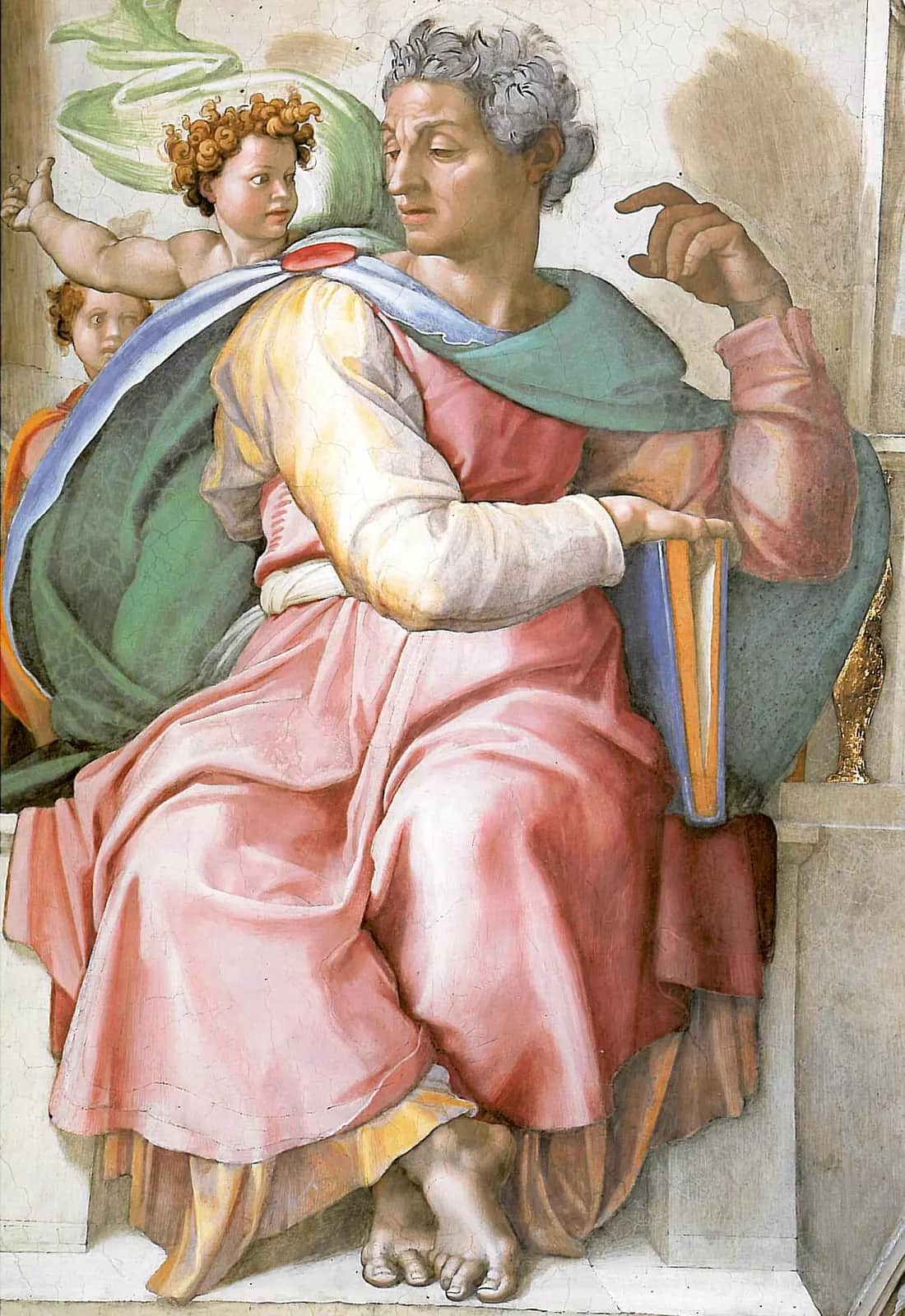
Isaiah 7:14 (WEB)
Therefore the Lord himself will give you a sign. Behold, the virgin will conceive, and bear a son, and shall call his name Immanuel.
As quoted in the map (KJV)
Isaiah 7:14 (KJV)
Therefore the Lord himself shall give you a sign; Behold, a virgin shall conceive, and bear a son, and shall call his name Immanuel.
Key words
- עַלְמָהalmah · Hebrew
- 'virgin' — a young woman of marriageable age; in the Bible the word never clearly refers to a married woman.
- παρθένοςparthenos · Greek (LXX)
- 'virgin' — the Greek translators (two centuries before Christ) chose the unambiguous word for a virgin, and Matthew 1:23 quotes their rendering.
- עִמָּנוּ אֵלImmanu El · Hebrew
- 'God with us' — the child's name declares that in him God himself is present.
Why it matters
The sign of the virgin who conceives and bears 'God with us' is applied by Matthew to Mary and Jesus. Pitre's argument for the title 'Mother of God' rests here: if the child Mary bears is Immanuel, God with us, then Mary is the mother of God-with-us — a statement about who Jesus is before it is a statement about her. Honouring her as such guards the truth of the Incarnation.
Catechism · 1
- §497Paragraph 2 · "Conceived by the Power of the Holy Spirit and Born of the Virgin Mary"Read at vatican.va
“The Church sees here the fulfilment of the divine promise given through the prophet Isaiah: "Behold, a virgin shall conceive and bear a son."” — Catechism footnote: Is 7:14 (LXX), quoted in Mt 1:23 (Greek).
Fathers and councils · 49
Origen
“Behold, a virgin shall conceive, and bear a son, and shall call His name Immanuel, which is, being interpreted, God with us.”” — editor's note: Cf. Isa. vii. 10–14 with Matt. i. 23.
Read the whole comment“The Lord is related to have spoken to Ahaz thus: “Ask a sign for thyself from the Lord thy God, either in the depth or height above;” and afterwards the sign is given, “Behold, a virgin shall conceive, and bear a son.”” — editor's note: Isa. vii. 14.
Read the whole comment
Irenaeus of Lyons
“…all others, in Himself that pre-eminent birth which is from the Most High Father, and also experienced that pre-eminent generation which is from the Virgin, the divine Scriptures do in both respects testify of Him: also, that He was a man without comeliness, and liable to suffering; that He sat upon the foal of an…” — editor's note: Isa. vii. 14.
Read the whole comment“But not as some allege, among those now presuming to expound the Scripture, [thus:] “Behold, a young woman shall conceive, and bring forth a son,” as Theodotion the Ephesian has interpreted, and Aquila of Pontus, both Jewish proselytes.” — editor's note: Isa. vii. 14.
Read the whole comment“…“He is a man, and who shall know him?” and, “I came unto the prophetess, and she bare a son, and His name is called Wonderful, Counsellor, the Mighty God;” and those [of them] who proclaimed Him as Immanuel, [born] of the Virgin, exhibited the union of the Word of God with His own workmanship, [declaring] that the…” — editor's note: Isa. viii. 3, Isa. ix. 6, Isa. vii. 14. [A confusion of texts.]
Read the whole comment
Jerome
“Isaiah tells of the mystery of our faith and hope:“Behold a virgin shall conceive, and bear a son, and shall call his name Emmanuel.”” — editor's note: Is. vii. 14.
Read the whole comment“But now that a virgin has conceived in the womb and has borne to us a child of which the prophet says that “Government shall be upon his shoulder, and his name shall be called the mighty God, the everlasting Father,” now the chain of the curse is broken.” — editor's note: Isa. vii. 14.
Read the whole comment“The same Matthew says:—“Now all this was done that it might be fulfilled which was spoken of the Lord by the prophet saying, Behold a virgin shall be with child and shall bring forth a son and they shall call his name Emmanuel.”” — editor's note: Matt. i. 22, 23; Isa. vii. 14.
Read the whole comment“This young child, this mere boy, who is fed on butter and honey, and who is reared among curdled mountains, quickly grows up to manhood, speedily spoils all that is opposed to him in you, and when the time is ripe plunders [the spiritual] Damascus and puts in chains the king of [the spiritual] Assyria.” — editor's note: Isa. vii. 14, 15.
Read the whole comment“…against her as an adulteress, like Susanna? for at the present day, now that the whole world has embraced the faith, the Jews argue that when Isaiah says, “Behold, a virgin shall conceive and bear a son,” the Hebrew word denotes a young woman, not a virgin, that is to say, the word is Almah, not Bethulah, a…” — editor's note: Is. vii. 14. See Cheyne’s Isaiah, and critical note.
Read the whole comment
Athanasius of Alexandria
“…one of themselves is said, ‘Behold, the Virgin shall conceive, and bear a Son, and they shall call his Name Emmanuel, which is being interpreted, God with us;’ and that, ‘A prophet shall the Lord your God raise up to you,’ is spoken of one of the Prophets; and who, as to the words, ‘He was led as a sheep to the…” — editor's note: Is. vii. 14; Matt. i. 23.
Read the whole comment“Isaiah again, ‘Behold, a virgin shall conceive and bear a son, and ye shall call his name Emmanuel.’” — editor's note: Deut. xviii. 15; Is. vii. 14. These two texts are also quoted together in Orat. i. §54.
Read the whole comment“And this Isaiah pointed to in his prophecy, in the words: ‘Behold the Virgin,’ while Gabriel is sent to her—not simply to a virgin, but ‘to a virgin betrothed to a man,’ in order that by means of the betrothed man he might shew that Mary was really a human being.” — editor's note: Isa. vii. 14.
Read the whole comment“For the Prophets say: ‘Send out Thy Word and Thy Truth,’ and ‘Behold the Virgin shall conceive and bear a son, and they shall call His name Emmanuel, which is being interpreted God with us.’” — editor's note: Matt. i. 23, and Isa. vii. 14.
Read the whole comment“For prophets proclaimed beforehand concerning the wonder of the Virgin and the birth from her, saying: “Lo, the Virgin shall be with child, and shall bring forth a Son, and they shall call his name Emmanuel, which is, being interpreted, God with us.”” — editor's note: Matt. i. 23; Isa. vii. 14.
Read the whole comment
Catena Aurea on Luke
- Ambrose of MilanCatena Aurea on Luke
“(Is.” — the author cites it
Read the whole comment
Tertullian
“Therefore God Himself will give you a sign; Behold, the virgin shall conceive, and bear a son, and ye shall call his name Emmanuel” (which is, interpreted, “God with us”): “butter and honey shall he eat;”: “since, ere the child learn to call father or mother, he shall receive the power of…” — editor's note: See Isa. vii. 13, 14.
Read the whole comment“But what concern has he with the Creator’s prophet, Isaiah?” — editor's note: A reference to Isa. vii. 14.
Read the whole comment““Behold a virgin shall conceive and bear a son.”” — editor's note: Isa. vii. 14.
Read the whole comment““Behold,” says he, “a virgin shall conceive in the womb.”” — editor's note: Isa. vii. 14; Matt. i. 23.
Read the whole comment“The sign (here meant) is that of the birth of Christ, according to Isaiah: “Therefore the Lord Himself shall give you a sign: behold, a virgin shall conceive and bear a son.”” — editor's note: Isa. vii. 14.
Read the whole comment“For it was not figuratively that the Virgin conceived in her womb; nor in a trope did she bear Emmanuel, that is, Jesus, God with us.” — editor's note: Isa. vii. 14; Matt. i. 23.
Read the whole comment“For, to begin with, you say that Isaiah’s Christ will have to be called Emmanuel; then, that He takes the riches of Damascus and the spoils of Samaria against the king of Assyria.” — editor's note: Isa. vii. 14.
Read the whole comment““Therefore,” says he, “the Lord himself shall give you a sign; behold, a virgin shall conceive, and bear a son.”” — editor's note: Isa. vii. 14.
Read the whole comment“…begotten of a father, and His mother be a virgin, because His father is not human—He will be that Christ whom Isaiah foretold that a virgin should conceive, on what principle you, Marcion, can admit Him Son of man, I cannot possibly see.” — editor's note: Isa. vii. 14.
Read the whole comment
John Damascene
“…to the prophecy of Isaiah, who said, Behold a virgin shall conceive and bare a Son and shall call His name Emmanuel, which is, being interpreted, ‘God with us,’ in order that he who taketh the wise in their own craftinessmay deceive him who always glorieth in his wisdom, the maiden is given in marriage to Joseph by…” — editor's note: Is. vii. 14; St. Matt. i. 23.
Read the whole comment
Cyril of Jerusalem
“Isaiah vii. 10–14” — the author cites it
Read the whole comment
Eusebius of Caesarea
“…giving the sign of the virgin; but not as some say, who now venture to translate the Scripture, ‘Behold, a young woman shall conceive and bring forth a son,’ as Theodotion of Ephesus and Aquila of Pontus, both of them Jewish proselytes, interpreted; following whom, the Ebionites say that he was begotten by Joseph.”” — editor's note: Isa. vii. 14. The original Hebrew has עַלְמָה, which means simply a “young woman,” not distinctively a “virgin.” The LXX, followed by Matt. i. 23, wrongly…
Read the whole comment
Augustine of Hippo
“For this also receive ye to have been foretold by the Prophet; “Behold, a Virgin shall conceive in the womb, and shall bring forth a Son, and they shall call His Name Emmanuel, which is, being interpreted, God with us.”” — editor's note: Is. vii. 14; Matt. i. 23
Read the whole comment“Ye saw not what was foretold and fulfilled concerning the human birth of Christ, “Behold, a Virgin shall conceive in the womb, and shall bear a Son;” but you see the Word of God which was foretold and fulfilled unto Abraham, “In thy seed shall all nations be blessed.”” — editor's note: Is. vii. 14
Read the whole comment“For by interpretation, Emmanuel means, “God with us.”” — editor's note: Isa. vii. 14; Matt. i. 23.
Read the whole comment“Behold, a virgin shall conceive, and bear a Son.”” — editor's note: Isa. vii. 14.
Read the whole comment“For so had the prophet foretold: “Behold, a virgin shall conceive in the womb, and bring forth a Son, and they shall call His name Immanuel, which, being interpreted, is, God with us.”” — editor's note: Isa. vii. 14, as in Matt. i. 23.
Read the whole comment
Justin Martyr
“But God shall bring on thee, and on thy people, and on the house of thy father, days which have not yet come upon thee since the day in which Ephraim took away from Judah the king of Assyria.’” — editor's note: Isa. vii. 10–17 with Isa. viii. 4 inserted. The last clause may also be translated, “in which He took away from Judah Ephraim, even the king of Assyria.”
Read the whole comment“…thy people, and on the house of thy father, days which have not yet come upon thee since the day in which Ephraim took away from Judah the king of Assyria.’ ” And I continued: “Now it is evident to all, that in the race of Abraham according to the flesh no one has been born of a virgin, or is said to have been born…” — editor's note: Isa. vii. 10–17, with Isa. viii. 4 inserted between vers. 16 and 17.
Read the whole comment
Sozomen
“And of the rest of the prophets some declared beforehand the birth of Christ, His ineffable conception, the mother remaining a virgin after His birth, His people, and country.” — editor's note: Isa. vii. 14, foretells that “a virgin shall conceive and bear a son”; but he does not declare, in words, the perpetual virginity of the mother of God. The…
Read the whole comment
Cyprian of Carthage
“And in order to show what this struggle would be, he added the words, “Behold, a virgin shall conceive and bear a son, and ye shall call His name Emmanuel.”” — editor's note: Isa. vii. 14.
Read the whole comment“Butter and honey shall He eat; before that He knows to prefer the evil, He shall exchange the good.”” — editor's note: Isa. vii. 10–15. The ordinary reading here is, “before He knows, to refuse the evil and to choose the good.” The reading in the text, however, is more…
Read the whole comment
Catena Aurea on Matthew
- Glossa OrdinariaCatena Aurea on Matthew
“So had she perished before the birth, that prophecy would have been made void which says, “She shall bring forth a Son.” [Isa 7:14]” — the author cites it
Read the whole comment - John ChrysostomCatena Aurea on Matthew
“Jerome, in Isa 7:14; Since it is introduced in the Prophet by the words, “The Lord Himself shall give you a sign,” it ought to be something new and wonderful.” — the author cites it
Read the whole comment - Rabanus MaurusCatena Aurea on Matthew
“Jerome, in Isa 7:14; The LXX and three others translate, ‘Thou shalt call,’ instead of which we have here, “They shall call,” which is not so in the Hebrew; for the word,…” — the author cites it
Read the whole comment
John Chrysostom
“…this was done, that it might be fulfilled which was spoken by Esias the prophet, saying, Behold, a virgin shall be with Child, and shall bring forth a Son” ( Matt. i. 22; Isa. vii. 14 ); and when He is plotted against and sought for everywhere so diligently, that even tender infancy is slaughtered by Herod, they…” — the author cites it
Read the whole comment“For he doth not merely say, “Behold, the Virgin shall be with child,” but having first said, “Behold, the Lord Himself shall give you a sign,” then he subjoins, “Behold, the Virgin shall be with child.”” — editor's note: Isa. vii. 14.
Read the whole comment
Leo the Great
“Isaiah’s prophecy also he might have grasped by a closer attention to what he says, “Behold, a virgin shall conceive and bear a Son and they shall call His name Immanuel,” which is interpreted “God with us.”” — editor's note: Is. vii. 14. and S. Matt. i. 23.
Read the whole comment“…through Isaiah: “behold a virgin shall conceive in her womb, and shall bear a Son, and His Name shall be called Emmanuel, which is interpreted, God with us,” and again, “a rod shall come forth from the root of Jesse, and a flower shall arise from his root.”” — editor's note: Is. vii. 14.
Read the whole comment“For not in vain had the Holy Ghost said by Isaiah: “Behold! a virgin shall conceive and shall bear a Son, and they shall call His name Emmanuel, which is, being interpreted, God with us.”” — editor's note: Is. vii. 14 ; S. Matt. i. 23.
Read the whole comment
John Cassian
“And so the prophet Isaiah says: “Behold a virgin shall conceive and bear a Son, and they shall call his name Emmanuel, which is interpreted God with us.”” — editor's note: Isa. vii. 14.
Read the whole comment
Aphrahat
“And that He was born as a child, Isaiah again said:—Lo, the virgin shall conceive and bear; and His name shall be called Immanuel, which is, our God with us.” — editor's note: Is. vii. 14; Matt. i. 23.
Read the whole comment
Hippolytus of Rome
“For this is the virgin who carries in her womb and conceives and brings forth a son, not animal, not corporeal, but blessed for evermore.” — editor's note: Isa. vii. 14.
Read the whole comment
Cross-references · 48
Cited together with
Cited together in Dialogue with Trypho Chapter 43 and 2 other places.
Cited together in The City of God XVIII.46.
Cited together in Dialogue with Trypho Chapter 43.
Cited together in Harmony of the Gospels I.26.
Cited together in Epistles Letter 8.
Cited together in The Five Books Against Marcion III.12.
Cited together in The Five Books Against Marcion III.12.
Cited together in On the Incarnation of the Lord, Against Nestorius II.3.
Cited together in Glossa Ordinaria on Matthew 1:22–23 (Catena Aurea) and 2 other places.
Cited together in Glossa Ordinaria on Matthew 1:22–23 (Catena Aurea) and 2 other places.
Cited together in Epistles Letter 8.
Cited together in On the Flesh of Christ Chapter 21.
Cited together in On the Flesh of Christ Chapter 23.
Cited together in On the Flesh of Christ Chapter 23.
Cited together in On the Flesh of Christ Chapter 21.
Cited together in The City of God XVIII.46.
Cited together in The City of God XVIII.46.
Cited together in The City of God XVIII.46.
Cited together in The City of God XVIII.46.
Cited together in The City of God XVIII.46.
Cited together in Epistles Letter 8.
Cited together in Epistles Letter 8.
Cited together in Epistles Letter 8.
Cited together in Epistles Letter 8.
Cited together in Epistles Letter 8.
Cited together in Epistles Letter 8.
Cited together in Epistles Letter 8.
Cited together in Church History V.8.
Cited together in On the Flesh of Christ Chapter 23.
Cited together in Harmony of the Gospels I.26.
Cited together in Against Celsus I.34.
Cited together in Against Celsus I.34.
Cited together in On the Incarnation of the Lord, Against Nestorius II.3.
Cited together in Concerning Faith of Things Not Seen Chapter 5.
Cited together in Concerning Faith of Things Not Seen Chapter 5.
Cited together in Concerning Faith of Things Not Seen Chapter 5.
Cited together in Concerning Faith of Things Not Seen Chapter 5.
Cited together in Concerning Faith of Things Not Seen Chapter 5.
Cited together in The City of God XVIII.46.
Cited together in The City of God XVIII.46.
Cited together in The City of God XVIII.46.
Cited together in The City of God XVIII.46.
Cited together in The Five Books Against Marcion III.12.
Cited together in The Five Books Against Marcion III.12.
Cited together in On the Incarnation of the Lord, Against Nestorius II.3.
Cited together in The Five Books Against Marcion III.12.
Cross-reference given by the World English Bible's translators.
Quoted in
Quoted from the Septuagint: 'the virgin shall conceive'.