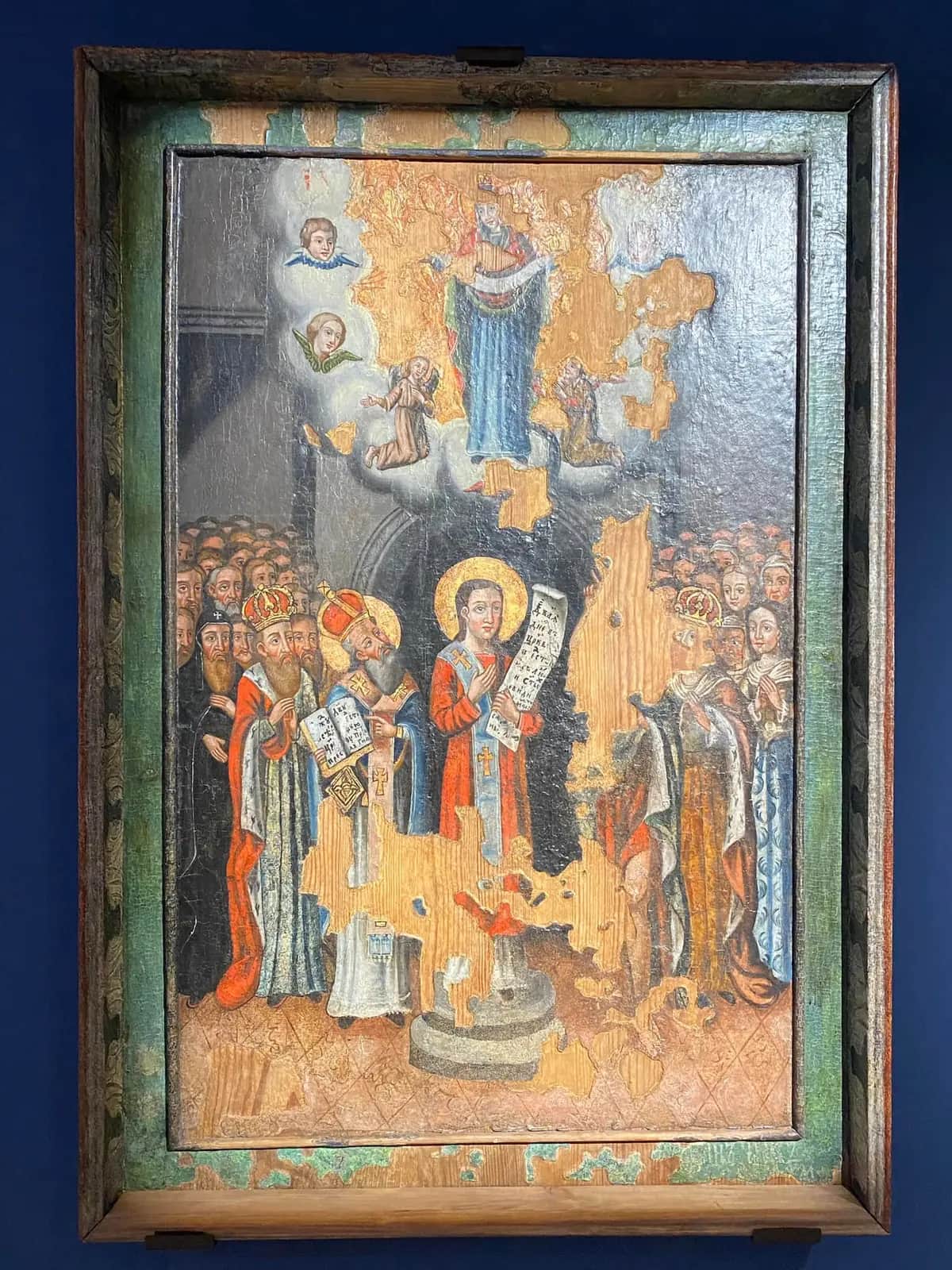
Definition
Mary prays for the Church and for each of its members, and the faithful may ask her to, as they ask one another (Lumen Gentium 62; Catechism §§969, 2673–2679). The Old Testament root is the queen mother who brings petitions to the king and is not refused (1 Kings 2:19–20) and Rachel, whose weeping for her children is heard (Jeremiah 31:15–17). At Cana Mary's request is the first Marian intercession. The oldest known prayer to Mary, Sub tuum praesidium, dates from about the third century. Asking her prayers is honour, not worship: sacrifice is offered to God alone.
Start here
Begin with the Old Testament root of asking for Mary's intercession, then "pray for one another" and why prayer need not stop at death, then the third-century prayer.
From Jewish Roots of Mary
- 1.The Old Testament root of asking for Mary's intercession.
The queen mother was the kingdom's chief intercessor. Adonijah asks Bathsheba to petition Solomon, certain 'he will not refuse you'; Solomon rises and seats her at his right hand. Pitre adds the honest qualifier that this particular request — for Abishag, a veiled claim on the throne — was refused and Adonijah executed; 'despite Solomon's abuse of his power,' the episode shows the queen mother's office as royal advocate (p 71). Asking the Queen Mother to bring a request to the King is the biblical pattern behind Marian intercession.
- 2.'Pray for one another' — why stop in heaven? and the earliest recorded prayers to Mary
Pitre's New Testament warrant for asking Mary's intercession is short. Even secular nations honour their leaders, and those who need something from a leader ask the people closest to him. Scripture commands Christians to 'pray for one another' (James 5:16) — 'Why should such prayers cease in heaven (cf. Revelation 5:8)?' — and Mary the queen is alive in heaven (Revelation 12:1). The early Church drew the conclusion: an anonymous Egyptian papyrus prayer of the third or fourth century — 'We take refuge in your mercy, Mother of God. Do not disregard our prayers in troubling times' — Gregory Nazianzen's account of the virgin Justina imploring Mary's help, Sozomen's report of healings credited to 'Mary, the Mother of God,' and John Damascene's 'Queen over all created things.' The link runs from Jesus' divinity, to Mary as Mother of God, to asking her prayers.
- 3.'Our Lady' comes from Judaism; the Collyridians; sacrifice is the line between honour and worship
'Our Lady' is Greek kyria, a royal 'Lady,' the queen. 'Mary is Our Lady… because Jesus actually is king of the universe — not because ancient Christians sold out to paganism. There was no need to borrow the idea of a queen from paganism, since they had already gotten it from Judaism.' The Catechism's summary of the Assumption calls her 'exalted by the Lord as Queen over all things' (CCC 966, in the words of Lumen Gentium 59, which builds on Pius XII's 1950 definition). The one recorded group who did worship Mary, the Collyridians, offered her the sacrificial loaf (kollyra) of the Eucharist, and Epiphanius condemned them with the very Jeremiah passage the Baptist pastor used on Pitre: 'Mary is to be held in honor, but the Lord is to be worshiped!' The criterion is sacrifice: in ancient Judaism and Christianity 'the essence of worship was sacrifice'; honour, petition and praise can all be given to humans. Protestants, whose worship is doxology without sacrifice, therefore read Catholic praise of Mary as idolatry — 'one of the main reasons' the two sides talk past each other.
- 4.Rachel's tomb outside the family tomb — how can she weep centuries later?
Rachel alone among the matriarchs is not buried with Sarah and Rebekah in the family tomb; she died on the road and Jacob set a pillar on her grave near Bethlehem, a site Genesis says is known 'to this day.' That geography answers the exegetical puzzle of Jeremiah 31: how can Rachel weep centuries after her death? Her tomb lay near the place where the Babylonians staged the exiles for deportation, so the prophet pictures 'the spirit' of Rachel still living, watching her descendants suffer, 'the classic mother who mourns and intercedes for her children' — and her intercession works: in the next verses God tells her that her 'work' will be rewarded and her children will return.
- 5.Lamentations Rabbah 24 — Rachel outprays Abraham and Moses
In the rabbinic commentary on Lamentations, after the destruction of the Temple Abraham and Moses come to God weeping and pleading for Israel, and God does not answer. Only when 'the matriarch Rachel' intercedes does he relent: 'Forthwith the mercy of the Holy One, blessed be He, was stirred, and He said, For your sake, Rachel, I will restore Israel to their place' — and the midrash quotes Jeremiah 31:15–16 as its proof. Pitre notes that the belief in Rachel's supremely effective intercession 'is directly based on the prophecy of Jeremiah,' and quotes Jacob Neusner: her intercession 'succeeds when all other intervention fails,' because 'she speaks not of sacrifice but of love.'
- 6.
- 7.