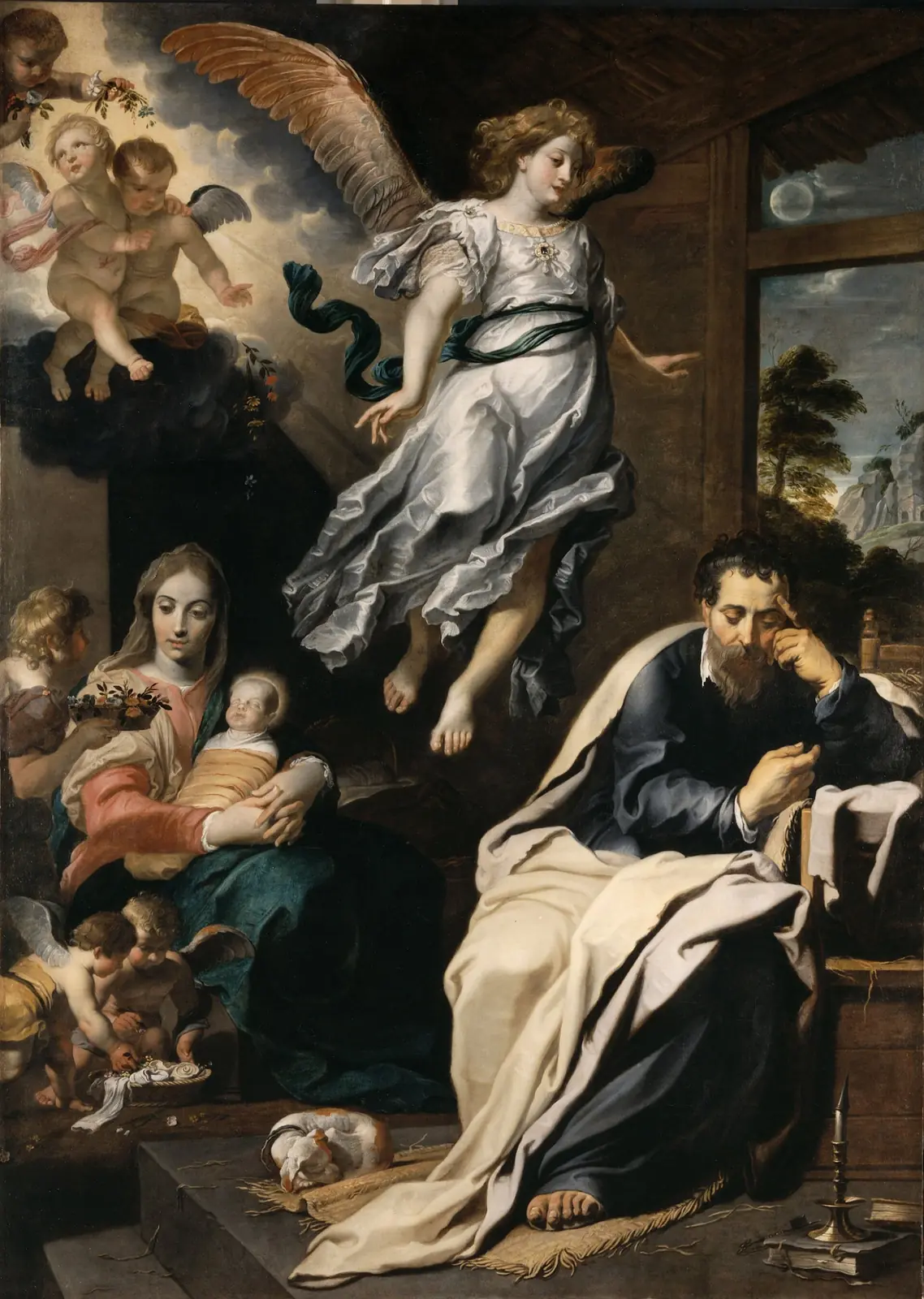
Matthew 1:25 (WEB)
and didn’t know her sexually until she had given birth to her firstborn son. He named him Jesus.
As quoted in the map (KJV)
Matthew 1:25 (KJV)
And knew her not till she had brought forth her firstborn son: and he called his name JESUS.
Key words
- οὐκ ἐγίνωσκεν αὐτήνouk eginōsken autēn · Greek
- 'knew her not' — 'know' is the biblical idiom for marital relations; the imperfect tense describes an ongoing state of abstinence through the pregnancy.
- ἕως οὗheōs hou · Greek
- 'till.' In biblical usage 'until' says nothing about what happens afterward: Michal 'had no child until the day of her death' (2 Samuel 6:23); Jesus is with us 'until the end of the age' (Matthew 28:20).
- πρωτότοκοςprōtotokos · Greek
- 'firstborn' (in the KJV's text) — a legal title for the son who opens the womb (Exodus 13:2), whether or not other children follow.
Why it matters
Joseph and Mary abstain from relations throughout the pregnancy. Pitre's third evidence for a vow of virginity is this abstinence even on the wedding night, unusual for a newly married couple unless a prior resolution was in place. He also answers the standard objection: 'until' in biblical Greek and Hebrew does not imply a change afterward, and 'firstborn' is a legal status that does not require later siblings.
Catechism · 1
- §497Paragraph 2 · "Conceived by the Power of the Holy Spirit and Born of the Virgin Mary"Read at vatican.va
“The Gospel accounts understand the virginal conception of Jesus as a divine work that surpasses all human understanding and possibility:” — Catechism footnote: Mt 1 18-25; Lk 1:26-38.
Fathers and councils · 18
Athanasius of Alexandria
“Therefore let those who deny that the Son is from the Father by nature and proper to His Essence, deny also that He took true human flesh of Mary Ever-Virgin; for in neither case had it been of profit to us men, whether the Word were not true and naturally Son of God, or the flesh not true which He assumed.” — editor's note: Vid. also Athan. in Luc. (Migne xxvii. 1393 c). This title, which is commonly applied to S. Mary by later writers, is found Epiph. Hær. 78, 5. Didym. Trin. i.…
Read the whole comment
John Damascene
“For although it is written, And knew her not till she had brought forth her first-born Son, yet note that he who is first-begotten is first-born even if he is only-begotten.” — editor's note: St. Matt. i. 25.
Read the whole comment
Cyril of Jerusalem
“…also was called the father of Christ, not from having begotten Him (for he knew her not, as the Gospel says, until she had brought forth her first-born Son), but because of the care bestowed on His nurture.” — editor's note: Matt. i. 25.
Read the whole comment
Augustine of Hippo
“Then Joseph, being raised from sleep, did as the angel of the Lord had bidden him, and took unto him his wife, and knew her not.” — editor's note: Matt. i. 18–25. [The last clause of ver. 25 is omitted here, but given in §14. Possibly the variation was intentional.—R.]
Read the whole comment
Jerome
“It turns upon the record in Matt. i. 18–25, and especially on the words, “Before they came together” (c. 4), “knew her not till, &c.” (5–8).” — the author cites it
Read the whole comment
Catena Aurea on Matthew
- Remigius of AuxerreCatena Aurea on Matthew
Life returned by the same entrance through which death had entered in. By Adam’s disobedience we were ruined, by Joseph’s obedience we all begin to be recalled to our former condition; for in these words is commended…
Read the whole comment - Glossa OrdinariaCatena Aurea on Matthew
He not only did what the Angel commanded, but as he commanded it. Let each one who is warned of God, in like manner, break off all delays, rise from sleep, and do that which is commanded him.
Read the whole comment - Pseudo-ChrysostomCatena Aurea on Matthew
“Took unto him” not took home to him; for he had not sent her away; he had put her away in thought only, and now took her again in thought.
Read the whole comment - Remigius of AuxerreCatena Aurea on Matthew
Or, Took her so far, as that the nuptial rites being complete, she was called his wife; but not so far as to lie with her, as it follows, “And knew her not.”
Read the whole comment - JeromeCatena Aurea on Matthew
Helvidius is at much superfluous trouble to make this word “know” refer to carnal knowledge rather than to acquaintance, as though any had ever denied that; or as if the follies to which he replies had ever occurred…
Read the whole comment - Pseudo-ChrysostomCatena Aurea on Matthew
As one might say, ‘He told it not so long as he lived;’ would this imply that he told it after his death? Impossible. So it were credible that Joseph might have known her before the birth, while he was yet ignorant…
Read the whole comment - JeromeCatena Aurea on Matthew
Lastly, I would ask, Why then did Joseph abstain at all up to the day of birth? He will surely answer, Because of the Angel’s words, “That which is born in her, &c.” He then who gave so much heed to a vision as not…
Read the whole comment - Pseudo-ChrysostomCatena Aurea on Matthew
It may be said, that “know” here signifies simply, to understand; that whereas before he had not understood how great her dignity, after the birth he then “knew” that she had been made more honourable and worthy than…
Read the whole comment - Glossa OrdinariaCatena Aurea on Matthew
Otherwise; On account of the glorification of the most holy Mary, she could not be known by Joseph until the birth; for she who had the Lord of glory in her womb, how should she be known? If the face of Moses talking…
Read the whole comment - JeromeCatena Aurea on Matthew
From the words, “her first-born Son,” some most erroneously suspect that Mary had other sons, saying that first-born can only be said of one that has brethren. But this is the manner of Scripture, to call the…
Read the whole comment - JeromeCatena Aurea on Matthew
For if he only was first-born who was followed by other brethren, then no first-birth could be due to the Priests, till such time as the second birth took place.
Read the whole comment - Glossa OrdinariaCatena Aurea on Matthew
Or; He is “first-born” among the elect by grace; but by nature the Only-begotten of God the Father, the only Son of Mary. “And called His name Jesus,” on the eighth day on which the circumcision took place, and the…
Read the whole comment - Remigius of AuxerreCatena Aurea on Matthew
It is clear that this Name was well known to the Holy Fathers and the Prophets of God, but to him above all, who spake, “My soul fainted for Thy salvation;” [Ps 119:81] and, “My soul hath rejoiced in Thy salvation.”…
Read the whole comment
Cross-references · 7
Cited together in Jerome on Matthew 1:24–25 (Catena Aurea).
Cited together in Jerome on Matthew 1:24–25 (Catena Aurea).
Cited together in Jerome on Matthew 1:24–25 (Catena Aurea).
Cited together in Remigius of Auxerre on Matthew 1:24–25 (3) (Catena Aurea).
Cited together in Remigius of Auxerre on Matthew 1:24–25 (3) (Catena Aurea).
Cited together in Remigius of Auxerre on Matthew 1:24–25 (3) (Catena Aurea).
Cited together in Jerome on Matthew 1:24–25 (Catena Aurea).